
$14.99+
Ableton MIDI Tracker
Max for Live MIDI Device (.amxd file)
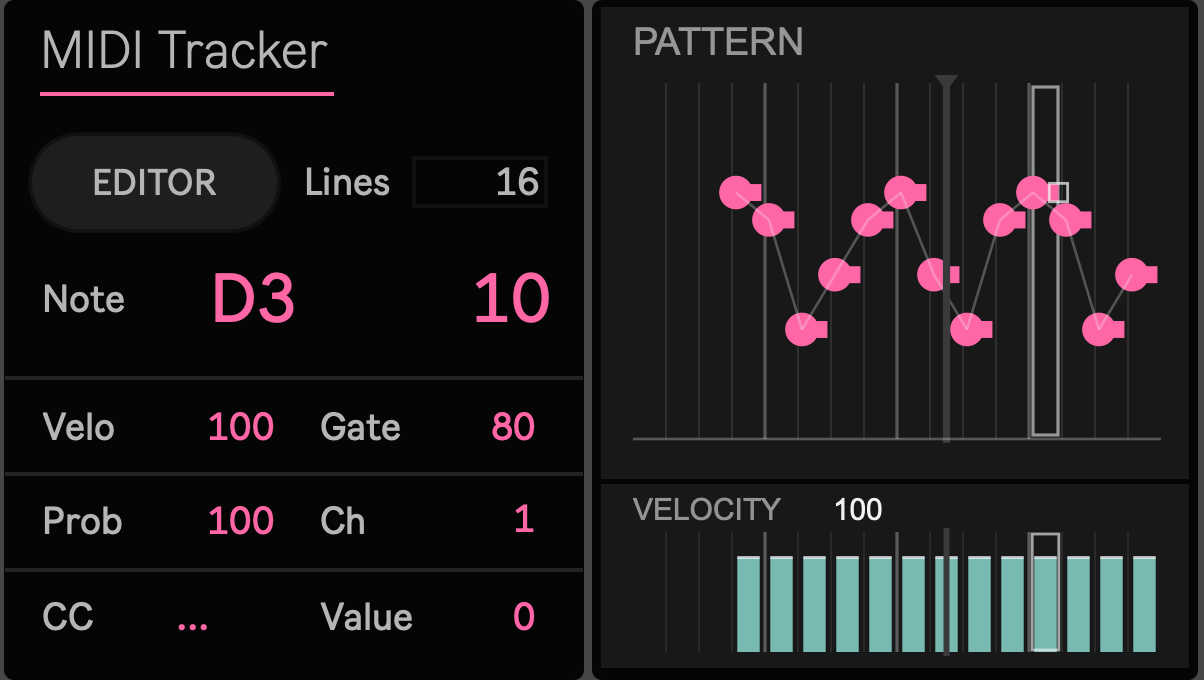
MIDI sequencing that feels like writing music into a grid
MIDI Tracker turns sequencing into a line based process.
Instead of building a phrase only by placing notes across a conventional piano roll, you work through a sequence one line at a time. Each line can define its own note, velocity, gate, probability, MIDI channel, and selected CC information.
The result is a compact way to build MIDI patterns where pitch, timing behavior, dynamics, and variation can all be considered as part of the same step.
MIDI Tracker is made for producers who enjoy precise programming but still want a sequence to change, breathe, and reveal patterns visually while it plays.
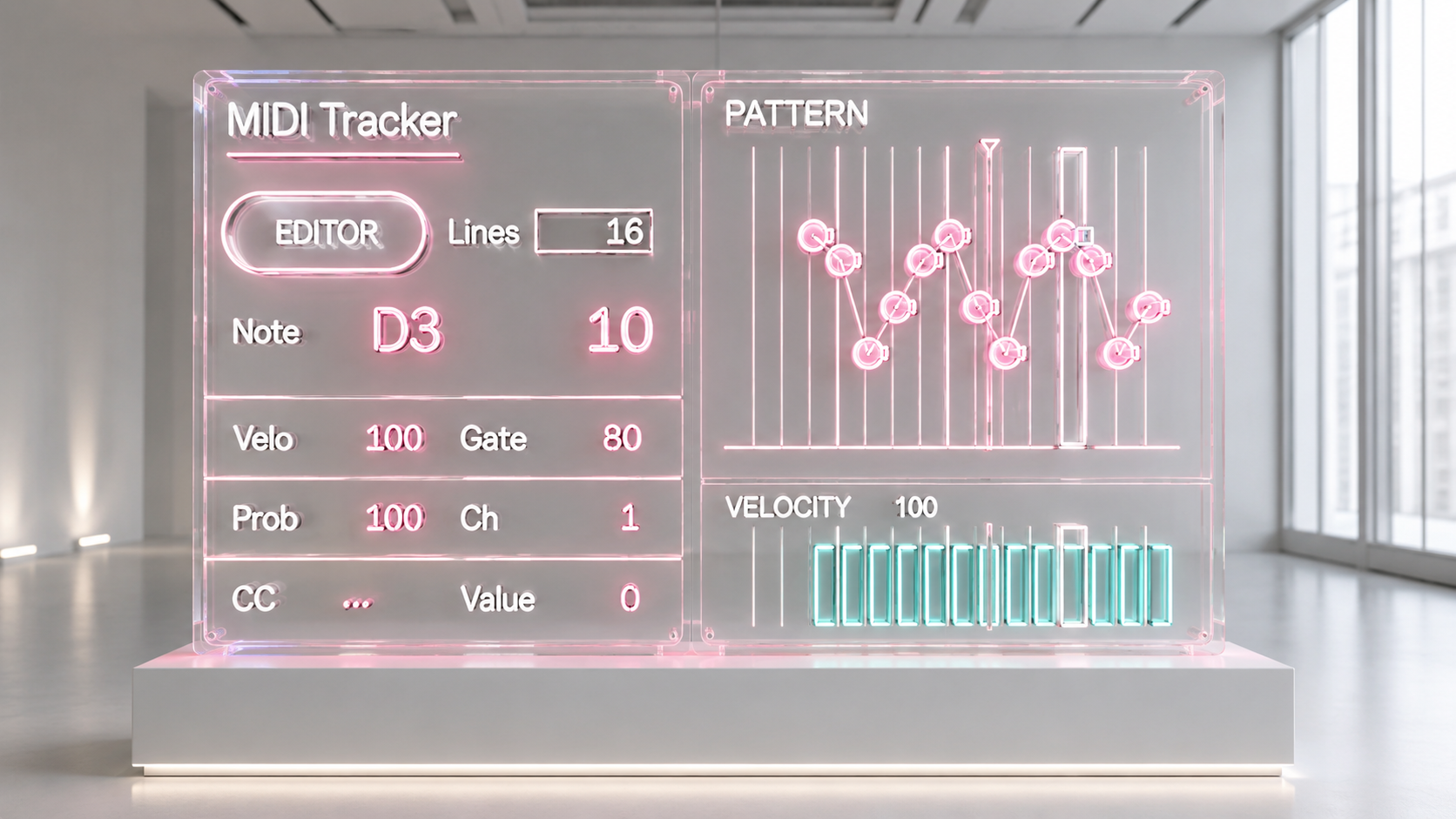
See the pattern before opening the details
The main view is intentionally compact.
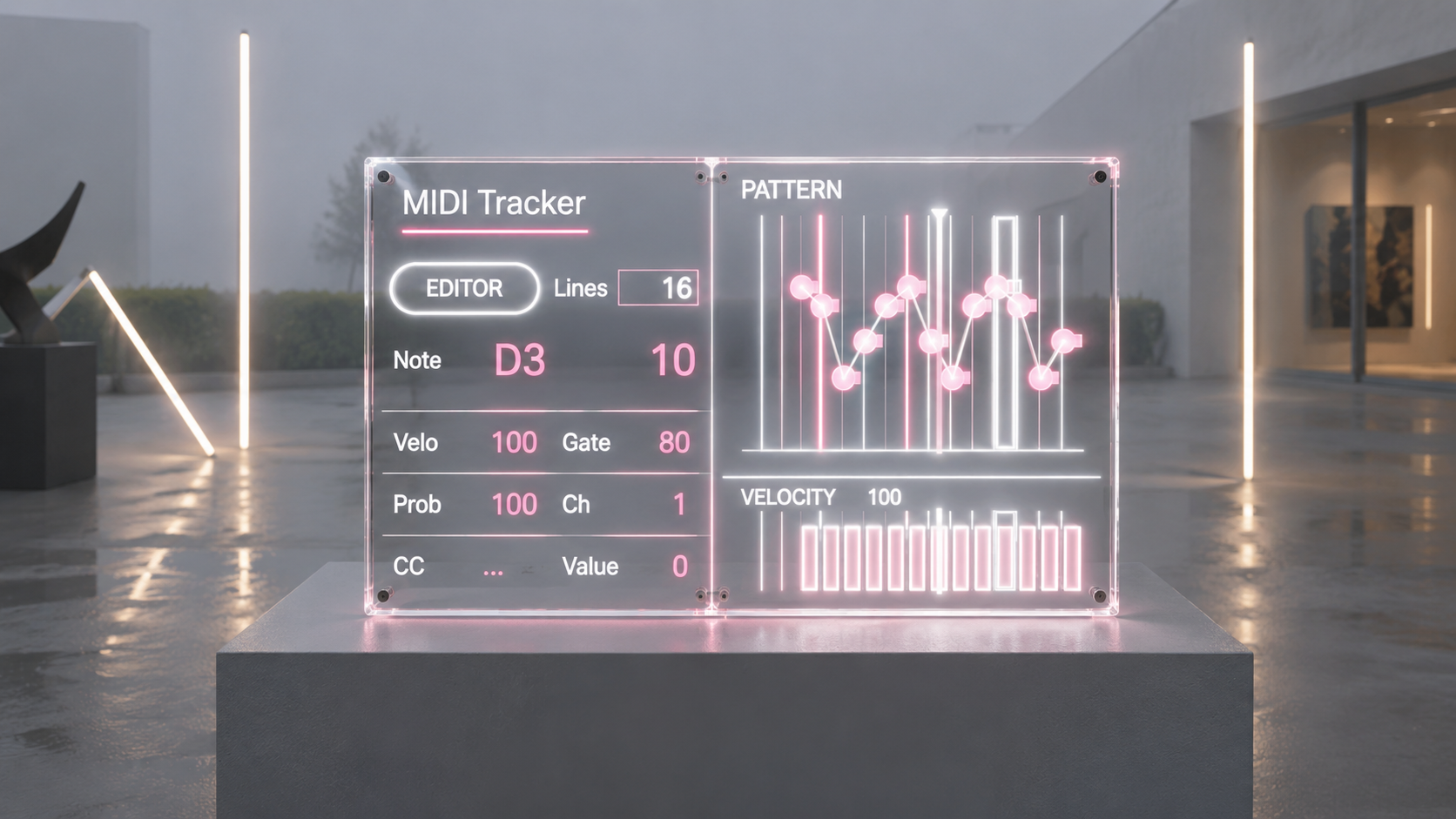
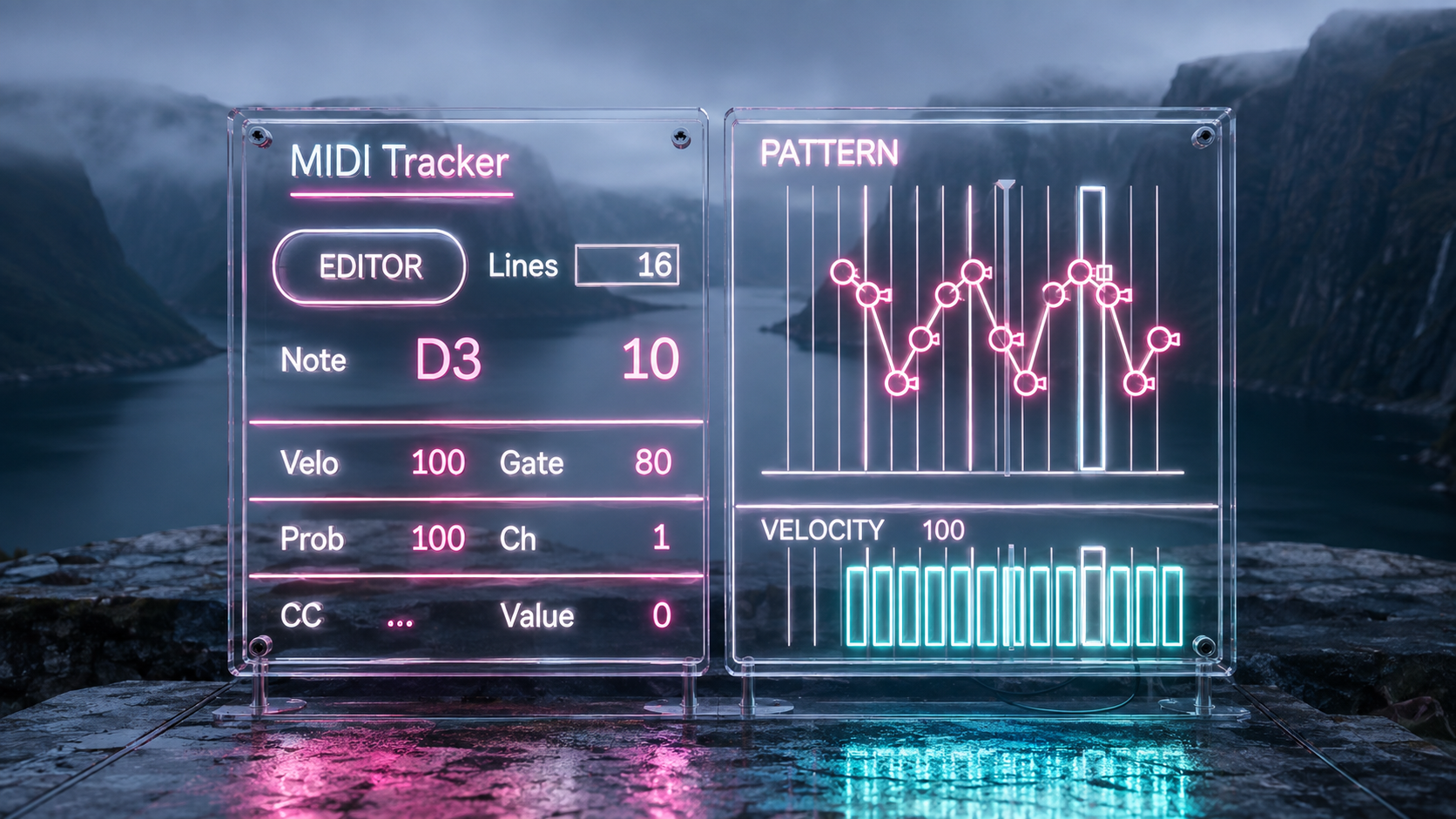
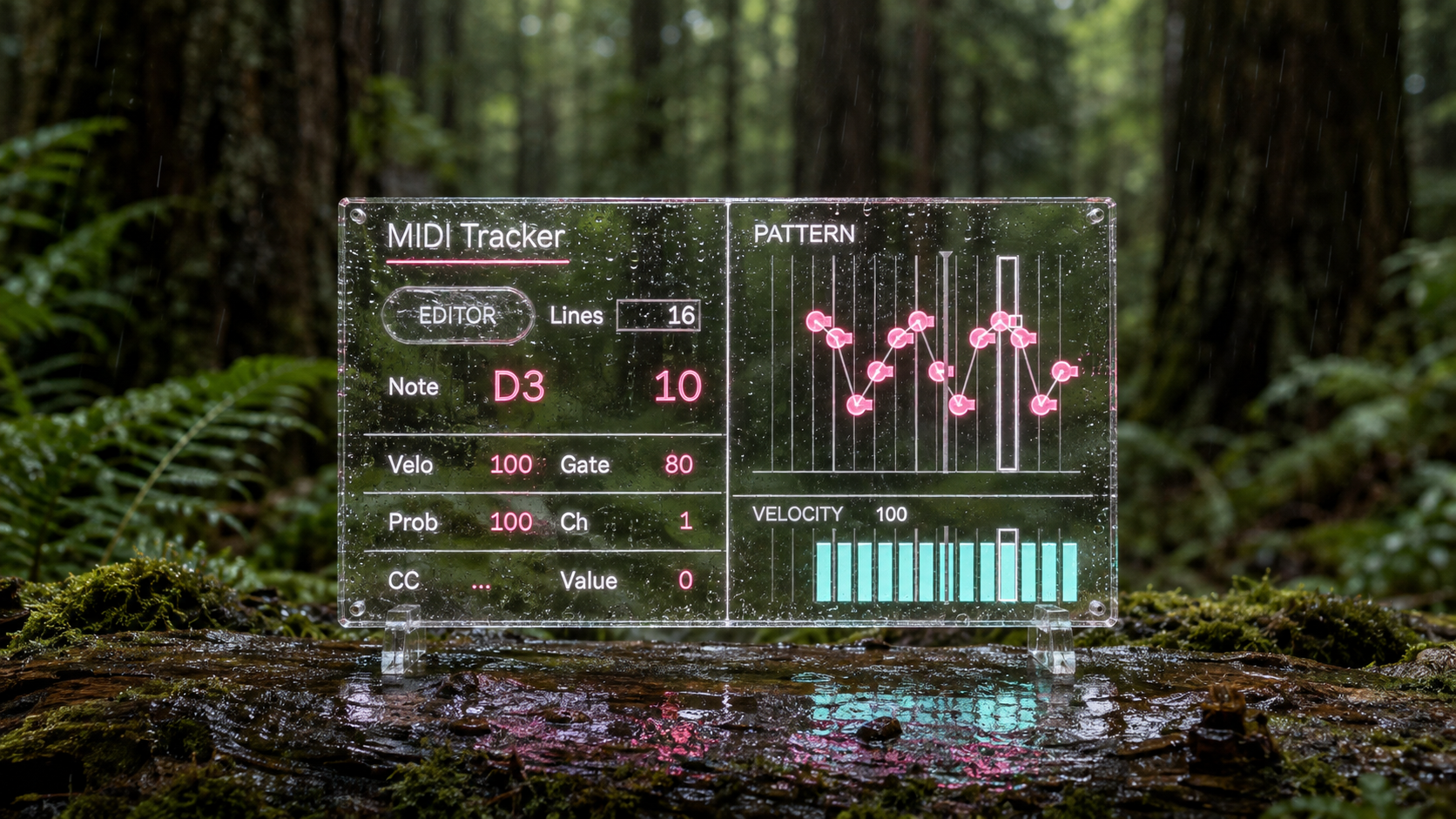
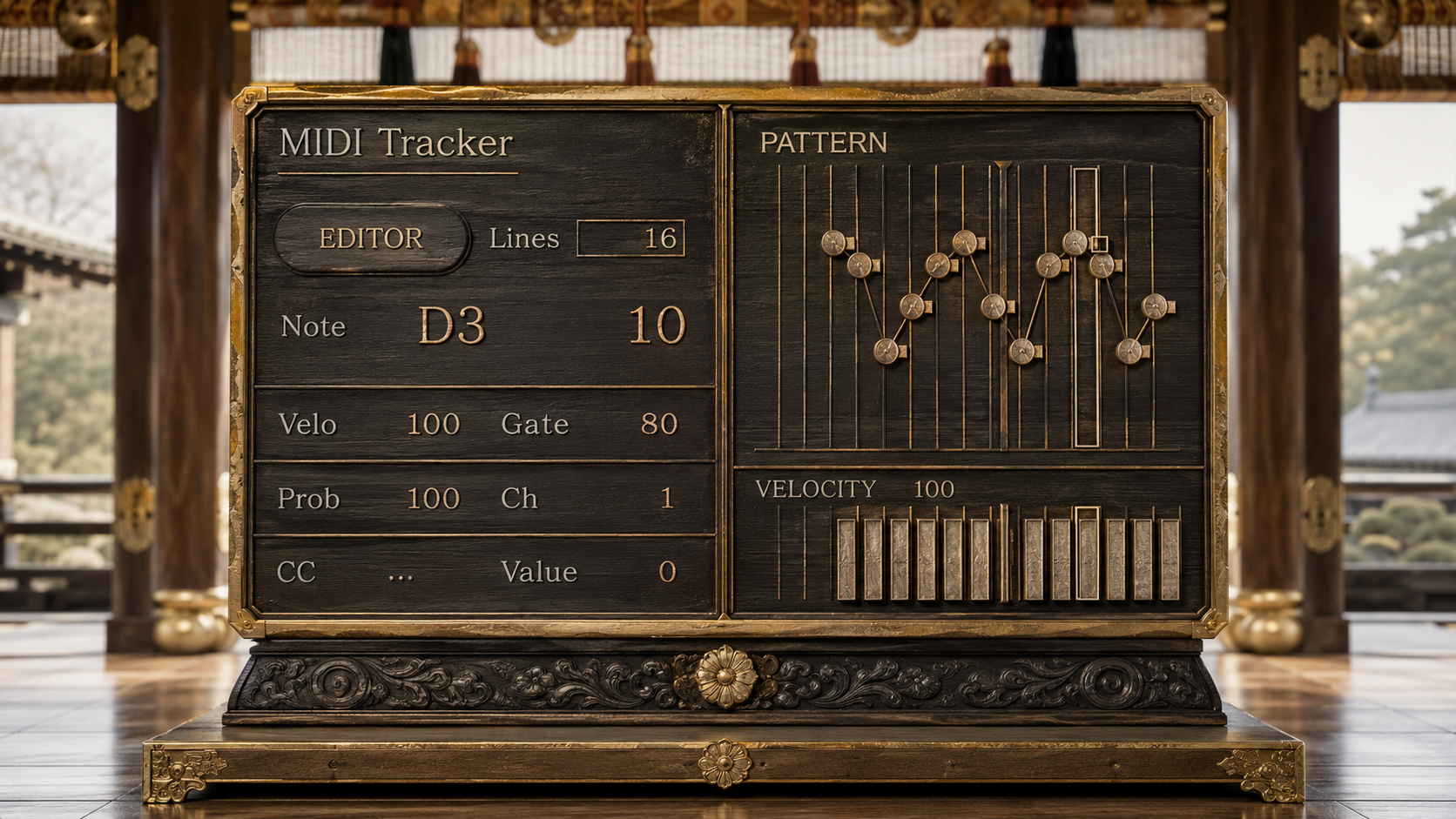
Pattern shows the pitch contour across the active sequence, while Velocity makes changes in dynamics visible underneath it. The current line information stays beside them, so the device can remain readable without keeping the full Editor open throughout a session.
When you need to go deeper, the separate Editor exposes the full tracker state.
This division keeps two different jobs separate: watching the musical shape, and editing the data that creates it.
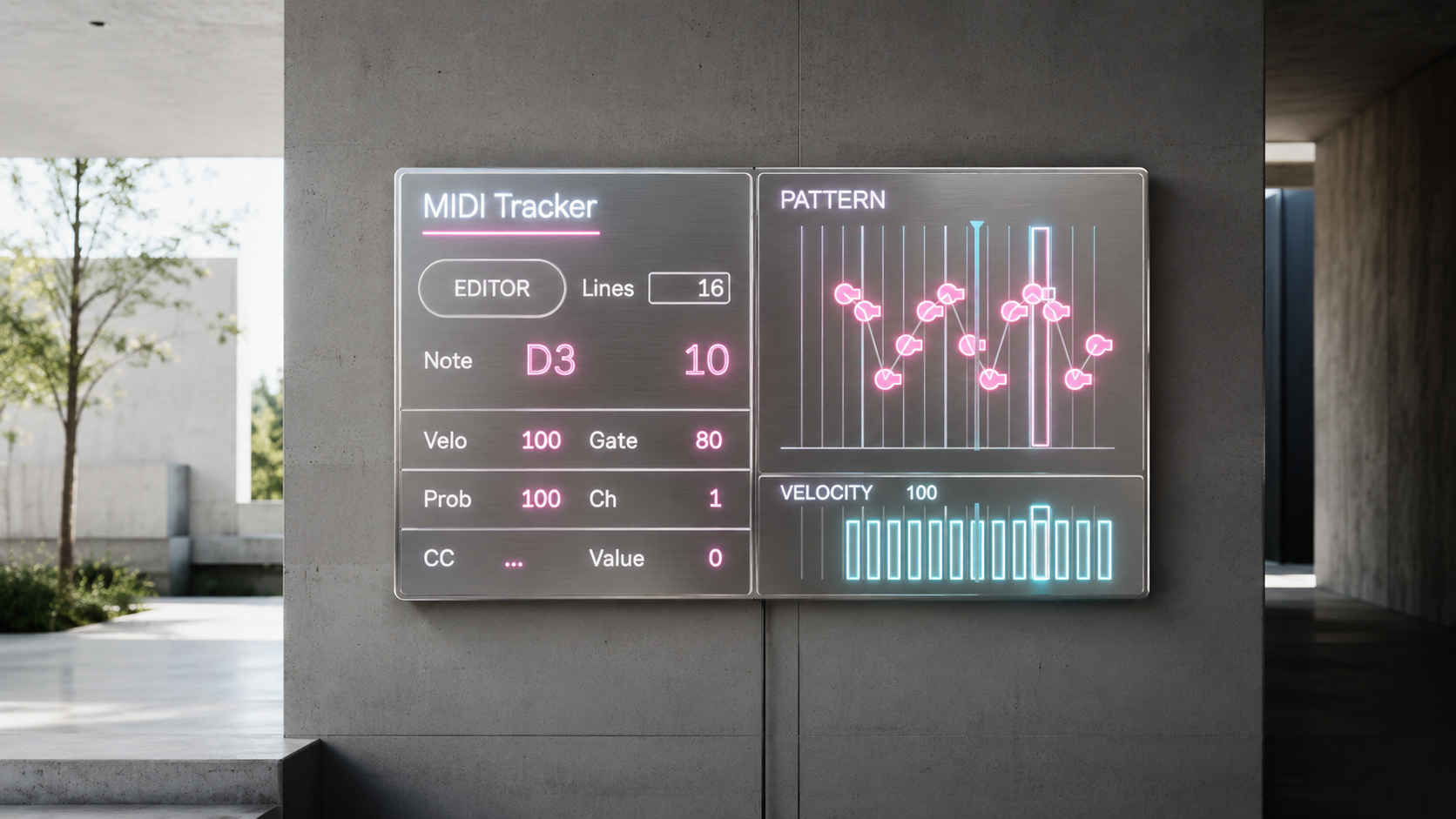
One line can carry more than a note
Every line can contain a Note, Velocity, Gate, Probability, MIDI Channel, CC, and Value.
Velocity controls the force of the note.
Gate changes its duration, making it possible to move from short, clipped events to longer sustained notes without changing the underlying pattern.
Probability determines whether an event is played on a particular pass. A completely fixed sequence can therefore become less predictable without continuously rewriting the notes themselves.
MIDI Channel can also be set per line, allowing channel changes to become part of the sequence.
For controller sequencing, MIDI Tracker supports CC1, CC7, and CC64 together with values from 0 to 127.
The interface remains small, but each line can describe considerably more than pitch alone.
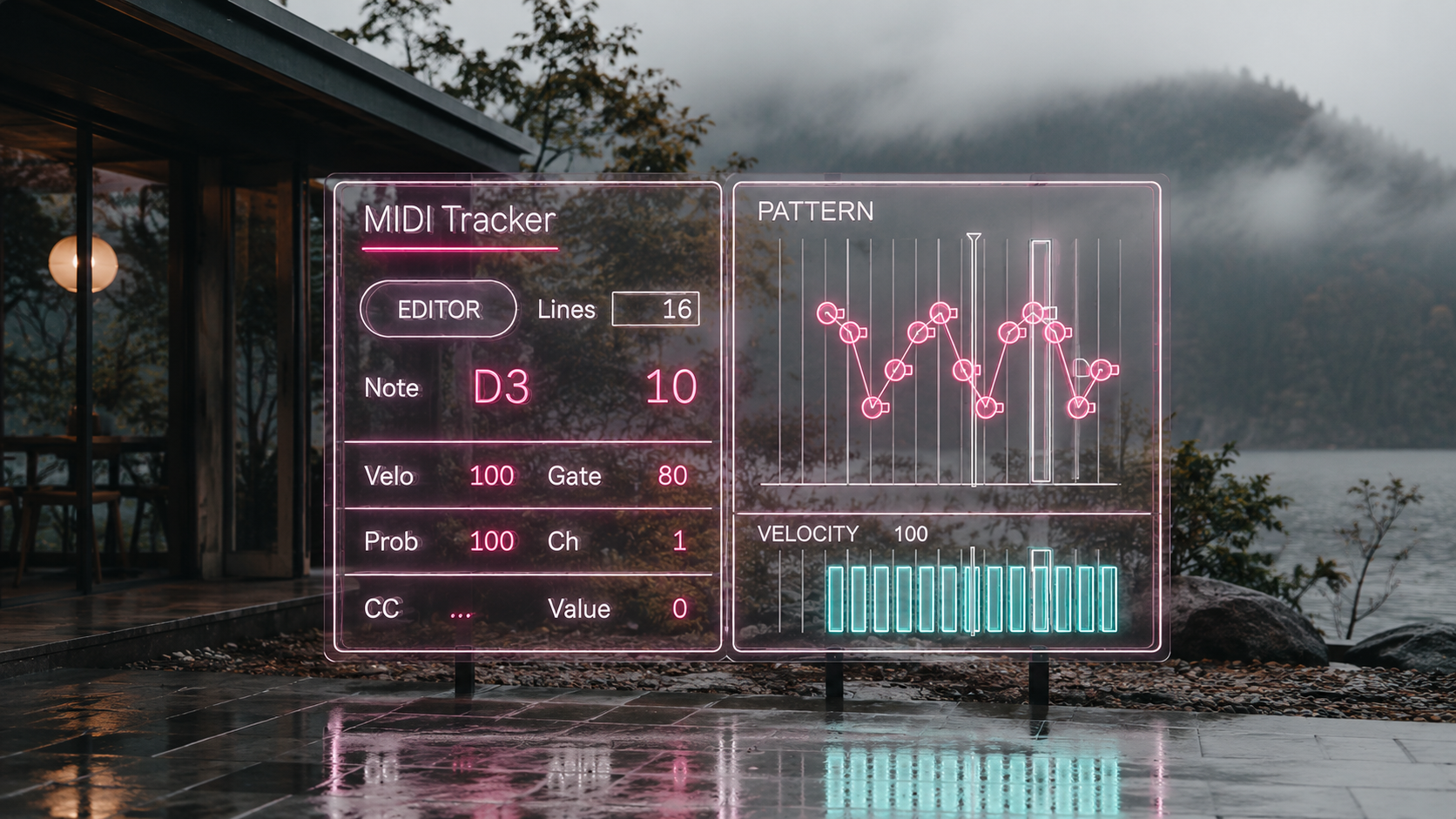
From rigid repetition to controlled variation
Probability is especially useful when a loop is structurally right but feels too certain.
A bass note can disappear occasionally. A percussion trigger can enter only on some repetitions. A melodic event can remain rare enough to feel like an interruption rather than a permanent part of the phrase.
Because probability belongs to the individual line, variation can be concentrated exactly where it matters instead of randomizing the entire pattern.
Gate adds a second kind of movement. The pitches can stay unchanged while articulation shifts between short and sustained events.
Together, these controls let a small pattern generate more musical behavior than its length initially suggests.
Choose the size of the idea
Pattern Length can be set from 1 to 64 lines.
A very short length can create repetitive figures and tightly cycling triggers. Longer settings give a phrase more time before it returns to the beginning.
Playback follows a fixed sixteenth note grid, keeping the relationship between line number and musical time easy to understand.
That simplicity makes MIDI Tracker useful not only for writing longer sequences, but also for building compact repeating structures that can be transformed through probability, gate, velocity, and channel changes.
A tracker inside an Ableton workflow
MIDI Tracker is a MIDI effect. It does not generate or process audio by itself.
Place it before an instrument or another MIDI receiving device and use it as the source of the sequence.
It can be used for bass lines, melodic phrases, percussion triggering, repeated control structures, and other situations where working line by line gives you a clearer view of how a pattern is constructed.
The visual overview is designed for staying oriented during playback, while the Editor is there when individual events need precise adjustment.
This is less about replacing every way of sequencing in Ableton Live and more about giving one particular way of thinking a dedicated surface: a sequence as a stack of decisions.
MIDI file workflow
MIDI Tracker includes Standard MIDI File import and export functionality in its Editor architecture.
This provides a path between tracker data and conventional MIDI files when moving material between different stages of a production workflow.
MIDI Tracker v1.0
MIDI Tracker v1.0 is the current release.
The device uses a 64 line tracker model with an adjustable active Pattern Length from 1 to 64. Each line contains Note, Velocity, Gate, Probability, Channel, CC, and Value data.
The main interface combines Pattern and Velocity visualization with a compact current event display, while detailed editing is handled by the separate Editor.
MIDI Tracker is supplied as a Max for Live MIDI device for Ableton Live.
Free lifetime updates
Your purchase includes free lifetime updates.
Any future published versions of MIDI Tracker covered by this product will be available at no additional cost. Existing customers can access the latest available files through the Sellfy account used for the original purchase.
No additional purchase is required for future published updates.
v1.0 ... Initial public version of MIDI Tracker. Introduced the 64 line tracker workflow, adjustable Pattern Length, per line Note, Velocity, Gate, Probability, MIDI Channel and selected CC data, compact Pattern and Velocity visualization, separate detailed Editor, and MIDI file workflow. (2026/8/17)
Akihiko Matsumoto