
$14.99+
Ableton 303quencer ver.3.0
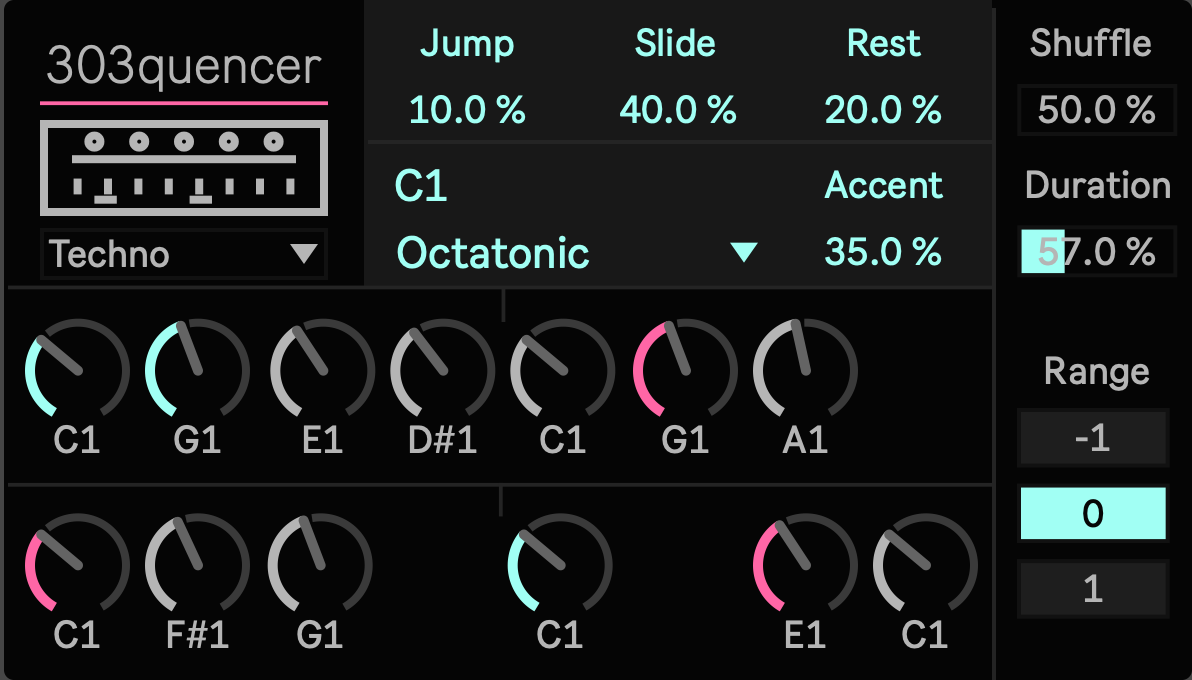
Generative Sequencer Max for Live Device (.amxd file)
The Roland TB 303 was never meant to become a machine for cultural mutation. It arrived in 1981 as an automatic bass accompanist, then found its real life elsewhere: in repetition, misuse, voltage, resonance, and the disciplined accident. Acid was not born from polite melody. It emerged when short patterns began to behave like living circuits, pushing rhythm and pitch into the same physical gesture.
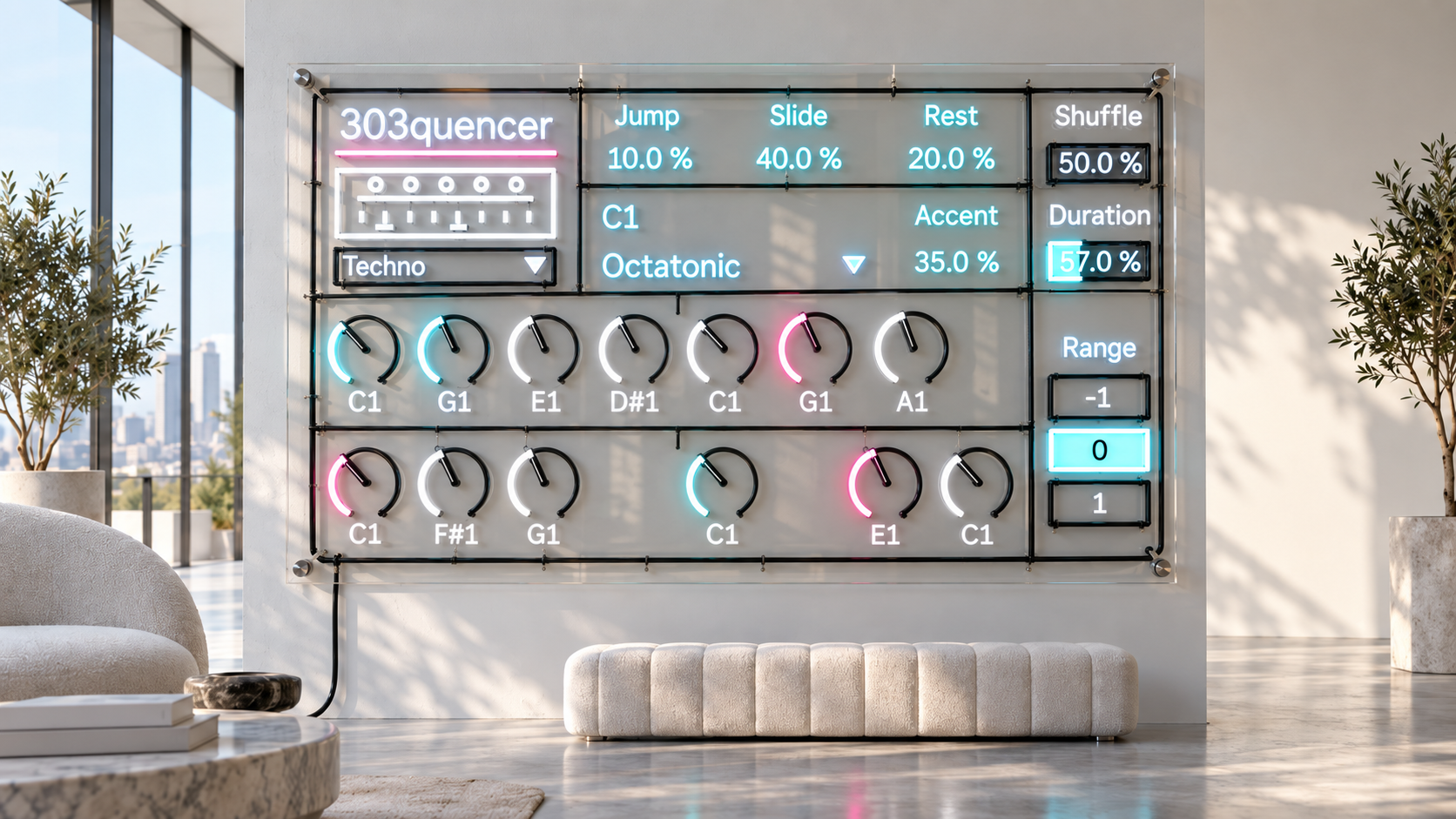
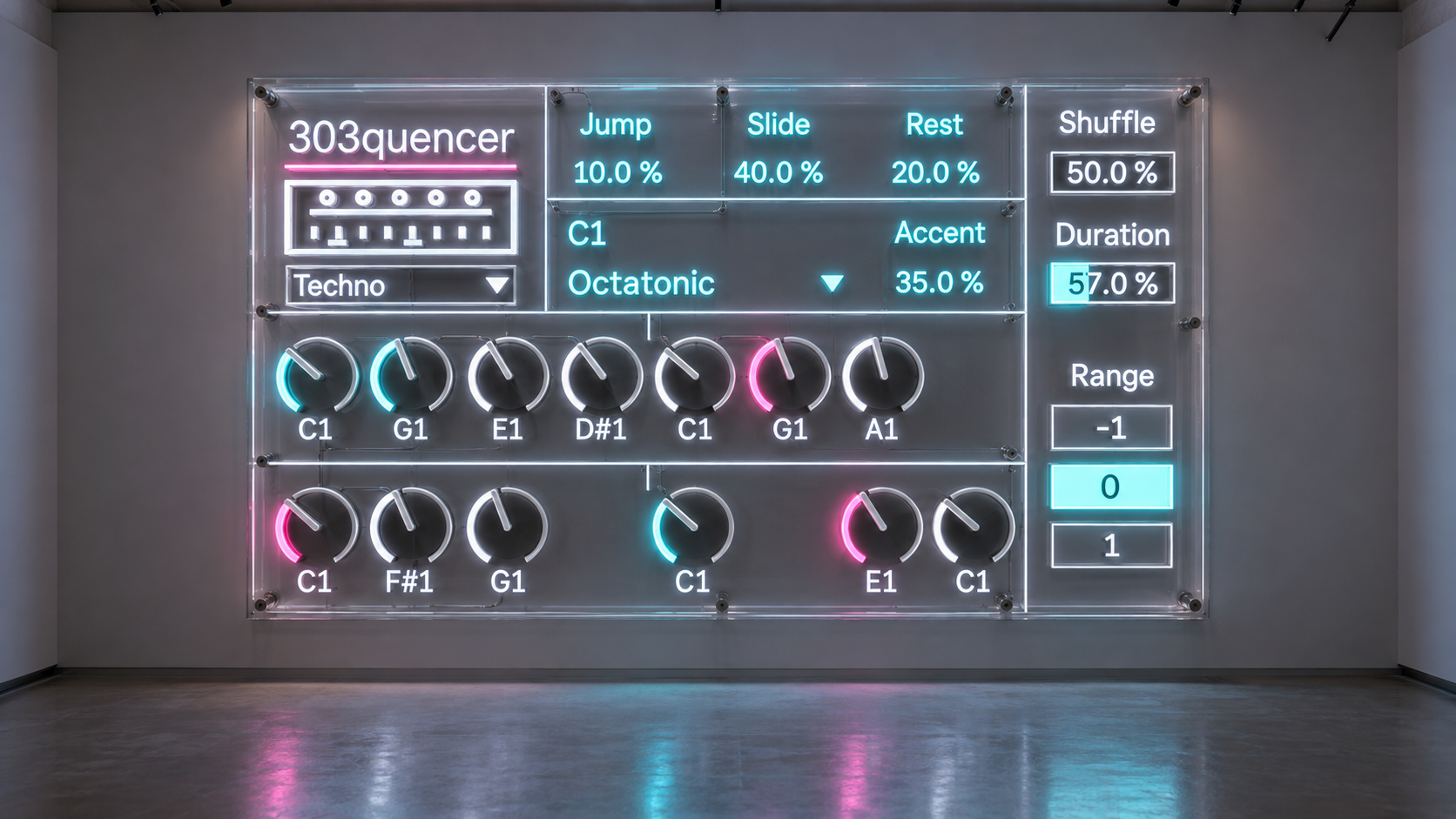
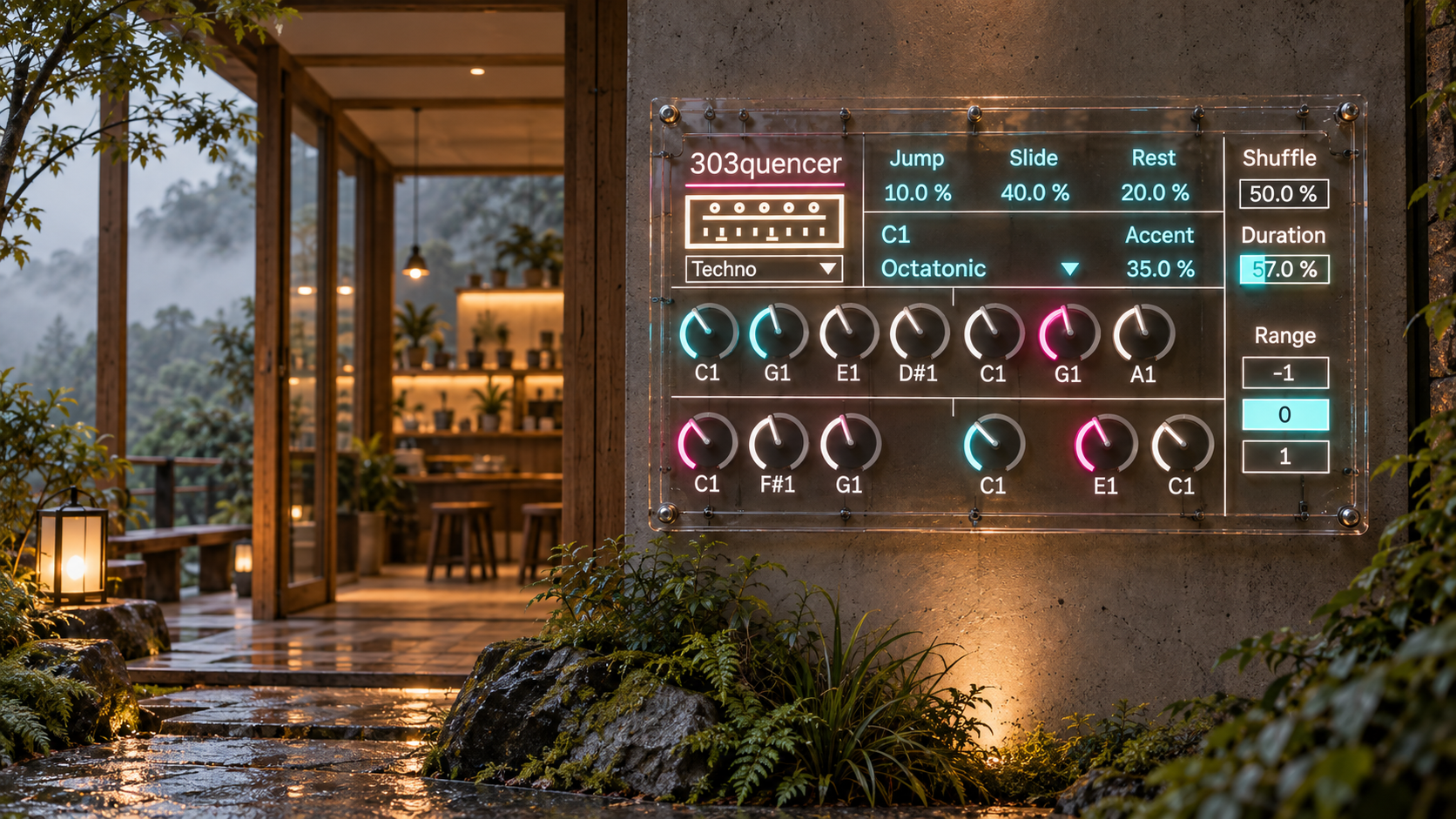
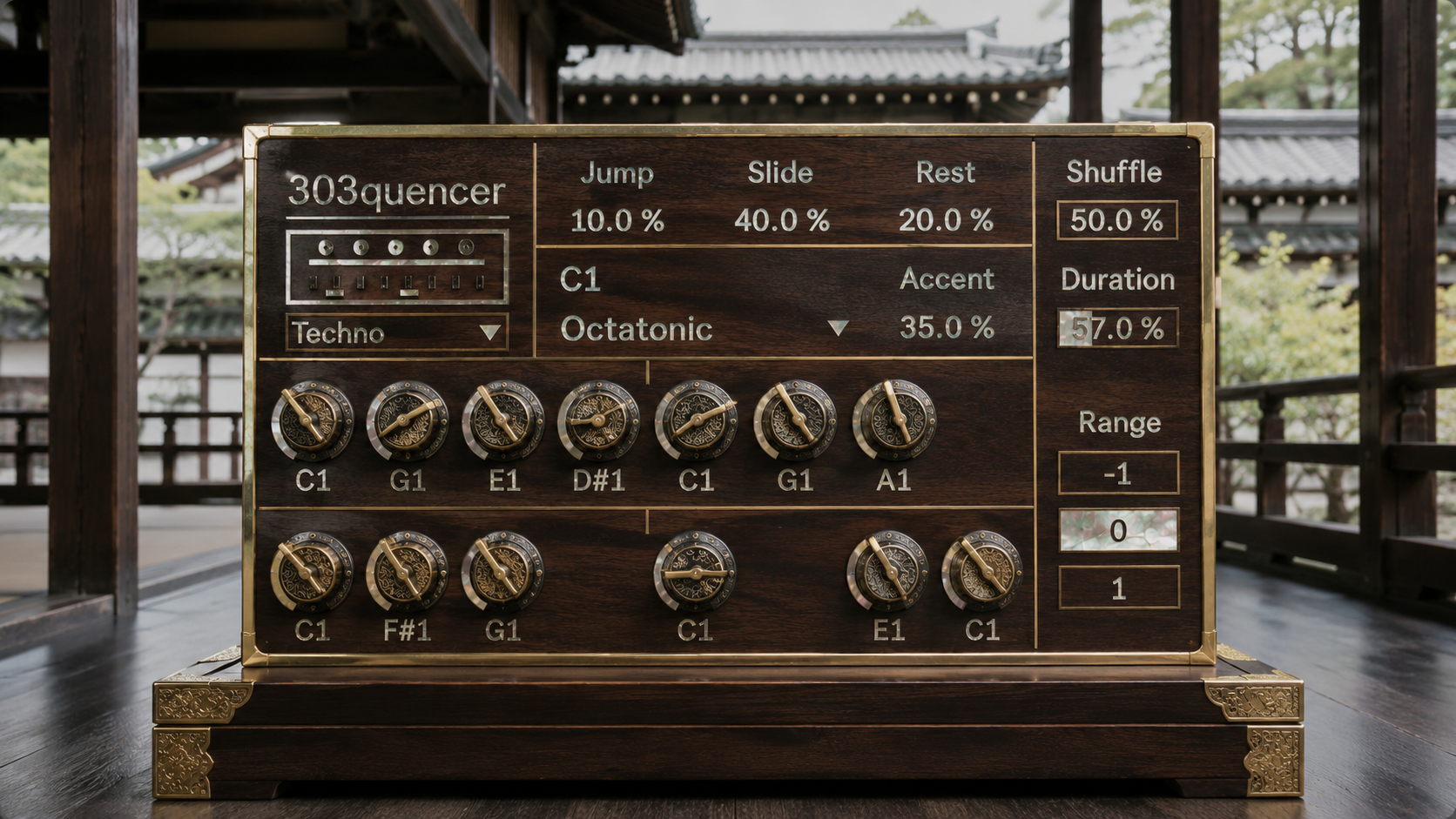
303quencer is built from that idea. It does not simply scatter notes across a grid. It generates sixteen step acid phrases with structure, pressure, return, and controlled instability. Each pattern is shaped by probability, but constrained by musical gravity.
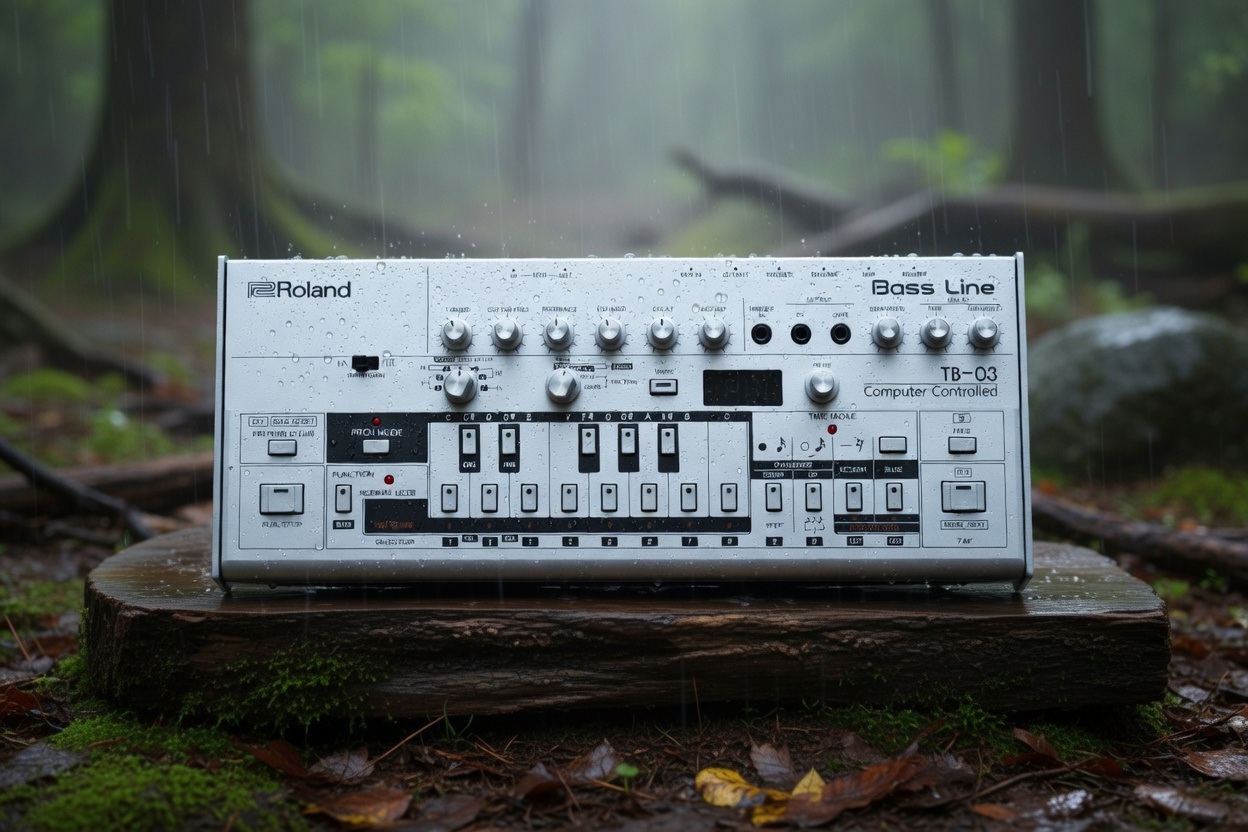
The Physics of the Silver Box
The sound of acid depends on a small set of events: rest, slide, accent, octave movement, gate length, and tonal center. In a weak sequencer, these events behave like separate switches. In a convincing acid line, they listen to one another.
303quencer treats them as connected forces. Rest defines density and silence. Slide creates liquid motion between adjacent notes. Accent gives the filter something to bite. Gate time decides whether a note snaps, breathes, or leans into the next step. Octave movement is not applied everywhere, but appears at strong variation points where the phrase can absorb the shock.
The result is not random decoration. It is a system for finding the narrow zone where a machine starts to sound intentional without becoming predictable.
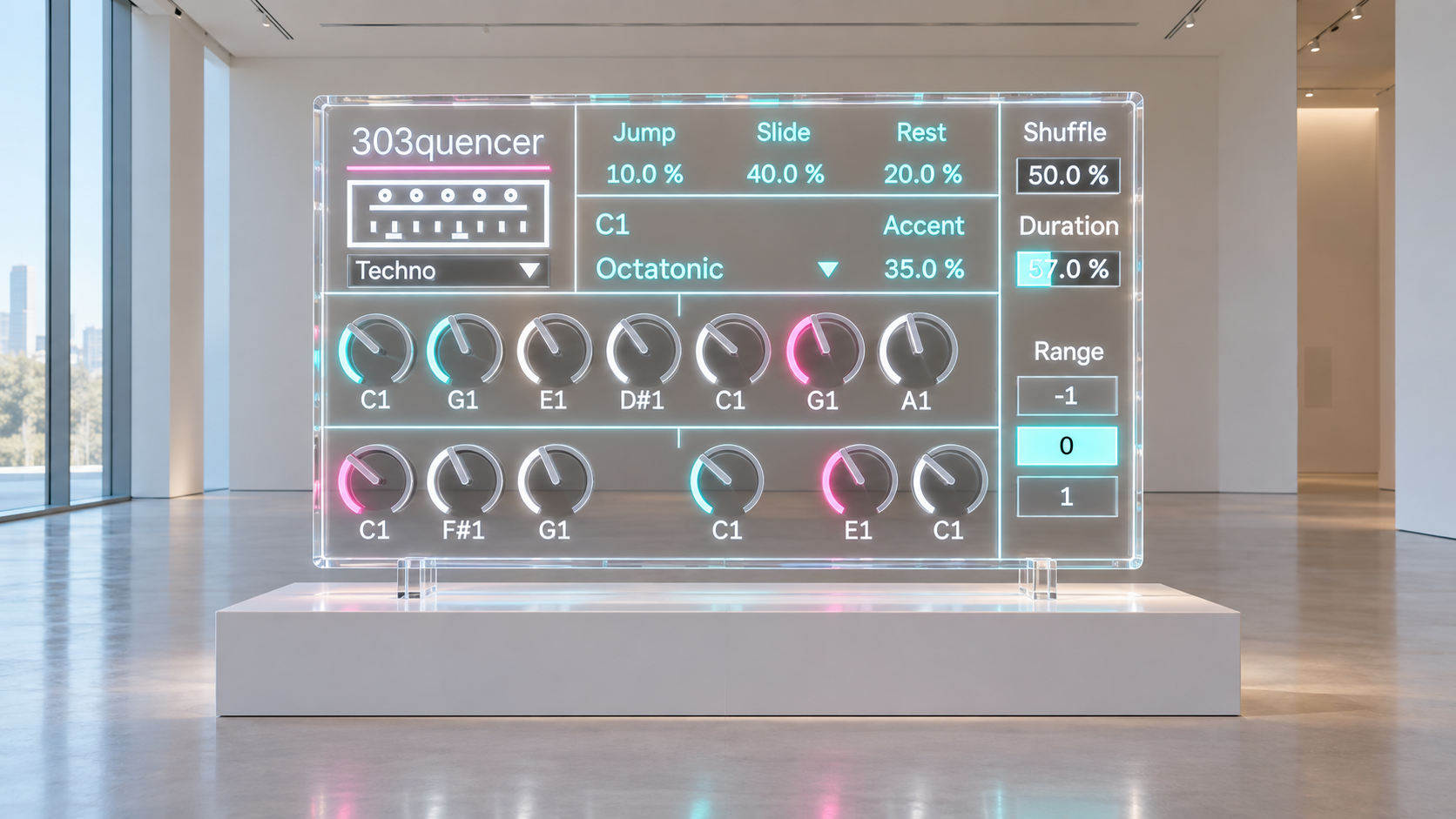
Engineering Probability: The 303quencer Engine
At its core, 303quencer is a specialized MIDI generation device for Ableton Max for Live. One command produces a complete phrase, but the engine does more than roll dice. It first chooses a phrase archetype, then builds a rhythmic skeleton, generates a short motif, places pitches, corrects the beat feel, reinforces the tonal center, applies accents, calculates slides, and outputs the final sequence.
This order matters. The rhythm comes before the ornament. The center comes before the deviation. The phrase is assembled like a small mechanical grammar, where every step has a role.
Inside the engine are several phrase behaviors: loop riffs for dense repetition, stab riffs for sparse impact, slide chains for connected motion, answer phrases for call and response, minimal root patterns for low end stability, blue hooks for acidic color, and high peak gestures for moments of lift. The user does not need to study these categories. They simply appear as musical tendencies while the controls remain direct.
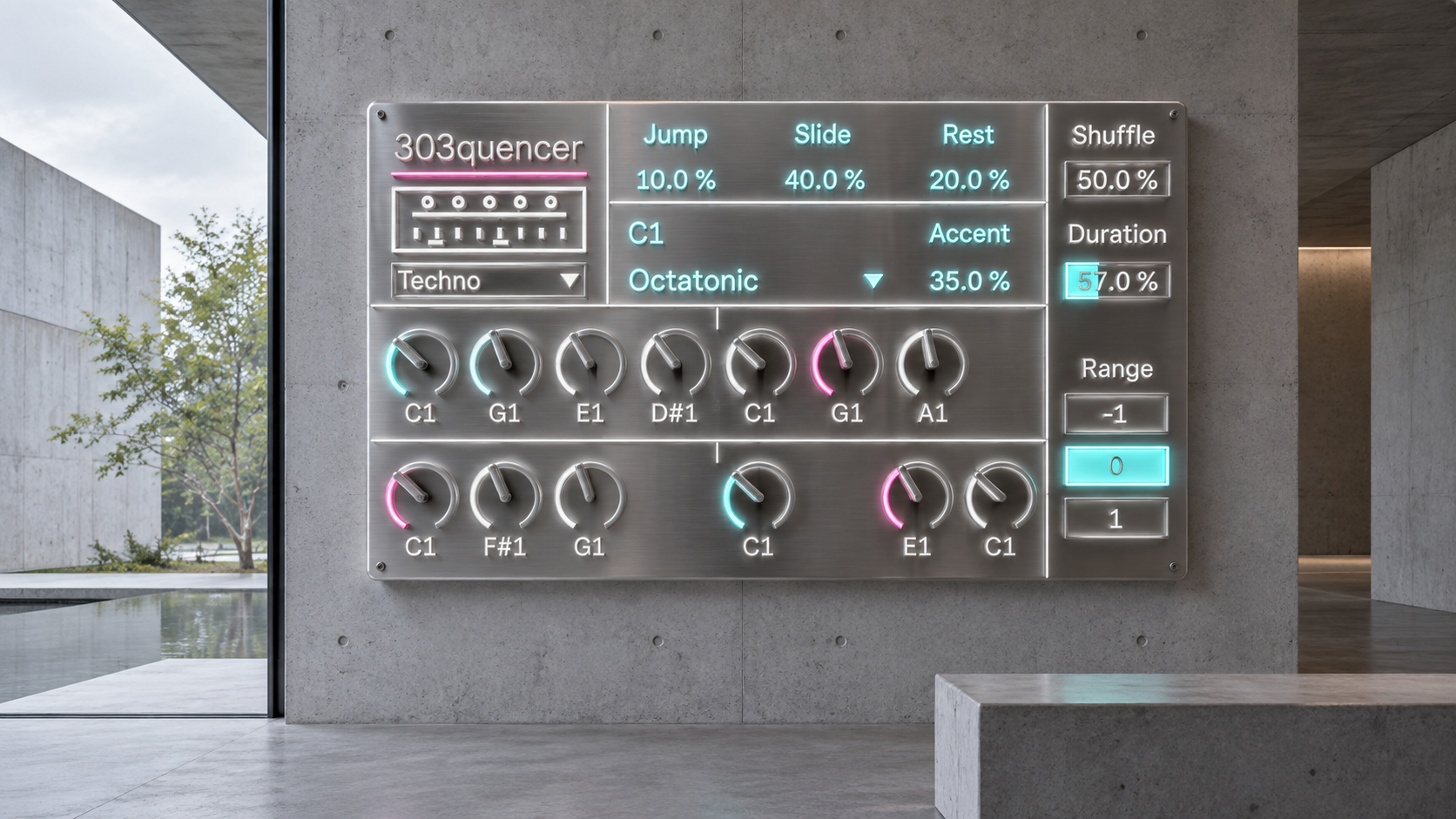
Scale Safety, Root Gravity, and Controlled Wrongness
Acid needs danger, but not confusion. 303quencer includes scale safe pitch handling, so generated notes are quantized into the chosen pitch collection. Custom scales can be used, and the system normalizes them before the phrase is generated. This keeps the output coherent even when the pattern is aggressive.
The rootNote is not treated as a simple transposition value. It acts as the phrase’s center of mass. Step 0 is anchored when active, the middle of the loop often returns to the root, and later steps are guided back toward resolution when needed. This gives the pattern a body. It can twist, bite, and slide, but it still knows where home is.
For harsher acid, chromatic and altered scale choices remain available. For tighter bass writing, minor triads and blues based scales keep the line focused. For darker or less familiar colors, Phrygian dominant, Maqam Saba, Iwato, whole tone, and octatonic options open other kinds of tension.
Rhythm as a Machine With Memory
Rest is not handled as a simple coin toss on every step. Instead, 303quencer estimates the desired number of active notes, selects rhythm templates, adjusts density, and reinforces a four beat sense across the sixteen step loop. Strong points, pickups, empty blocks, and long gaps are corrected so the phrase keeps moving.
This is why the output feels less like a random MIDI clip and more like a riff that has already spent time inside a drum machine. It can leave space. It can become dense. It can lean into the next beat. It can repeat just enough for the ear to recognize it, then mutate just enough for the body to stay alert.
Slide and Accent as Musical Speech
In a classic 303 line, slide is not only pitch movement. It is articulation. 303quencer makes slides more likely when the interval is close, less likely when a large jump would blur the phrase, and more expressive around hook positions. When a slide is generated, the duration of the source note is extended so the connection has physical continuity.
Accent works in the same spirit. It responds to beat position, hook position, pitch height, short interval movement, and phrase type. It is not merely a louder note. It is the point where the filter begins to speak.
Together, slide and accent turn the sequence from a grid into a voice: clipped, elastic, unstable, and exact.
Integration Into Live Performance
In performance, 303quencer is less a preset machine than a riff instrument. You can hold the root and scale steady while moving rest, slide, accent, jump, and gate time. The pattern keeps its identity, but its surface begins to change. With a hardware or software 303 style synth, this lets the performer focus on cutoff, resonance, drive, and arrangement while the phrase continues to generate new pressure.
For Roland Boutique TB 03 users, slide behavior can be addressed through MIDI CC 102, allowing the generated pattern to communicate with external hardware in a way that preserves the acid gesture rather than reducing it to ordinary MIDI notes.
This is where the device becomes useful on stage. It replaces fixed loops with a controlled stream of variations. The set can stay locked to a physical pulse while the bassline remains alive.
Access and Version Updates
If you already own 303quencer, the latest available version can be downloaded from the same Sellfy account used for the original purchase.
303quencer is not a shortcut to acid. It is a compact framework for listening to probability as a musical material. Instead of programming every note by hand, you define the conditions: density, gravity, scale, motion, bite, and release. The machine proposes the phrase. You decide when it becomes music.
v.3.0 ... Added phrase style menu. (2026/6/16)
v.2.0.1 ... Fixed note on bug. (2026/5/29)
v.2.0 ... Update generative algorithm and UI. (2026/5/27)
ver.1.9.5 ... Fixed TB-03 slide bug. (2026/4/19)
ver.1.9 ... Fixed slide bug. (2026/4/18)
ver.1.85 ... Updated UI. (2026/4/17)
ver.1.8 ... Updated 303 Algorithm. (2026/4/17)
ver.1.6 ... Fixed small bug. (2026/3/28)
ver.1.5 ... Fixed slide bug. (2026/3/28)
Sequencers & MIDI Generation
Air https://akihikomatsumoto.sellfy.store/p/abletonair/
A generative MIDI sequencer for continuously evolving ambient patterns built from overlapping repetition.
MODE https://akihikomatsumoto.sellfy.store/p/abletonmode/
A modal generative sequencer that creates pitches and patterns from scale based musical logic.
Telequencer https://akihikomatsumoto.sellfy.store/p/abletontelequencer/
A generative sequencer that reshapes repetition through snake routing, duration control, and shuffle.
Trance Arpeggiator https://akihikomatsumoto.sellfy.store/p/ableton-trance-arpeggiator/
A MIDI generator that turns chords into repeating 1990s inspired trance arpeggios.
Solfa https://akihikomatsumoto.sellfy.store/p/abletonsolfa/
A MIDI sequencer that creates minimalist isorhythms from independent pitch and rhythm cycles.
Trance Shifter https://akihikomatsumoto.sellfy.store/p/abletontranceshifter/
A MIDI effect that transforms simple notes into fast ornamental phrases for trance and hardwave.
Div Beat https://akihikomatsumoto.sellfy.store/p/ableton-div-beat/
A probability based MIDI sequencer that divides a bar into flexible rhythmic trigger positions.
Hardwave Arpeggiator https://akihikomatsumoto.sellfy.store/p/hardwavearpeggiator/
A MIDI sequencer for sharp, driving arpeggio patterns in hardwave and bass music.
MIDI Gate Slicer https://akihikomatsumoto.sellfy.store/p/ableton-midi-gate-slicer/
A MIDI slicer that chops note gates into tight rhythmic repetitions and trigger patterns.
GENE https://akihikomatsumoto.sellfy.store/p/abletongene/
A random MIDI sequencer that generates unpredictable phrases within scale, range, and timing constraints.
303quencer https://akihikomatsumoto.sellfy.store/p/ableton-303quencer/
A generative MIDI sequencer for repeating and evolving 303 style bassline patterns.
MIDI Burst https://akihikomatsumoto.sellfy.store/p/ableton-midi-burst/
A MIDI generator that turns a single note into rapid bursts of repeated note events.
Ratchet Gate https://akihikomatsumoto.sellfy.store/p/ableton-ratchet-gate/
A rhythmic MIDI effect that divides notes into fast ratcheting gate repetitions.
ISO https://akihikomatsumoto.sellfy.store/p/abletoniso/
An isorhythmic MIDI sequencer that cycles pitch and rhythm sequences at independent lengths.
Euclidean SEQ https://akihikomatsumoto.sellfy.store/p/ableton-euclidean-seq/
A Euclidean MIDI sequencer that distributes hits evenly while controlling pitch and velocity.
Akihiko Matsumoto
Study Site https://akihikomatsumoto.com/study/
Ableton M4L, Serum Preset Store https://akihikomatsumoto.com/download/
Sample Pack https://akihikomatsumoto.sellfy.store/sample-pack/
Bandcamp https://akihikomatsumoto.bandcamp.com
Ableton Skin https://akihikomatsumoto.sellfy.store/p/ableton-skin-pack/
Spotify https://open.spotify.com/artist/1tZMmxzZbvNu6klyKXa0L1?si=2JZaFeLbREi-UownD8POSg