
$24.99+
Ableton ChromeSpringVerb v.2.0 | Physical Modeling Spring Reverb Max for Live Device (.amxd file)
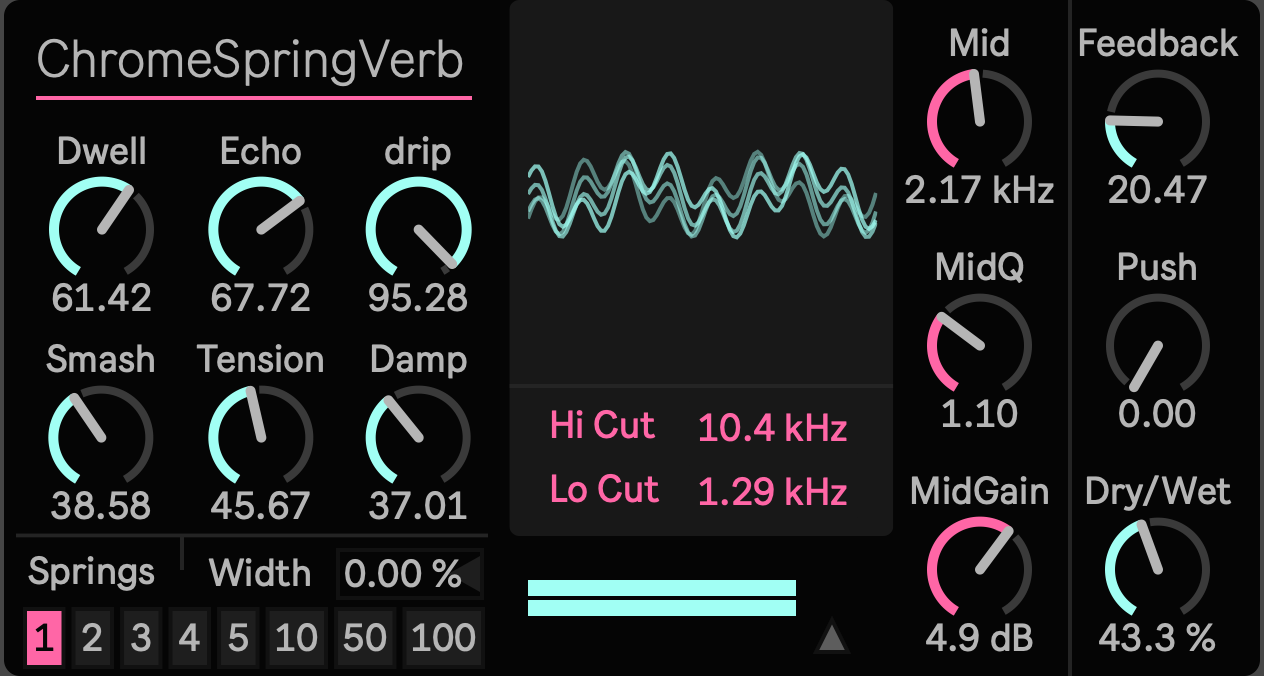
ChromeSpringVerb: A Study in Resonant Systems
In the early 1960s, the emergence of spring reverberation was less an aesthetic choice than an engineering compromise. Mechanical springs, compact and resilient, allowed spatial simulation inside portable amplifiers. What began as a constraint evolved into a signature. The unmistakable shimmer associated with the Fender Twin Reverb was not an abstract algorithm, but a physical system under tension, driven, saturated, and slightly unstable.
Spring reverbs do not behave like rooms. They exhibit dispersion, non linear reflections, and frequency dependent decay that resists uniformity. Each vibration propagates through coiled metal with microscopic inconsistencies. The result is a dense cluster of resonances that feels metallic, immediate, and alive.
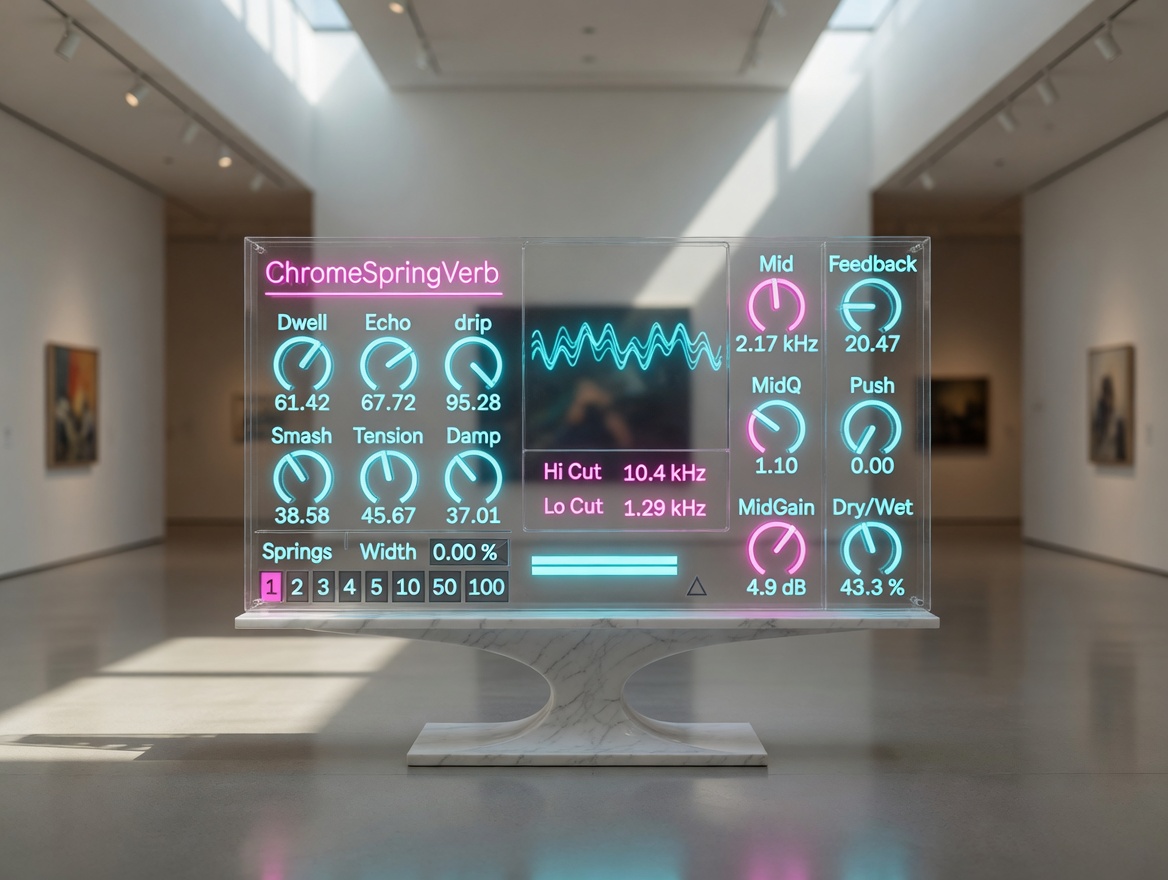
From Emulation to Parameterization
Most contemporary digital reverbs approximate spring behavior through impulse responses or simplified models, which collapse physical variability into a fixed snapshotChromeSpringVerb v.2.0 rejects this static approach, treating the spring not as a preset, but as a dynamic mechanical system defined by its internal circuitry and physical constraints.
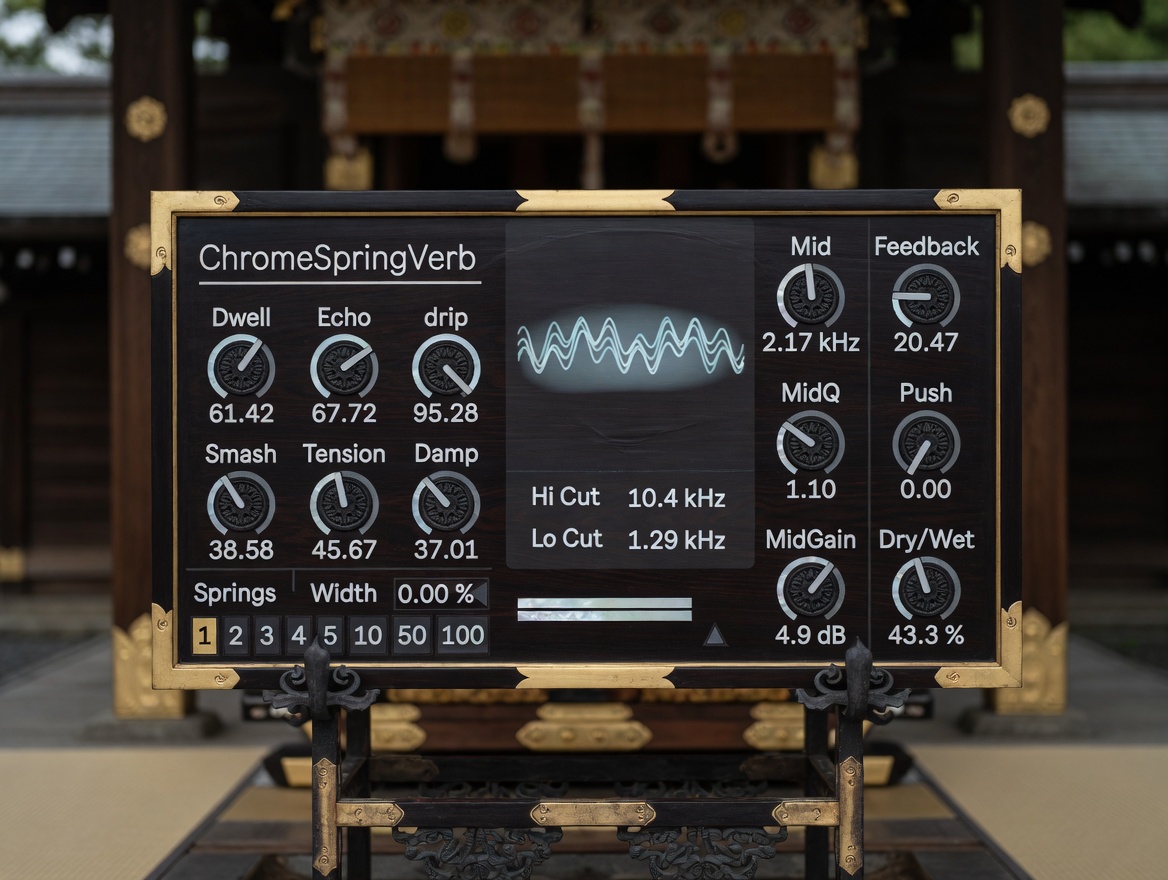
The following parameters are not cosmetic; they expose the internal mechanics of a modeled object:
- Dwell: Regulates excitation energy. This controls how hard the springs are driven, analogous to the drive gain in a physical tank, directly influencing the system's non-linear saturation.
- Springs: Modifies modal density by altering the number of simulated springs. It shifts the response from sparse, discrete reflections to complex, high-density interference patterns.
- Tension: Modifies propagation speed and brightness by simulating the physical tension of the wire. This affects how transients smear over time and dynamically scales the delay constants.
- Damping: Defines energy loss within the loop. v10 implements a dual-stage 12dB/octave filter to replicate the frequency-proportional friction of a physical coil, ensuring a natural decay "tail" where high frequencies vanish rapidly.
- Hicut: A 2nd-order Butterworth LPF applied to the wet output. Based on hardware measurements, it enforces a 12kHz ceiling, replicating the bandwidth limitations of a physical transducer and removing digital harshness.
- Drip: Controls the "wet" splash characteristic of the spring. In v10, this includes cumulative high-frequency absorption per tap, meaning the "drip" becomes darker as the reflections repeat, just as they do in mechanical tanks.
- Saturation: Introduces non-linearities at both the input stage and the output transformer. It applies light 3rd-order harmonic distortion to provide "analog" density and warmth.
- Instability & Feedback Push: Introduces recursive instability and micro-modulations. These parameters push the decay into controlled saturation or introduce organic pitch fluctuations caused by mechanical inconsistency.
- Tank Smash: Simulates the extreme non-linear response of a spring tank being physically struck. It forces the system into a state of intense, "smashed" excitation.
- Locut & Mid Boost: Shapes the spectral entry and resonance of the system. Mid Boost specifically replicates the inductive resonance of the transducer (around 1kHz), adding the mid-range "bite" typical of guitar amp springs.
- Width: Distributes the mechanical response across the stereo field, separating the mid and side components of the spring's vibrations.
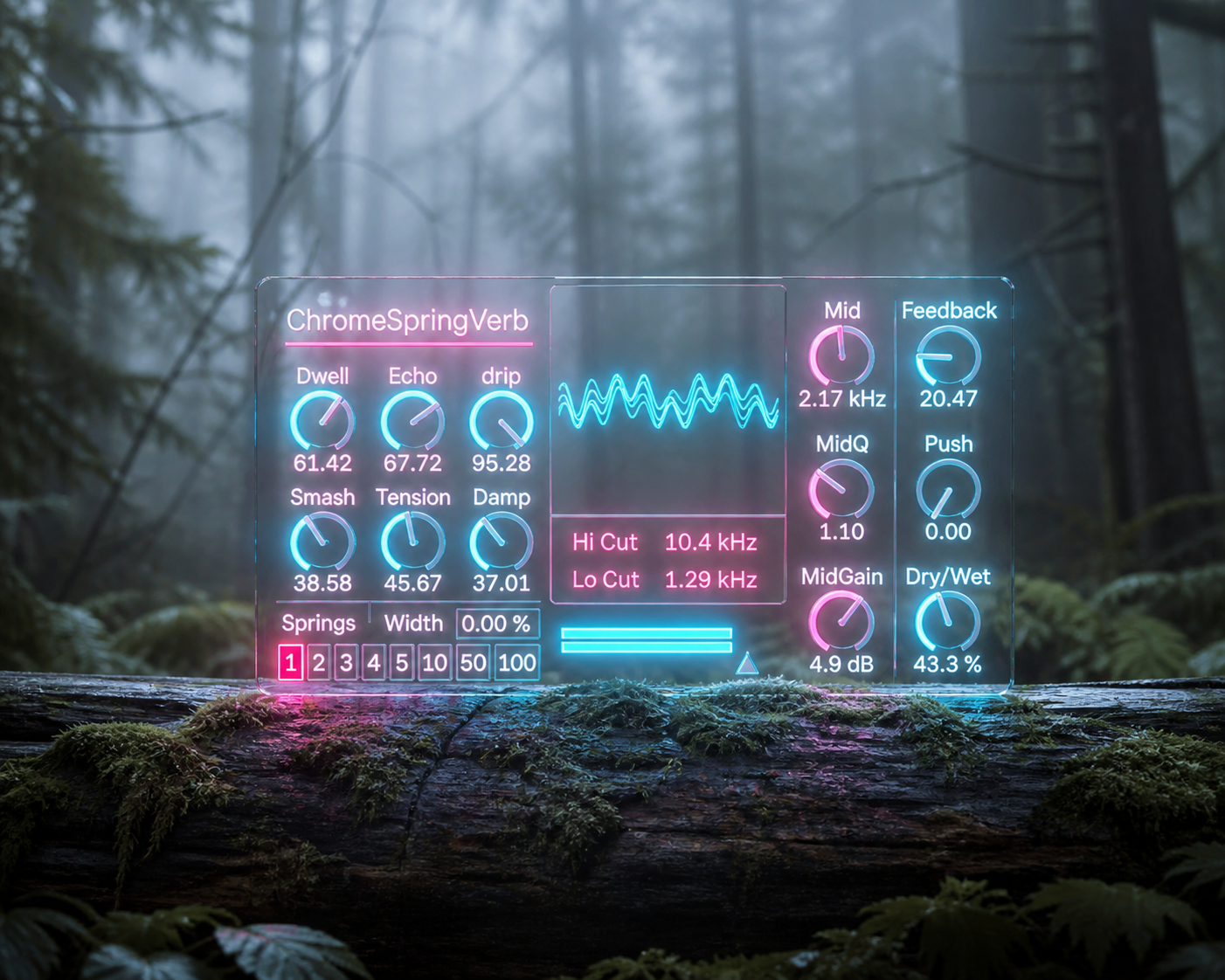
Behavior Over Presets
What becomes apparent during use is that small parameter shifts do not produce linear changes. Increasing tension does not simply brighten the sound. It reorganizes the distribution of resonant peaks. Adjusting spring count does not just thicken the tail. It alters the statistical behavior of reflections.
This positions the device less as an effect and more as a controllable acoustic experiment. It invites iterative listening rather than preset browsing.
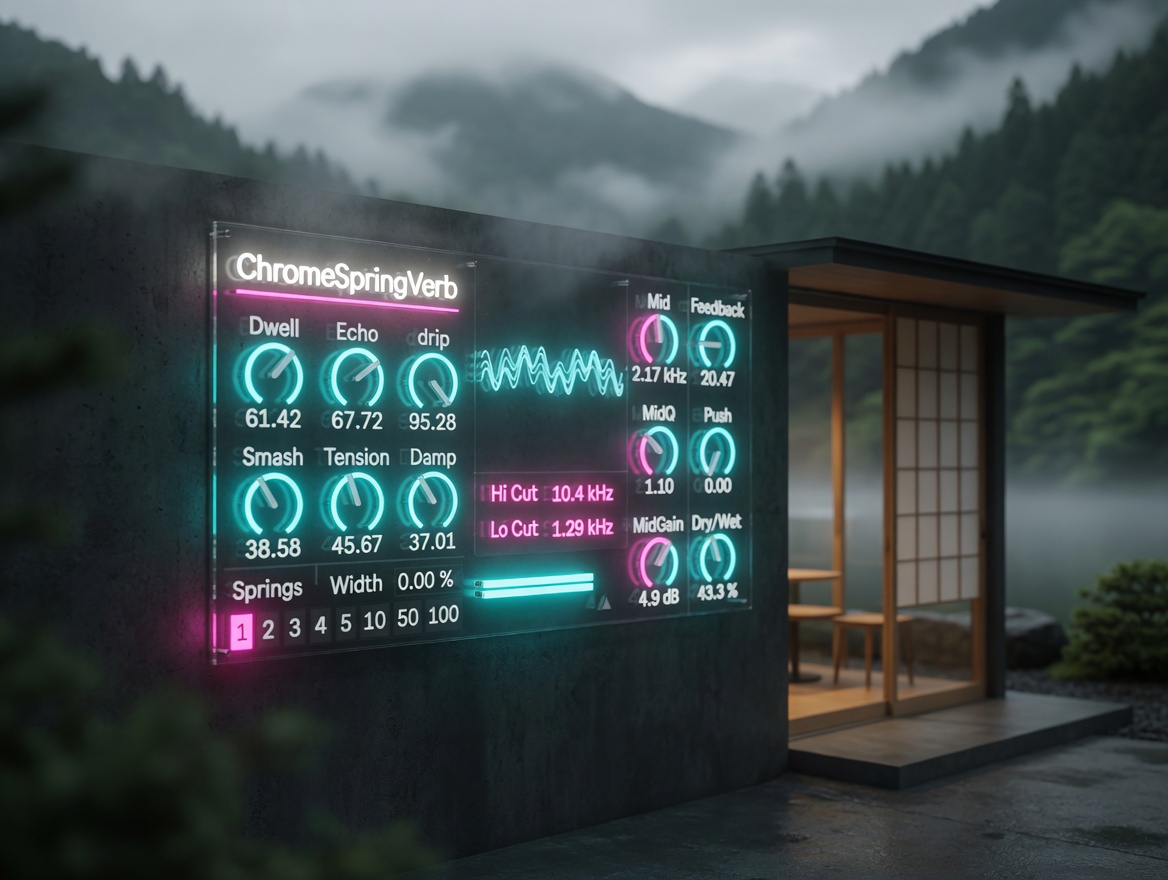
Why It Matters for Sound Design
For creators working beyond conventional mix tasks, the distinction is critical. When spatial processing becomes part of synthesis, fixed reverbs impose limits. A physically informed model, by contrast, behaves like an extension of the instrument.
ChromeSpringVerb is particularly suited to:
- Designing percussive textures where transient deformation is essential
- Creating metallic ambiences that avoid convolution staticness
- Integrating feedback structures into generative systems
- Exploring instability as a compositional parameter
In these contexts, the spring is not simulating a space. It is generating one.
On Continuity
The system is maintained as an evolving model. Access to updates remains continuous through the original distribution channel. This ensures that refinements in behavior, efficiency, and parameter response propagate without friction into existing workflows.
v.2.0 ... Totally update. (2026/5/2)
Reverb
AethelVerb https://akihikomatsumoto.sellfy.store/p/ableton-aethelverb/
ChromeSpringVerb https://akihikomatsumoto.sellfy.store/p/ableton-chrome-spring-verb/
HardVerb https://akihikomatsumoto.sellfy.store/p/ableton-hardverb/
Reverse Verb https://akihikomatsumoto.sellfy.store/p/ableton-reverse-verb/
Preset Verb https://akihikomatsumoto.sellfy.store/p/ableton-reverse-verb/
Shoegazer Reverse Gate https://akihikomatsumoto.sellfy.store/p/abletonshoegazerreversegate/
Akihiko Matsumoto
Study Site https://akihikomatsumoto.com/study/
Ableton M4L, Serum Preset Store https://akihikomatsumoto.com/download/
Sample Pack https://akihikomatsumoto.sellfy.store/sample-pack/
Bandcamp https://akihikomatsumoto.bandcamp.com
Ableton Skin https://akihikomatsumoto.sellfy.store/p/ableton-skin-pack/
Spotify https://open.spotify.com/artist/1tZMmxzZbvNu6klyKXa0L1?si=2JZaFeLbREi-UownD8POSg