
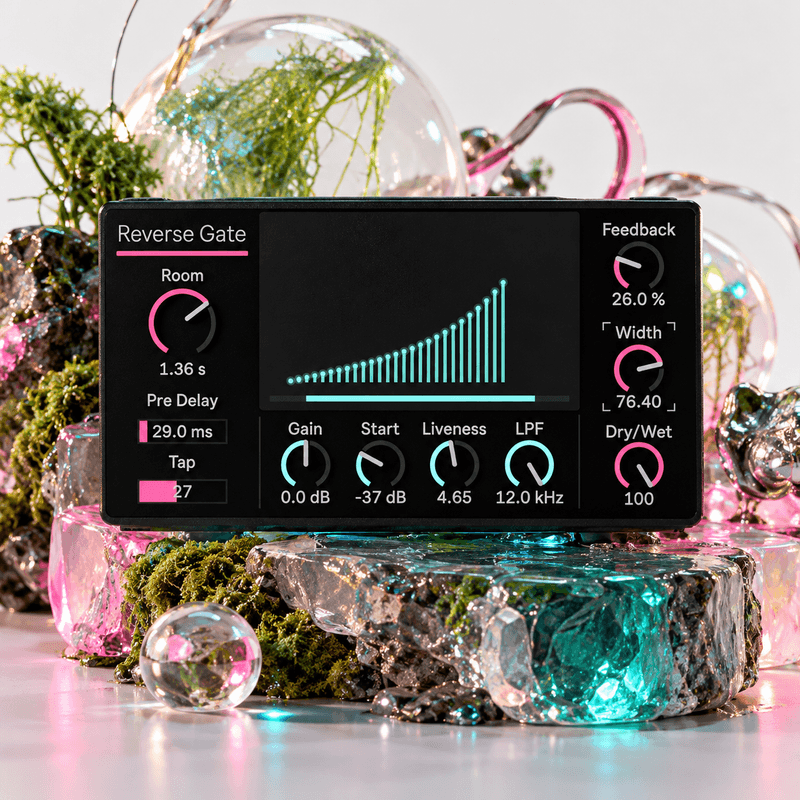
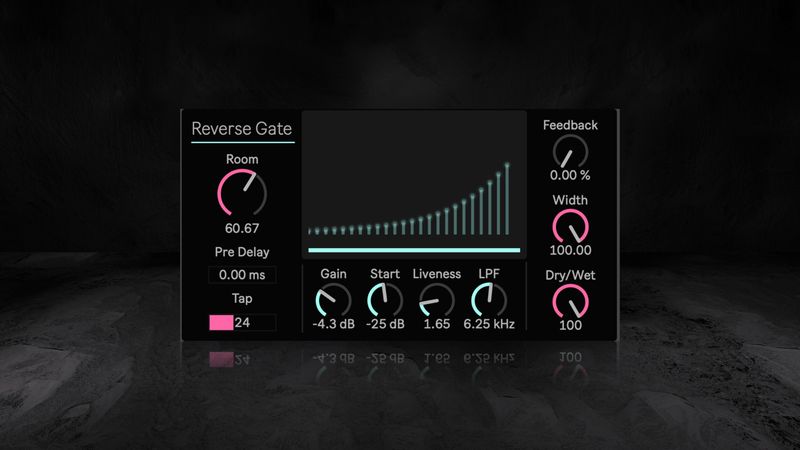
Ableton Shoegazer Reverse Gate v.5.2 | Recreate the Magic of the Legendary Yamaha SPX-90
Max for Live Device (.amxd file)
When the Reflections Grow Instead of Fade
A distorted guitar chord can fill a remarkable amount of space, yet its character is often decided in the first instant. The pick strikes the strings, the attack establishes the beginning of the sound, and everything that follows gradually loses energy. Conventional reverb extends that decay, allowing the chord to settle into its surroundings. But what happens when the reflected sound moves in the opposite direction, becoming stronger after the initial attack rather than immediately fading away?
Shoegazer Reverse Gate 5.2 explores this relationship between an instrument's attack and the sound that develops behind it. Inspired by the Reverse Gate effect associated with the Yamaha SPX90II, this Max for Live stereo audio effect constructs a rising sequence of early reflections. The later reflections become progressively more prominent, creating a swelling texture that can transform a short guitar gesture into a broader layer of sound. It is not simply playing recorded audio backward. The effect processes incoming audio through multiple delayed reflections, shaping how their combined energy develops over time.For shoegaze guitar, that distinction is particularly important. A chord does not need to lose its identity to become part of a larger texture. Its original attack can remain audible while the reflected layer develops afterward, producing a relationship between the physical gesture of playing and the less immediate movement of the surrounding sound.
Building a Wall of Sound from Reflections
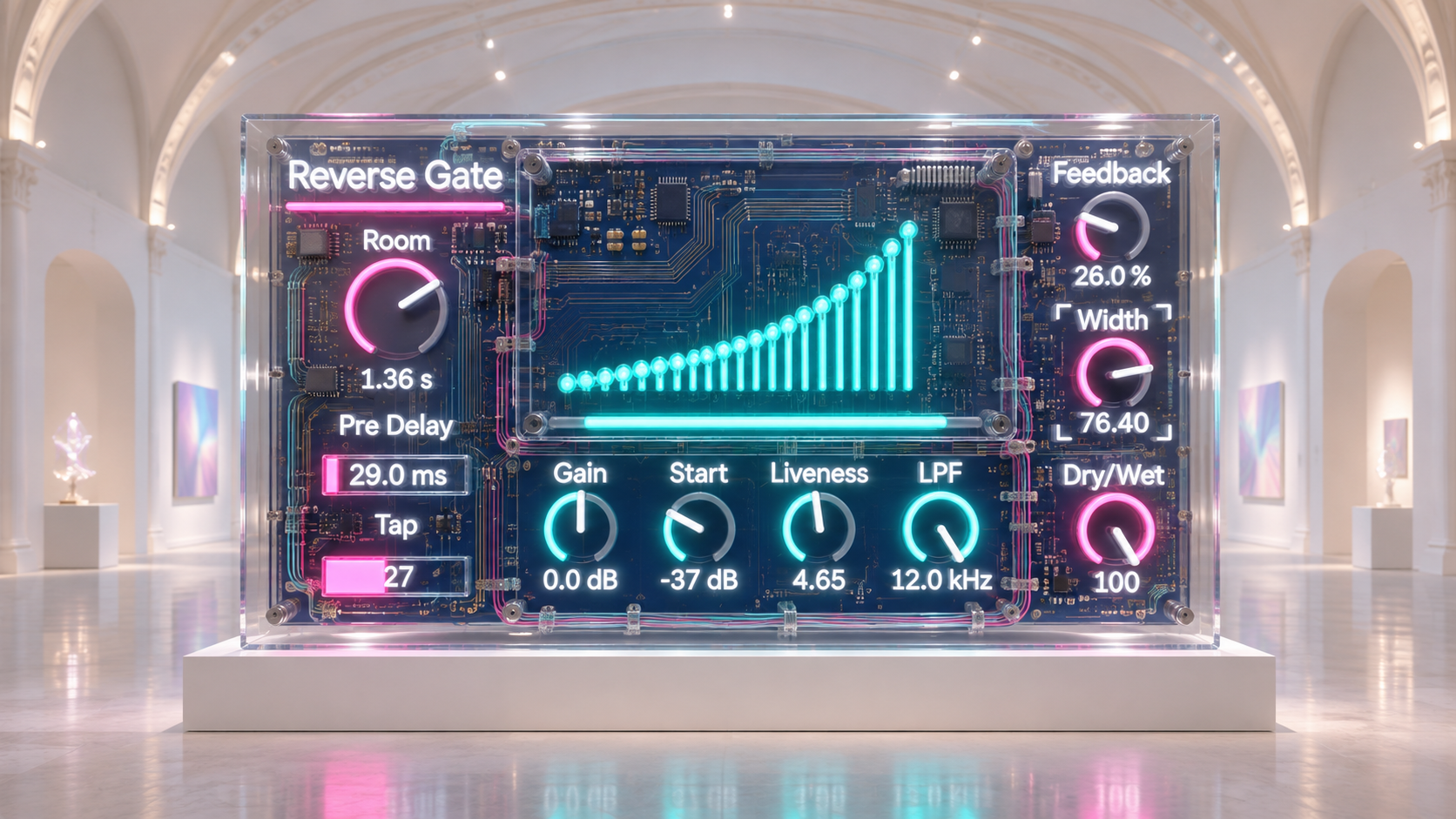
The density of a reverse style reverb is not determined only by how long it lasts. The number of reflections, their spacing, and the way their levels increase all contribute to whether the result feels like a collection of separate echoes or a more continuous mass.
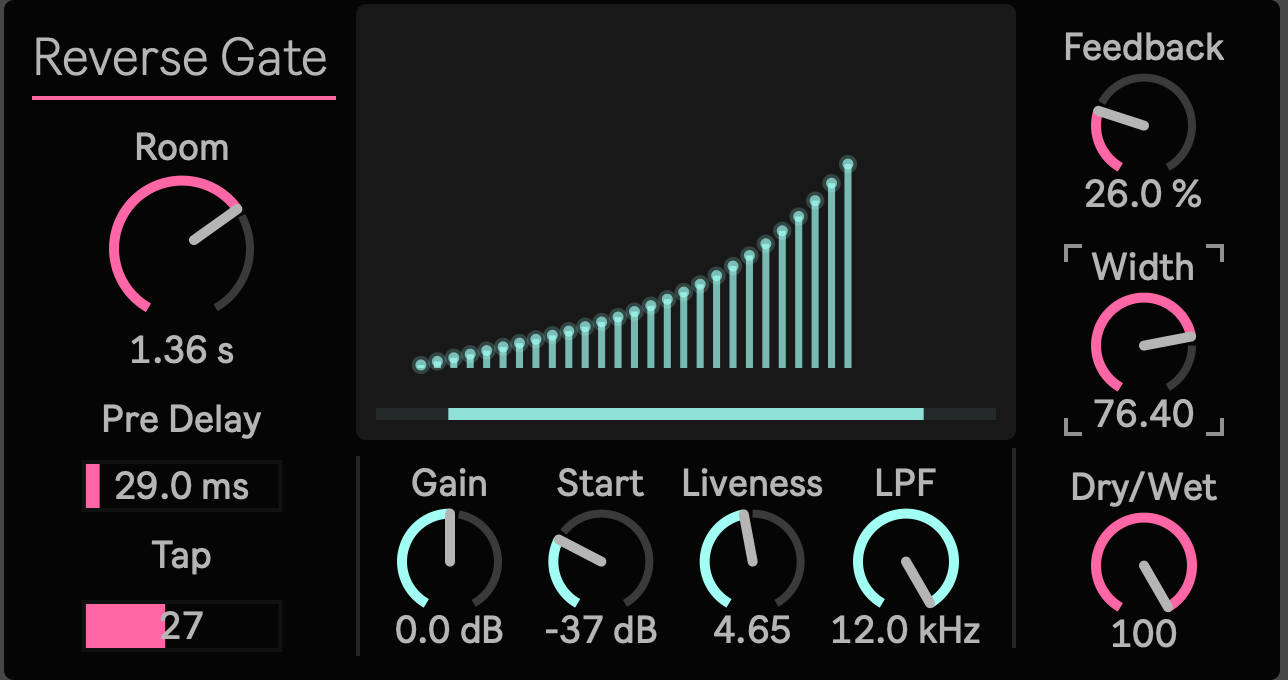
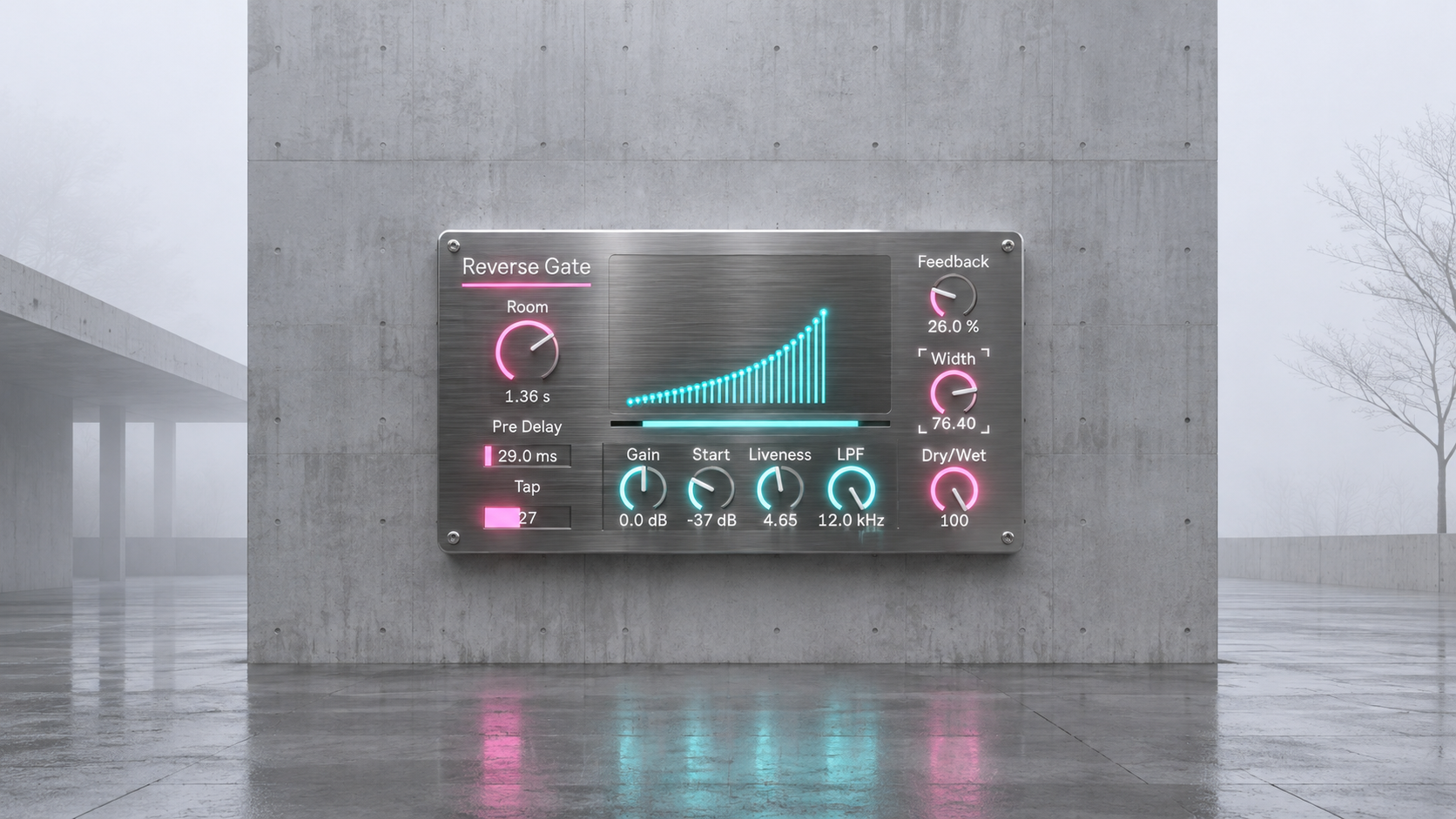
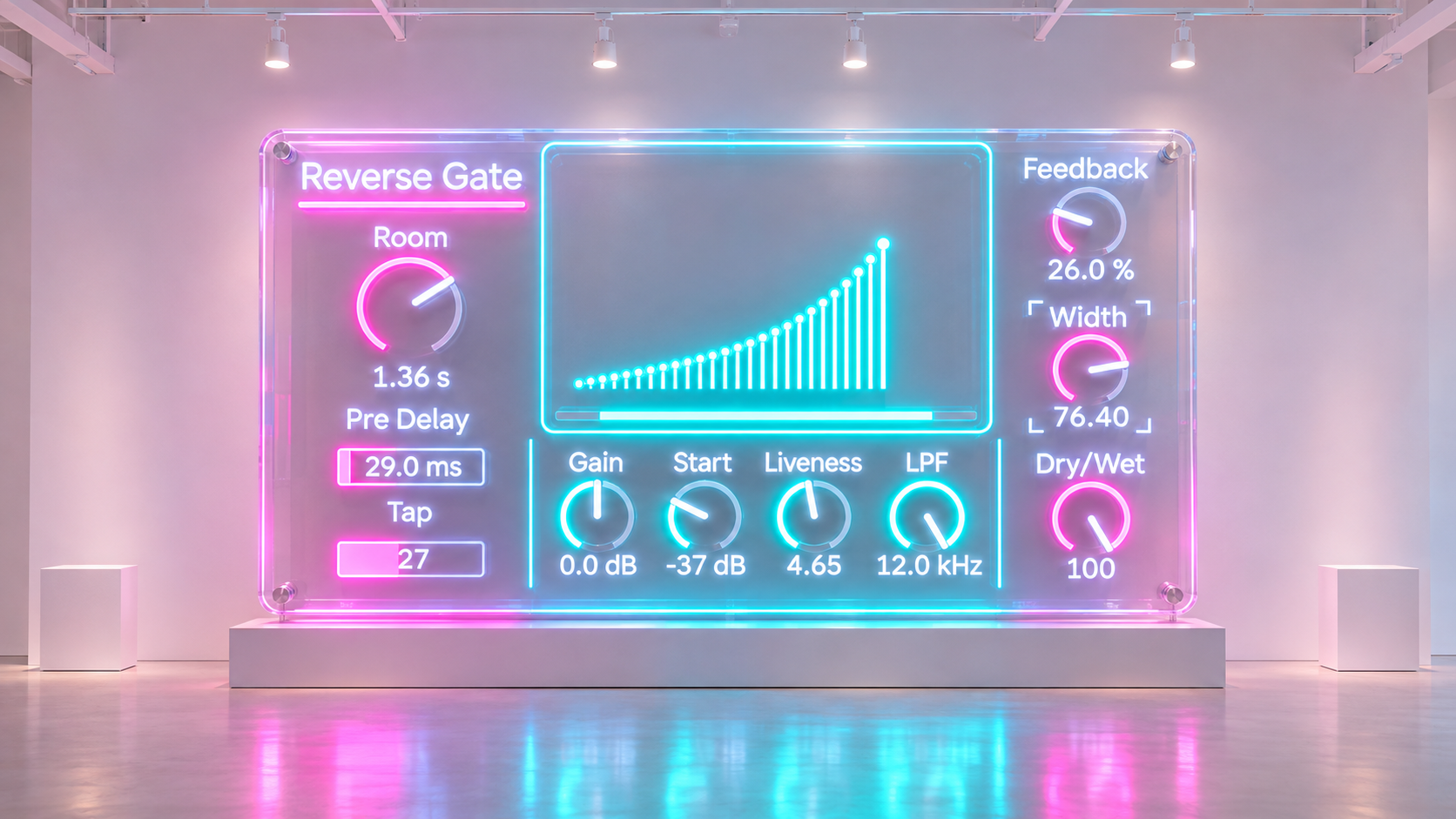
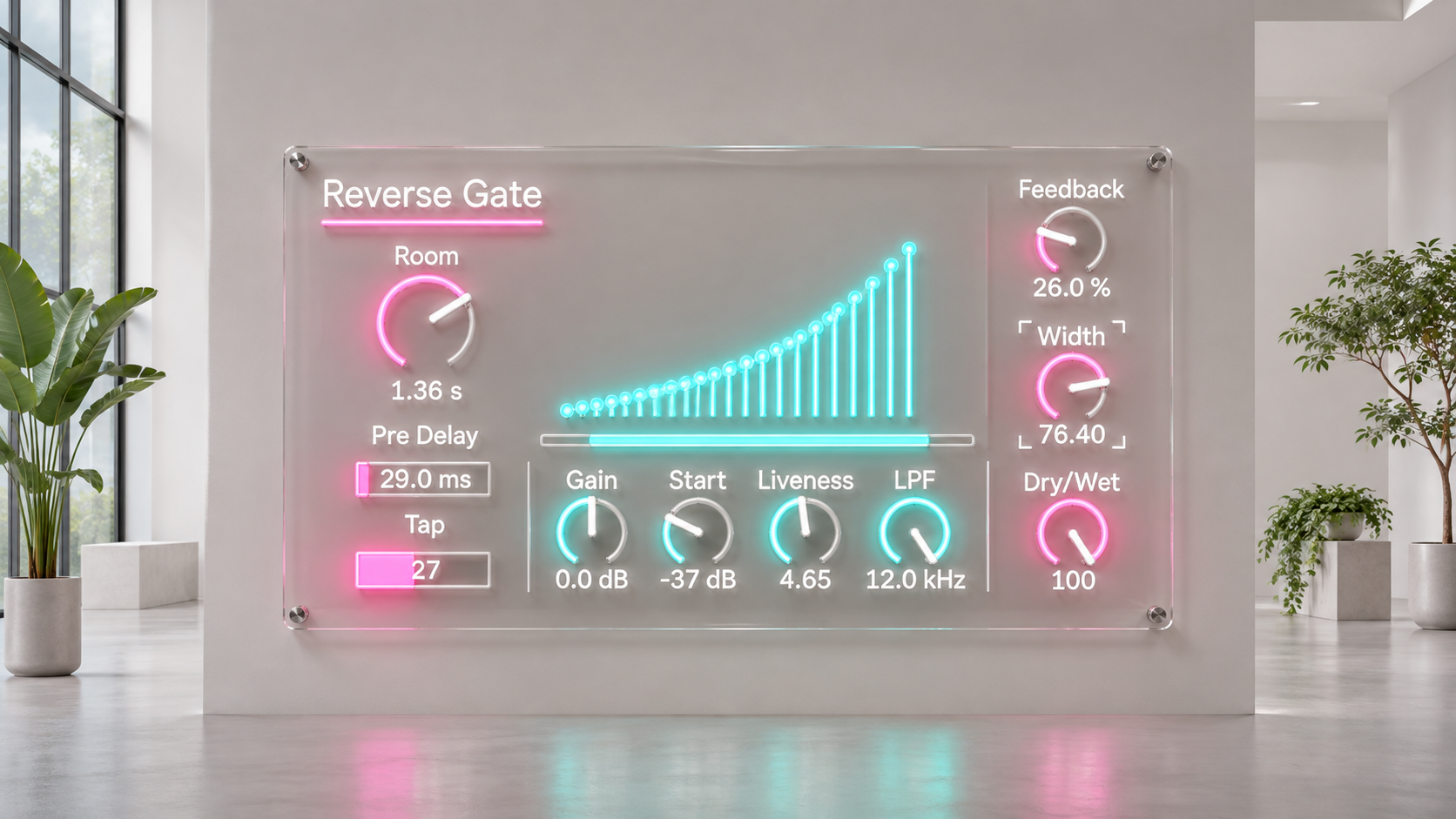
Shoegazer Reverse Gate gives you direct control over this structure. Tap determines how many delayed reflections participate in the effect, with up to 64 software taps available. Room specifies the modeled time of the final reflection in milliseconds, while Pre Delay establishes the interval before the first reflection. These controls work together, allowing you to explore a relatively compact swell or extend the reflected movement across a longer period.
The default configuration uses 12 taps, a Pre Delay of 29 milliseconds, and a modeled Room endpoint of 891 milliseconds. These values describe the software model rather than the internal specifications of the Yamaha hardware. They provide a starting point for hearing how a sequence of reflections can gather into a larger gesture.
On a heavily distorted guitar, the result can become an additional layer of sustained energy behind the chord. With a shorter source, the separate reflections may become more apparent. Increasing the tap density offers another way to explore how individual delayed events overlap, changing the perceived continuity of the sound without requiring a new performance.
Shaping the Rise of the Sound
A reversed envelope is not simply a matter of making every reflection louder than the previous one. The rate at which the energy increases has an important influence on the character of the effect. A gradual rise can allow the reflected texture to emerge alongside the original sound, while a more concentrated increase near the end can produce a stronger sense of delayed expansion.
The Liveness control changes this relationship by adjusting the curvature of the rising reflection envelope. Lower settings emphasize a more pronounced increase toward the later reflections, while higher settings approach a more linear progression. Start determines the relative level of the earliest reflection, allowing the beginning of the sequence to become more subdued or more prominent.
These adjustments make it possible to explore different relationships between the original gesture and the reflected texture. A guitar chord might benefit from reflections that begin quietly and gradually become more noticeable. A short synthesizer sound, by contrast, may reveal more detail when the individual reflections remain distinguishable throughout the sequence.
The effect also provides an LPF control for shaping the high frequency content of the processed reflections. Reducing the upper frequencies can make the reflected layer less bright, while the maximum setting allows the filter stage to pass through. This offers another way to distinguish the swelling texture from the original instrument without changing the source sound itself.
Space, Texture, and the Character of Digital Processing
The distinctive appeal of early digital effects is not limited to their use of delay and reverberation. The conversion process, the spacing of reflections, and the restrictions of the underlying processing system can all contribute to the character of a sound.
Shoegazer Reverse Gate includes a digital conversion inspired processing model, using internal sampling and quantization stages as part of its approach to the texture of early digital effects. These elements are informed by the architecture associated with the SPX90II, but the device is a software approximation rather than a measured, component accurate reproduction of the original hardware.
Its stereo processing maintains separate delay histories for the left and right input channels. Width adjusts how the reflected signals are distributed across the stereo output, while Dry/Wet determines the balance between the original signal and the processed layer. This allows the rising reflections to be heard on their own or combined with the direct sound.
Feedback extends the possibilities beyond a single group of reflections by returning part of the processed sound into the effect. It is an additional creative control rather than a reproduction of a parameter from the original SPX90II Reverse Gate program. With Feedback at zero, the basic rising reflection structure can be explored independently. Introducing feedback creates the possibility of further repetitions and more sustained textures, with the amount adjusted according to the source material and the intended intensity.
Between the Guitar and the Atmosphere
The relationship between an instrument and its reverberation becomes especially interesting when the effect begins to assume a musical role of its own. A guitar chord can provide the initial harmonic material while the rising reflections contribute a separate movement through time. The original sound establishes the gesture, but the processed layer changes how long that gesture continues to develop.
This approach is not limited to distorted guitars. Clean chords can reveal the individual reflections more clearly, while synthesizer pads and drones provide sustained material against which the changing reflection envelope can be heard. Short percussion sounds offer another perspective, making the timing and density of the delayed events more apparent.
In each case, the purpose is not necessarily to create a realistic acoustic space. It is to treat the reflected sound as an intentional part of the composition, shaping the interval between the initial attack and the moment when the processed texture becomes most prominent.
Shoegazer Reverse Gate 5.2 is a way to explore what happens after a sound begins, when its reflections are allowed to grow rather than simply disappear.
Free Lifetime Updates
Your purchase includes free lifetime updates for Shoegazer Reverse Gate. Any future updates published for this product are included at no additional cost.
Existing customers can access the latest available files through the Sellfy account used for their original purchase. There is no need to purchase the same product again to receive its published updates.
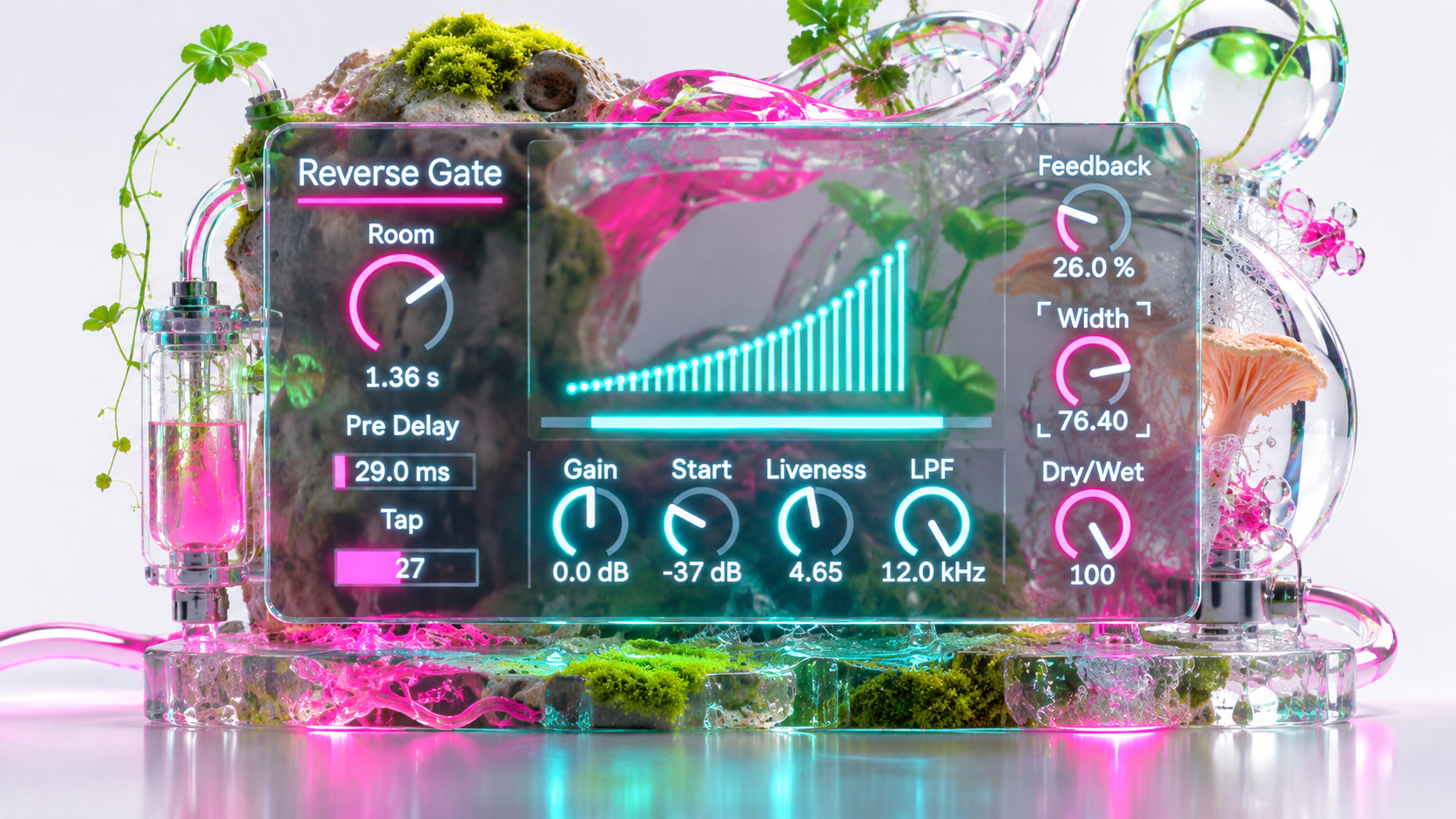
v5.2 Finalized ShoegazerReverseGate with a Room dial that displays the modeled final reflection time in milliseconds and a 12-tap starting configuration. The stereo reverse-style reflections retain adjustable Liveness, filtering, width and Dry/Wet controls, alongside a more gradual Feedback response for subtle repeats. (2026/10/16)
v.5.1 ... Updated more like spx90 sound. (2026/5/27)
ver.5.0 ... Totally updated. (2026/4/26)
ver.4.2 ... Missing file bug fixed. (12/5/2024)
ver.4.1 ... UI Updated. (11/30/2024)
ver.2.1 ... initialize bug fixed.
ver.2.2 ... New Compact UI Updated.
ver.2.3 ... initialize bug fixed.
ver.2.4 ... UI and degrading updated.
ver.3.0 ... UI and more like YAMAHA sound.
ver.3.5 ... UI updated.
ver.4.0 ... Live 12, Apple silicon support.
Delay
Reverse Delay https://akihikomatsumoto.sellfy.store/p/abletonreversedelay/
Delay that returns captured fragments in reverse for backward moving echoes.
REcho https://akihikomatsumoto.sellfy.store/p/abletonrecho/
Physical modeling tape echo with three playback heads, modulation, degradation, and spring reverb.
Over Delay https://akihikomatsumoto.sellfy.store/p/ableton-over-delay/
Delay that turns modulation, feedback, and degradation into unstable evolving repeats.
Color Delay https://akihikomatsumoto.sellfy.store/p/abletoncolordelay/
Delay that switches among distinct classic inspired tonal characters for different echo colors.
VDB Delay https://akihikomatsumoto.sellfy.store/p/abletonvdbdelay/
Variable delay buffer effect for pitch movement and extreme time manipulation.
Bouncing Delay https://akihikomatsumoto.sellfy.store/p/abletonbouncingdelay/
32 tap delay that creates accelerating and decelerating bouncing echo patterns.
2290 Delay https://akihikomatsumoto.sellfy.store/p/ableton-2290-delay/
Precision digital delay inspired by classic 2290 style repeats and ducking.
Analog Delay https://akihikomatsumoto.sellfy.store/p/abletonanalogdelay/
Warm delay focused on darkening feedback repeats and analog style temporal movement.
D7 Tap Delay https://akihikomatsumoto.sellfy.store/p/ableton-d7-tap-delay/
Multitap digital delay for complex 1990s rack style echo patterns.
DD-2 Delay https://akihikomatsumoto.sellfy.store/p/ableton-dd2-delay/
Compact digital delay inspired by the crisp character of early digital pedal echoes.
Mod Delay https://akihikomatsumoto.sellfy.store/p/ableton-mod-delay/
Delay with dual LFO modulation for chorus like motion and unstable pitch movement.
MS Delay https://akihikomatsumoto.sellfy.store/p/ableton-ms-delay/
Mid Side delay that processes the stereo center and sides with independent feedback paths.
Akihiko Matsumoto
Study Site https://akihikomatsumoto.com/study/
Ableton M4L, Serum Preset Store https://akihikomatsumoto.com/download/
Sample Pack https://akihikomatsumoto.sellfy.store/sample-pack/
Bandcamp https://akihikomatsumoto.bandcamp.com
Ableton Skin https://akihikomatsumoto.sellfy.store/p/ableton-skin-pack/
Spotify https://open.spotify.com/artist/1tZMmxzZbvNu6klyKXa0L1?si=2JZaFeLbREi-UownD8POSg