
$9.99+
Ableton LFMW ver.7.1 | The Ultimate Modulation Tool for Creative Music Makers
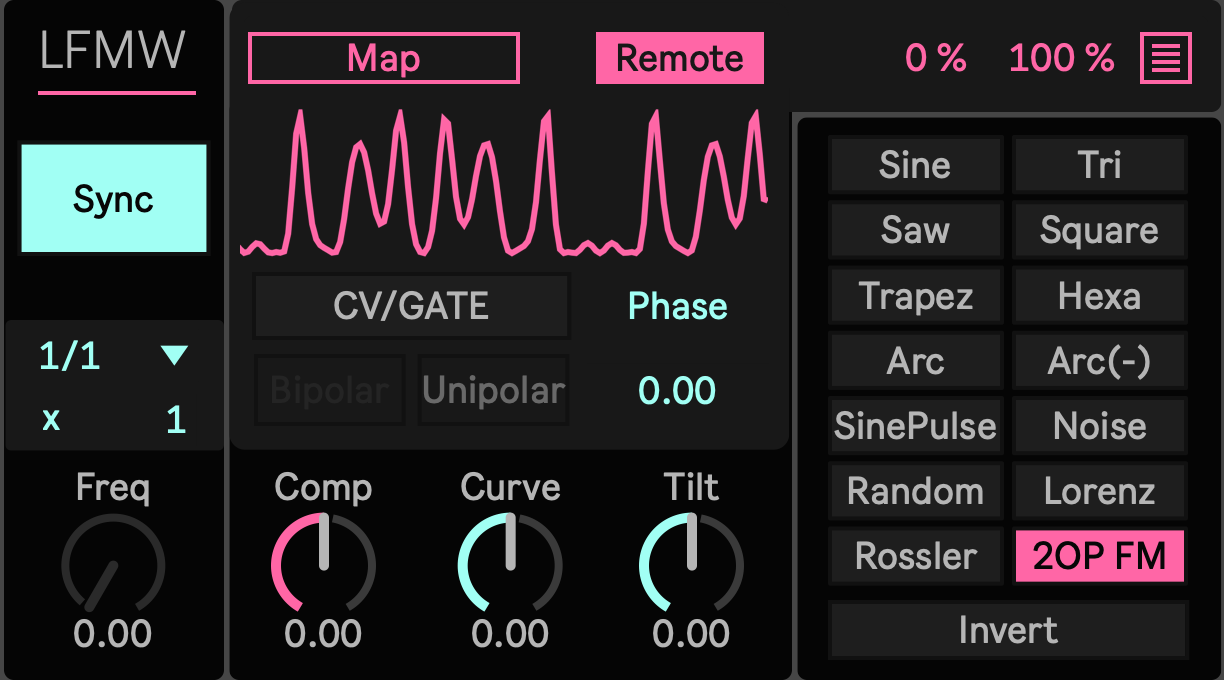
Shape time, not just movement
If all you need is to move a filter cutoff up and down, a conventional LFO can already do that.
LFMW is a Max for Live modulation device designed to go further. Instead of choosing only a rate and a waveform, you can shape how time moves through each cycle, where the motion becomes concentrated, and how the resulting curve reaches the parameter you are controlling.
Map LFMW to Filter Cutoff, Wavetable Position, Delay Time, Reverb Amount, Distortion, or another parameter in Ableton Live. From there, you can move from simple synchronized cycles to wobble patterns that fold inside the beat, stepped random motion, slowly evolving chaos, and more complex rhythmic modulation.
LFMW is less about changing a value and more about designing the time through which that value changes.
From regular LFO motion to movement that does not simply repeat
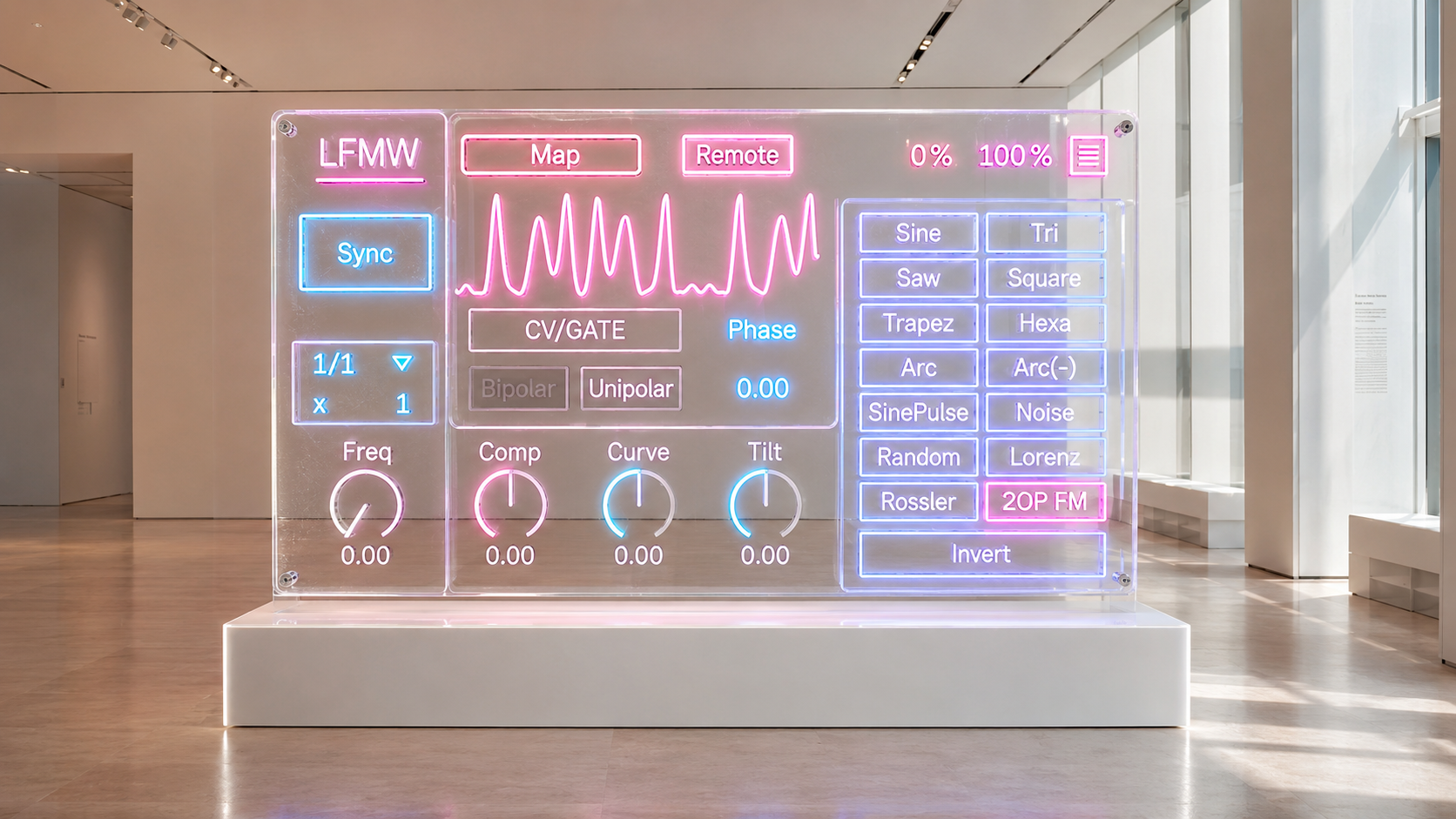
LFMW includes 14 waveforms. Alongside familiar periodic shapes such as Sine, Tri, Saw, and Square, it includes Noise, Random, Lorenz, Rossler, and 2OP FM.
Random changes to a new value at each cycle boundary. Instead of continuous noise, it creates stepped modulation that can shift a parameter from one rhythmic state to another.
Lorenz and Rossler behave differently again. They are generated from deterministic chaotic systems, so the motion can evolve over longer periods without feeling like a short LFO pattern repeating again and again. They work especially well for filters, spatial effects, textures, and other parameters that benefit from gradual variation over time.
At the other end of the spectrum, LFMW can remain tightly synchronized to Ableton Live. Sync mode provides 21 note values, including straight, triplet, and dotted divisions. SyncNum can extend those rates further, allowing the same rhythmic basis to unfold across much longer periods.
When synchronization is not needed, Freq mode provides free running modulation from 0 to 40 Hz.
Make the inside of the beat more complex without losing the beat
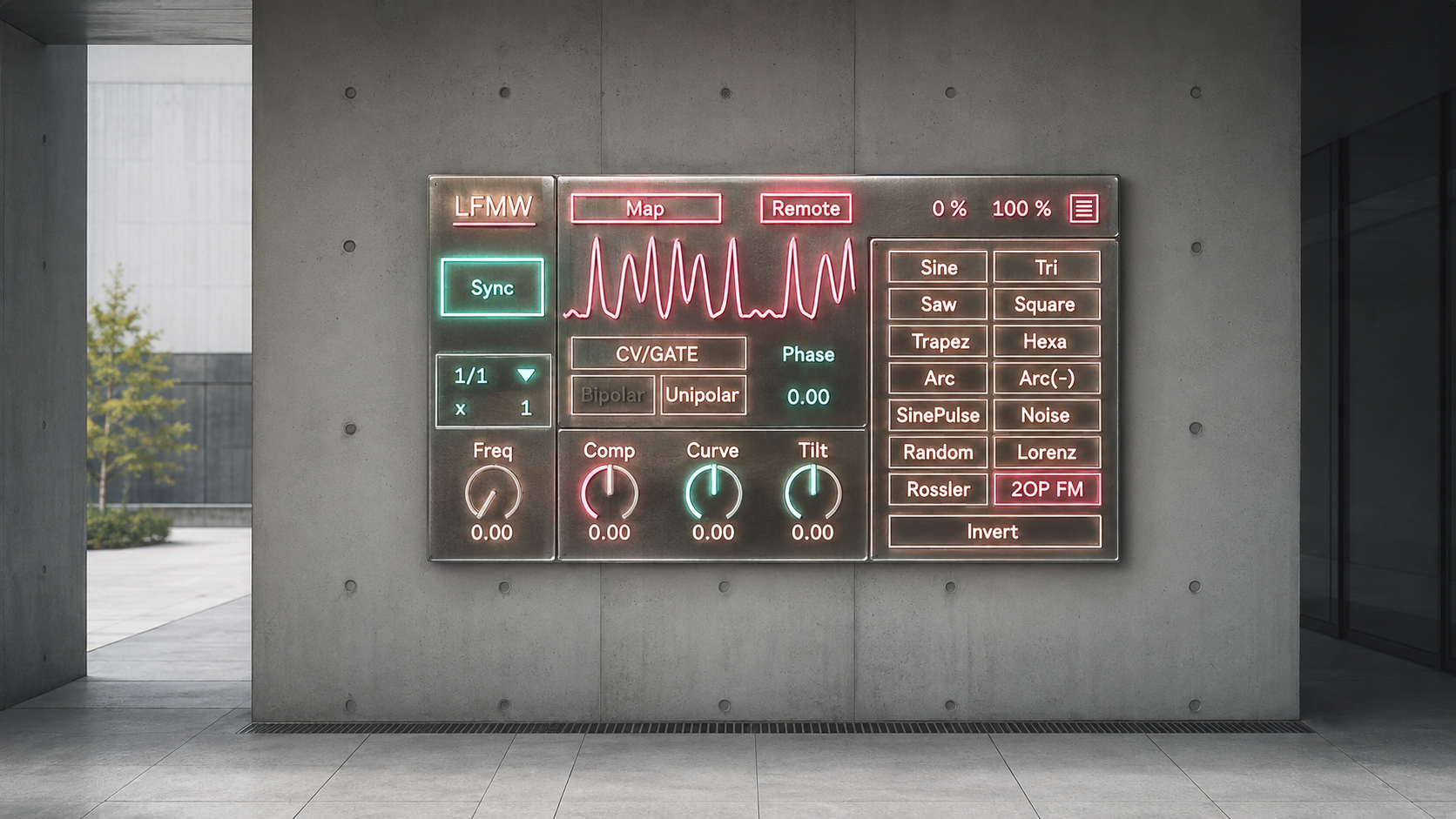
The 2OP FM mode in LFMW 7.0.6 is not conventional FM synthesis for generating audio.
It is designed as tempo synchronized control modulation, combining a four cycle carrier with a three cycle modulator.
This keeps a larger metric structure intact while introducing additional folds, accents, and motion inside it. For filter wobble and rhythmic timbral movement, the result can feel much more intricate than a conventional Sine LFO without losing the underlying rhythmic reference.
Comp controls the FM depth.
At lower values, the motion stays closer to the basic four cycle carrier structure. As Comp increases, the three cycle modulator pushes further into the carrier phase and creates greater internal complexity.
Tilt has a different role.
It does not control FM depth. Instead, it changes the timing shape of the carrier itself.
This means Comp can control internal complexity while Tilt independently changes whether the motion feels more forward leaning or more delayed.
Phase rotates the starting position, while Curve changes how values move through their range. Together, these controls can make the same waveform feel substantially different without simply replacing it with another shape.
Let one modulation shape move the whole sound
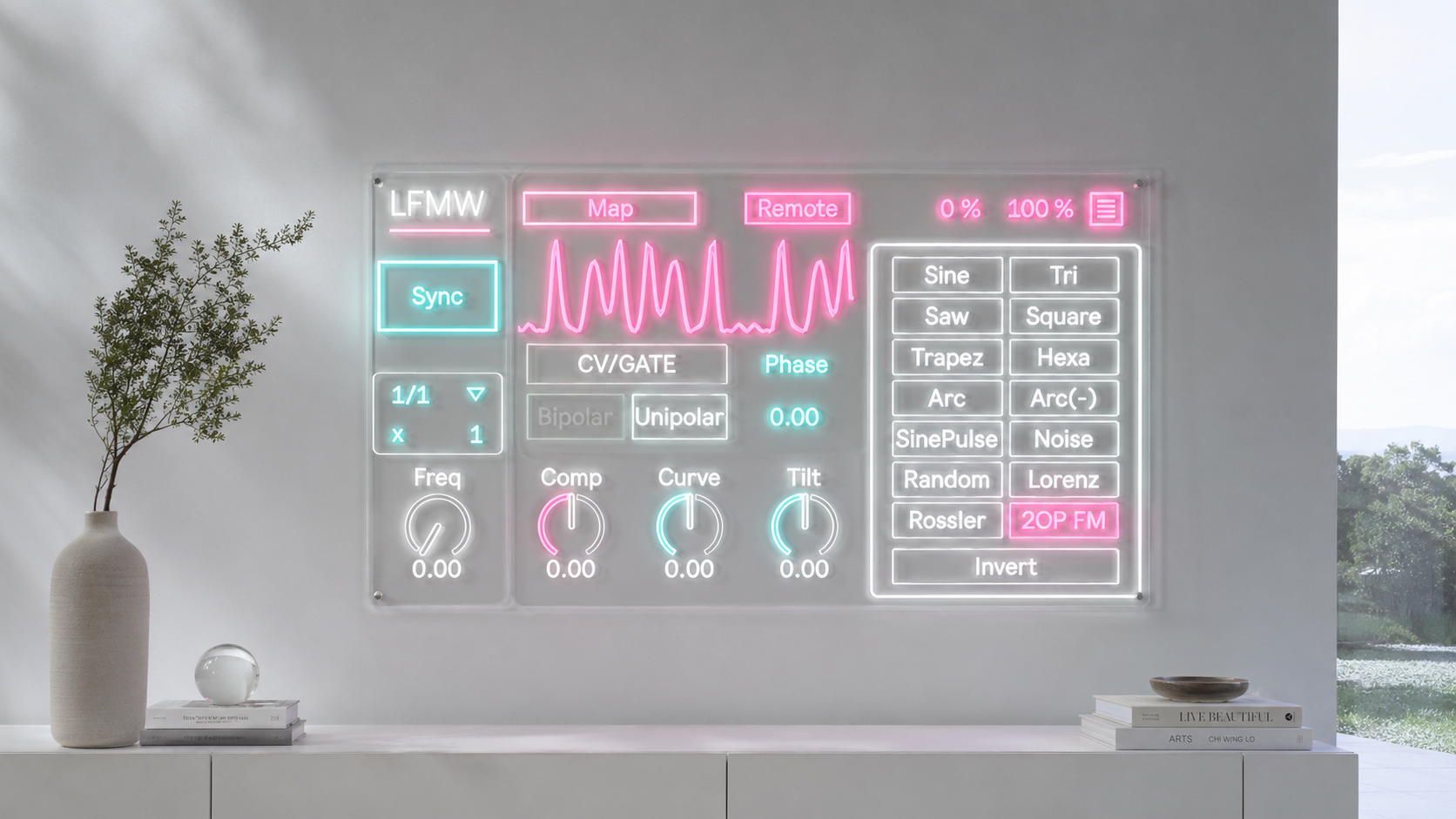
Press Map, choose a parameter in Ableton Live, then define the range in which LFMW is allowed to move it.
Min and Max establish the working range. ModAmount controls the modulation depth, while Polarity and Mode determine how the modulation is applied.
MultiMap allows the same LFMW modulation source to control multiple destinations.
A slow Lorenz movement, for example, can influence both filtering and reverb. A 2OP FM pattern can move Cutoff while also affecting Distortion or another Macro.
Instead of drawing separate automation for every parameter, several parts of a sound can share the same temporal structure.
LFMW does not have to sound dramatic.
A slow Sine mapped gently to Wavetable Position can create movement that unfolds almost invisibly over several bars. Random can switch timbral states on rhythmic boundaries. Lorenz and Rossler can produce long evolving changes with less obvious repetition. 2OP FM can preserve the groove while increasing the amount of activity inside it.
The same device can move from subtle background motion to something that becomes part of the rhythmic identity of the track.
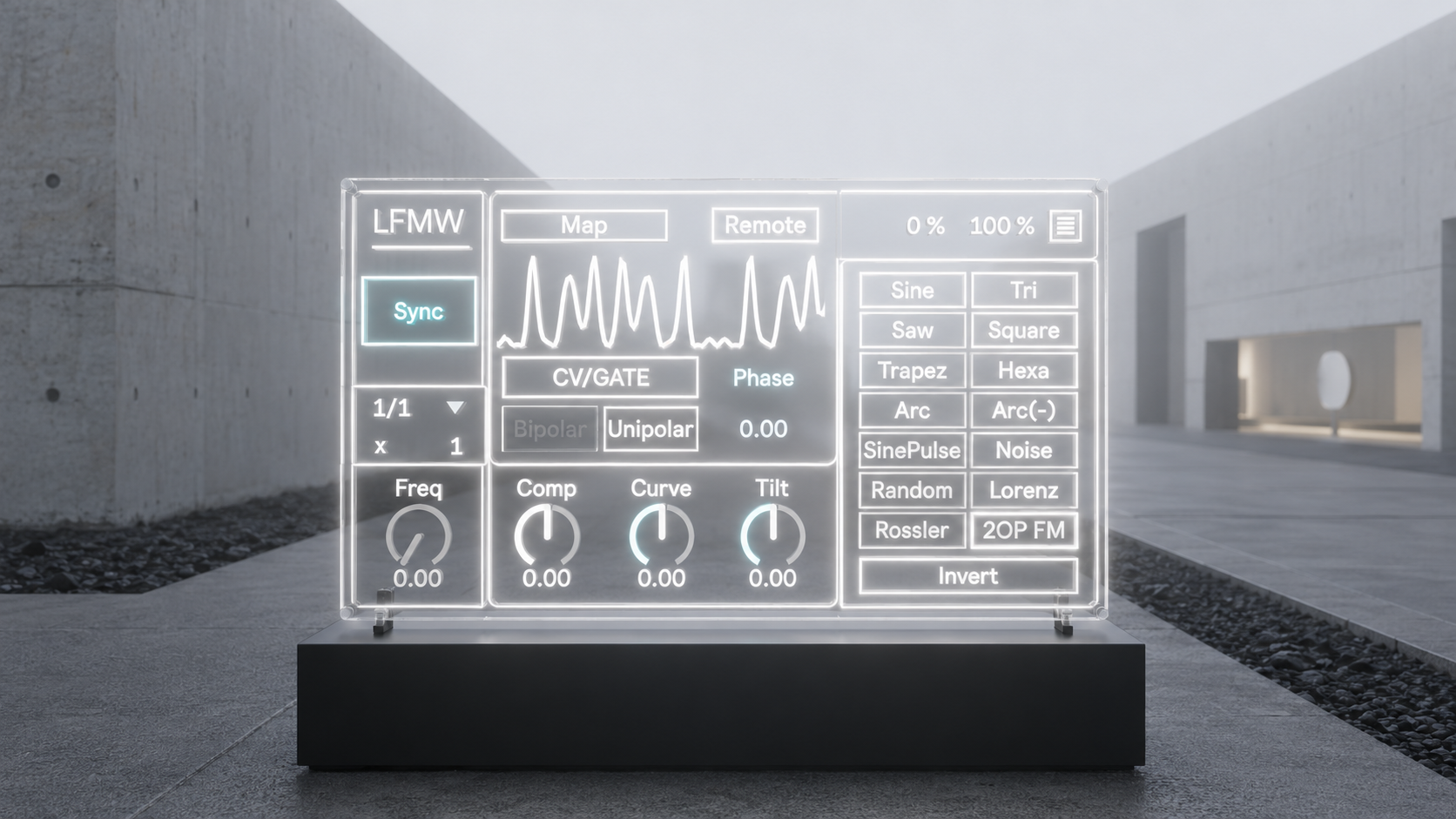
LFMW 7.0.6
LFMW 7.0.6 is a Max for Live modulation device combining tempo synchronized and free running modulation, 14 waveforms, Phase, Tilt, Curve, Comp, Mapping, MultiMap, and CV or GATE output.
The current 7.0.6 version preserves the final owner edited interface together with the polyrhythmic 2OP FM engine, where Tilt controls carrier slope and Comp controls FM depth. Its mapping system also preserves fail closed behavior when a target is disconnected.
LFMW is not simply an LFO for moving parameters.
It is a device for giving time a shape, then mapping that shape into sound.
Updates for existing customers
Existing customers can access the latest version by logging in with the Sellfy account used for the original purchase.
Updates are available at no additional cost.
v.7.1 ... Fixed unwanted spikes that could occur in Noise mode when modulation values changed. Noise modulation now transitions cleanly between values while the behavior of the other waveform modes remains unchanged. (2026/9/2)
v.7.0.6 ... Finalized the owner edited interface, retained the polyrhythmic 2OP FM engine with Tilt controlling carrier slope and Comp controlling FM depth, preserved fail closed Mapping behavior, and completed both embedded and same folder runtime dependency closure. (2026/8/11)
v.7.0 ... Rebuilt the LFMW DSP architecture around GenExpr centered processing while preserving the owner layout and modulation phase behavior, restored the original v.6.8 Sync note value semantics, retained the Arc waveform family, and established the LFMW 7 generation architecture for waveform, Sync, phase, shaping, Mapping, and dependency integration. (2026/8/8)
ver.6.8 ... Fixed random frequency & mapping UI bug. (4/25/2025)
ver.6.6 ... Fixed random wave phase reset. (1/27/2025)
ver.6.5 ... Fixed rendering sync phase bug. (1/26/2025)
ver.6.4 ... Fixed a bug that caused duplicate parameter names. Added the ability to reset the phase when the waveform speed is changed. (1/23/2025)
ver.6.2 ... Multiplier bug fixed, new wave tilt dial added. (10/2/2024)
Ver2.0... CV/GATE added
Ver2.2... Bipolar / Unipolar selector added
Ver2.3... Phase Control added
Ver2.4... Attenuator added, Meter bandwidth updated
Ver2.5.3... bug fixed
Ver2.5.4... CV out bug fixed
Ver2.6... UI changed, Attenuation removed
Ver3.0... New compact UI
Ver3.1... New UI Max8.1 Compatible
Ver.3.5... Smooth Waveform Fading
Ver3.6... New compact UI
Ver.3.6.2 ... Mapping bug fixed
Ver4.0... New Theme Reactive UI
ver.4.2 ... Mapping downsampling removed.
ver.4.3 ... UI updated.
ver.4.4 ... Remote resolution improved.
ver.5.0 ... UI & Mapping updated.
ver.5.2 ... Multi-mapping updated.
ver.6.0 ... UI updated. Live 12 support.
ver.6.1 ... Mapping bug fixed. (6/13/2024)
Modulator
Grid SEQ Params https://akihikomatsumoto.sellfy.store/p/abletongridseqparams/
LFMW https://akihikomatsumoto.sellfy.store/p/abletonlfmw/
Parameter SEQ https://akihikomatsumoto.sellfy.store/p/ableton-parameter-seq/
LFDUO https://akihikomatsumoto.sellfy.store/p/abletonlfduo/
Random Value https://akihikomatsumoto.sellfy.store/p/ableton-random-value/
Akihiko Matsumoto
Study Site https://akihikomatsumoto.com/study/
Ableton M4L, Serum Preset Store https://akihikomatsumoto.com/download/
Sample Pack https://akihikomatsumoto.sellfy.store/sample-pack/
Bandcamp https://akihikomatsumoto.bandcamp.com
Ableton Skin https://akihikomatsumoto.sellfy.store/p/ableton-skin-pack/
Spotify https://open.spotify.com/artist/1tZMmxzZbvNu6klyKXa0L1?si=2JZaFeLbREi-UownD8POSg