
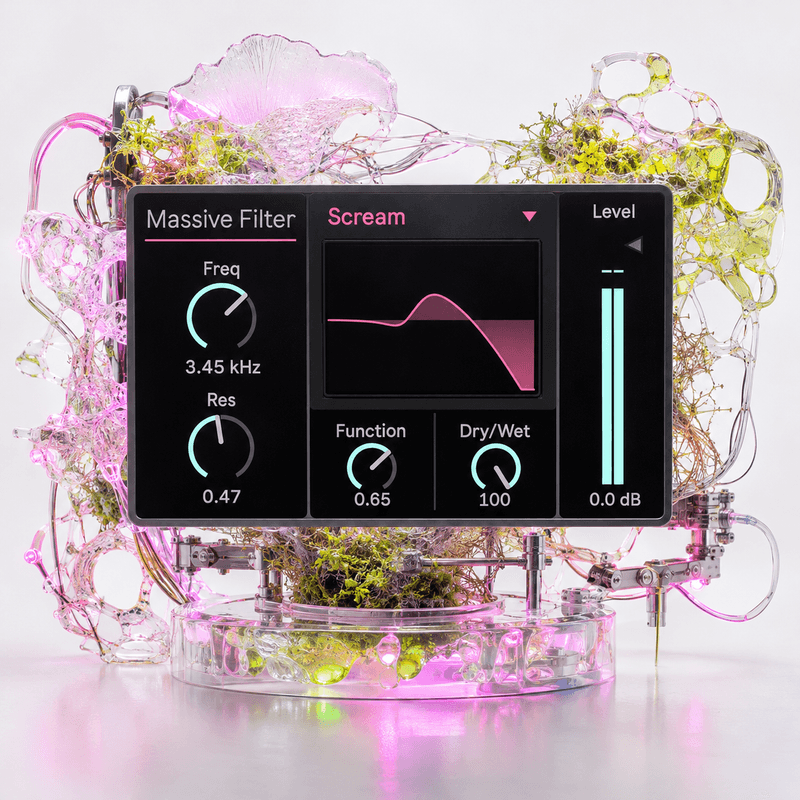
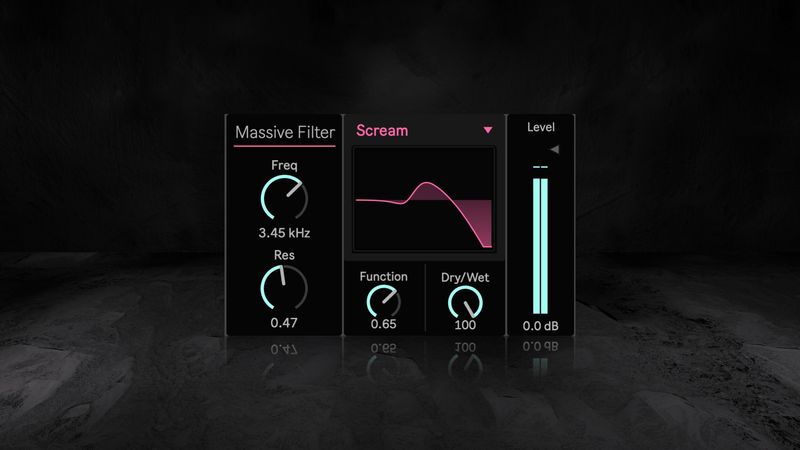
Ableton Massive Filter v.2.0
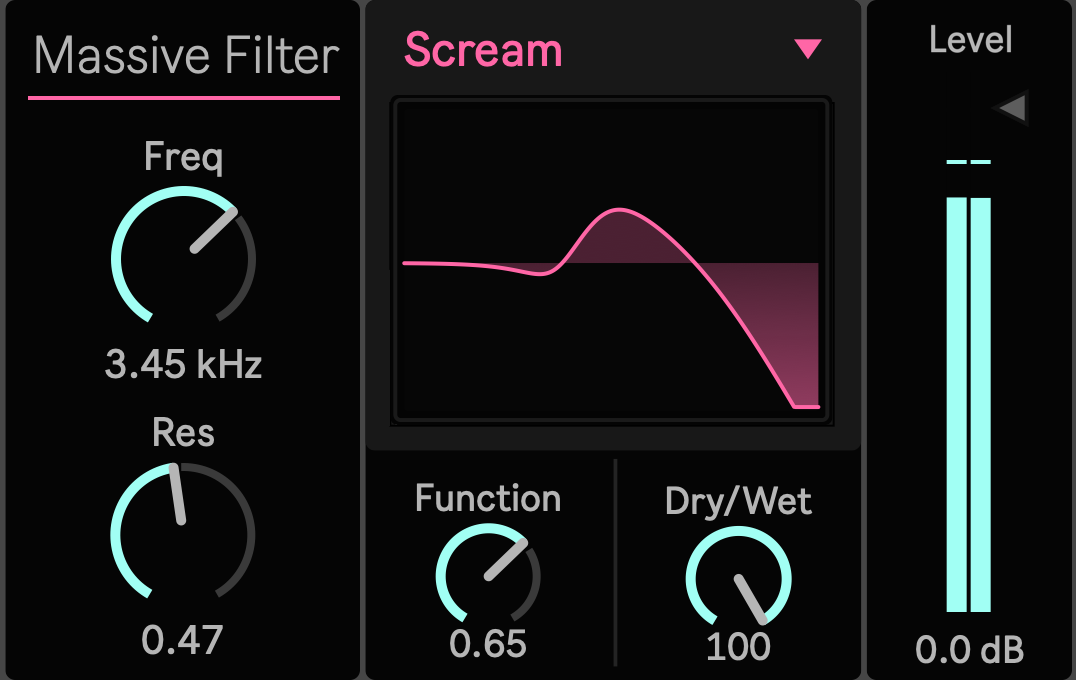
Max for Live Device (.amxd file) | Twelve filter models inside one compact control surface
Filtering is often treated as a simple choice between removing low frequencies or removing high frequencies. In practice, the character of the filter itself can become part of the arrangement. A smooth lowpass sweep, a steep four pole cutoff, moving phase cancellation, nonlinear feedback, tuned comb resonance, and acid style ladder behavior can all create very different musical results even when the same automation gesture is used.
Massive Filter brings twelve filter models into one Max for Live audio effect while keeping the control surface intentionally compact. Frequency and Resonance remain the main operating axis across the device. Function appears only when the selected model defines a meaningful third behavior. Dry/Wet places the processed signal beside the original, and Level manages the final output.
The result is a filter designed for moving between familiar spectral control and more character driven processing without rebuilding the signal chain.
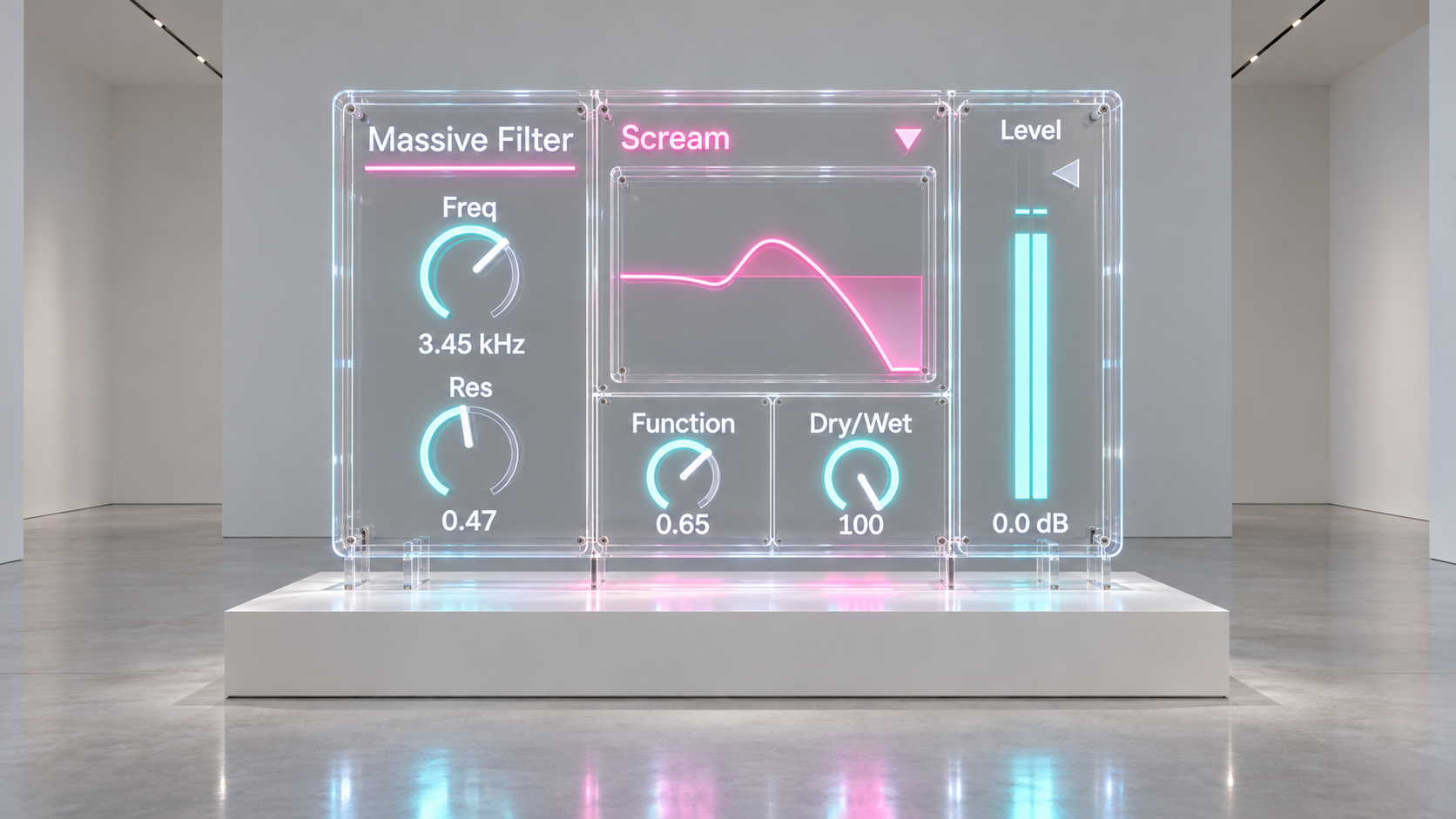
Move from conventional filtering into character models
Massive Filter includes Lowpass2, Lowpass4, Highpass2, Highpass4, Bandpass, Bandreject, Allpass, Double Notch, Scream, Daft, Comb, and Acid.
The conventional models provide familiar filtering roles while preserving the same Frequency and Resonance workflow. Two pole modes offer a more gradual response, while four pole modes use cascaded filter sections for a steeper transition. Bandpass and Bandreject introduce a Function controlled bandwidth dimension, allowing the same central Frequency control to move a narrower or wider region through the spectrum.
The other models move further away from conventional cutoff filtering. Double Notch creates movement through phase cancellation rather than by placing two independent static notches. Comb turns Frequency into a tuned delay reference and uses Resonance for feedback, while Function controls damping inside the feedback path. Acid uses a dedicated nonlinear ladder style model where Frequency and Resonance interact more strongly than in the standard filter branches.
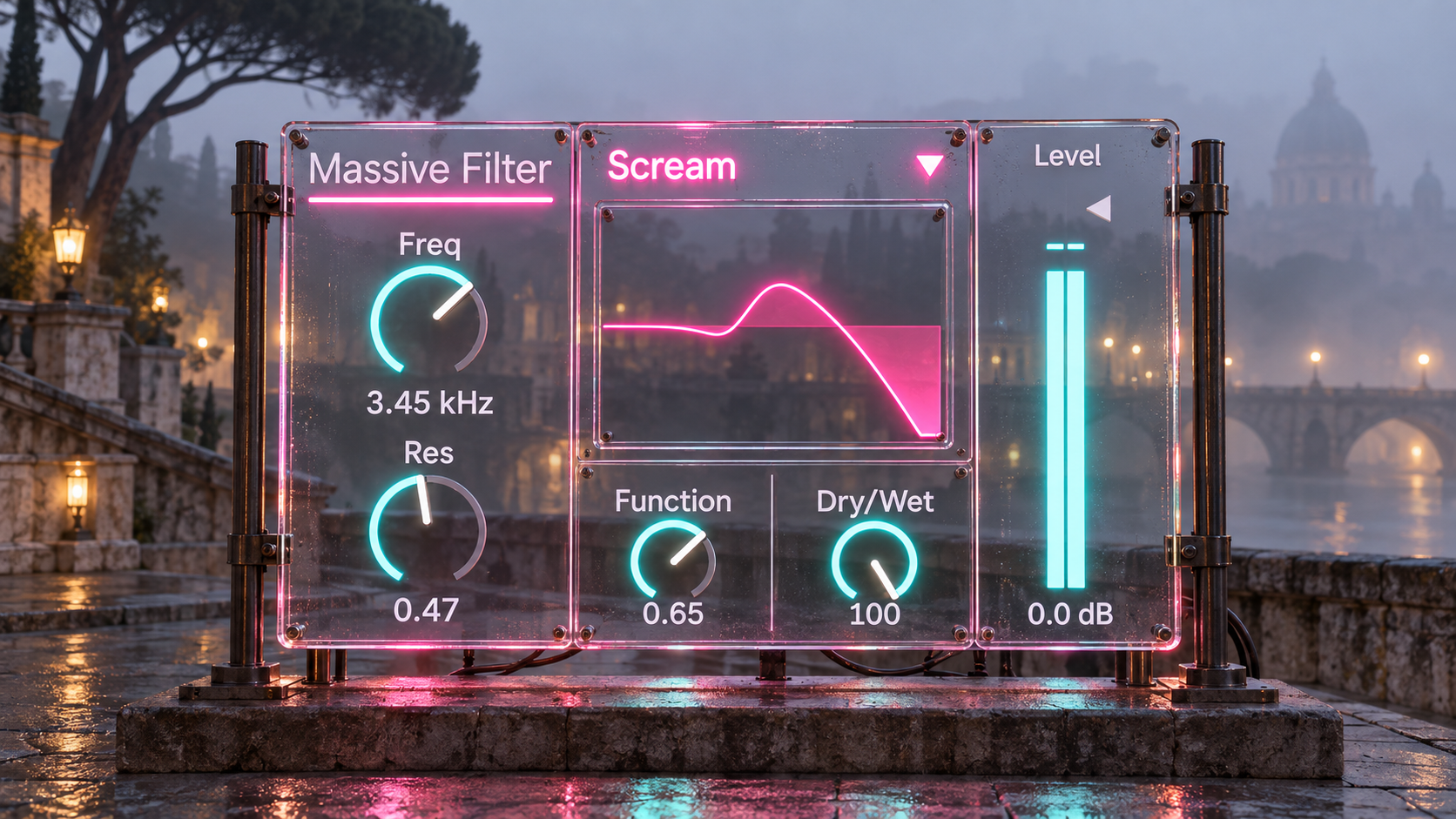
Model as Behavior
Twelve filter models are available. Each represents a distinct internal structure rather than a variation in settings.
- LP2, HP2, BP
Responsive and controlled. Suitable for shaping while preserving motion. - LP4, HP4
Steeper response with a stronger focus on resonance. HP4 removes low frequencies with precision while keeping the upper spectrum active. - Notch, Double Notch
Phase interaction becomes audible. Double Notch introduces a movable spectral gap that can be tuned for rhythmic or tonal modulation. - Allpass
No amplitude change, only phase rotation. Useful for altering spatial perception and transient alignment. - Scream
A feedback driven mode that produces aggressive harmonic content. Known for its vocal, almost shouting character. - Daft
A saturated lowpass response. Thick, compressed, and forward in presence. - Comb
Feedback delay behavior integrated into the filter. Metallic, resonant, and highly sensitive to input timing. - Acid
A nonlinear filter model derived from the filter section of the Roland TB-303, reconstructed as an independent system.
Its response is shaped by feedback and asymmetric saturation, producing a fluid and continuously shifting tone. Resonance interacts with the input signal, creating motion that remains controlled while retaining instability.
These models do not behave as presets. Each one changes how the signal evolves over time.
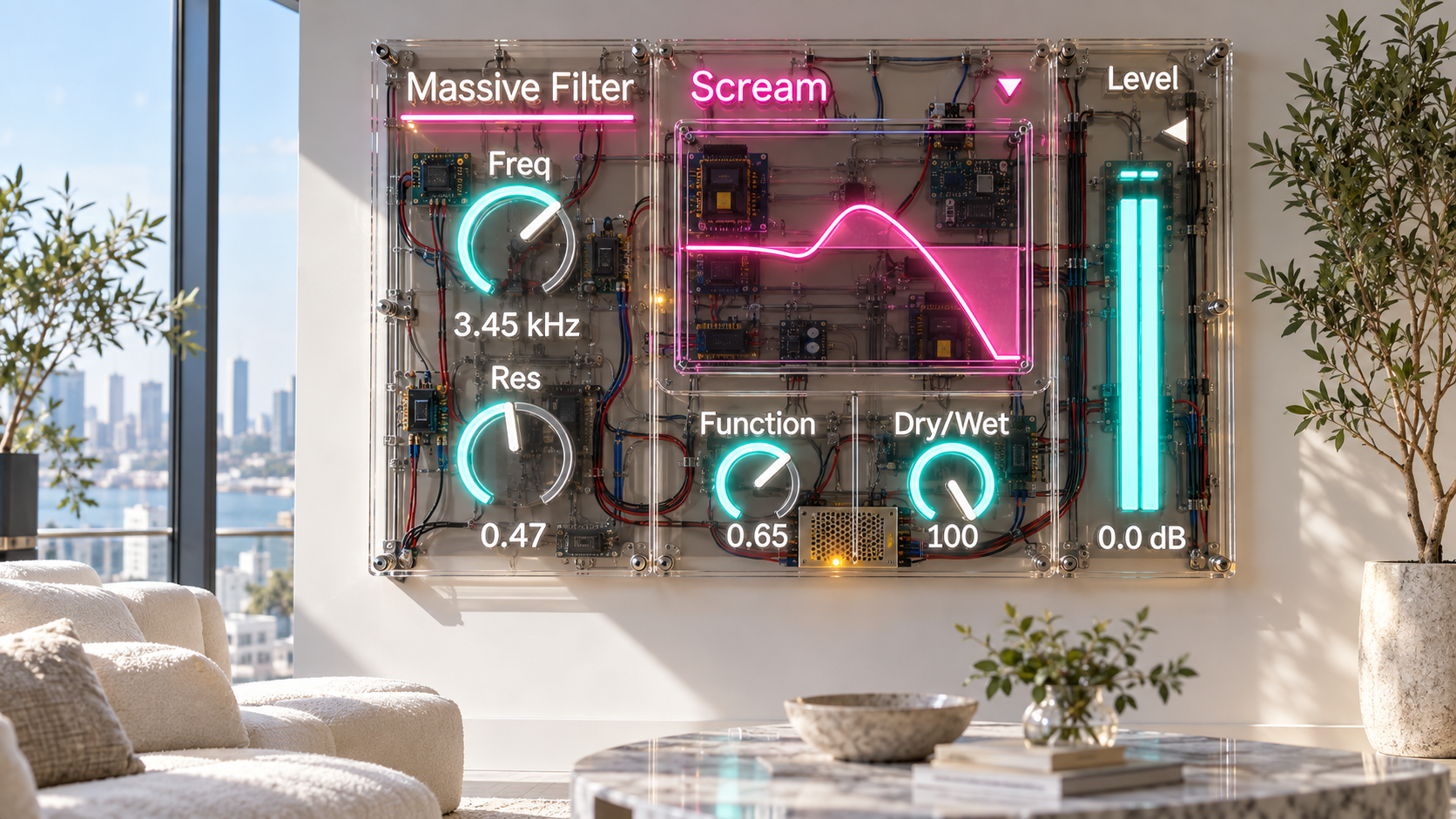
Scream adds another feedback dimension
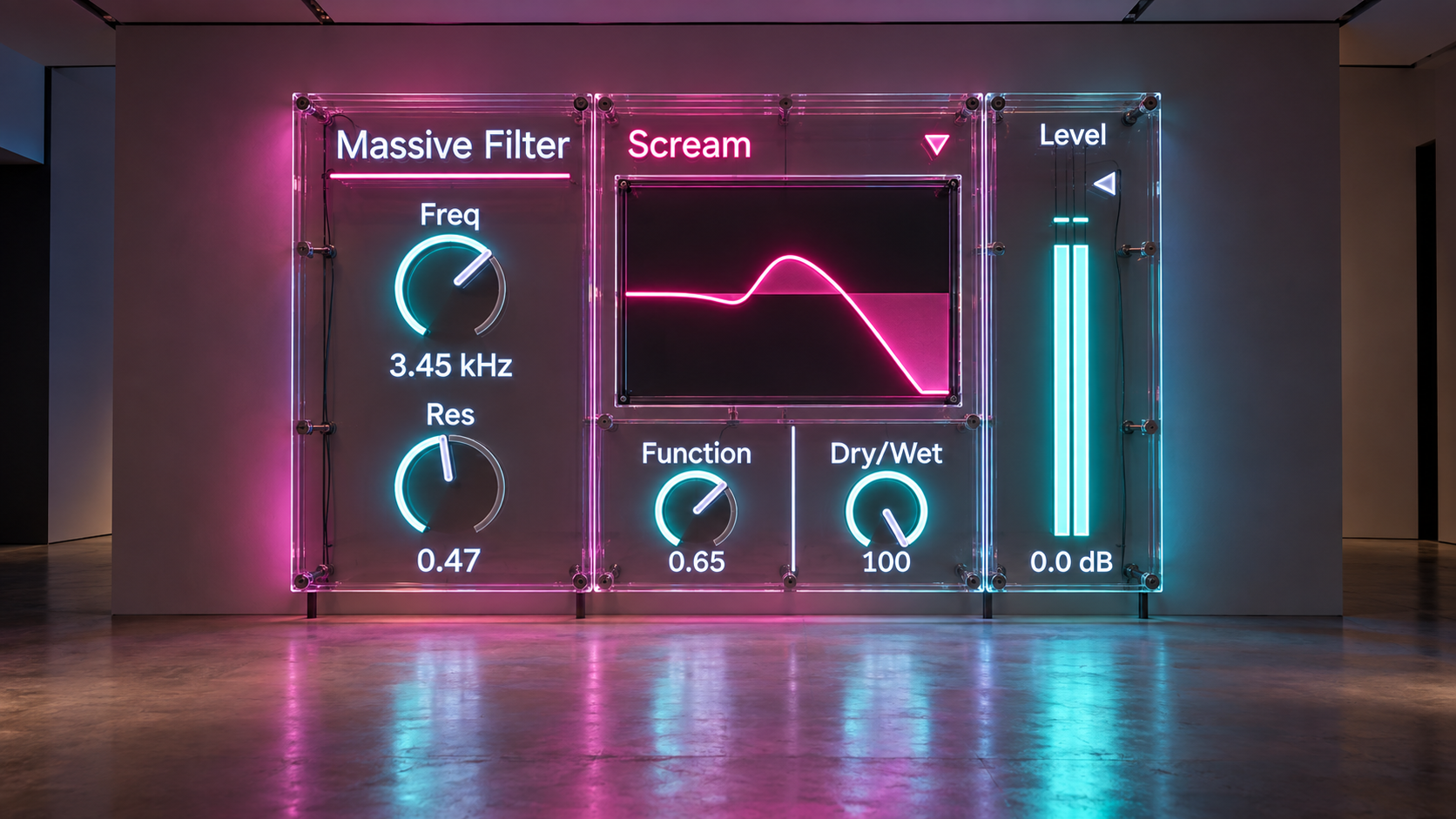
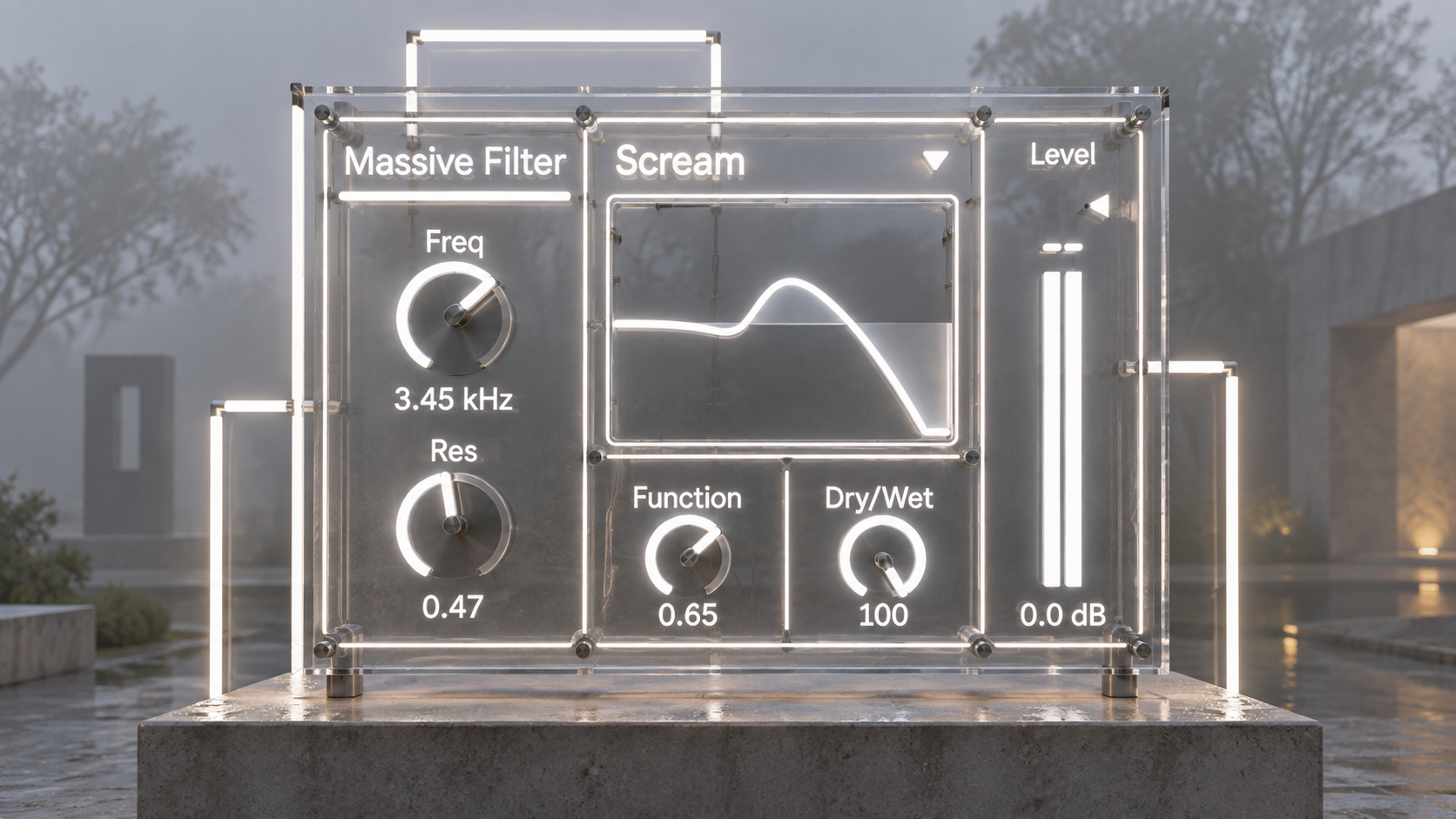
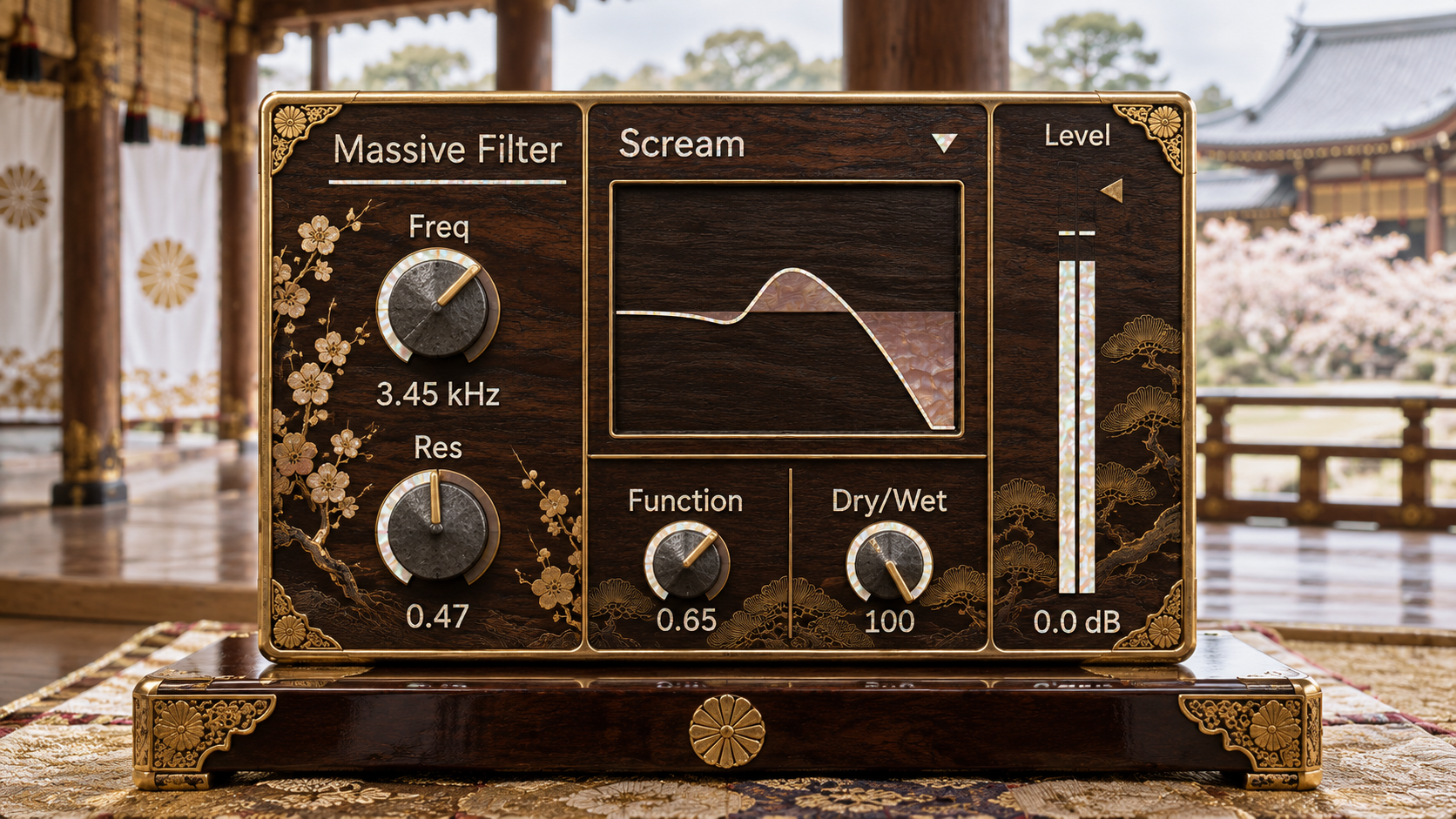
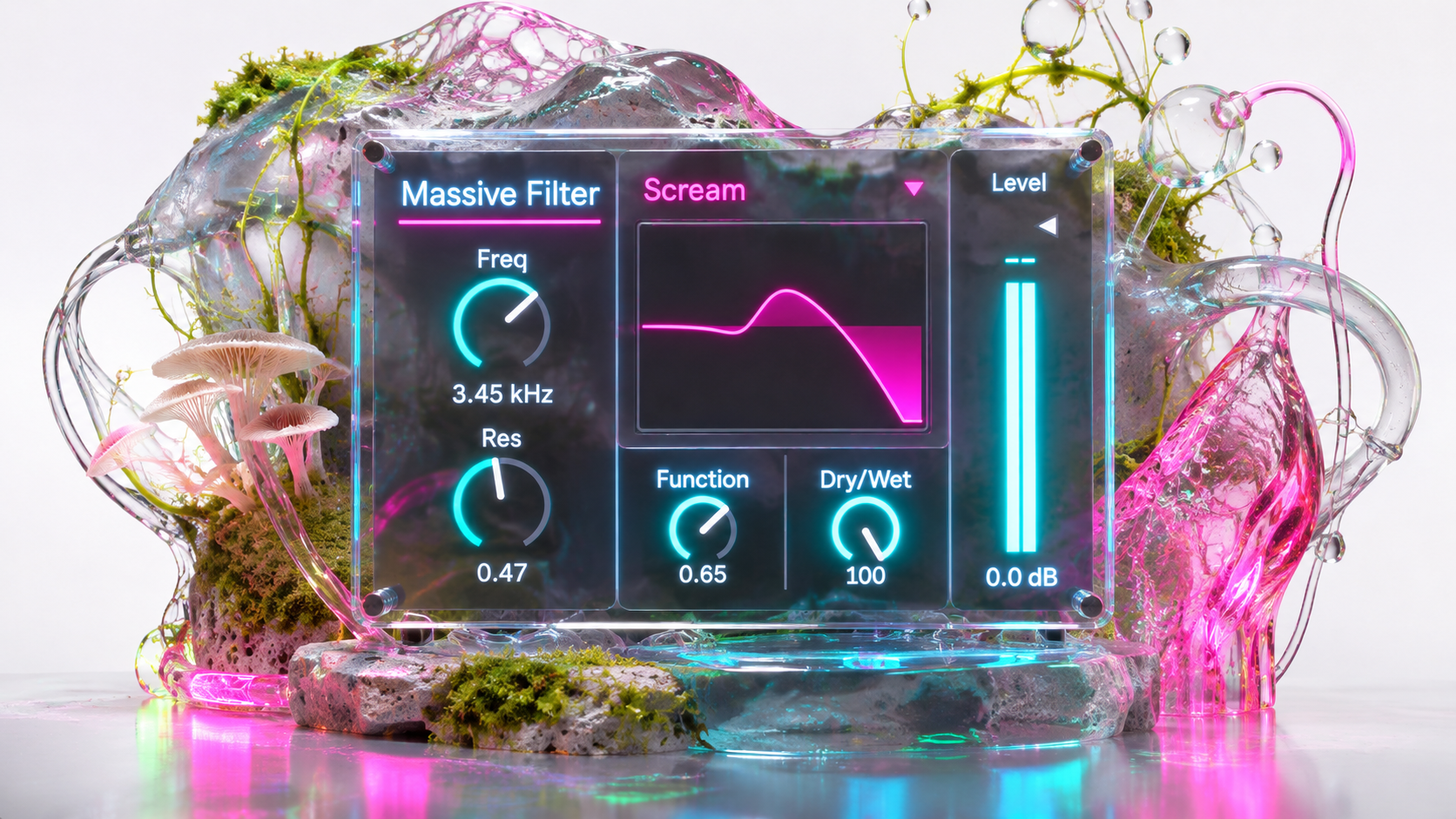
Scream is built around nonlinear processing and an additional internal feedback path. Resonance establishes the main resonant behavior, while Function directly controls the amount of added internal feedback.
This makes Function more than a generic variation control. At lower values, Scream can remain closer to a resonant filter with added color. Increasing Function pushes more energy through the nonlinear feedback path, creating a stronger and more aggressive response. If the result becomes too dominant, Function can be reduced independently before changing the main Resonance setting.
Dry/Wet can then bring that character back underneath the original signal, which makes extreme Scream settings usable as a parallel layer rather than requiring the entire source to pass through the strongest processing.
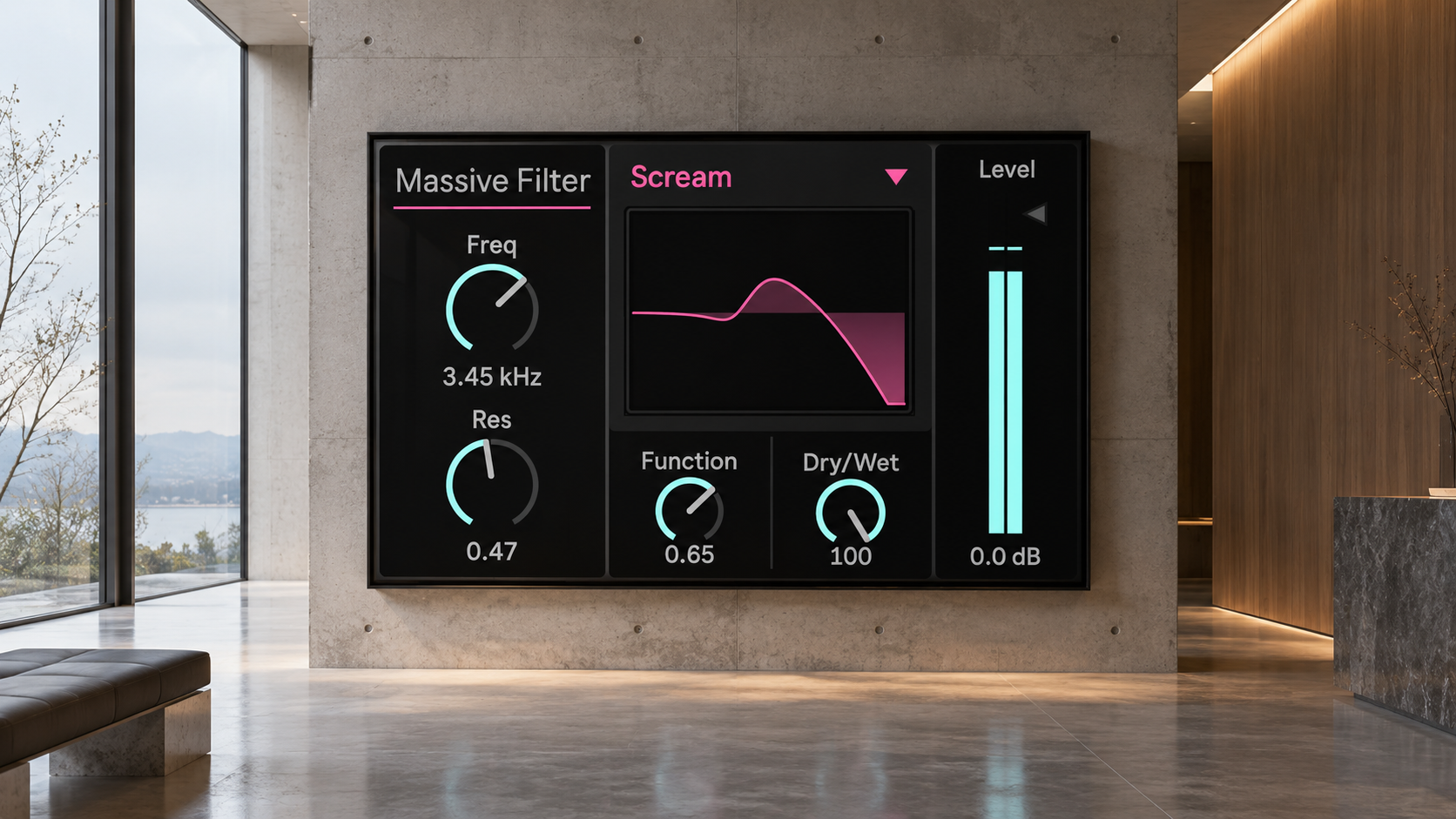
Function changes meaning only when the model needs it
Massive Filter deliberately avoids forcing every model to use every control.
Function is active for Bandpass, Bandreject, Scream, and Comb because those models each define a clear third behavior. In Bandpass and Bandreject it changes bandwidth. In Scream it controls added internal feedback. In Comb it controls damping inside the feedback loop.
For Lowpass2, Lowpass4, Highpass2, Highpass4, Allpass, Double Notch, Daft, and Acid, Function remains inactive.
This keeps the interface compact without inventing arbitrary parameter behavior simply to make every model look identical. Frequency and Resonance remain stable concepts across the device, while Function appears only where the selected algorithm actually has another useful dimension.
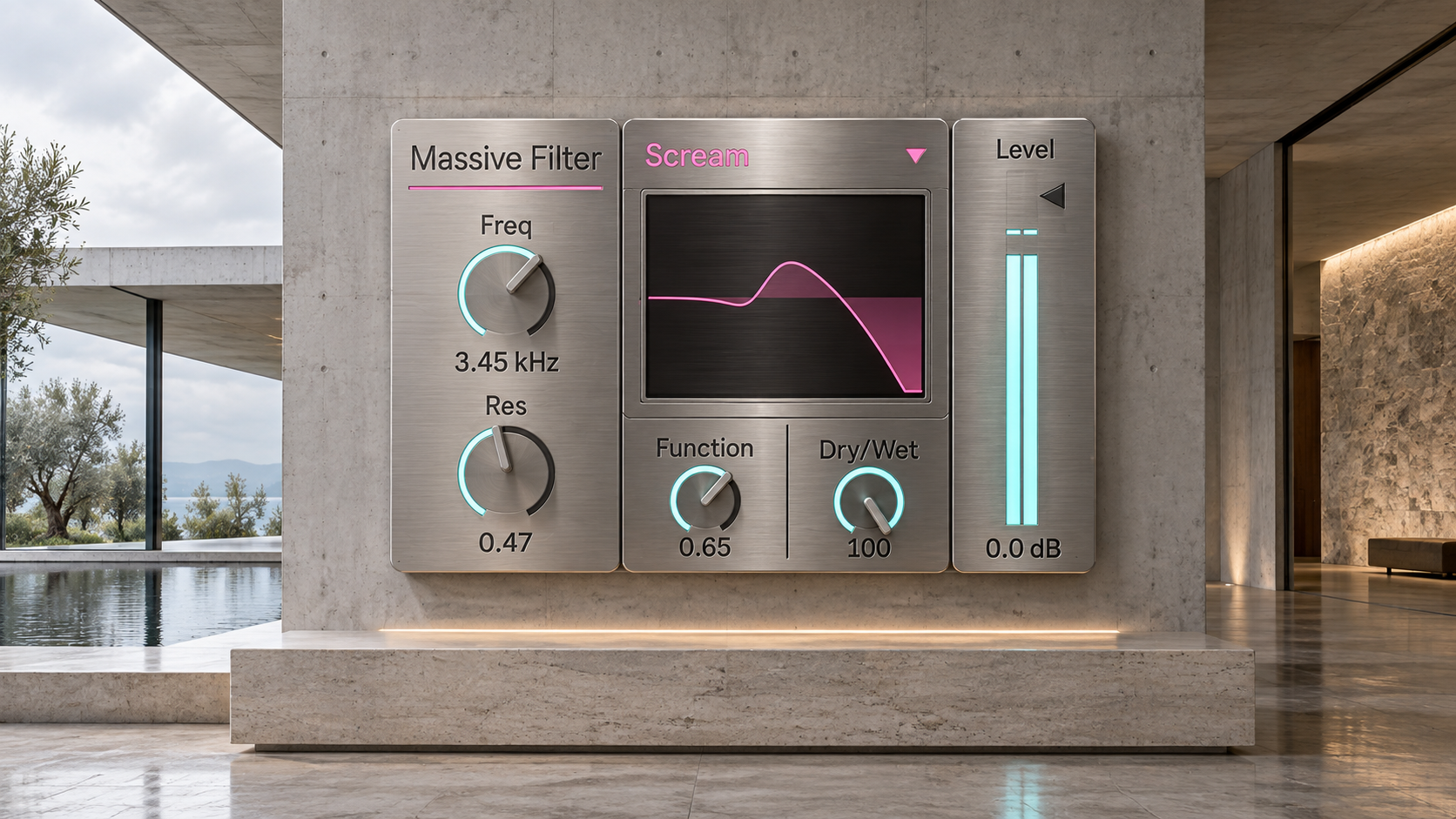
Turn filtering into arrangement movement
Because the same core parameters remain visible while the underlying model changes, Massive Filter works well as an automation device.
A conventional Lowpass2 or Lowpass4 sweep can handle gradual arrangement transitions. Double Notch can create slow phaser like cancellation movement. Comb can turn Frequency automation into shifting tuned resonance. Scream can gradually introduce nonlinear feedback through Function. Acid provides a separate resonant character when a more strongly coupled response is needed.
This allows the role of one device to change throughout a track without replacing it with another filter every time the desired behavior changes.
Filter Model itself can also be automated, but changing models is a real topology change rather than a continuous morph. Internal state is reset when the selected model changes so that resonance, feedback, or delay history from one model does not leak into the next.
Use extreme filters in parallel
Strong resonance and nonlinear feedback can easily become larger than the source around them. Massive Filter places Dry/Wet outside the selected filter model, allowing aggressive processing to be treated as a layer.
A resonant Comb sound can be blended underneath the original transient. Scream can contribute nonlinear motion without completely replacing the dry signal. Acid can add a focused resonant character while preserving some of the original body.
Level is placed after this blend, giving a final gain stage for matching the result before it reaches the next device in the Live chain.
See both the response and the resulting spectrum
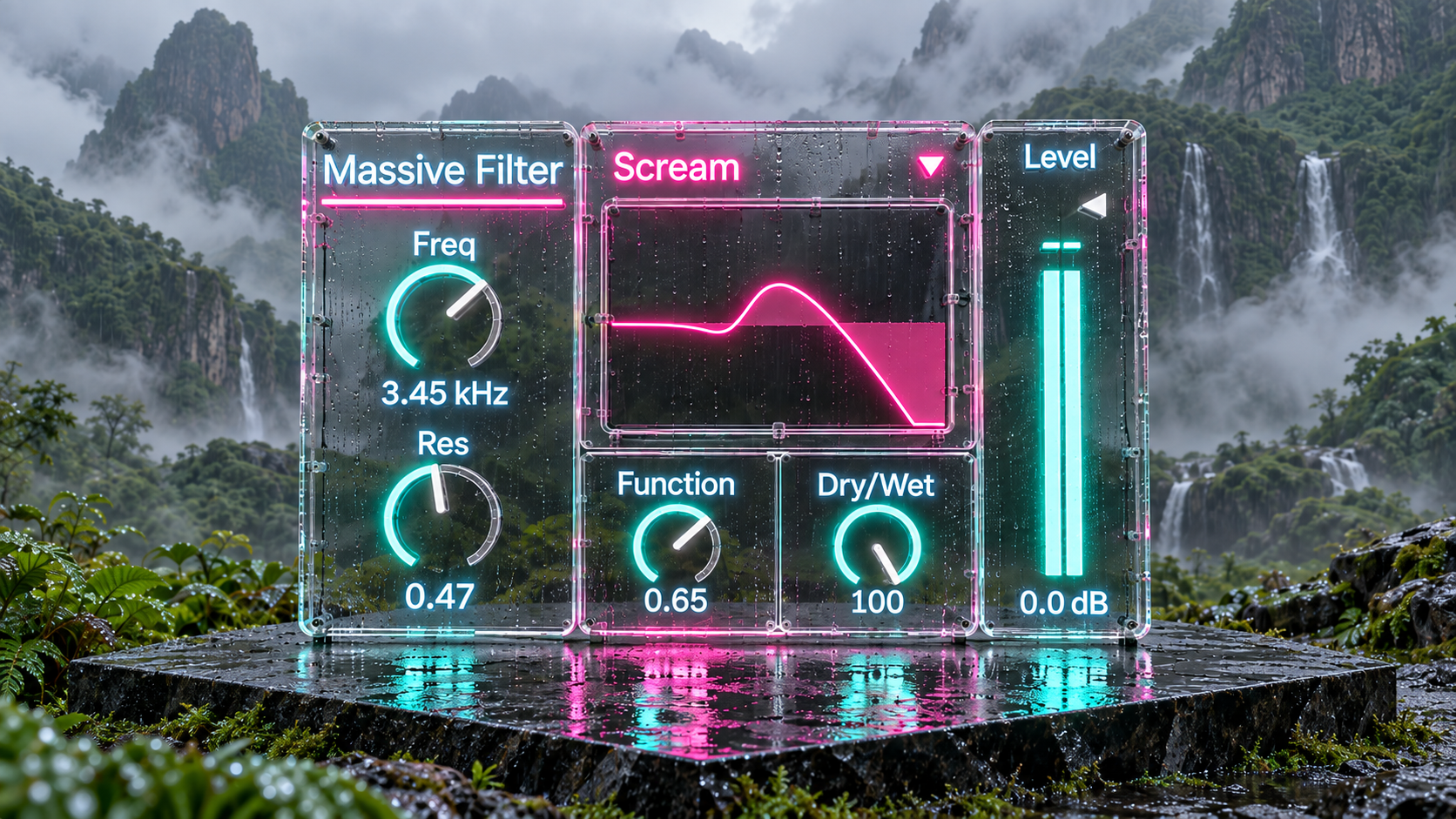
Massive Filter includes two different visual references.
The response display reflects the selected model and the current parameter state, giving a visual indication of how Frequency, Resonance, and Function are shaping the model. A separate spectrum display analyzes the processed output, allowing the filter state and the resulting signal to be viewed as two different kinds of information.
The displays remain separate from parameter authority. The native Ableton Live controls continue to own automation and saved state, while the visual layers provide feedback without creating a second parameter system.
Internally oversampled processing
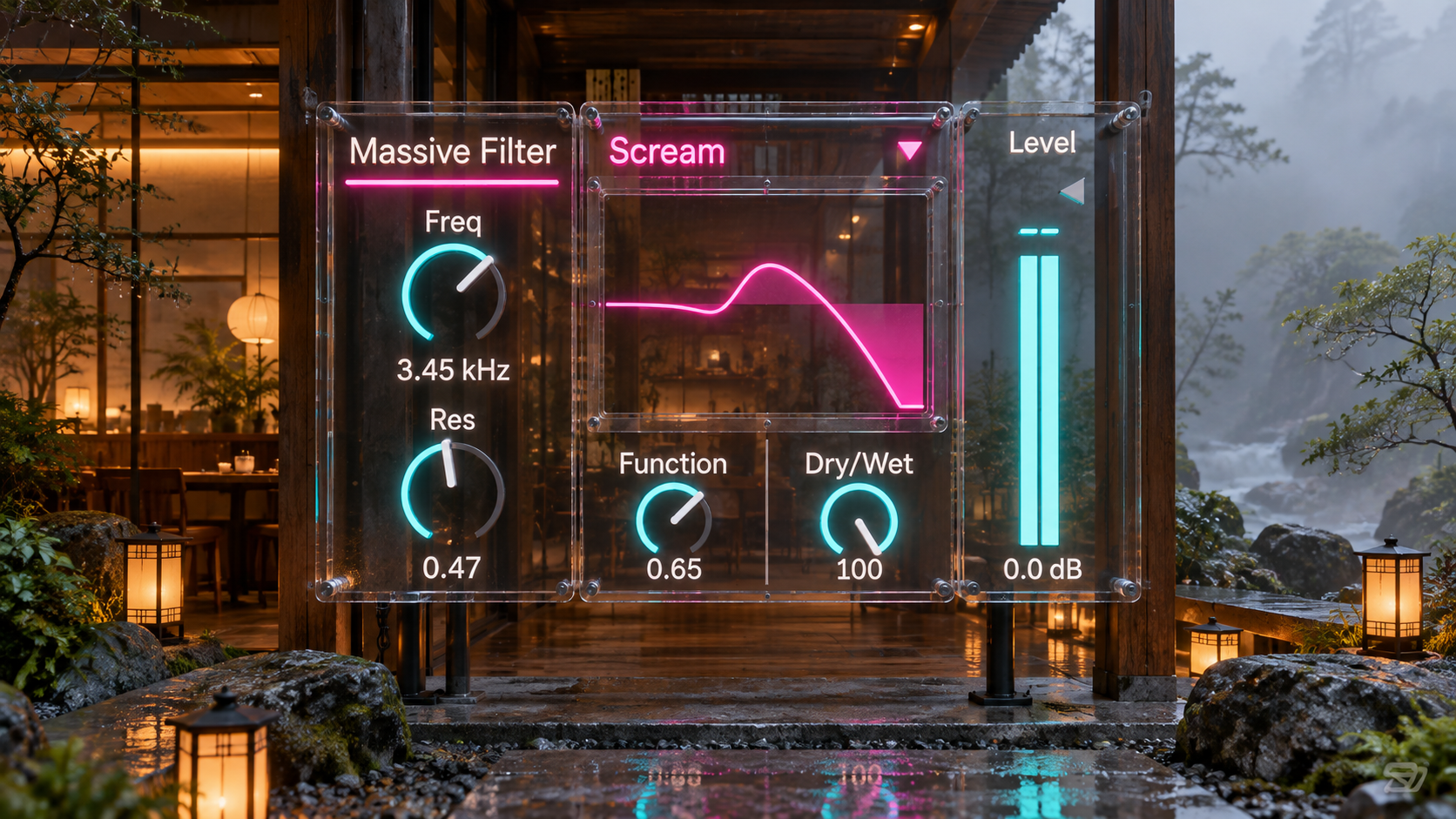
The filter core runs through an internal 8x processing wrapper. The nonlinear and model specific DSP therefore operates at a higher internal processing rate while the public interface remains unchanged.
This is an implementation characteristic rather than a claim of automatic superiority over other filter designs. The purpose is to keep the additional DSP structure inside the device instead of exposing technical processing controls to the user.
The creative surface remains simple: select the model, set Frequency and Resonance, use Function where it becomes available, then decide how much of the result belongs in the mix.
A filter for both utility and character
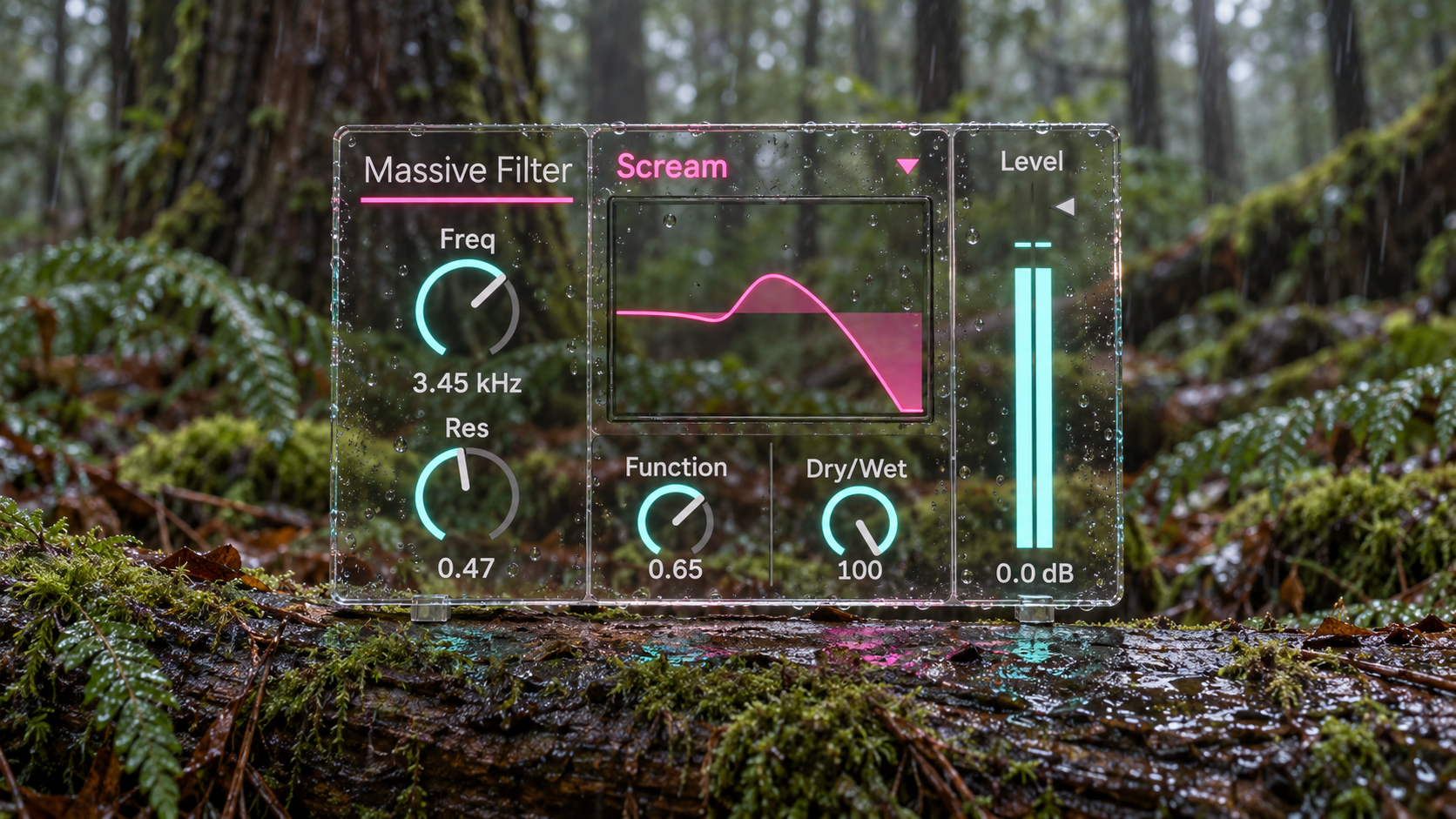
Massive Filter can function as a straightforward arrangement filter, but its larger purpose is to make different filtering behaviors accessible without changing the basic workflow.
Use Lowpass or Highpass when the task is conventional spectral control. Use Bandpass or Bandreject when bandwidth itself should become part of the automation. Use Double Notch for moving cancellation. Use Comb for tuned resonance. Use Scream when nonlinear feedback should become part of the gesture. Use Acid when a dedicated nonlinear ladder style response is more appropriate.
The device keeps those choices inside one consistent surface so the creative decision can remain focused on how the filter should behave rather than on rebuilding the processing chain.
Built for Ableton Live
Massive Filter v2.0 is a Max for Live stereo audio effect targeting Ableton Live 12 with Max 9. The final device exposes six native Live parameters and includes response and spectrum visualization alongside its twelve selectable filter models.
Massive Filter is an independent product. It is not an official Native Instruments product, and the twelve models should not be interpreted as a claim of exact sonic identity with NI MASSIVE.
Free lifetime updates
Your purchase includes free lifetime updates. Future published versions of Massive Filter are included at no additional cost. Existing users can access the latest published files through the Sellfy account used for the original purchase, so there is no need to purchase the product again when a new version is released.
Filters & Resonators
XY-Plane Filter https://akihikomatsumoto.sellfy.store/p/abletonxyplanefilter/
Filter that morphs continuously between spectral states through XY performance control.
Octa Comb https://akihikomatsumoto.sellfy.store/p/ableton-octa-comb/
Multi comb resonator that extracts pitch and harmonic structure from noise and transients.
Growl Filter https://akihikomatsumoto.sellfy.store/p/ableton-growl-filter/
Aggressive filter designed for fast wobble and growl movements in bass music.
Massive Filter https://akihikomatsumoto.sellfy.store/p/ableton-massive-filter/
Sound design filter for large spectral shifts and strongly resonant transformations.
Tetra Comb https://akihikomatsumoto.sellfy.store/p/abletontetracomb/
Four comb filter processor for pitched resonance, metallic tones, and spatial coloration.
Akihiko Matsumoto
Study Site https://akihikomatsumoto.com/study/
Ableton M4L, Serum Preset Store https://akihikomatsumoto.com/download/
Sample Pack https://akihikomatsumoto.sellfy.store/sample-pack/
Bandcamp https://akihikomatsumoto.bandcamp.com
Ableton Skin https://akihikomatsumoto.sellfy.store/p/ableton-skin-pack/
Spotify https://open.spotify.com/artist/1tZMmxzZbvNu6klyKXa0L1?si=2JZaFeLbREi-UownD8POSg