
$24.99+
Ableton Deep SpringVerb v.5.0 | Physical Modeling Spring Reverb
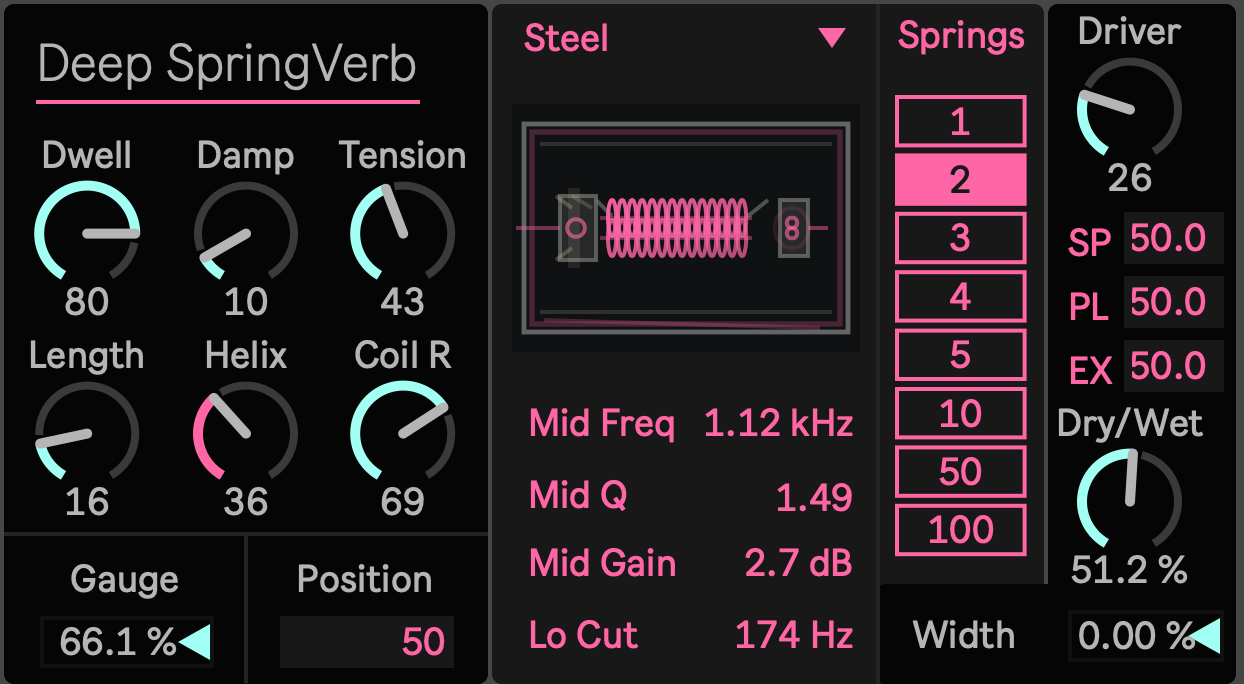
Max for Live Device (.amxd file) : The Physics of Mechanical Reverberation and the Illusion of Space
A spring reverb becomes more interesting when the spring itself is part of the composition. Deep SpringVerb starts from that idea. Instead of asking you to choose a generic room and then adjust a decay time, it lets you shape how a modeled spring system holds energy, changes density, responds to excitation, and returns to the mix.
That makes the effect useful when a conventional reverb feels too finished before you have touched it. A dry drum hit can gain a narrow metallic afterimage, a synth can open into a moving tail, and a small fragment of audio can become a sustained layer that keeps evolving after the original sound has stopped. The goal is not to imitate one familiar tank. It is to make spring behavior playable inside an Ableton Live session.
Shape one response from several connected decisions
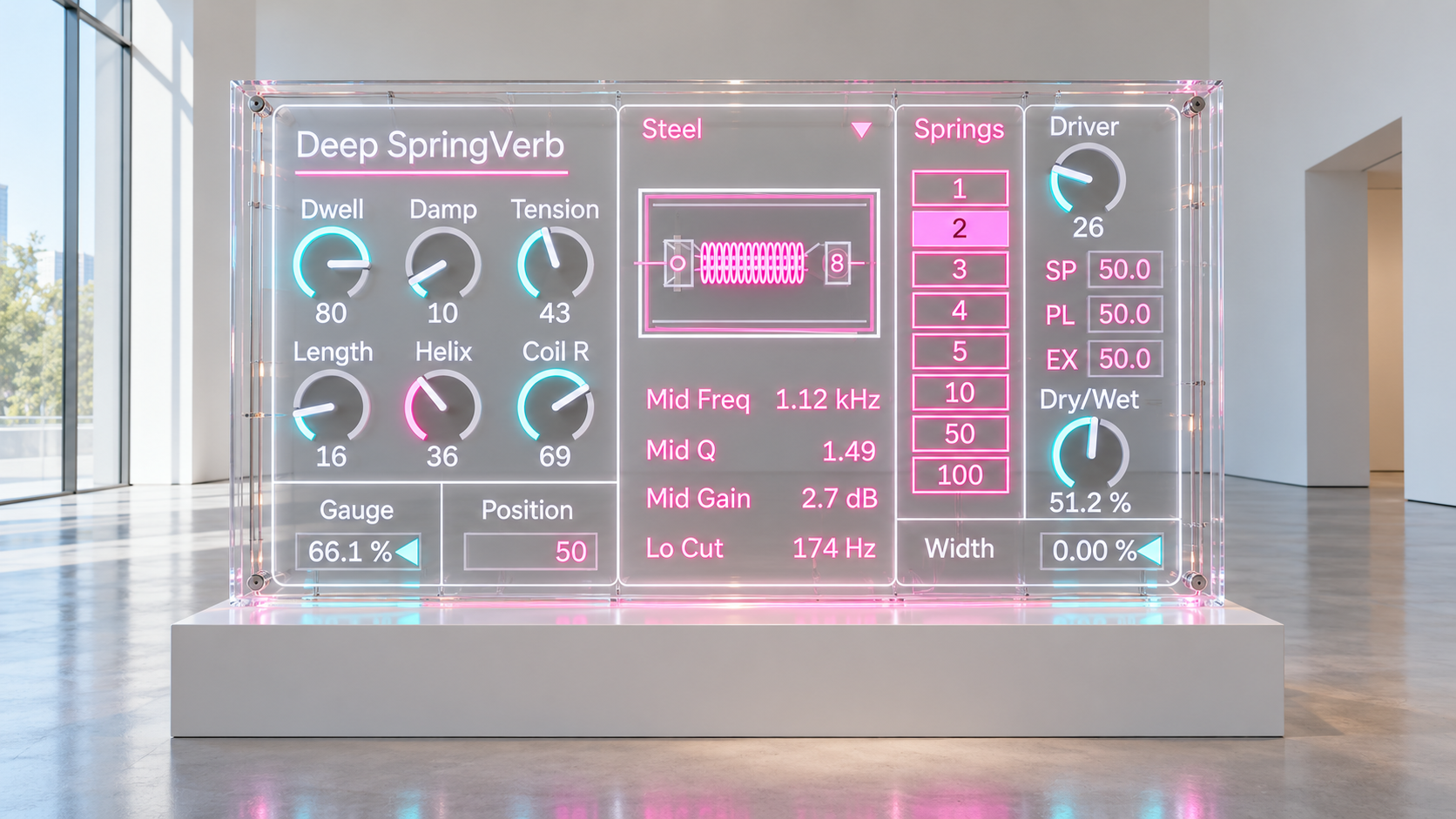
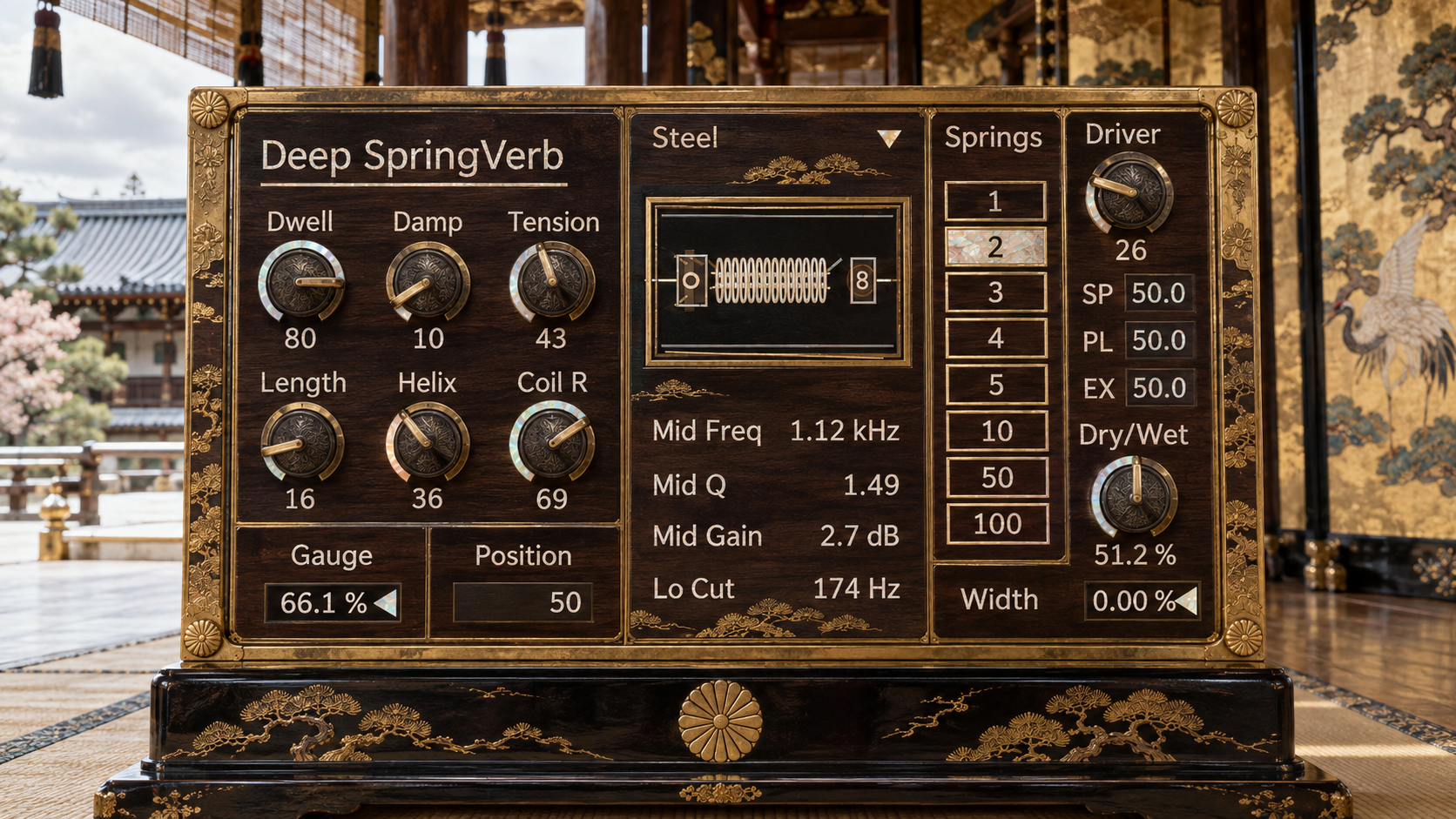
Dwell and Damp establish how long energy remains in the response and how quickly that energy is absorbed. Tension and the geometry controls then change how the spring behaves around that energy, so the tail can feel tighter, more dispersed, more restless, or more settled without reducing the decision to a single reverb time. Driver and Pickup complete the relationship by deciding how strongly the source excites the system and how prominently the resulting motion is heard.
These controls are designed to work together rather than as isolated effects. You can keep a tail compact while making its internal movement more apparent, let a stronger excitation push the spring forward without immediately changing the final stereo placement, or establish the physical response first and use Width only after the character is already working. Deep SpringVerb rewards that order because the reverb remains connected to the sound that created it.
Move between sparse springs and denser fields
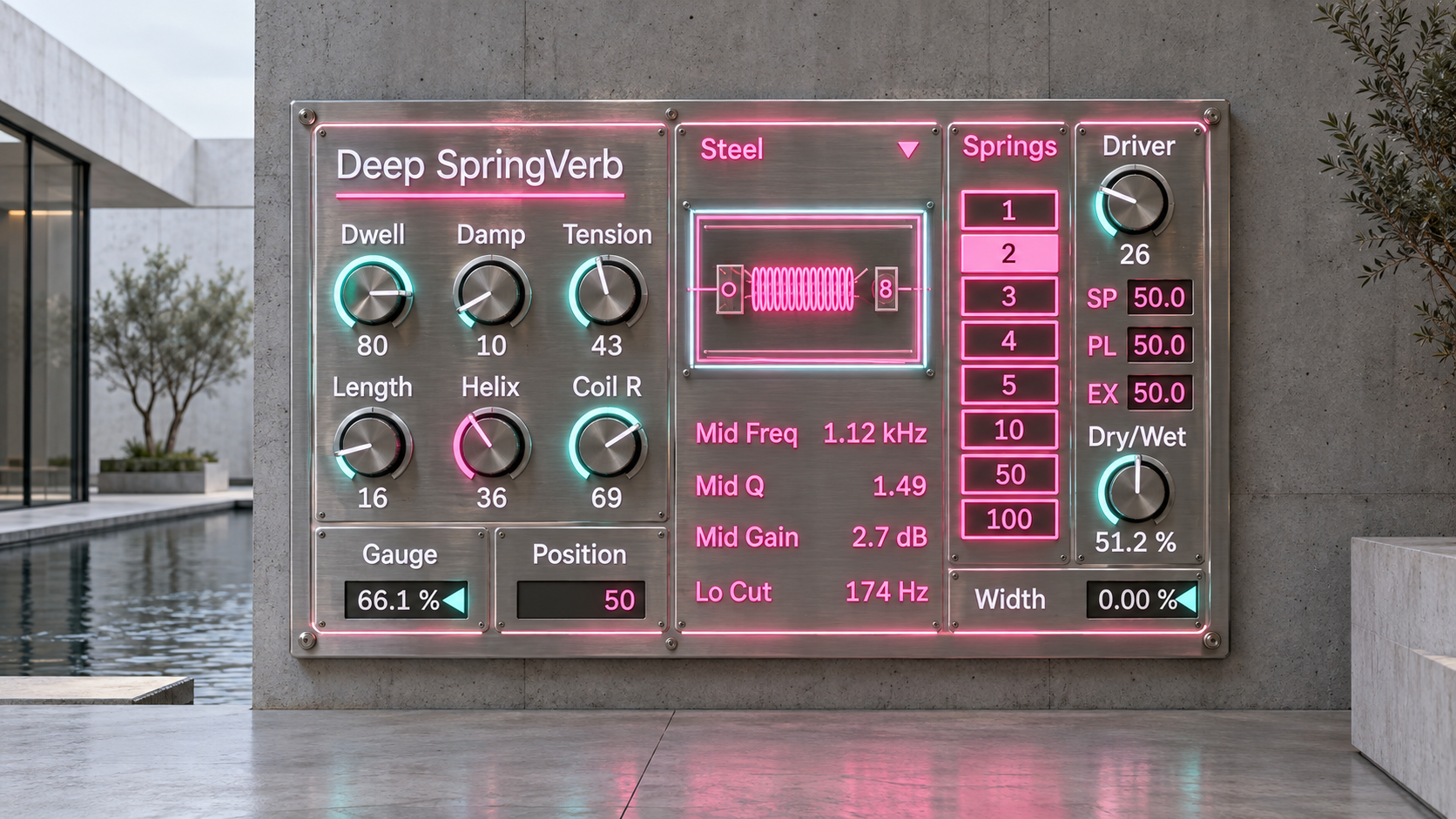
Spring count changes structure, not simply output level. Eight choices move from a single spring toward progressively denser ensemble behavior, with dedicated treatment for the lower counts and a model that compensates the count path around a one spring reference. In practice, this makes Springs useful as a compositional control. Lower settings can keep more individual identity, while higher settings can create a thicker response without intentionally turning the control into a basic gain increase.
Material gives that structural change another dimension. Fifteen choices select different modeled coefficient families, allowing several relationships inside the spring response to change from one decision. The labels are not claims of laboratory replicas of specific alloys. They are a way to make material part of the sound design process, so the same geometry and source can move into a different family of response without rebuilding the device from scratch.
Let the tail participate in the arrangement
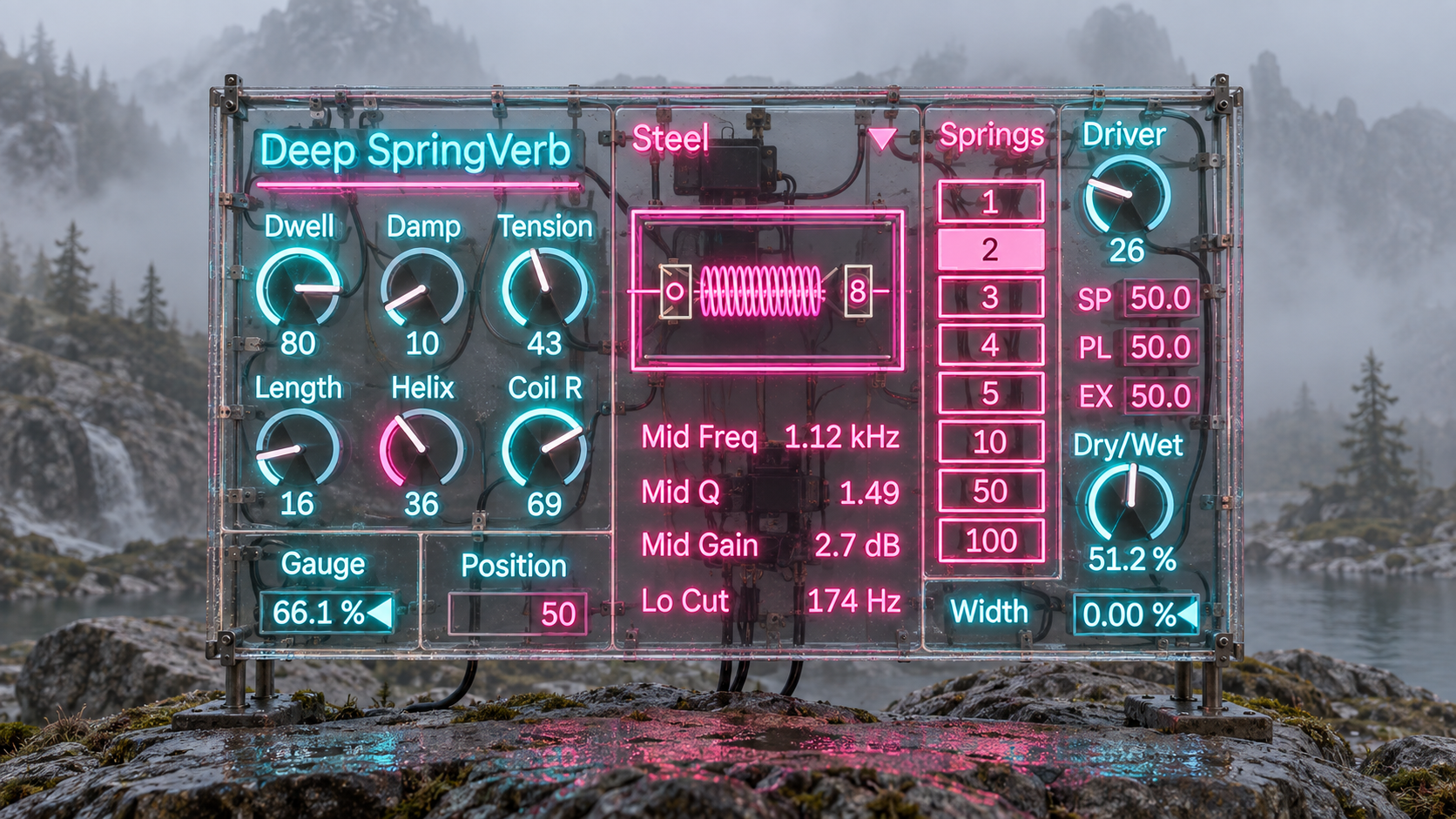
Deep SpringVerb is most useful when the reverb is allowed to do more than sit behind the source. On percussion, Dwell and Damp can turn selected hits into tails that continue through the next moment of the pattern. On sustained material, slow movement in the geometry controls can reshape the response across a phrase. Changing Springs can move a section from a clearer low count texture toward a denser field, while Driver and Pickup can change how assertively the effect reacts to the source.
The finished response can then be placed with Width and the post shaping controls rather than using those controls to create the character from the beginning. Dry/Wet can reach a fully processed position for return style routing when that fits the Live Set. The wet path still contains delay and state, so this is a routing option rather than a zero latency claim.
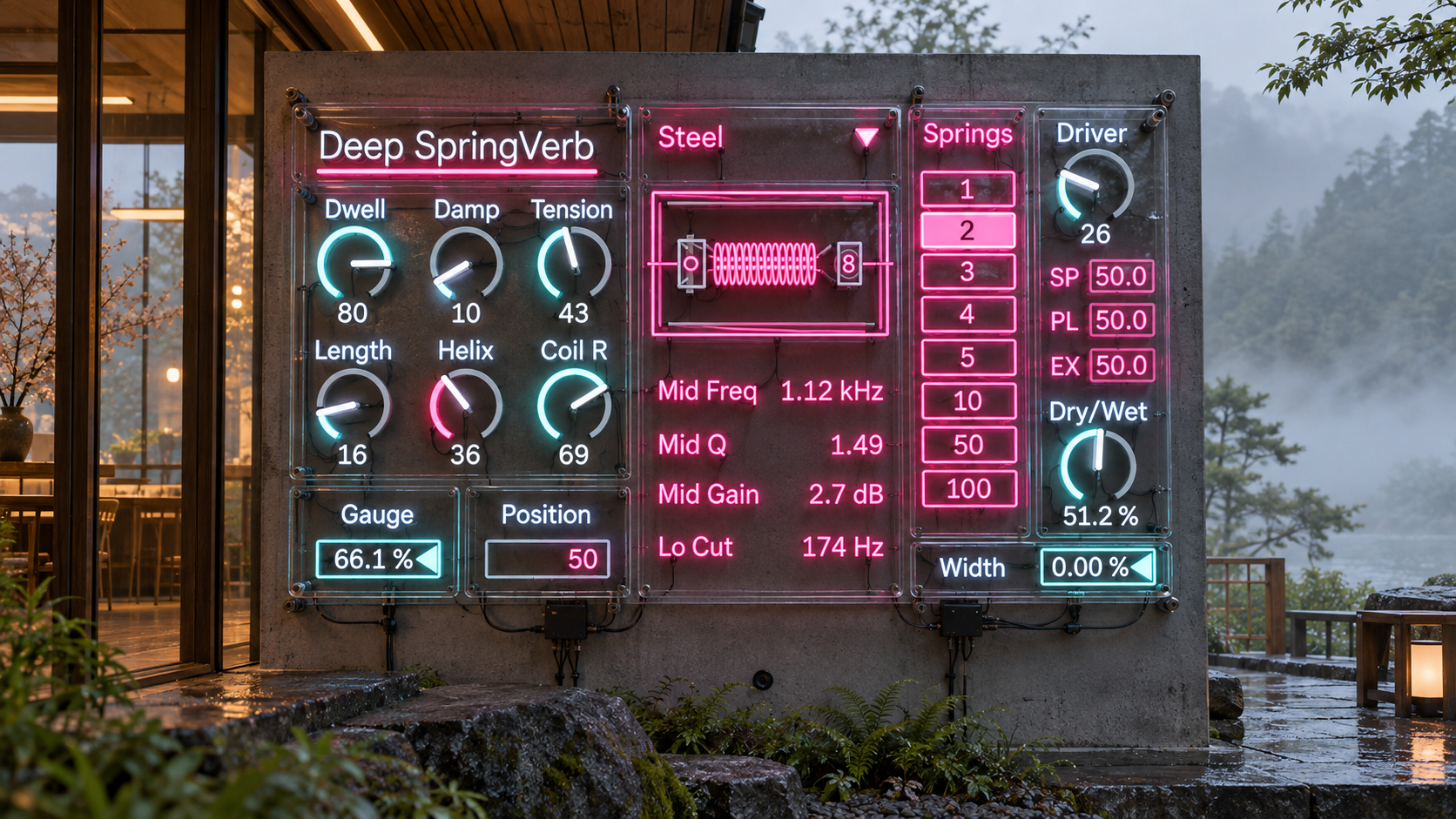
A physically informed spring instrument for Ableton Live
Deep SpringVerb v.5.0 runs in Max for Live as a stereo processor and targets Ableton Live 12 with Max 9. Its public interface exposes 20 Live parameters, but the point is not the number of controls. The useful depth comes from treating persistence, geometry, material, spring count, excitation, observation, stereo placement, and final shaping as parts of one response rather than a row of unrelated features.
The underlying model is reduced order and physically informed. It uses spring related construction variables to shape a bounded DSP system, but it is not presented as an exact simulation of a named hardware tank or a complete physical solver. That boundary keeps the emphasis where it belongs: on making the spring itself a practical sound design surface inside Ableton Live.
Free Lifetime Updates
Your purchase includes free lifetime updates. Future published versions of Deep SpringVerb are included at no additional cost. Existing customers can access the latest available files through the Sellfy account used for the original purchase. No additional purchase is required for future published updates.
v.5.0 ... Finalized direct 15 material routing, low count phase coherence, spring count level normalization against the one spring reference, and the Owner selected final startup state. (2026/9/22)
v.4.0 ... Expanded the physical model with 15 modeled metals and deeper control over spring construction and behavior. (2026/7/11)
v.3.1 ... Improved overall physics modeling fidelity. (2026/5/26)
Reverb & Spatial FX
Shoegazer Reverse Gate https://akihikomatsumoto.sellfy.store/p/abletonshoegazerreversegate/
A reverse gate reverb inspired by classic rack effects for dense shoegaze style spatial textures.
AethelVerb https://akihikomatsumoto.sellfy.store/p/ableton-aethelverb/
A deep bloom reverb for building large, smooth, slowly expanding ambient spaces.
GravityVerb https://akihikomatsumoto.sellfy.store/p/ableton-gravityverb/
A synthetic reverb where the tail appears to sink, float, and move beyond realistic room behavior.
Preset Verb https://akihikomatsumoto.sellfy.store/p/abletonpresetverb/
A preset driven reverb for quickly switching among distinct spatial characters during production.
Feedback Verb https://akihikomatsumoto.sellfy.store/p/ableton-feedback-verb/
A feedback focused reverb that grows from long tails into drones and self sustaining textures.
Deep SpringVerb https://akihikomatsumoto.sellfy.store/p/ableton-deep-springverb/
A physical modeling spring reverb focused on metallic resonance, reflections, and mechanical movement.
Deep PlateVerb https://akihikomatsumoto.sellfy.store/p/ableton-deep-plateverb/
A physical modeling plate reverb for dense diffusion and smooth metallic decay.
HardVerb https://akihikomatsumoto.sellfy.store/p/ableton-hardverb/
An aggressive reverb that combines saturation, wave folding, and dynamics inside the reverb path.
Reverse Verb https://akihikomatsumoto.sellfy.store/p/ableton-reverse-verb/
A real time reverse reverb that creates swelling attacks and inverted spatial motion.
IR Verb https://akihikomatsumoto.sellfy.store/p/ableton-ir-verb/
Algorithmic IR Shaping Reverb
Akihiko Matsumoto
Study Site https://akihikomatsumoto.com/study/
Ableton M4L, Serum Preset Store https://akihikomatsumoto.com/download/
Sample Pack https://akihikomatsumoto.sellfy.store/sample-pack/
Bandcamp https://akihikomatsumoto.bandcamp.com
Ableton Skin https://akihikomatsumoto.sellfy.store/p/ableton-skin-pack/
Spotify https://open.spotify.com/artist/1tZMmxzZbvNu6klyKXa0L1?si=2JZaFeLbREi-UownD8POSg