
$24.99+
Ableton IR Verb | Algorithmic IR Shaping Reverb
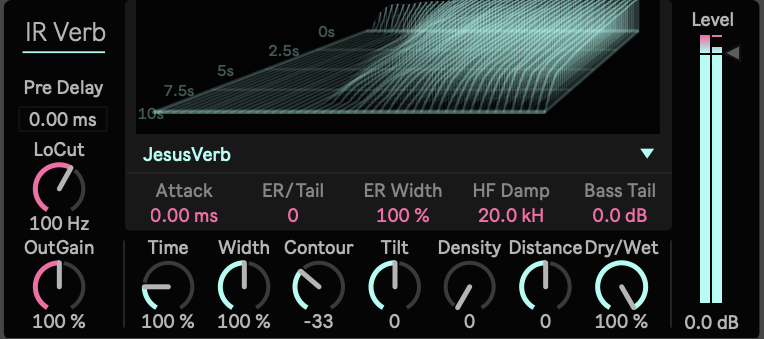
Convolution Reverb with Algorithmic Freedom
Convolution reverb is usually built around a compromise. You gain the complex character of a captured impulse response, but much of the sound has already been decided for you. The room, the distance, the density, and the way the response develops are contained inside the IR you loaded. If you want a fundamentally different result, the usual answer is to choose another response.
Algorithmic reverb creates a very different relationship with sound. Instead of searching for the right recording, you shape the reverb itself until it becomes the space you want.
IR Verb was created to bring that freedom into convolution.
It begins with impulse responses, but it does not treat them as finished spaces that should simply be reproduced. The IR becomes raw material. Once it is loaded, you can keep shaping the response with the kind of creative intent normally associated with an algorithmic reverb. The deeper you work, the less important the original identity of the IR becomes. What matters is the reverb you are creating from it.
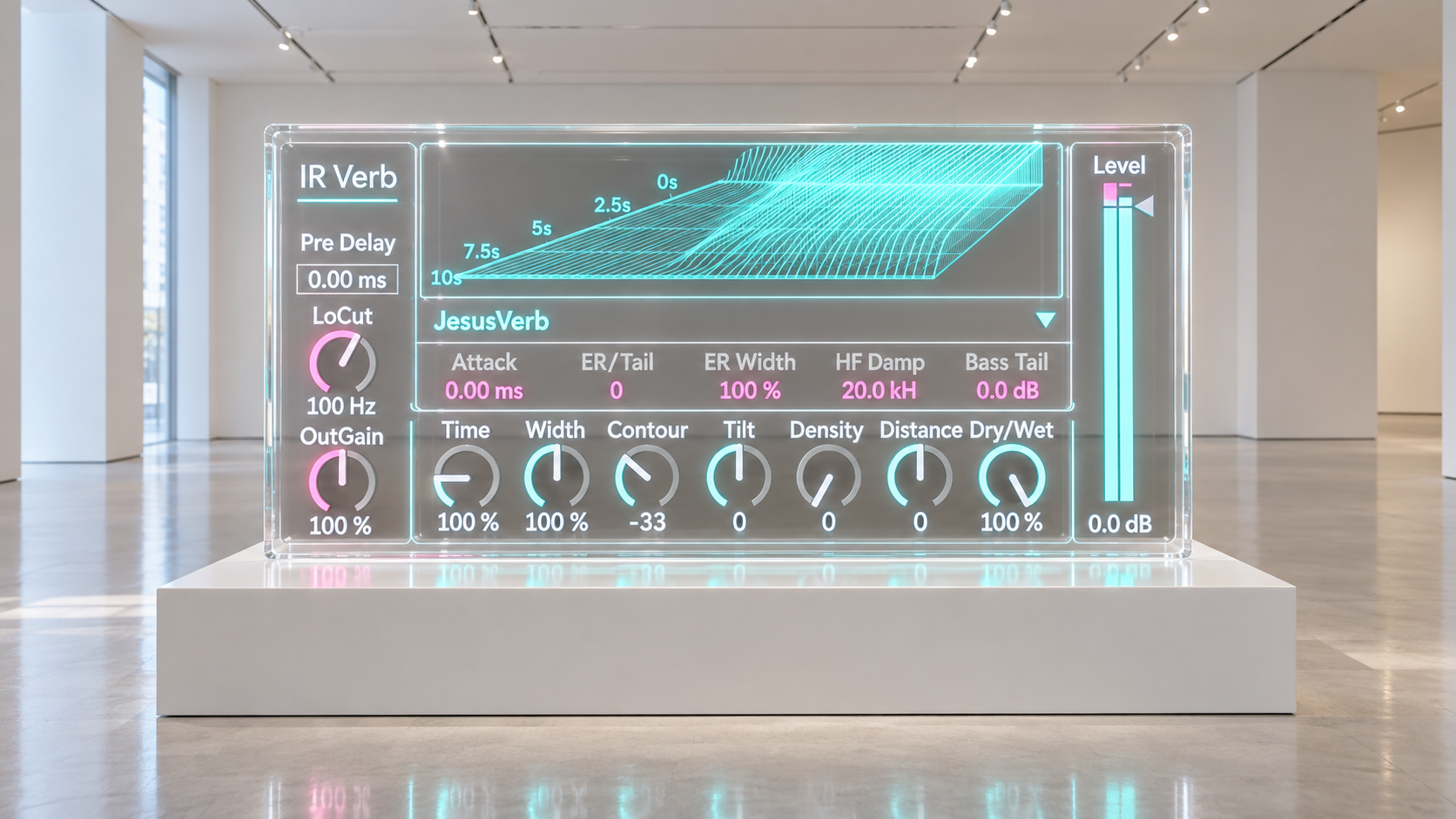
Forget which IR you started with
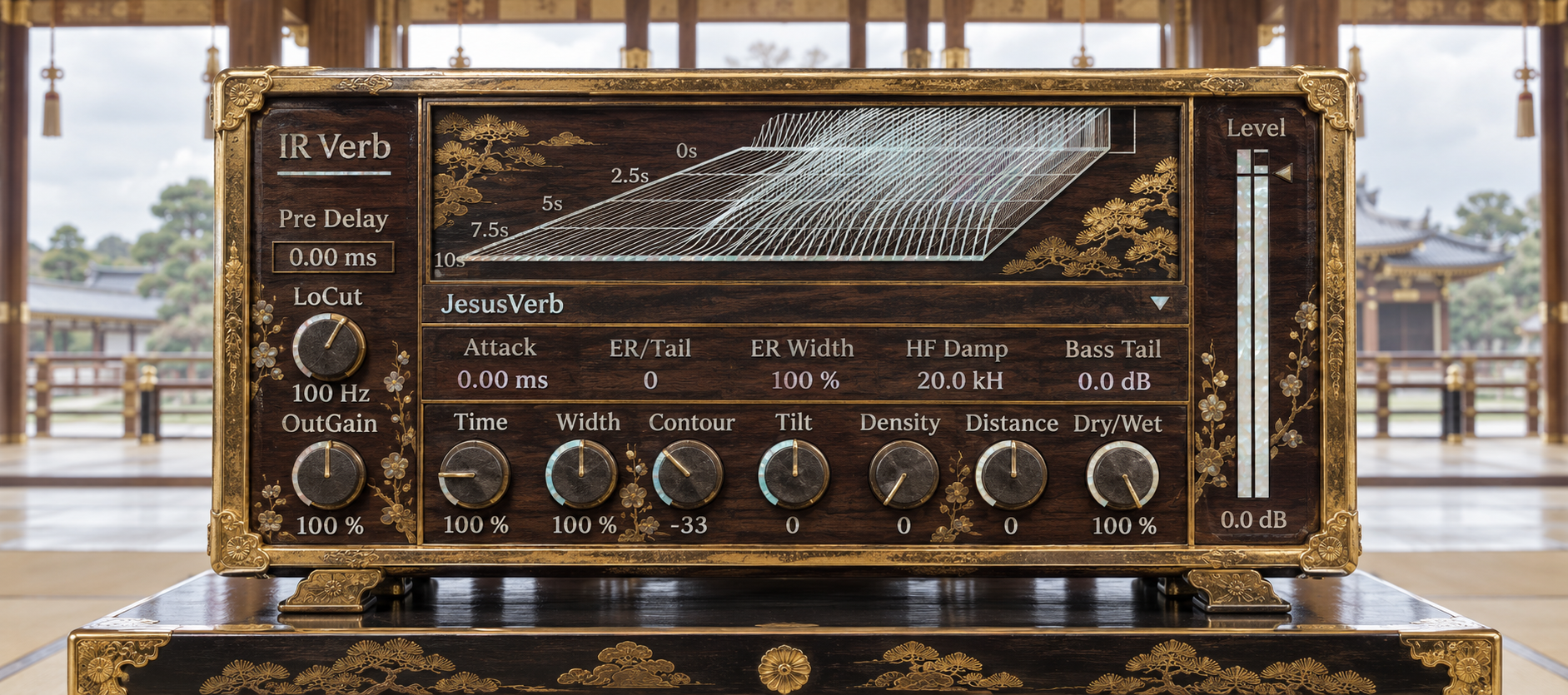
IR Verb includes 23 selectable factory presets, but preset selection is deliberately only the beginning of the process. The device gives you 18 user parameters for continuing to transform the response after you have found a useful starting point.
This changes the way convolution works in a session. Instead of moving through an IR library until one file happens to contain the exact space you need, you can choose a response for its potential and then push it somewhere else.
Distance and Density are good examples of that philosophy. Distance is concerned with the perceptual relationship between near and far, while Density brings multiple internal diffusion mechanisms together into one musical control. They are not there to document the properties of an IR. They are there to make the response behave like something you are actively designing.
The important distinction is that IR Verb does not ask you to remain faithful to the captured space. A factory response can begin as recognizable acoustic material and end as something that no longer feels like the reproduction of a particular room at all. The IR provides complexity, texture, and structure, but the finished reverb is determined by what you do with it.
That is the point where IR Verb starts to feel closer to an instrument than an IR player.
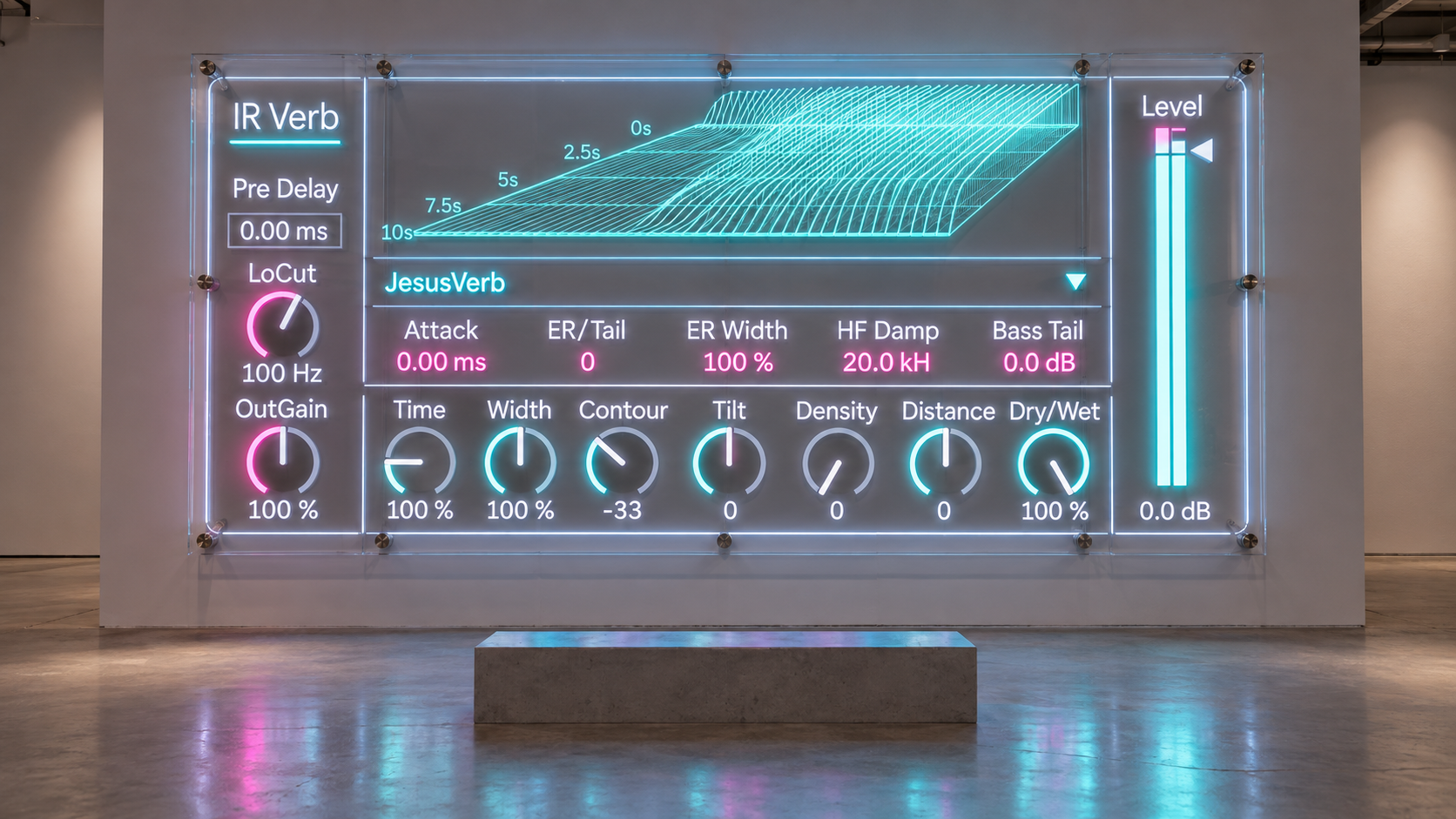
Convolution becomes a sound design method
This freedom is not created by placing a conventional effects chain after a fixed convolution reverb. The creative shaping happens to the response itself before stereo convolution.
The transformed response is rendered into all four paths of the stereo convolution matrix, and that transformed material is what produces the resulting reverb. The sound therefore remains fundamentally convolution based, even when the response has been pushed far away from its original form.
This is what gives IR Verb its particular character. You can work with the richness and irregularity that make impulse responses compelling, without accepting the usual idea that the captured response must remain largely intact.
In practice, the distinction between convolution and algorithmic reverb becomes less useful. You are no longer thinking primarily about reproducing an existing acoustic space. You are deciding what kind of reverb the track needs, then using an impulse response as the material from which that reverb is built.
A subtle acoustic response can remain subtle. It can also become the starting point for something much more artificial. The important thing is that you are not limited to choosing between preexisting rooms. The space itself becomes part of the sound design.
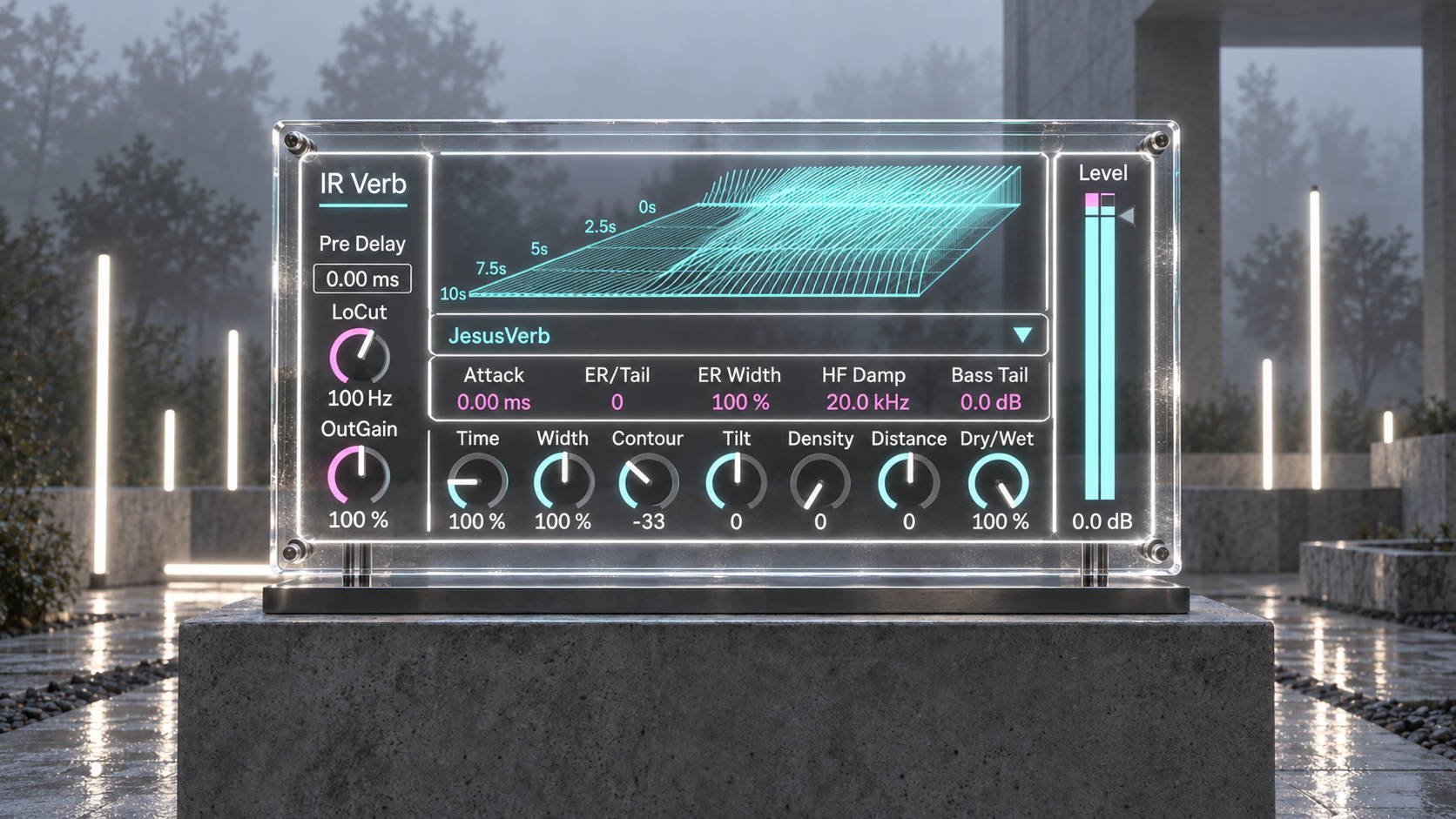
The IR is the source, not the destination
That is the central idea behind IR Verb.
An impulse response gives you an extraordinarily detailed starting structure, but it does not have to dictate the finished sound.
IR Verb keeps the convolution architecture while giving you enough control to stop treating the IR as a fixed destination. After a while, the question is no longer which impulse response you loaded. The question is simply whether the reverb sounds right.
If conventional convolution feels too dependent on the source IR, but you still want the depth and complexity that convolution can provide, IR Verb is designed for that territory.
It is convolution reverb with the expectation that you will reshape it.
Enough that you can forget it started as an IR.
Availability and Lifetime Updates
IR Verb 1.0.1 is the current release in .amxd format.
Your purchase includes free lifetime updates. Future published updates for IR Verb are included at no additional cost. Existing customers can access the latest available files through the Sellfy account used for the original purchase.
Reverb & Spatial FX
Shoegazer Reverse Gate https://akihikomatsumoto.sellfy.store/p/abletonshoegazerreversegate/
A reverse gate reverb inspired by classic rack effects for dense shoegaze style spatial textures.
AethelVerb https://akihikomatsumoto.sellfy.store/p/ableton-aethelverb/
A deep bloom reverb for building large, smooth, slowly expanding ambient spaces.
GravityVerb https://akihikomatsumoto.sellfy.store/p/ableton-gravityverb/
A synthetic reverb where the tail appears to sink, float, and move beyond realistic room behavior.
Preset Verb https://akihikomatsumoto.sellfy.store/p/abletonpresetverb/
A preset driven reverb for quickly switching among distinct spatial characters during production.
Feedback Verb https://akihikomatsumoto.sellfy.store/p/ableton-feedback-verb/
A feedback focused reverb that grows from long tails into drones and self sustaining textures.
Deep SpringVerb https://akihikomatsumoto.sellfy.store/p/ableton-deep-springverb/
A physical modeling spring reverb focused on metallic resonance, reflections, and mechanical movement.
Deep PlateVerb https://akihikomatsumoto.sellfy.store/p/ableton-deep-plateverb/
A physical modeling plate reverb for dense diffusion and smooth metallic decay.
HardVerb https://akihikomatsumoto.sellfy.store/p/ableton-hardverb/
An aggressive reverb that combines saturation, wave folding, and dynamics inside the reverb path.
Reverse Verb https://akihikomatsumoto.sellfy.store/p/ableton-reverse-verb/
A real time reverse reverb that creates swelling attacks and inverted spatial motion.
Akihiko Matsumoto
Study Site https://akihikomatsumoto.com/study/
Ableton M4L, Serum Preset Store https://akihikomatsumoto.com/download/
Sample Pack https://akihikomatsumoto.sellfy.store/sample-pack/
Bandcamp https://akihikomatsumoto.bandcamp.com
Ableton Skin https://akihikomatsumoto.sellfy.store/p/ableton-skin-pack/
Spotify https://open.spotify.com/artist/1tZMmxzZbvNu6klyKXa0L1?si=2JZaFeLbREi-UownD8POSg