
$19.99+
Ableton Swarma ver.3.5 Max for Live Device (.amxd file)
Expand What Exists Inside a Single Note
When several oscillators are combined in a synthesizer, the usual goal is to make a sound larger. But density is only one consequence of placing multiple frequencies together. Small differences in frequency create beating. Wider differences begin to form relationships of their own, allowing a sustained note to contain movement and structure without adding more notes.
Swarma is a Max for Live instrument built around that idea.
Play a single MIDI note and eight oscillators form around its pitch center. Turn Swarm and those oscillators move from a tightly concentrated sound into a wider field of frequencies. Instead of tuning eight oscillators separately, one gesture changes the internal pitch structure of the entire voice.
Turn Frequency Distance Into Timbre
Swarma 3.5 uses Equal Hz spacing for its eight oscillator swarm.
This distinction matters. Equal distances in Hz are not equal musical intervals. As the oscillators spread apart, their relationship does not behave like a conventional detuned unison based on equal pitch intervals.
At narrow Swarm settings, the oscillators remain concentrated around the played note and introduce tension close to the pitch center. Open Swarm further and increasingly complex interval relationships emerge inside the same note.
The result is not simply a larger unison sound. A single MIDI note can begin to behave like a field of interacting frequencies.
In Swarma, distance itself becomes part of the timbre.
Hear the Same Structure From Different Angles
The character of that frequency field changes dramatically depending on the waveform used to reveal it.
Wave moves continuously through Saw, Square, and Sine. Toward Saw, the richer harmonic content allows the eight oscillators to merge into a denser body of sound. Move toward Sine and the harmonic layers recede, exposing the pitch differences and beating inside the swarm more clearly. Around Square, the sound takes on a more defined pulse character while retaining the same underlying oscillator structure.
Drift adds another dimension by introducing stochastic pitch movement over time. A small amount can keep a sustained sound evolving as the relationships between the oscillators gradually shift. Return Drift to zero and the random pitch movement stops.
Cutoff, Reson, and Drive then shape the combined oscillator field through a nonlinear low pass filter. At restrained settings, the filter can bring a complex swarm into focus. Push resonance and drive further and its behavior becomes less static, including intentionally modeled states where the output can weaken and recover under extreme conditions.
These are not separate features that need to be explored one at a time. They are different ways of changing how the same eight oscillator structure is perceived.
Let Simple Phrases Contain Complex Motion
Swarma is particularly useful when the musical input should remain simple while the sound itself continues to evolve.
A sustained pad does not need a dense chord to contain internal movement. Swarm and Drift can change the relationships inside a single held note over time.
For a lead, Swarm can remain close to the pitch center while Drift stays at zero, preserving definition while giving the note a structure that differs from a conventional single oscillator voice.
For drones, Swarm can open much further while Wave moves toward Sine, shifting attention away from harmonic thickness and toward the interaction between the individual frequencies themselves.
The complexity does not have to come from adding more notes.
Swarma asks a different question: how many relationships can exist inside one note?
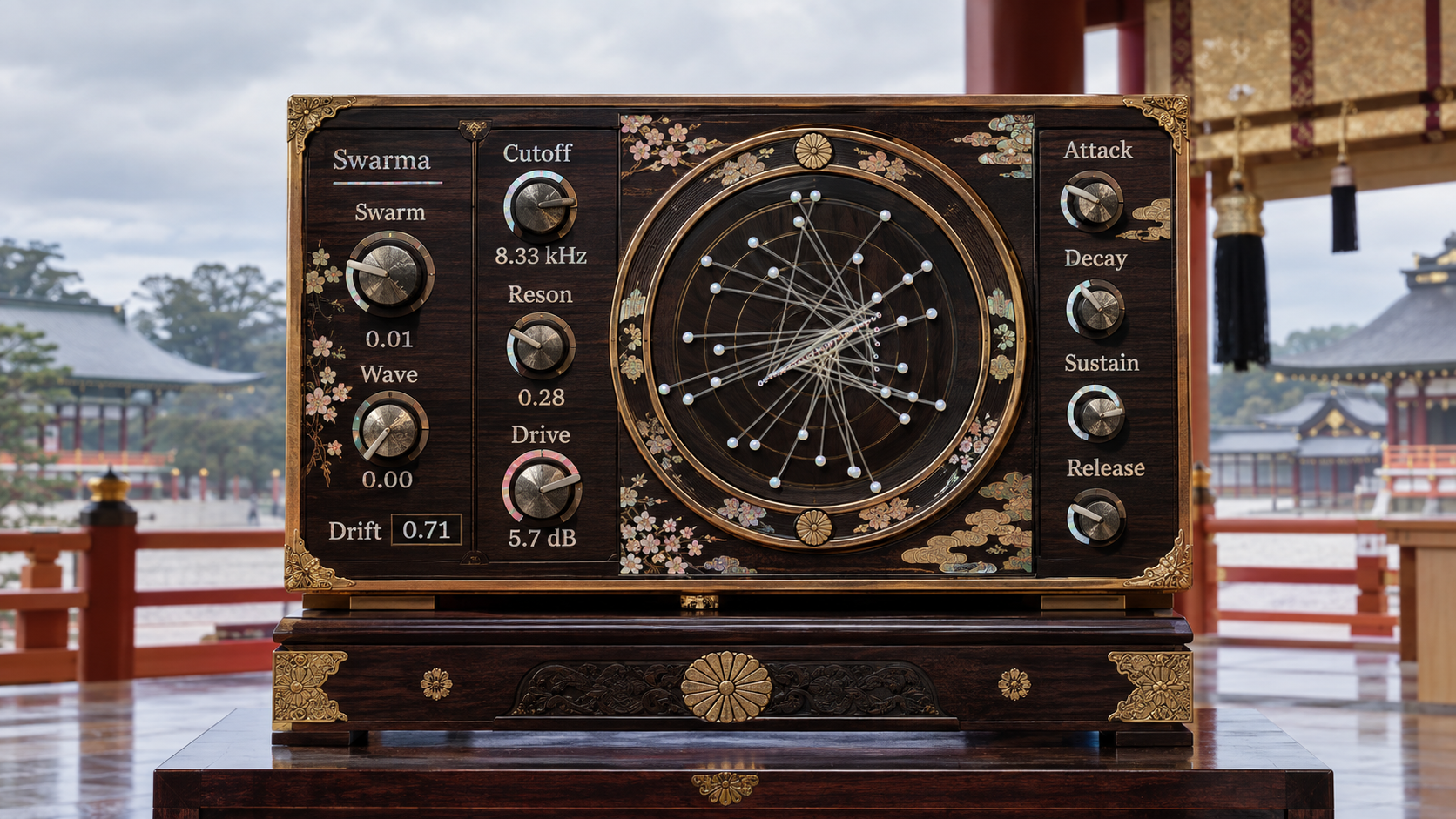
Swarma 3.5
Swarma 3.5 is a Max for Live instrument for Ableton Live with Max for Live.
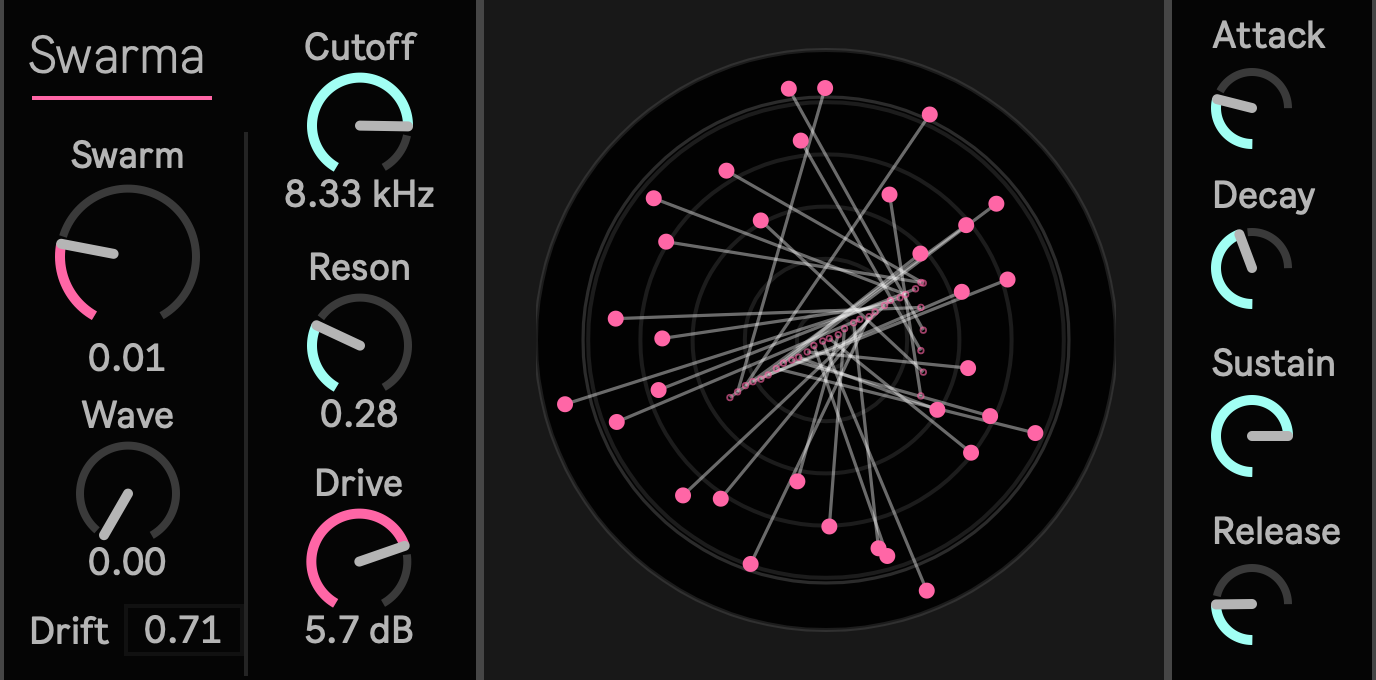
Its compact interface brings together Swarm, Wave, Drift, filtering, and envelope control around the eight oscillator voice. The central visualization responds to key synthesis parameters, providing a visual representation of the changing swarm state without adding another layer of controls.
Your purchase of Swarma includes free lifetime updates. If future Swarma updates are published, those published updates are available at no additional cost.
If you have already purchased Swarma, log in to the Sellfy account used for your original purchase to access the latest currently available files at no additional cost.
Swarma is synthesizer inspired by the famous cluster synth "Swarmatron" created by Dewanatron.
https://en.wikipedia.org/wiki/Swarmatron
v.3.5 ... Refined Swarm behavior for a more natural spread across the eight oscillators, with improved control response and oscillator consistency. (2026/9/18)
v.3.0 ... Improved overall circuit modeling fidelity. (2026/5/26)
v.2.0 ... Totally updated. (2026/4/29)
ver.1.2 ... xy-map bug fixed, over and multi added.
ver.1.1 ... metro bug fixed, fir filter removed.
Instruments & Drum Synths
Reese90 https://akihikomatsumoto.sellfy.store/p/ableton-reese-90/
A dedicated bass synth for deep, moving Reese tones with weight and stereo width.
OP-2 https://akihikomatsumoto.sellfy.store/p/ableton-op2/
A stereo FM synth with independent left and right structures for metallic modern bass design.
Complex https://akihikomatsumoto.sellfy.store/p/abletoncomplex/
A West Coast inspired synth combining complex oscillator concepts, FM, AM, warp, and LPG behavior.
Harmo https://akihikomatsumoto.sellfy.store/p/ableton-harmo/
A harmonic oscillator synth for building timbre directly from additive overtone components.
Cycle https://akihikomatsumoto.sellfy.store/p/ableton-cycle/
A twelve sine oscillator synth for drones, beating patterns, and non equal tempered harmonic structures.
Holy7 https://akihikomatsumoto.sellfy.store/p/ableton-holy7/
A seven oscillator experimental synth for drones, clusters, and slowly shifting harmonic masses.
Kick Bass https://akihikomatsumoto.sellfy.store/p/ableton-kick-bass/
A low frequency synth that integrates kick pitch drops and sub bass design in one instrument.
808 https://akihikomatsumoto.sellfy.store/p/ableton-808/
A low end synth for shaping modern 808 impact, pitch drop, attack, and sub pressure.
Swarma https://akihikomatsumoto.sellfy.store/p/ableton-swarma/
A swarm synth using dense voices, detuning, and drift to create clouds and evolving drones.
303 https://akihikomatsumoto.sellfy.store/p/ableton-303/
A 303 inspired bass synth for resonant acid tones and fluid pitch movement inside Ableton Live.
PCMer https://akihikomatsumoto.sellfy.store/p/ableton-pcmer/
A PCM synth for quickly switching among classic and modern sampled synthesizer waveforms.
Trap Snare https://akihikomatsumoto.sellfy.store/p/ableton-trap-snare/
A dedicated drum synth for shaping trap and bass music snares from pitch, noise, and attack.
DMGboi https://akihikomatsumoto.sellfy.store/p/ableton-dmgboi/
A chip synth inspired by the Game Boy APU, combining pulse, wavetable, and noise voices.
Akihiko Matsumoto
Study Site https://akihikomatsumoto.com/study/
Ableton M4L, Serum Preset Store https://akihikomatsumoto.com/download/
Sample Pack https://akihikomatsumoto.sellfy.store/sample-pack/
Bandcamp https://akihikomatsumoto.bandcamp.com
Ableton Skin https://akihikomatsumoto.sellfy.store/p/ableton-skin-pack/
Spotify https://open.spotify.com/artist/1tZMmxzZbvNu6klyKXa0L1?si=2JZaFeLbREi-UownD8POSg