
Ableton Cycle ver.3.0
Max for Live Device (.amxd file)
Twelve Sine Oscillators for Frequency Based Sound Design
A sustained electronic tone can occupy a track without drawing attention to itself. Yet place another pure tone beside it, only slightly higher in frequency, and the sound may begin to move. Its level seems to swell and recede even though neither oscillator is following a rhythmic modulation pattern. What the listener hears is the changing relationship between two waves, and that relationship can be composed as deliberately as a rhythm or a melody.
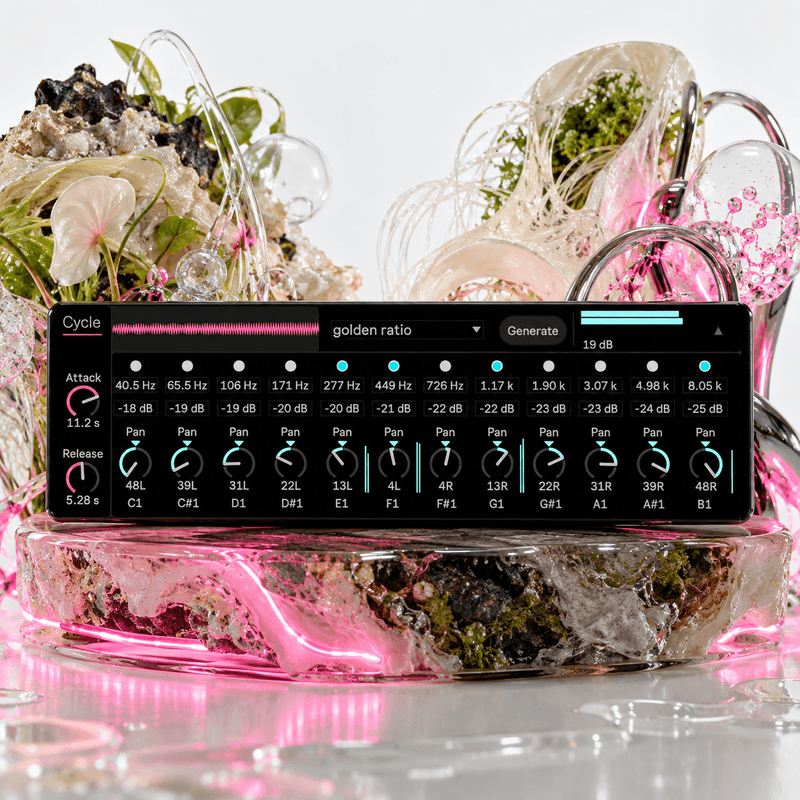
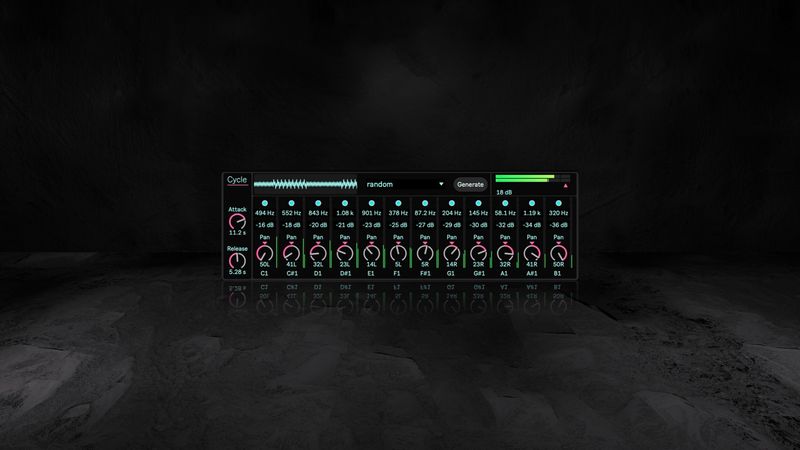
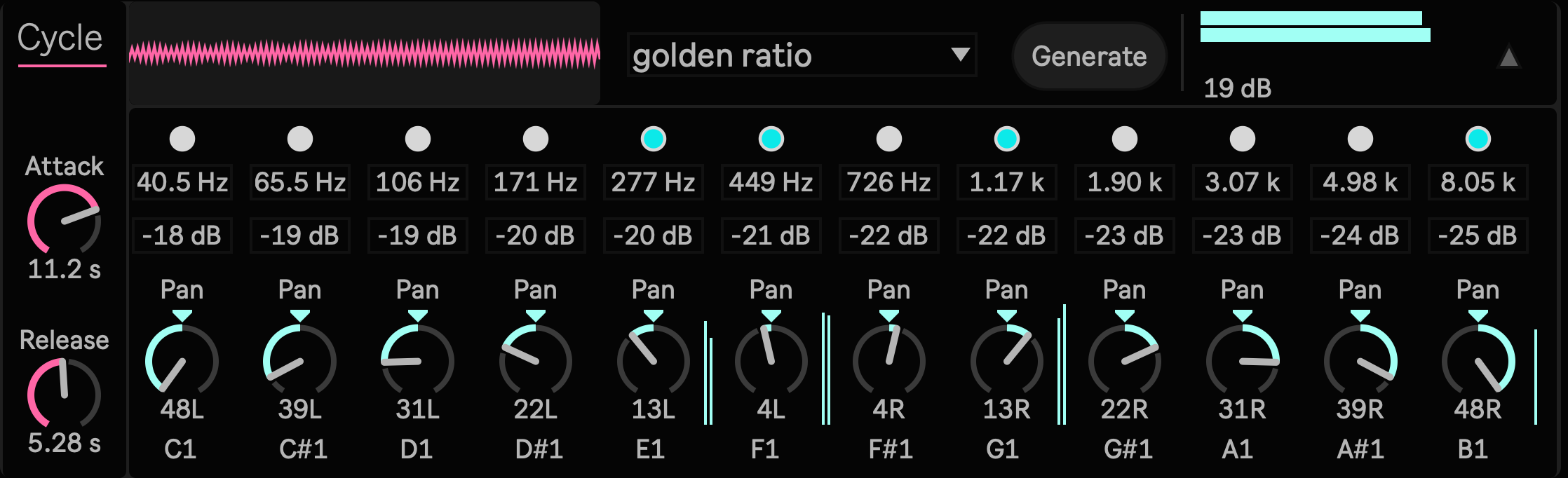
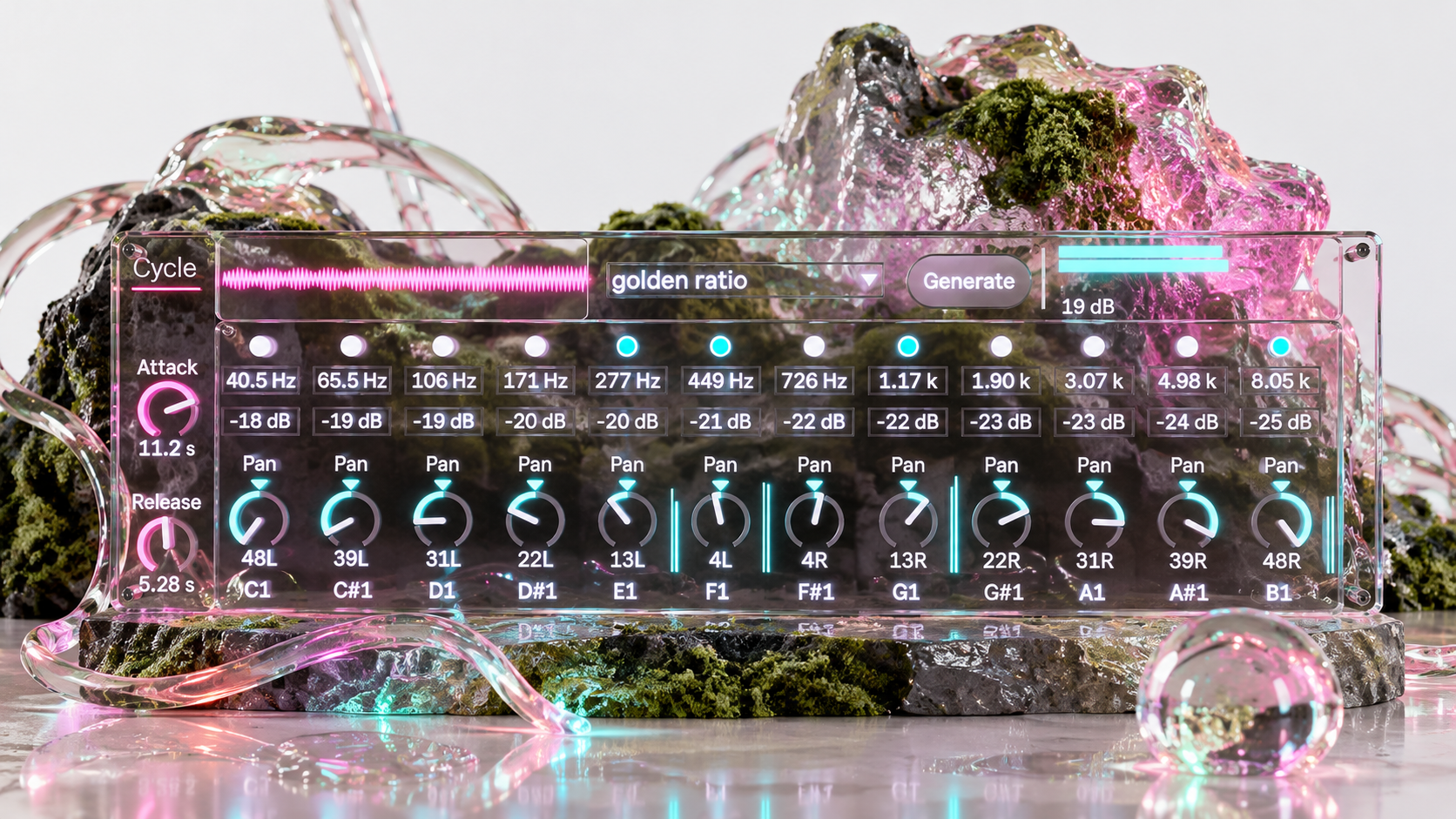
Cycle 3.0 is a Max for Live instrument for exploring this territory with twelve independent sine oscillators. Each voice has its own frequency in Hz, level and stereo position. Rather than treating pitch as a series of equally spaced keyboard notes, Cycle lets the precise distances between frequencies determine the behavior of the sound. A sustained chord of pure tones can therefore become a shifting acoustic structure, even while its individual frequencies remain fixed.
The attraction of working with sine waves lies in their apparent simplicity. There are no elaborate waveforms to hide the interactions. Small decisions become audible: which two tones are close enough to interfere, which one is allowed to dominate, and whether the resulting movement belongs at the center of a piece or almost below the threshold of attention.
Create Pulse and Tension Through Frequency Interference
Consider a sparse passage with one high tone hanging above a low drone. The sound is stable until a second high tone arrives close to the first. Depending on their frequency difference, level and listening conditions, the pair may begin to pulse or tremble. That movement can feel connected to the percussion without being locked to the track's tempo. If the frequencies separate further, the quality of the interaction changes, and the same passage takes on a different kind of tension.
This is the territory explored by Cycle's Beating Pairs and Beating Cluster generation methods. They establish useful relationships between neighboring frequencies, but the outcome is never contained in the numbers alone. The oscillators must sound together for their interaction to be heard, and their levels and spatial positions influence the result. Listening remains an essential part of choosing the structure.
Once that movement becomes part of the arrangement, it changes the production question. Adding another rhythmic layer may be unnecessary when a held sound already contains its own fluctuations. In a more exposed composition, a single changing relationship can carry an entire passage. The interest comes from how long the ear can follow a small difference before it begins to hear a new pattern inside it.
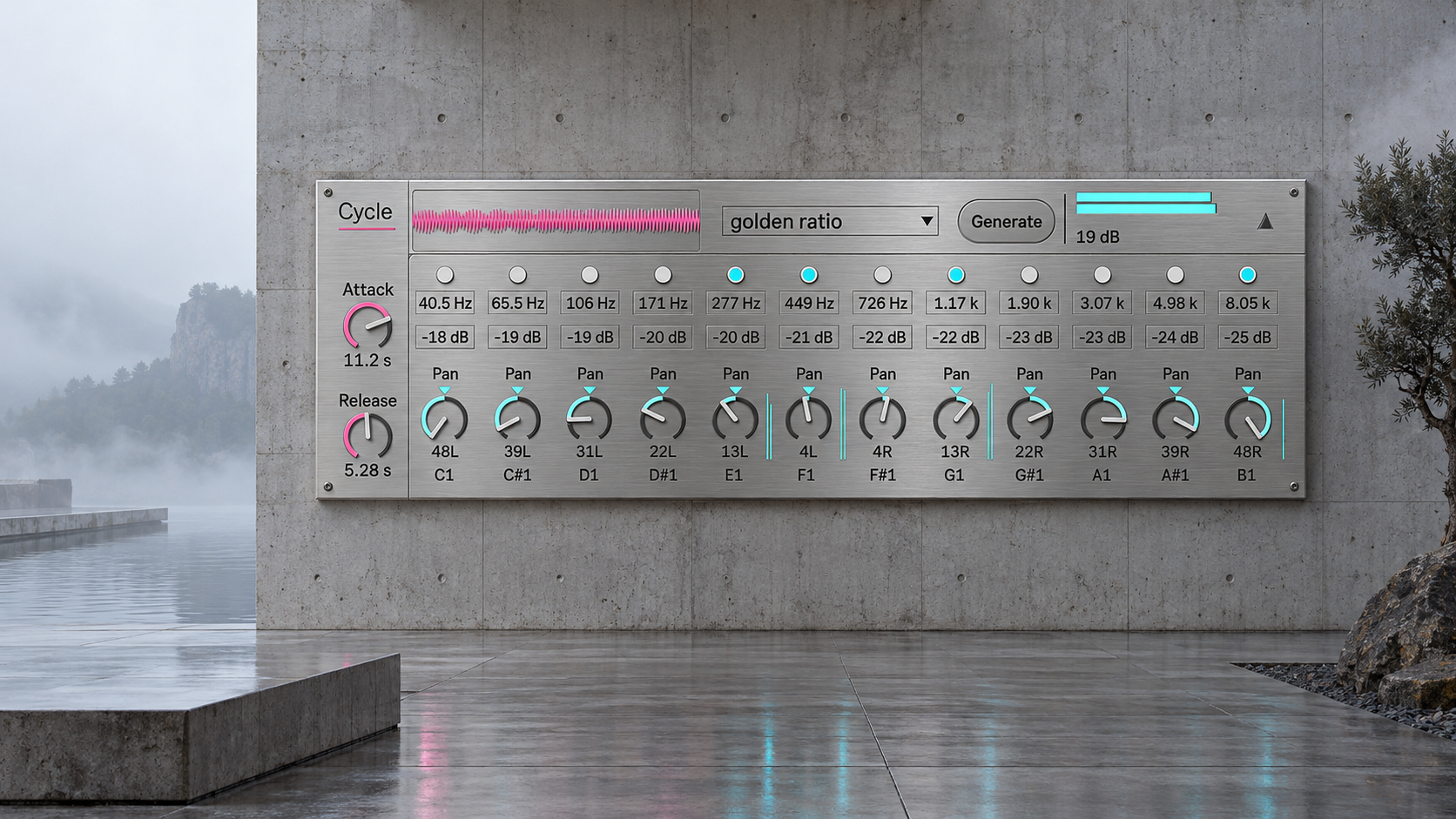
Shape a Frequency Cluster in Stereo
A cluster becomes especially expressive when its parts do not all compete for attention. Raising one oscillator's Gain may bring a previously hidden interaction forward; adjusting its Frequency by a small amount can change the movement it shares with neighboring tones. These edits affect the structure as a whole, so working on one voice becomes a way of reshaping the relationships around it.
Cycle also gives each voice an independent Pan control. Imagine a pair of close frequencies placed near the center while a quieter third tone sits to one side. Bringing that third tone forward changes the apparent balance and spatial character of the group, even though the other frequencies have not moved. Listening in stereo becomes part of the composition, not a final positioning task applied after the sound is complete.
That sensitivity asks for restraint as much as invention. Twelve oscillators need not all be equally prominent. A few carefully balanced tones may reveal a slower, more delicate motion than a dense configuration. The individual voice meters, master meter and waveform display help you follow signal levels while deciding how much of the structure should remain audible. Master controls the overall stereo output.
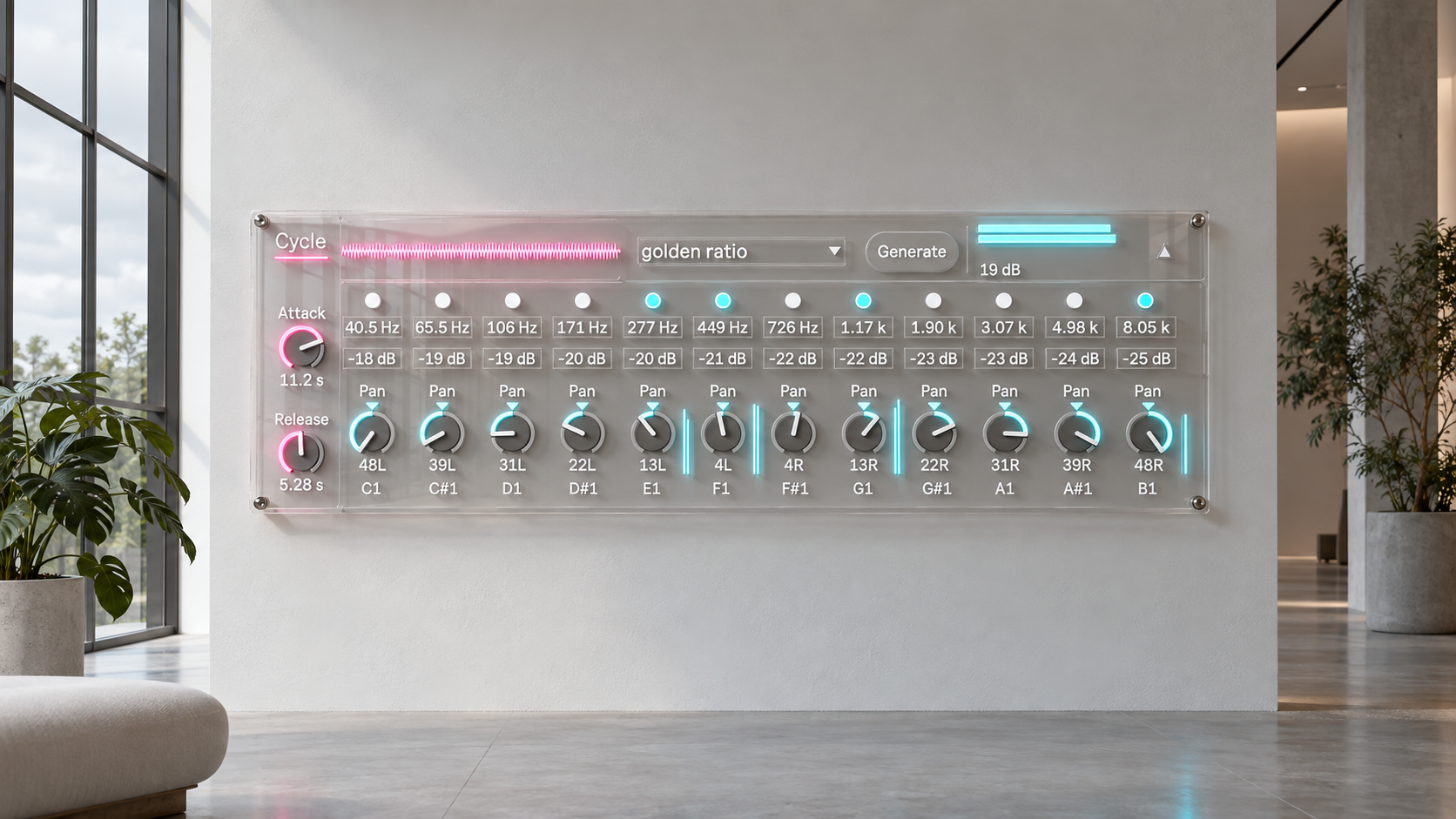
Discover New Relationships with Mathematical Generation
Fine adjustments make a cluster personal, but designing every starting frequency by hand can keep an experiment within familiar habits. Cycle's Mode and Generate provide a way to encounter a structure you might not have chosen yourself. A selected method produces a new set of twelve frequencies together with their gains and stereo positions, ready to be auditioned and then edited.
There are 18 mathematical generation methods, with an additional Random option that selects among them. Some construct relationships through integer or prime number ratios; others use numerical sequences, binary structures or deliberately close frequency groupings. These approaches are valuable because they lead the ear toward different kinds of organization. A result can be surprisingly sparse, unevenly distributed across registers, or tightly concentrated around a small region.
A useful way to work is to keep the same MIDI notes held while trying a different generated structure. The performance stays constant, making the changes in the frequency relationships easier to hear. Generate uses a brief output fade around the change and applies the new frequency values without a long pitch glide. Once a promising configuration appears, individual edits can take it somewhere the underlying mathematical method did not prescribe.
Generation is therefore an invitation to listen rather than a demand to accept a preset. The structure suggests a possibility; the next decisions concern which interactions are worth keeping, which voices should recede, and how the sound might unfold inside the piece.
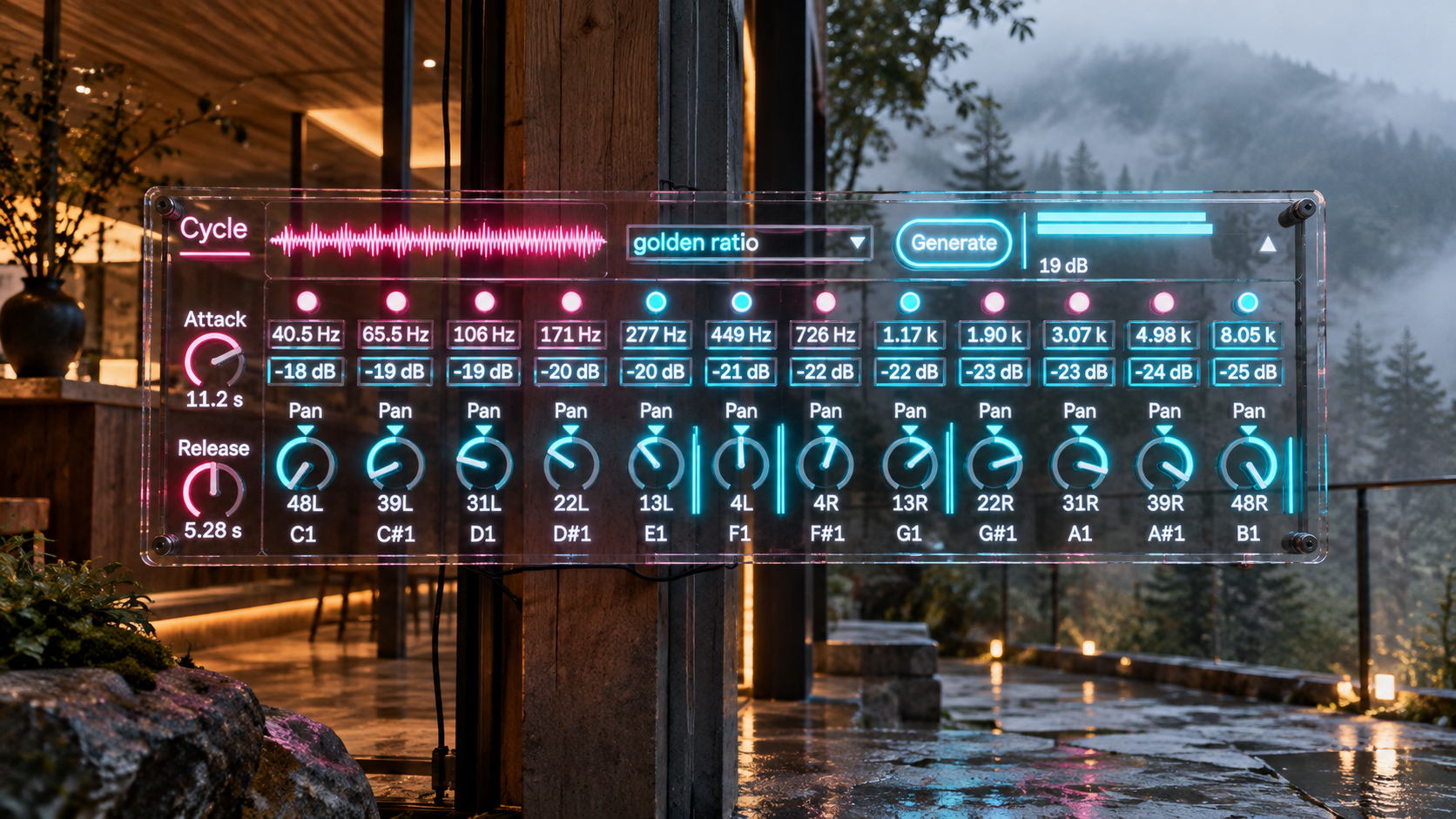
Perform Frequency Structures with MIDI
The final step is to decide when these relationships appear. Cycle responds to MIDI, but its twelve note labels identify oscillator positions rather than a conventional chromatic scale. Incoming MIDI pitch classes select voices at their assigned frequencies. Playing a higher octave does not transpose those oscillators through equal temperament, because the frequency of each voice is set independently of the incoming note number.
That separation makes performance unusually direct. You might introduce a single oscillator, let it establish a stable tone, then play another note to reveal the interference between them. Releasing one voice dissolves the relationship while the other continues. Attack and Release shape how the tones enter and leave, so a change in articulation can alter the perceived structure without changing any frequency values.
The same idea works in a Live arrangement. A held layer can develop through the overlap of selected voices; a sparse MIDI phrase can repeatedly expose and conceal a particular frequency pairing. Cycle is not a MIDI sequencer, and its generation methods create frequency configurations rather than timed note patterns. The musical sequence comes from the performance, while the instrument supplies the spectral relationships that give it character.
Cycle 3.0 makes the distance between tones a playable element of sound design. It invites you to build movement from interference, discover unfamiliar structures through mathematical generation, and refine them until a small collection of pure waves has its own unmistakable place in the music.
License & Free Lifetime Updates
Your purchase grants a license to use the software, not ownership of its program code. Unauthorized copying, sharing, resale, sublicensing, or redistribution of the device, its source code, or bundled software assets is prohibited, except where permitted by applicable law or for authorized installation and backup.
The software, including its source code, algorithms, and bundled software assets, may not be used to create training datasets or to train or fine tune machine learning or AI models without prior written permission. These restrictions do not prohibit the creation or commercial use of original music made with the device.
Your purchase includes free lifetime updates. Future published updates to this product are available at no additional cost. Existing customers can access the latest available files through the Sellfy account used for their original purchase, without purchasing the product again.
- 0 Random
- 1 historical_beat
- 2 harmonic_primes
- 3 subharmonic
- 4 spectra_high
- 5 spectra_sweep
- 6 beating_cluster
- 7 beating_pairs
- 8 just_intonation
- 9 fibonacci
- 10 binary_pattern
- 11 infrasonic
- 12 mixed_register
- 13 minimal_focus
- 14 threshold
- 15 combination_tones
- 16 golden_ratio
- 17 prime_spectrum
- 18 data_binary
v.3.0 ... Updated pitch set algorithms, Generate transitions, level meter colors, and interface layout. (2026/10/30)
v.1.1 ... Fixed File Missing Bug. (2025/10/26)
Max For Live Synthesizer
Reese90 https://akihikomatsumoto.sellfy.store/p/ableton-reese-90/
Dedicated bass synth for deep, moving Reese tones with weight and stereo width.
OP-2 https://akihikomatsumoto.sellfy.store/p/ableton-op2/
Stereo FM synth with independent left and right structures for metallic modern bass design.
Complex https://akihikomatsumoto.sellfy.store/p/abletoncomplex/
West Coast inspired synth combining complex oscillator concepts, FM, AM, warp, and LPG behavior.
Harmo https://akihikomatsumoto.sellfy.store/p/ableton-harmo/
Harmonic oscillator synth for building timbre directly from additive overtone components.
Cycle https://akihikomatsumoto.sellfy.store/p/ableton-cycle/
Twelve sine oscillator synth for drones, beating patterns, and non equal tempered harmonic structures.
Holy7 https://akihikomatsumoto.sellfy.store/p/ableton-holy7/
Seven oscillator experimental synth for drones, clusters, and slowly shifting harmonic masses.
Kick Bass https://akihikomatsumoto.sellfy.store/p/ableton-kick-bass/
Low frequency synth that integrates kick pitch drops and sub bass design in one instrument.
808 https://akihikomatsumoto.sellfy.store/p/ableton-808/
Low end synth for shaping modern 808 impact, pitch drop, attack, and sub pressure.
Swarma https://akihikomatsumoto.sellfy.store/p/ableton-swarma/
Swarm synth using dense voices, detuning, and drift to create clouds and evolving drones.
303 https://akihikomatsumoto.sellfy.store/p/ableton-303/
303 inspired bass synth for resonant acid tones and fluid pitch movement inside Ableton Live.
PCMer https://akihikomatsumoto.sellfy.store/p/ableton-pcmer/
PCM synth for quickly switching among classic and modern sampled synthesizer waveforms.
Trap Snare https://akihikomatsumoto.sellfy.store/p/ableton-trap-snare/
Dedicated drum synth for shaping trap and bass music snares from pitch, noise, and attack.
DMGboi https://akihikomatsumoto.sellfy.store/p/ableton-dmgboi/
Chip synth inspired by the Game Boy APU, combining pulse, wavetable, and noise voices.
Akihiko Matsumoto
Study Site https://akihikomatsumoto.com/study/
Ableton M4L, Serum Preset Store https://akihikomatsumoto.com/download/
Sample Pack https://akihikomatsumoto.sellfy.store/sample-pack/
Bandcamp https://akihikomatsumoto.bandcamp.com
Ableton Skin https://akihikomatsumoto.sellfy.store/p/ableton-skin-pack/
Spotify https://open.spotify.com/artist/1tZMmxzZbvNu6klyKXa0L1?si=2JZaFeLbREi-UownD8POSg