
$29.99+
Ableton DMGboi v.2.0 | Beyond Chip Emulation
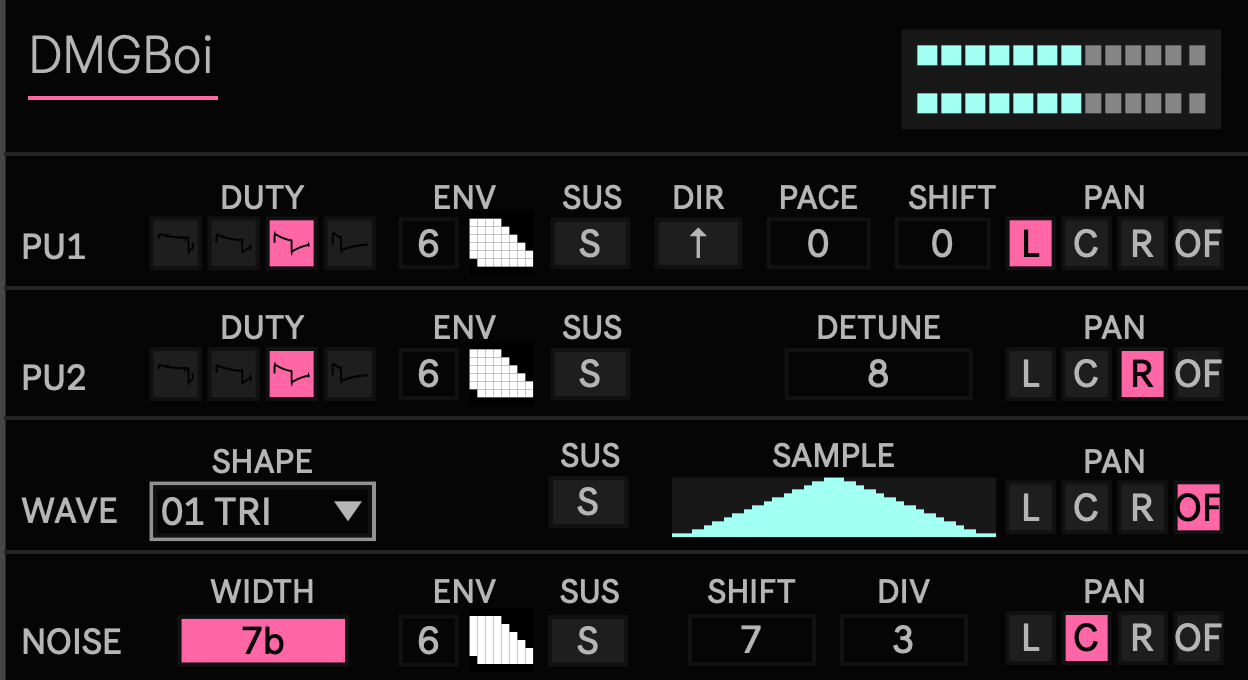
Max for Live Device (.amxd file) | The Game Boy sound was never just a square wave
It is easy to make something that immediately reads as retro digital sound. Start with a pulse wave, reduce the resolution, add some noise, and the reference is already there.
What is much harder to recreate is the reason the original Game Boy became such an interesting musical instrument in the first place.
Its sound architecture was extremely small. Two pulse channels, one programmable WAVE channel, and one NOISE channel had to carry an entire piece of music. There was no enormous oscillator bank or modulation system waiting behind them. A change in duty, envelope behavior, Wave RAM, or noise timing therefore mattered far more than it might inside a larger synthesizer.
That scarcity produced a particular way of working. Instead of continuously adding more synthesis, you decided what each limited part of the machine should contribute. One channel could define the body of a note, another its edge. Noise could become rhythm. A tiny waveform memory could become the identity of a sound.
DMGboi brings that way of thinking into Ableton Live.
It is not built around the idea that the Game Boy is interesting simply because it sounds old. It treats the original architecture as a compact method for constructing sound, where a small number of decisions remain audible and musically useful.
From the Game Boy to mGB
mGB was important because it changed how musicians could approach the Game Boy.
Instead of treating the console as a machine that happened to contain memorable game music, mGB made it possible to approach its sound hardware as a MIDI controlled instrument. Through systems such as Arduinoboy, the internal channels could be addressed from an external sequencer or keyboard.
That shift matters.
The interesting part was no longer only the finished chip sound. The pulse channels, WAVE memory, noise behavior, envelopes, and pitch movement became things that could be performed and sequenced directly.
DMGboi is an homage to that idea.
It does not attempt to become a software clone of mGB, and it does not claim perfect identity with original Game Boy hardware. Instead, it takes the same fundamental approach and places it inside Max for Live: expose the limited architecture as an instrument, keep the important decisions close to the surface, and let MIDI drive the system from inside an Ableton Live session.
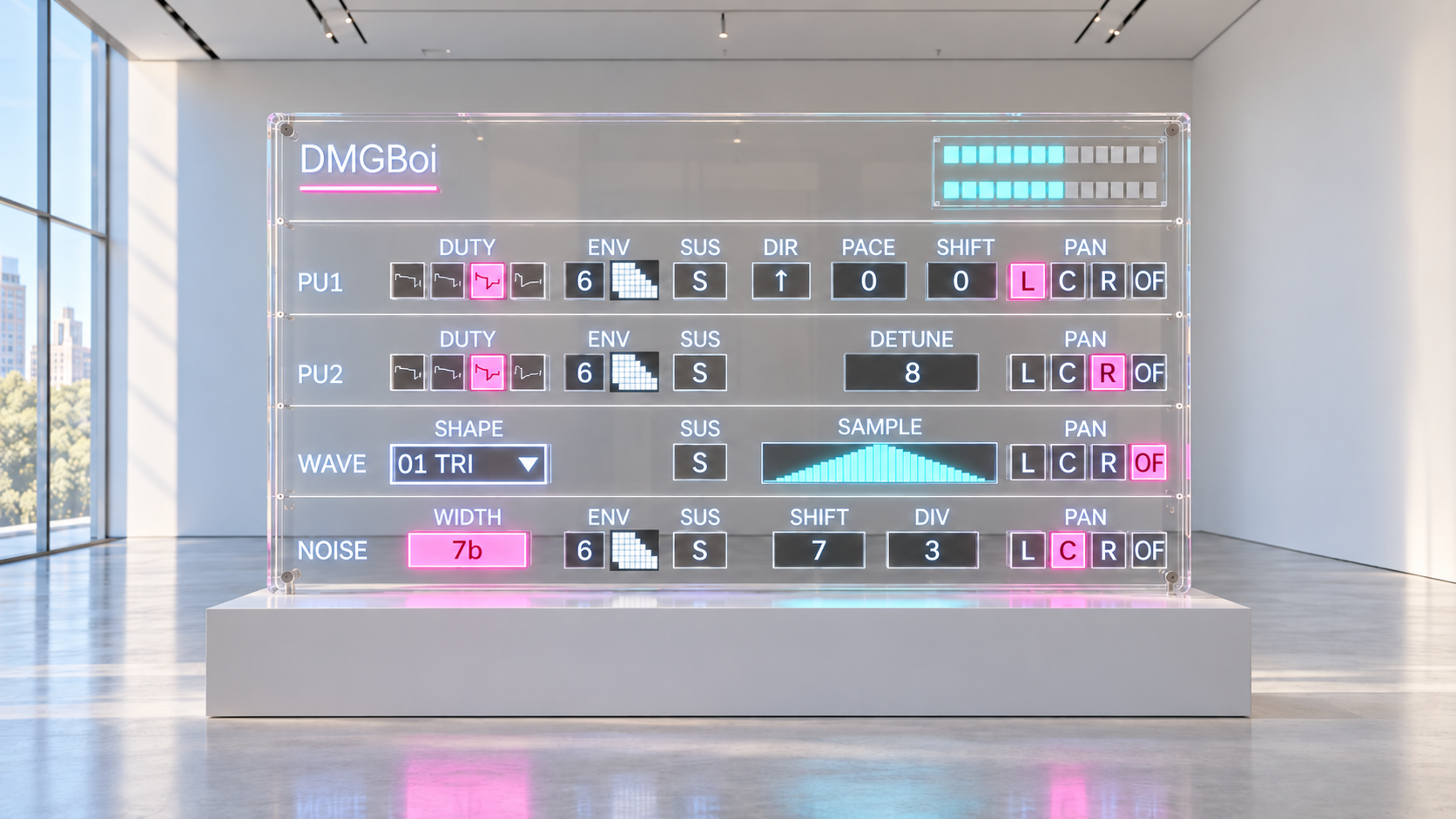
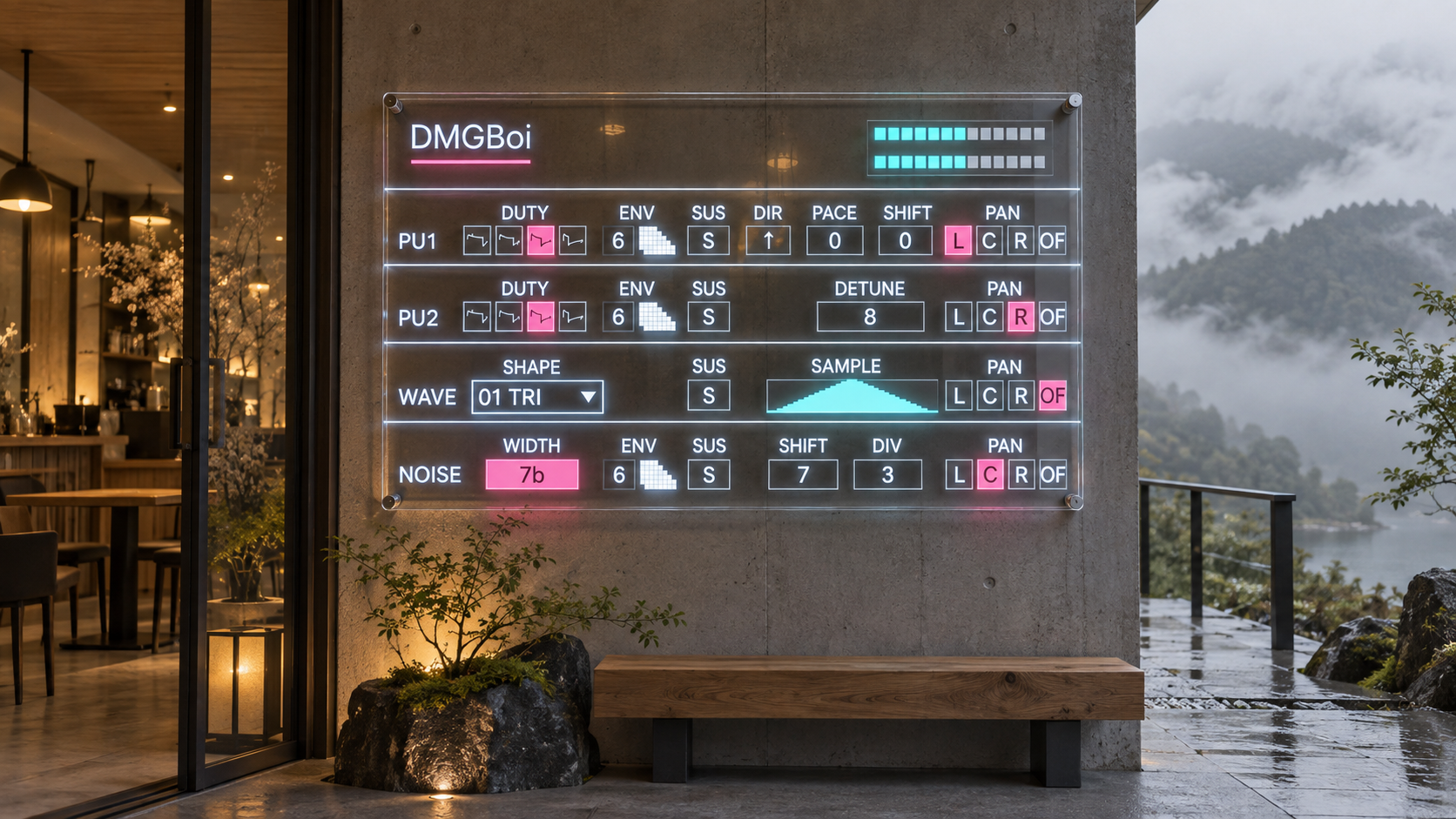
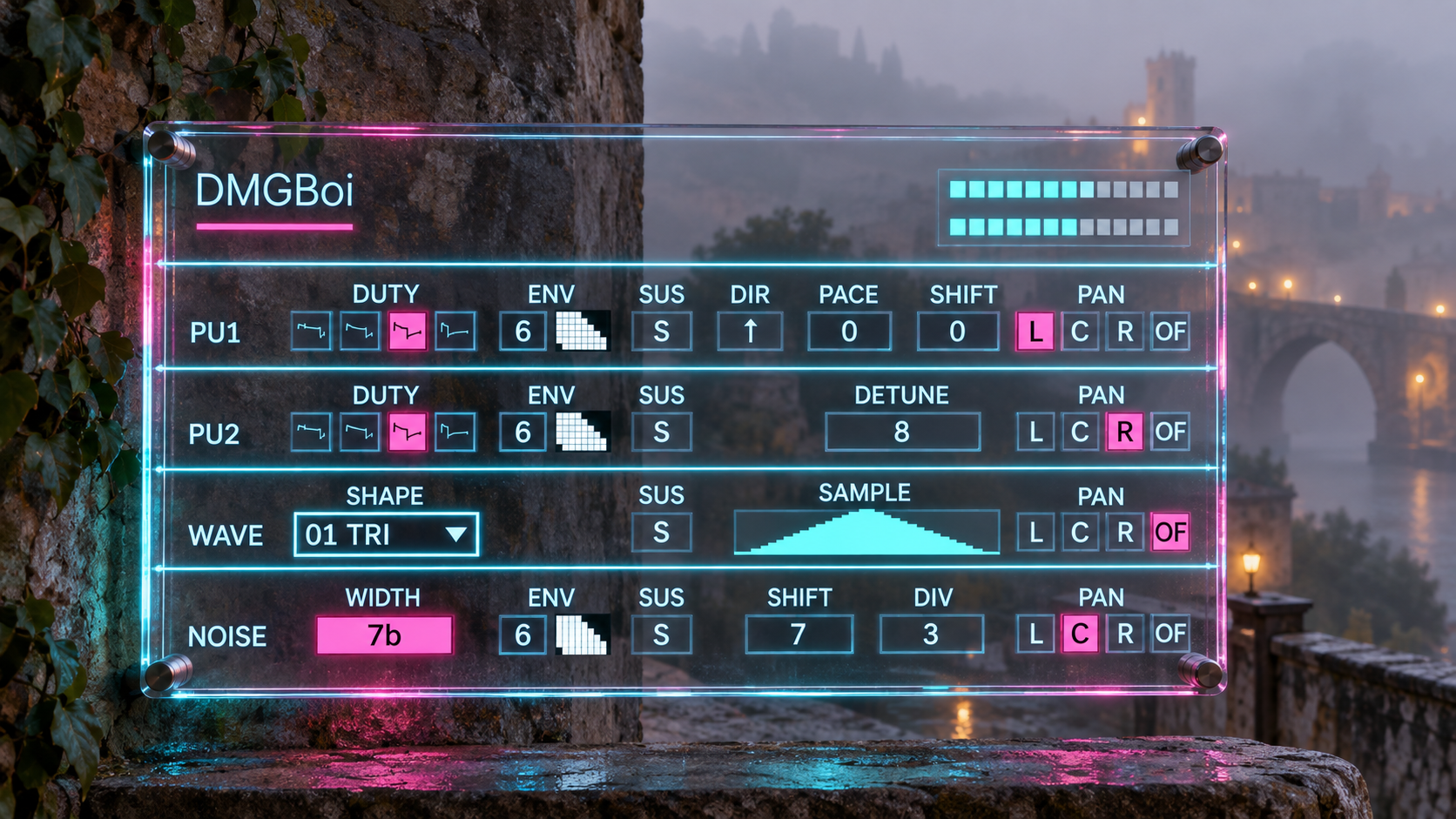
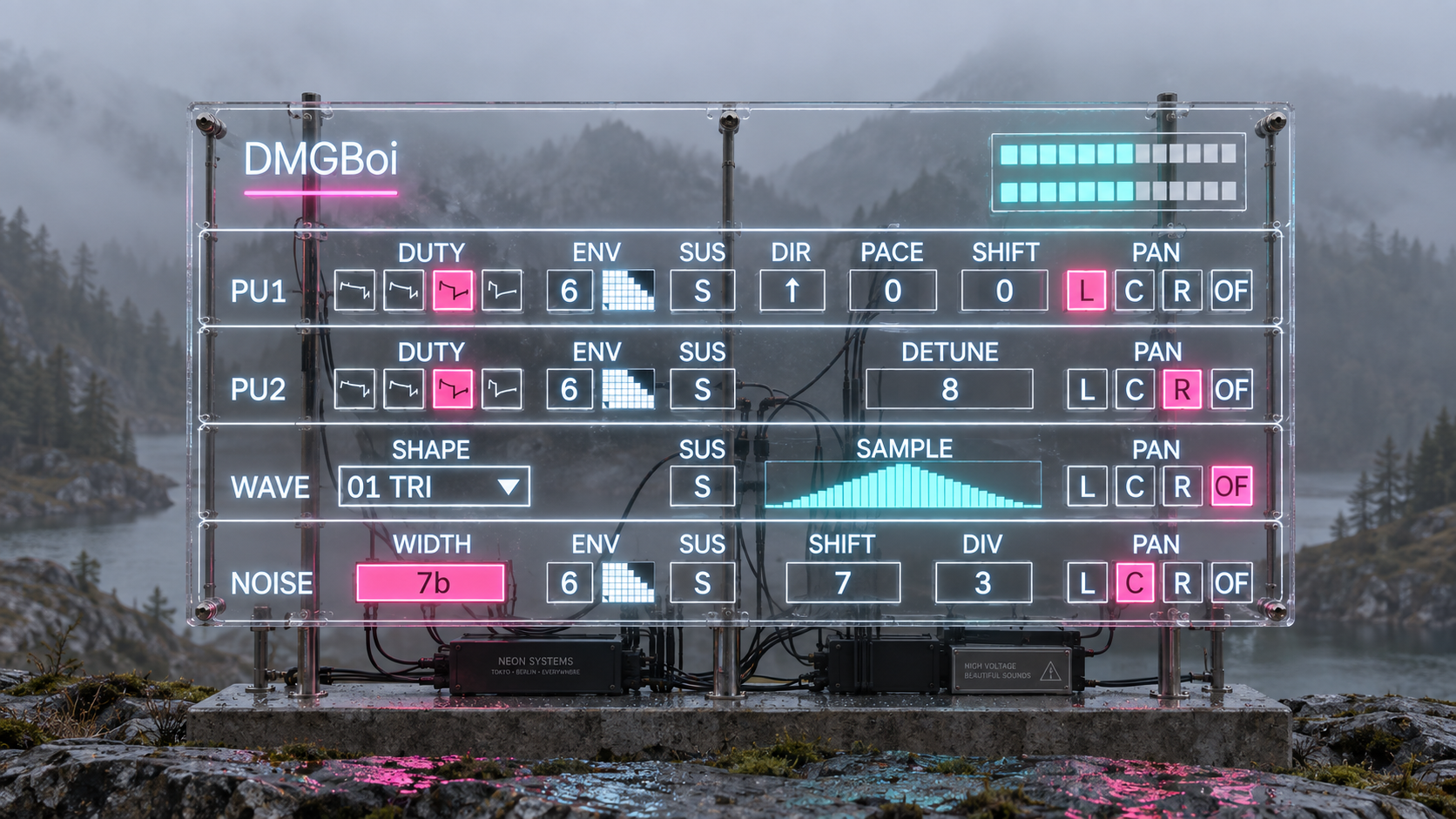
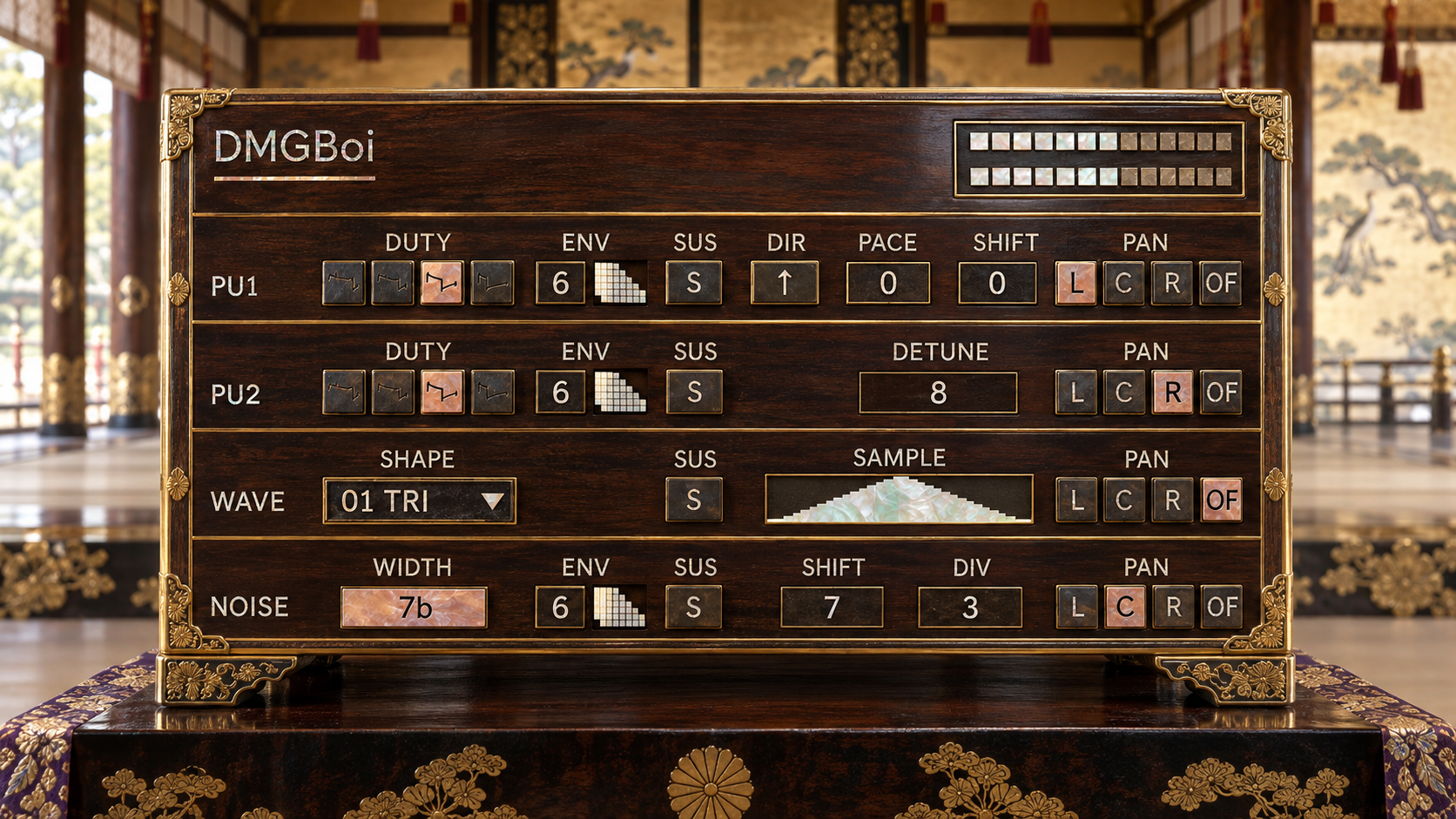
A single MIDI note activates PU1, PU2, WAVE, and NOISE inside one monophonic voice. These are not four independent polyphonic oscillators. They are four roles contributing to the same note.
That distinction changes the way DMGboi is used.
Build an arrangement inside a single note
A common way to make a synthesizer sound larger is to add another oscillator, another layer, another effect, then another track.
DMGboi encourages a different decision.
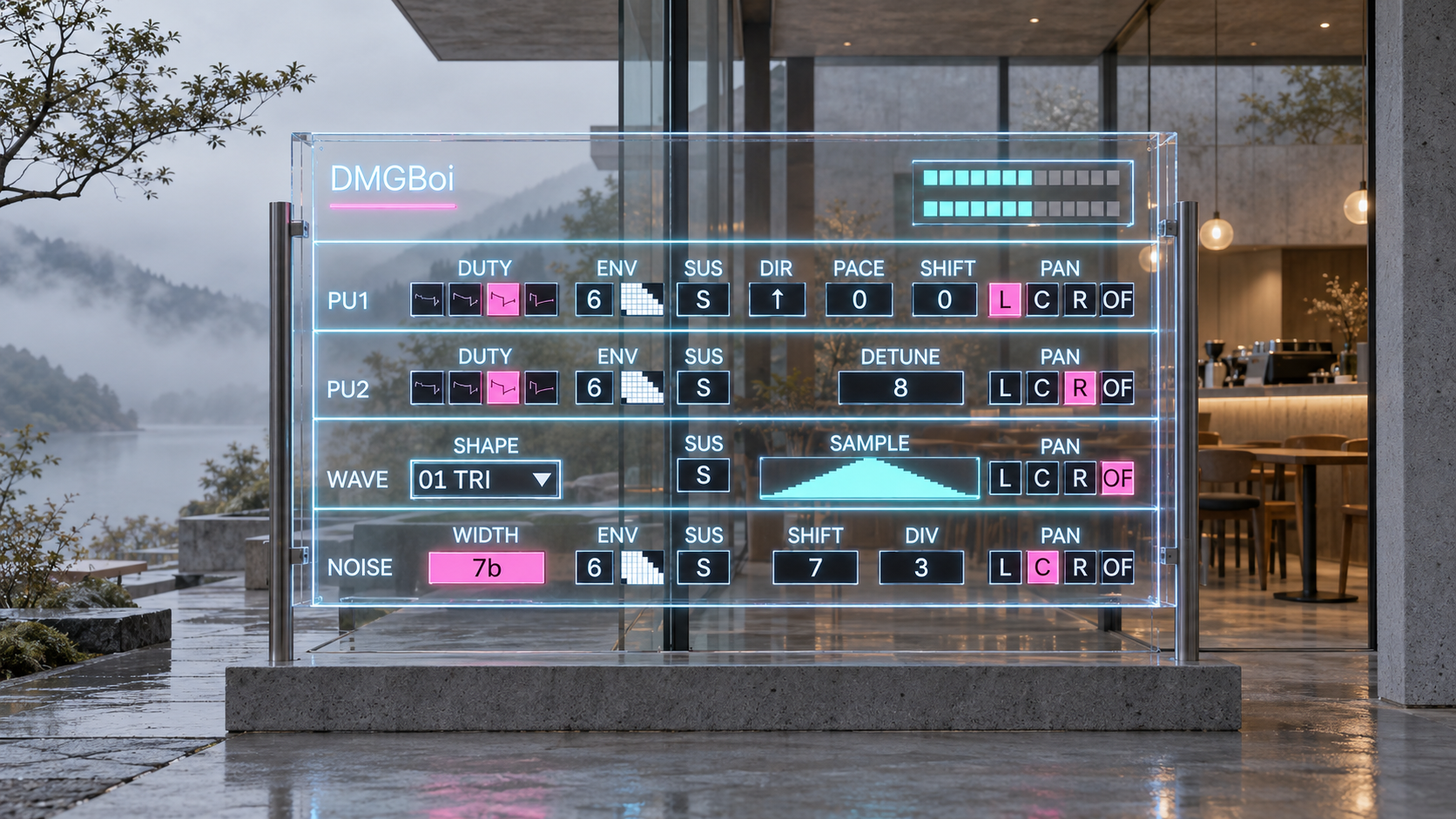
PU1 can define the sharper edge of a bass while PU2 adds a different harmonic weight through another duty pattern. WAVE can sit underneath them as the tonal body. NOISE can be used only for the attack, or allowed to become a more obvious repeating texture.
Each of the four sections can also be sent Left, Center, Right, or Off. This means the internal roles can be separated in stereo without first splitting the instrument into several Ableton tracks.
The result is still one monophonic line, but the note itself can already contain contrast, movement, transient structure, and stereo organization before it reaches an effects chain.
That is particularly useful for sounds that need to remain small in a mix.
A short bass does not need to become a huge layered patch in order to have an identifiable attack and body. A narrow lead can remain thin while still containing several different internal colors. A percussion sound can be made from NOISE and a pulse without loading another instrument simply to create the transient.
The limitation becomes a form of arrangement.
Thirty two values can define an entire timbre
The WAVE section makes this philosophy especially visible.
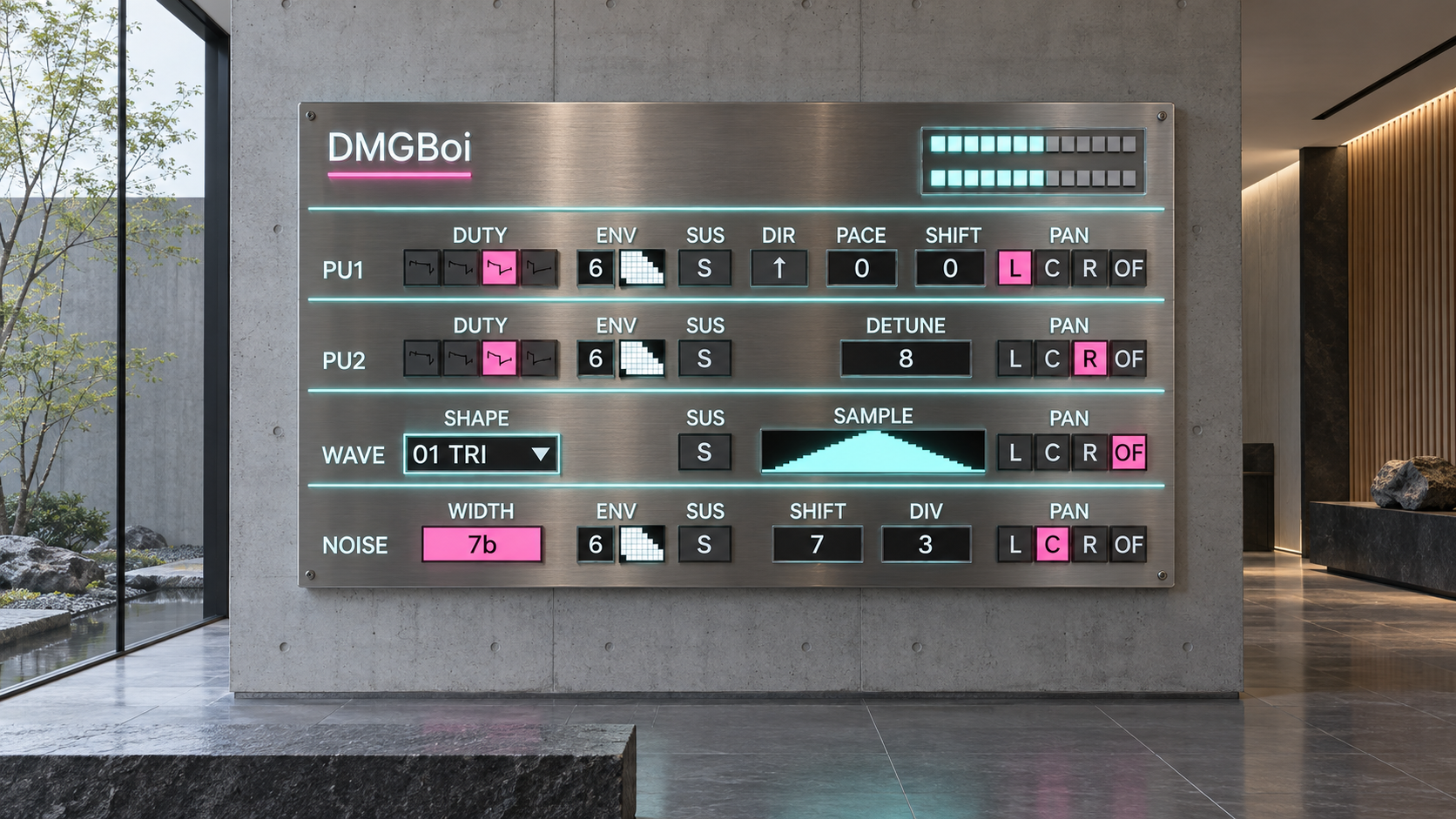
DMGboi includes 16 built in WAVE shapes, but choosing one does not hide the waveform from you. The waveform itself remains available as 32 individual values, each with 4 bit resolution from 0 to 15.
That makes WAVE feel very different from browsing a large wavetable library.
You can choose a shape, alter only a few positions, and hear a closely related variation. You can flatten part of the contour, break a repeated pattern, exaggerate one area, or rewrite the whole thing. Because only 32 values describe the waveform, every change has a clear relationship to the result.
The waveform becomes something closer to a tiny numerical score for timbre.
This is useful when resampling as well. Keep the MIDI phrase unchanged, alter a few WAVE values, record another pass, then continue. Several related source sounds can come from the same phrase without searching through another preset library.
The same economy appears throughout DMGboi.
PU1 and PU2 each use four discrete duty choices, so harmonic changes happen through clearly different pulse structures rather than an endlessly variable shape control. ENV uses compact stepped behavior rather than a conventional large ADSR interface. PU1 sweep creates pitch movement from inside the voice. NOISE uses SHIFT, DIV, and WIDTH to change its timing and recurrence, allowing it to move between short percussion, rough digital texture, and strongly repeating patterns.
The interface remains small enough that the relationship between an action and what you hear does not disappear.
The model continues beyond the generators
There is another part of the Game Boy sound that is easy to overlook.
Generating the correct kind of pulse or Wave RAM signal is only the beginning of the path. In actual hardware, those channel states still have to pass through a DAC, mixer, stereo routing, and the analog behavior of the output stage before they become an audible signal.
A software instrument can ignore this and send a clean floating point oscillator directly to its output. It can then add noise, distortion, filtering, or bit reduction afterward to suggest older hardware.
DMGboi takes a deeper route.
Its internal model continues from the channel PCM states into DAC and mixer behavior. The signal is converted into an analog style signed representation while maintaining individual charge state for the channels. Stereo routing and master level codes remain part of the same path, and capacitor high pass behavior can also participate in the output model.
This means the output side is not treated as a generic effect placed after an otherwise ideal synthesizer.
The DSP also maintains dedicated DAC state for PU1, PU2, WAVE, and NOISE, including individual charge and PCM hold states. Left and right capacitor states are retained as part of the running signal history.
DMGboi goes further by including internal states related to nonideal behavior that can exist around this kind of output system. DAC pop and mixer pop are represented. Clock bleed, LCD related noise, amplifier hum, and power sag also exist within the model.
These are not presented as a collection of front panel Lo Fi knobs.
They belong to the internal behavior of the instrument.
That difference is important because it changes where the character is created. The goal is not to generate a clean pulse first and then make it sound old at the end. The generator, DAC behavior, mixer behavior, and output path are considered parts of one connected system before the sound reaches the rest of Ableton Live.
DMGboi does not claim bit perfect reproduction, universal cycle accuracy, or transistor level physical reconstruction of original Game Boy hardware. Those would require a different level of verification.
The point is more practical.
Game Boy character is not reduced to a waveform preset. DMGboi models a larger part of the path that turns those limited channel states into an output signal, while keeping that complexity behind a compact musical interface.
Let Ableton take it somewhere else
DMGboi can make immediately recognizable chip style basses, leads, and percussion, but that is only one use for the architecture.
A WAVE centered bass can be given a harder front edge with PU1. PU2 can introduce a second pulse color without adding another MIDI layer. NOISE can become a transient that appears only on selected notes. Sweep can change the end of a phrase from inside the instrument itself.
Then the sound can leave the historical reference behind.
Run it into a filter. Distort it. Resample several versions of the same MIDI phrase while changing the 32 WAVE values. Stretch those recordings. Layer them with acoustic material. Use a short repeating NOISE pattern as raw percussion rather than as a finished chip sound.
Because the source begins with a limited and clearly structured voice, later processing has something definite to work on.
This is where the Game Boy idea remains relevant inside a modern production environment. The limitation does not have to remain an aesthetic quotation. It can simply become a disciplined starting point for producing digital sound.
mGB helped turn the Game Boy into something that could be played from MIDI. DMGboi carries that idea into Ableton Live and extends it into a self contained instrument where pulse structure, editable Wave RAM, noise recurrence, internal stereo roles, and DAC and mixer behavior all participate in the same voice.
A small system with consequences
DMGboi is for the moments when more synthesis is not necessarily better.
When a bass needs character without becoming wide and oversized. When a lead should remain thin but identifiable. When a digital percussion sound needs a precise internal logic. When you want to edit the source waveform itself instead of scrolling through another large preset collection.
The architecture stays deliberately constrained so that each decision remains audible.
One MIDI note. Four internal roles. Thirty two 4 bit waveform values. A noise generator whose repetition can become part of the rhythm. An output model that continues through DAC and mixer behavior.
The original Game Boy turned severe technical limitations into a recognizable musical language. DMGboi uses those same kinds of constraints as a production tool for Ableton Live.
Availability and Lifetime Updates
DMGboi v2.0 is a monophonic Max for Live MIDI Instrument for Ableton Live.
The current repository targets Ableton Live 12, Max 9, macOS, and Windows. These are target environments and should not be interpreted as exhaustive certification of every operating system, Live version, or Max maintenance combination.
Purchase includes free lifetime updates for DMGboi. Any future updates that are published for the product are available to existing customers at no additional cost.
If you already own DMGboi, sign in to the Sellfy account used for your original purchase to access the latest available files without purchasing the product again.
Instruments & Drum Synths
Reese90 https://akihikomatsumoto.sellfy.store/p/ableton-reese-90/
A dedicated bass synth for deep, moving Reese tones with weight and stereo width.
OP-2 https://akihikomatsumoto.sellfy.store/p/ableton-op2/
A stereo FM synth with independent left and right structures for metallic modern bass design.
Complex https://akihikomatsumoto.sellfy.store/p/abletoncomplex/
A West Coast inspired synth combining complex oscillator concepts, FM, AM, warp, and LPG behavior.
Harmo https://akihikomatsumoto.sellfy.store/p/ableton-harmo/
A harmonic oscillator synth for building timbre directly from additive overtone components.
Cycle https://akihikomatsumoto.sellfy.store/p/ableton-cycle/
A twelve sine oscillator synth for drones, beating patterns, and non equal tempered harmonic structures.
Holy7 https://akihikomatsumoto.sellfy.store/p/ableton-holy7/
A seven oscillator experimental synth for drones, clusters, and slowly shifting harmonic masses.
Kick Bass https://akihikomatsumoto.sellfy.store/p/ableton-kick-bass/
A low frequency synth that integrates kick pitch drops and sub bass design in one instrument.
808 https://akihikomatsumoto.sellfy.store/p/ableton-808/
A low end synth for shaping modern 808 impact, pitch drop, attack, and sub pressure.
Swarma https://akihikomatsumoto.sellfy.store/p/ableton-swarma/
A swarm synth using dense voices, detuning, and drift to create clouds and evolving drones.
303 https://akihikomatsumoto.sellfy.store/p/ableton-303/
A 303 inspired bass synth for resonant acid tones and fluid pitch movement inside Ableton Live.
PCMer https://akihikomatsumoto.sellfy.store/p/ableton-pcmer/
A PCM synth for quickly switching among classic and modern sampled synthesizer waveforms.
Trap Snare https://akihikomatsumoto.sellfy.store/p/ableton-trap-snare/
A dedicated drum synth for shaping trap and bass music snares from pitch, noise, and attack.
DMGboi https://akihikomatsumoto.sellfy.store/p/ableton-dmgboi/
A chip synth inspired by the Game Boy APU, combining pulse, wavetable, and noise voices.
Akihiko Matsumoto
Study Site https://akihikomatsumoto.com/study/
Ableton M4L, Serum Preset Store https://akihikomatsumoto.com/download/
Sample Pack https://akihikomatsumoto.sellfy.store/sample-pack/
Bandcamp https://akihikomatsumoto.bandcamp.com
Ableton Skin https://akihikomatsumoto.sellfy.store/p/ableton-skin-pack/
Spotify https://open.spotify.com/artist/1tZMmxzZbvNu6klyKXa0L1?si=2JZaFeLbREi-UownD8POSg