
$25.90+
Ableton Complex Synthesizer ver.5.0.2 | Redefining Buchla Modular Synthesis
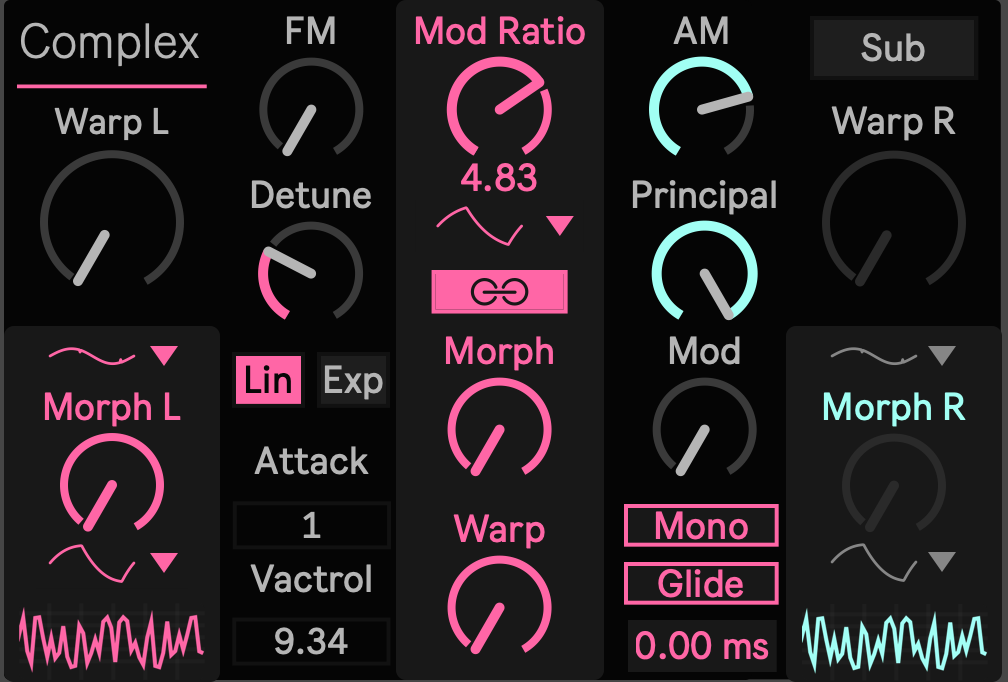
Max for Live Device (.amxd file)
Complex brings the tradition of the complex oscillator into Ableton Live, then moves it forward through the digital character of the Buchla 259e and the stereo thinking of contemporary modular synthesis.
Its waveform library was captured from the Buchla 259e and the Buchla Music Easel. Its low pass gate models the connected movement of loudness and brightness that gives classic Buchla percussion its physical, elastic response. Its independently constructed left and right oscillators create a stereo architecture related to the Make Noise XPO, where space begins inside the oscillator rather than being added at the end of the signal chain.
Complex is not a collection of modular inspired functions. It is a Max for Live instrument built to bring the musical practice developed through complex oscillators into the Ableton Live production process.
Buchla Modular Synth (Sample Pack) https://akihikomatsumoto.sellfy.store/p/buchla-modular-synth-sample-pack/
What Is a Complex Oscillator?
A conventional synthesizer often begins with one oscillator producing a stable waveform. Filters, envelopes, modulation, and effects are then used to reshape that source.
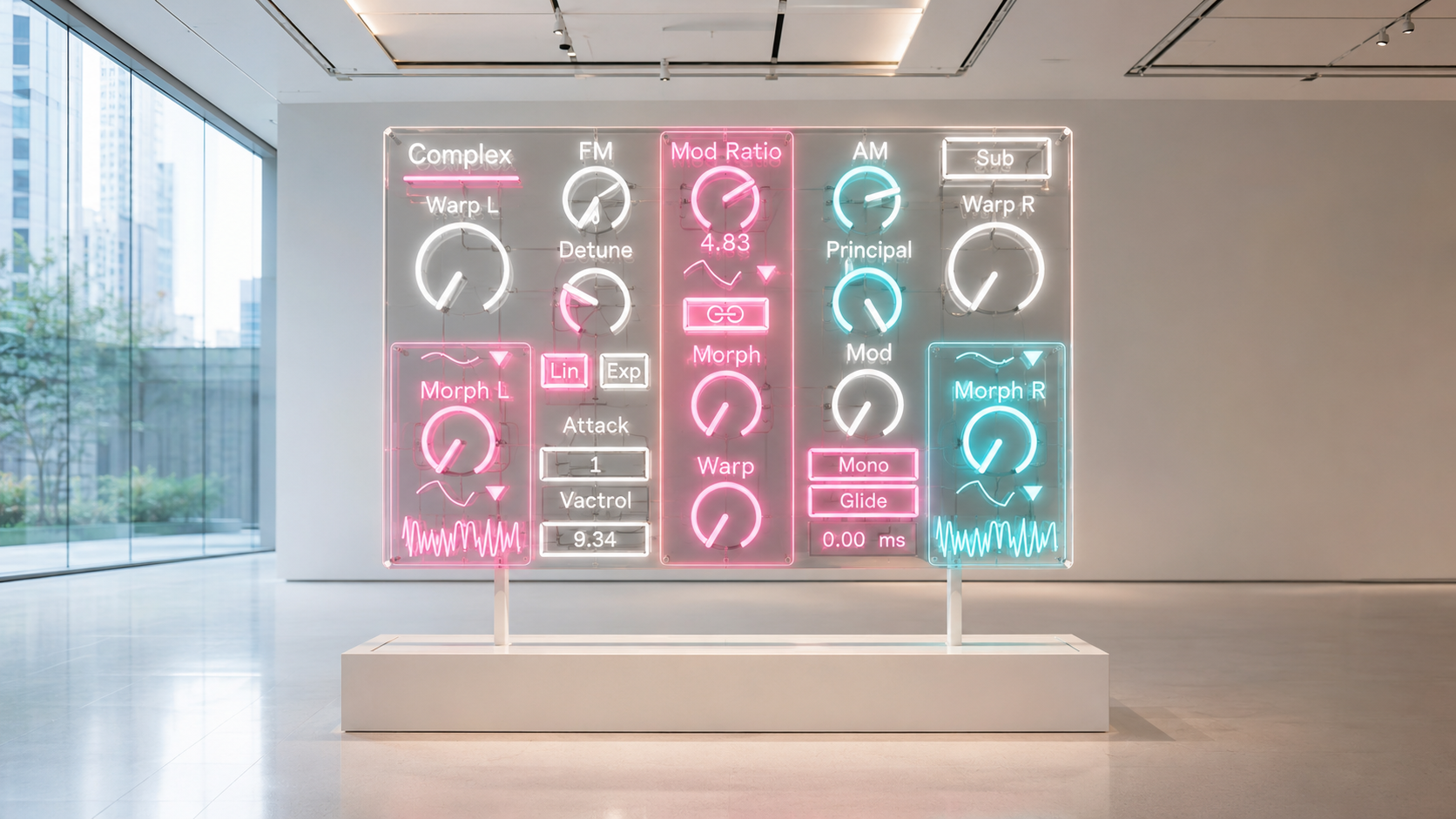
A complex oscillator begins from a different principle. Its identity emerges from the relationship between two oscillators.
One oscillator acts as the Principal voice. The other acts as the Modulation voice. The Modulation oscillator changes the frequency, amplitude, waveform position, and harmonic movement of the Principal oscillator. The resulting sound is not defined by a single waveform. It is defined by an interaction.
This approach became central to West Coast synthesis because it made timbre playable at its source. Rather than beginning with a harmonically dense waveform and removing frequencies through filtering, the musician generates complexity through oscillator ratios, FM, AM, waveform transformation, and low pass gate articulation.
Complex preserves this method inside Ableton Live. Its Modulation oscillator can move continuously from extremely slow cycles into the audible range. A gradual tonal movement can become tremolo, then harmonic animation, then metallic sidebands without changing instruments or rebuilding the modulation system.
The sound is discovered through relationships rather than selected from a finished list.
The Digital Character of the Buchla 259e
Complex does not treat the earlier Buchla 259 as an idealized analog destination.
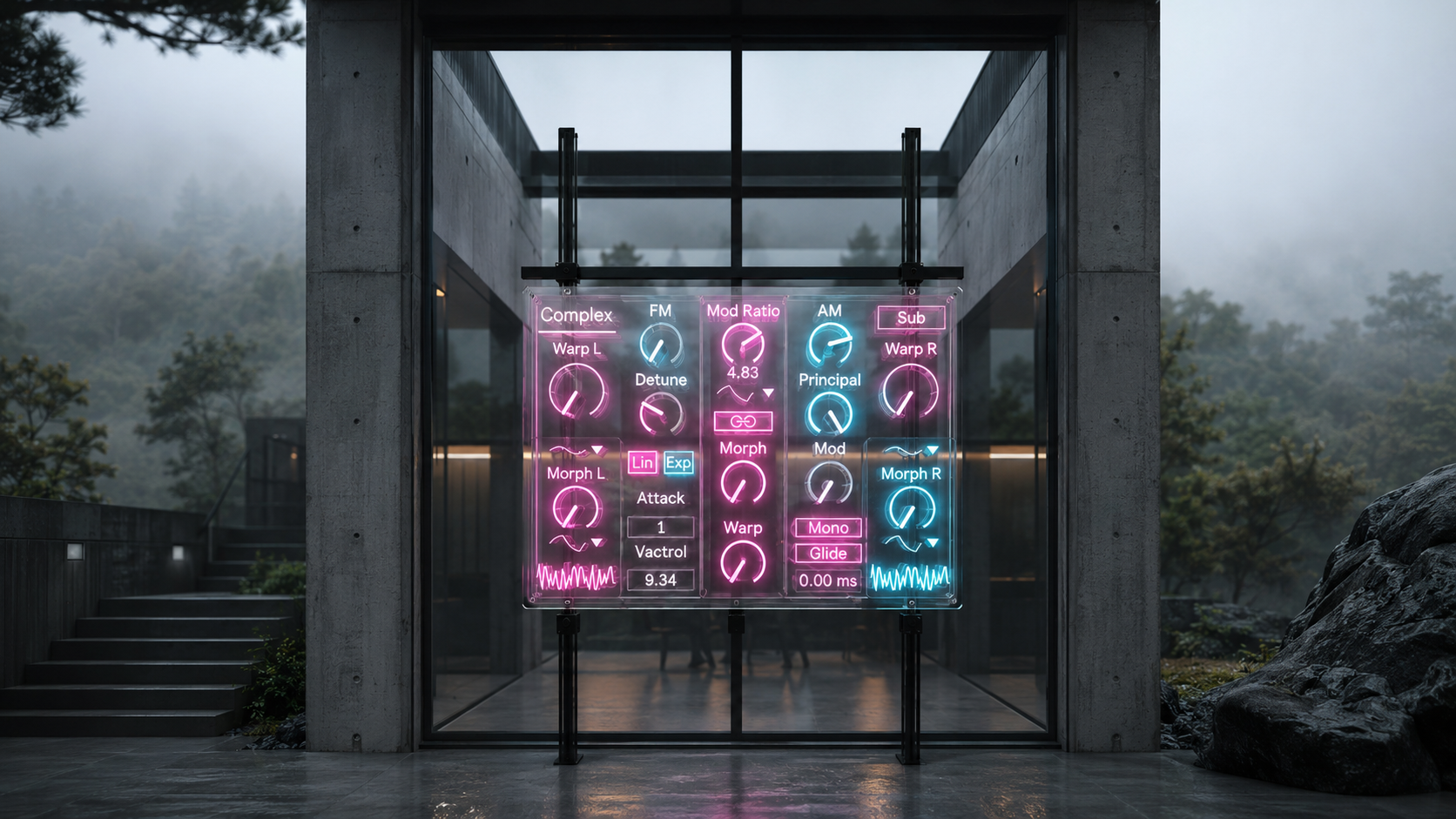
Its central reference is the Buchla 259e and the distinctly digital harmonic language introduced by its waveform system.
The 259e maintained the traditional relationship between Principal and Modulation oscillators while opening the complex oscillator to digital waveforms, irregular spectra, abrupt harmonic changes, aliasing, and instability. It represented a later interpretation of Buchla synthesis in which digital character was not something to hide.
Complex continues from that point.
The instrument contains waveform families captured from the 259e Green and Red sections. These include nearly fundamental tones, hollow octave structures, dense odd harmonics, and complex spectra with energy distributed across unusual harmonic regions.
They are joined by waveforms captured from the Buchla Music Easel, including complex sine, triangle, and square forms.
Easel Complex Glitch has a different structure. It remains close to the simplicity of a sine wave, but a sharp spike appears inside the waveform cycle. Its digital identity does not come from a constant cloud of fine upper harmonics. It comes from this concentrated spike and from the way Warp, FM, and audio rate modulation expose and enlarge it.
At restrained settings, the spike remains a small irregularity inside an otherwise clear tone. Under stronger transformation, it becomes the source of clicks, hard edges, unstable attacks, and fractured digital timbres.
Strong Warp and FM can also produce phase reversal, aliasing, and unstable upper harmonics. These results are intentionally retained as part of the instrument.
Complex therefore treats the 259e not as a historical endpoint, but as the beginning of a modern interpretation of the complex oscillator.
A New Stereo Horizon
The traditional complex oscillator is generally understood as one Principal oscillator interacting with one Modulation oscillator.
Complex expands this relationship into stereo.
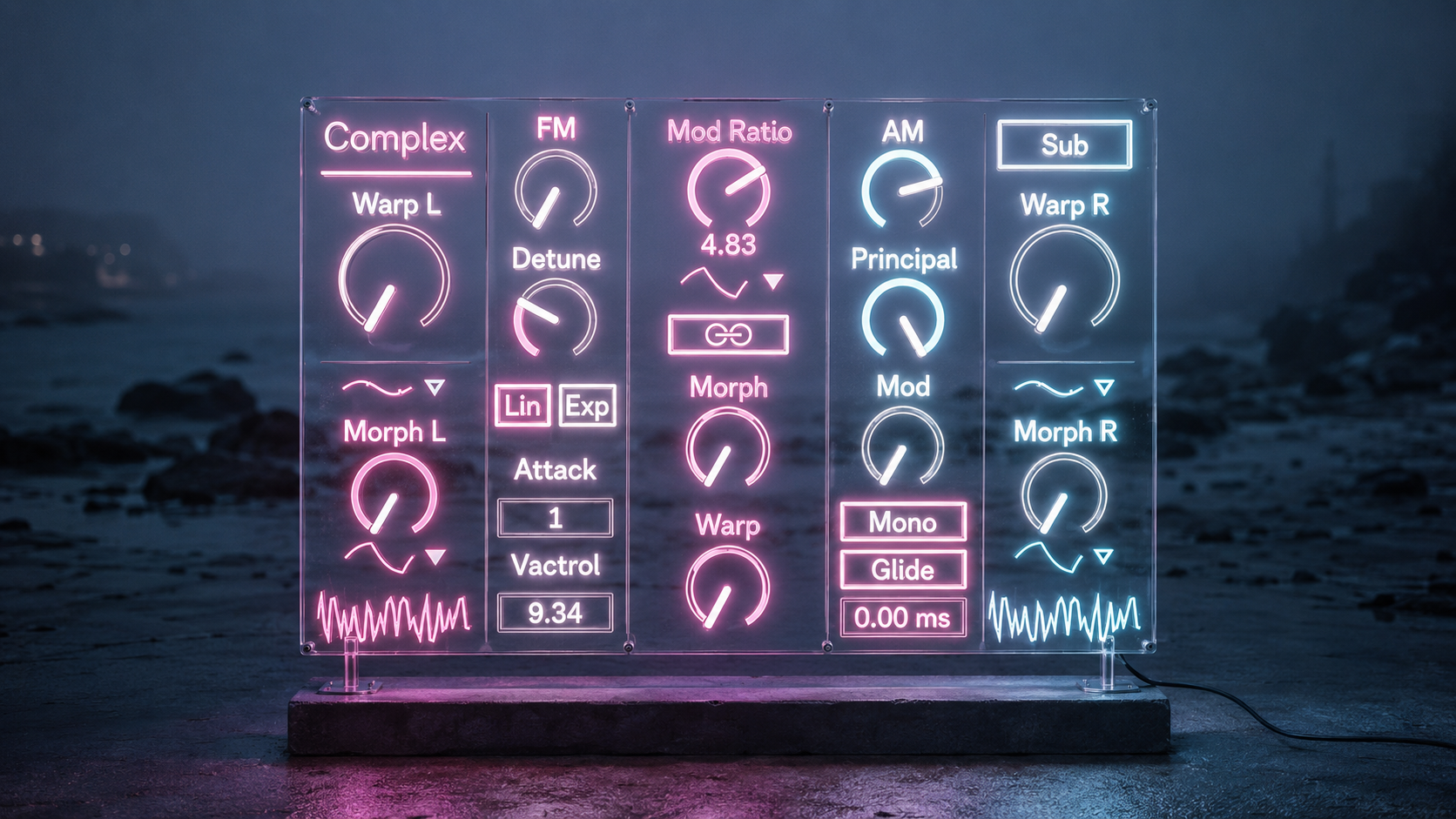
The left and right Principal oscillators can use completely different Wave A and Wave B combinations. Each side also has its own Morph and Warp position.
The channels do not need to be slightly detuned copies of the same waveform. The left side can begin with a smooth 259e Green waveform while the right side uses a harder 259e Red waveform or Easel Complex Glitch. One side can remain close to a fundamental while the other develops dense metallic harmonics.
Both sides still follow the same played note and remain parts of one coherent instrument.
This opens a field beyond conventional stereo widening.
Like the Make Noise XPO, Complex treats stereo as an oscillator level decision. Width does not need to come from chorus, delay, or phase manipulation placed after a mono source. It can emerge from two different harmonic identities existing inside the same note.
A drone can have two different spectral surfaces. A bass can retain stable weight on one side while digital fracture develops on the other. A lead can move through asymmetrical Morph and Warp positions while remaining one playable voice.
Detune can separate the left and right pitches symmetrically around the played note, but pitch separation is only one part of the stereo design. The greater possibility comes from allowing the actual waveform structure to differ between the channels.
When a strict central signal is required, LR Link copies the left waveform settings to the right and sends the left low pass gate signal to both Main outputs. Stereo is not permanently imposed. It becomes a compositional decision.
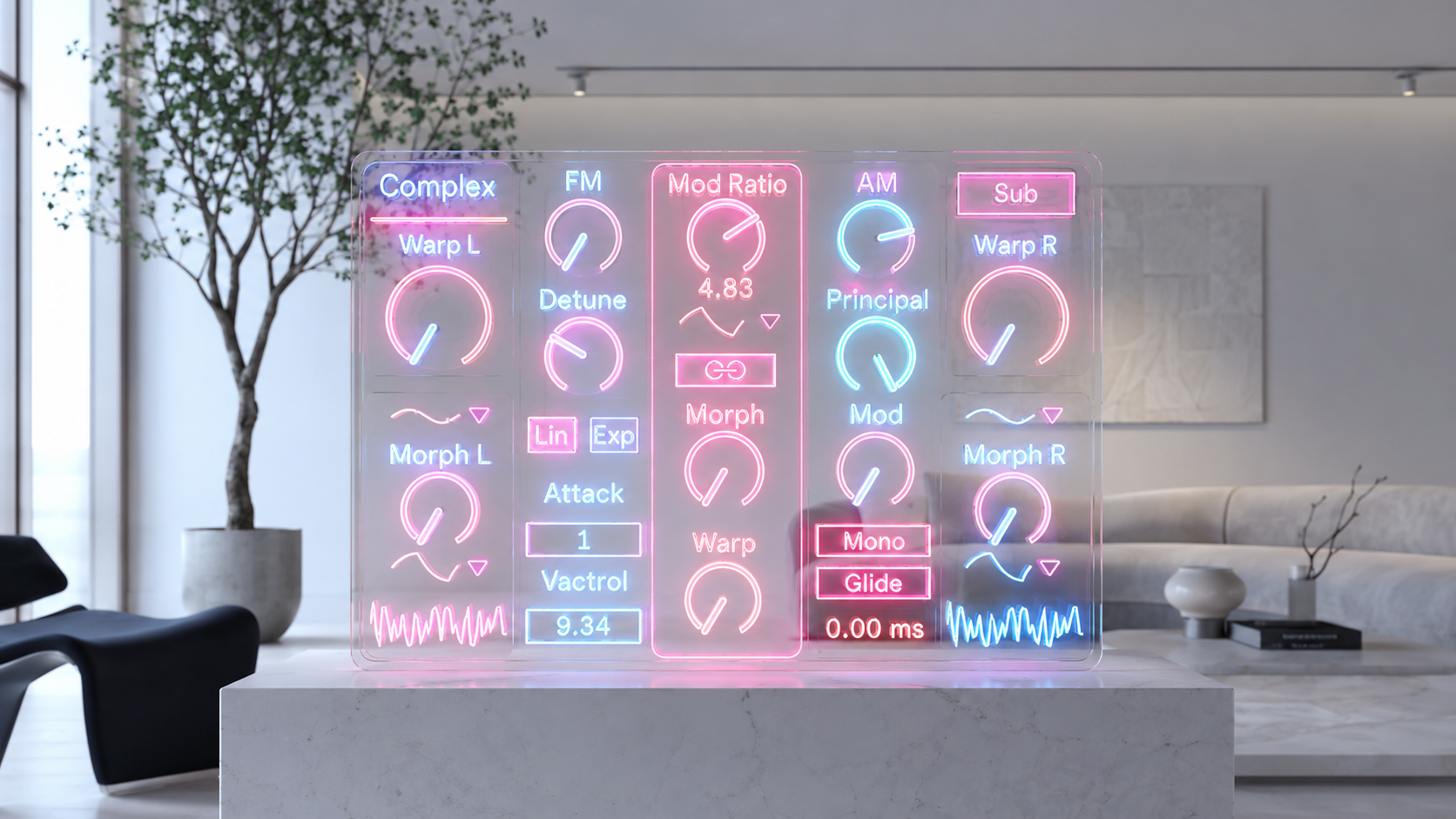
The Buchla Bongo Inside Ableton Live
One of the most recognizable sounds associated with Buchla synthesis is the Buchla bongo.
It is short, resonant, electronic, and physical at the same time. Its identity does not come from a sampled drum or a conventional subtractive patch. It emerges from the interaction of oscillator modulation and a low pass gate.
Complex makes this traditional sound easy to construct inside Ableton Live.
A sine based or restrained Principal waveform establishes the body of the note. FM introduces a short change in pitch and harmonic pressure. AM changes the internal amplitude structure. The modeled low pass gate then closes loudness and brightness together.
With a fast Attack and a short Vactrol response, the sound becomes compact, dry, and percussive. Increasing FM adds the struck and pitched quality associated with Buchla percussion. Adding a smaller amount of AM introduces stronger sidebands and a less conventional attack. Extending the Vactrol response gives the note a softer and more elastic decay.
Because FM, AM, and the low pass gate already belong to one connected instrument, the Buchla bongo vocabulary can be reached without constructing a large modular patch.
The same structure can then move beyond tradition.
Different left and right waveforms can turn the bongo into a stereo object. Higher modulation ratios can move it toward bells and metallic percussion. Stronger Warp can transform it into digital clicks, broken drums, or experimental bass transients.
Complex does not only reproduce a familiar Buchla sound. It provides a way to continue developing it.
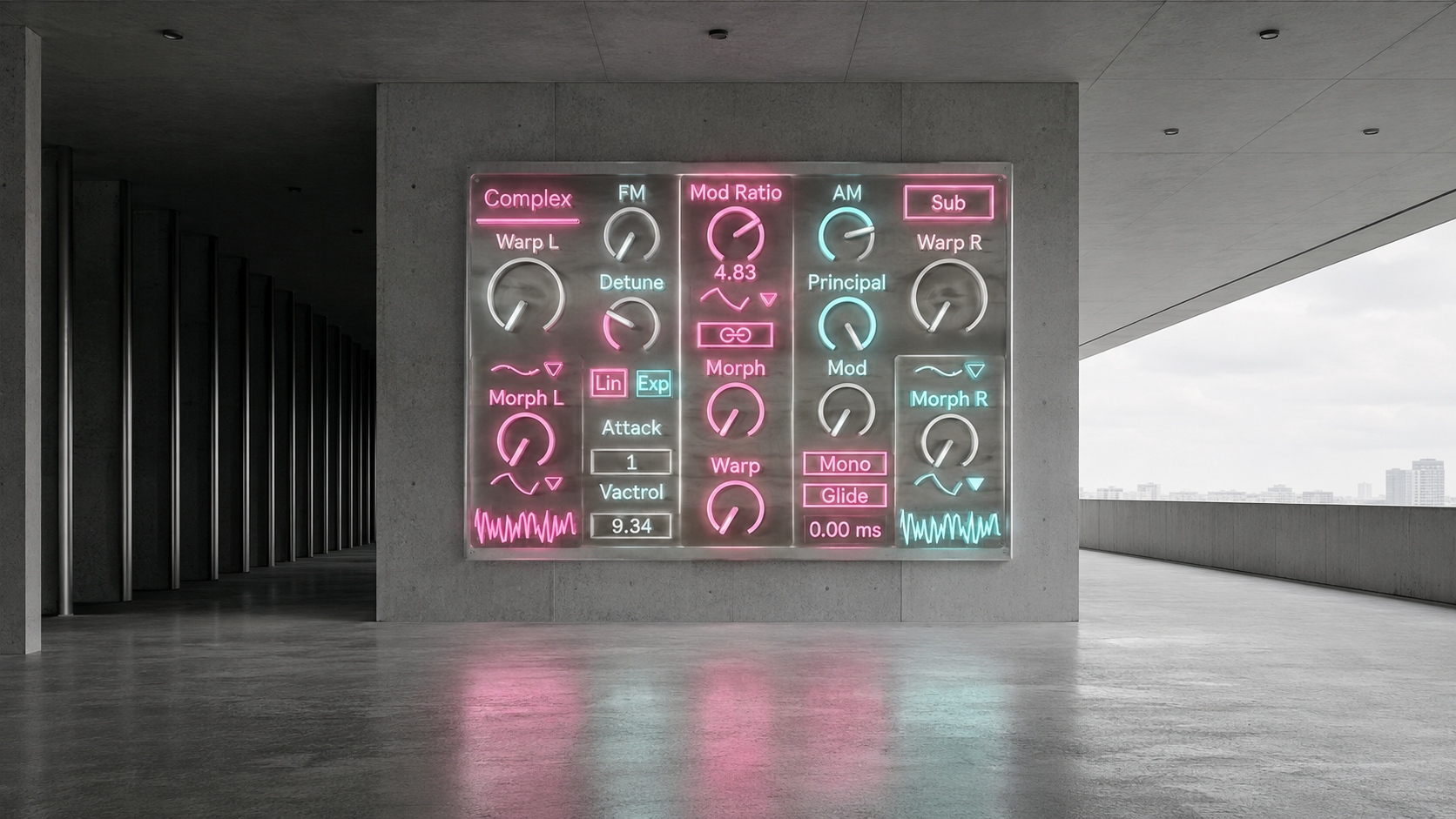
The Physical Motion of the Low Pass Gate
The low pass gate is essential to the way Complex behaves as an instrument.
In a conventional synthesizer, amplitude and brightness are often controlled by separate systems. A low pass gate connects them. As the sound closes, it also becomes darker.
Complex models this coupled response through multiple time behaviours rather than treating Vactrol as a simple release control.
Short settings produce a dry and immediate response suitable for bongos, plucks, compact bass sounds, and percussion. Longer settings allow the sound to bend and decay with greater softness and weight.
MIDI velocity affects both amplitude and brightness. A softly played note does not merely become quieter. It also opens differently.
This relationship is one reason Buchla percussion can feel more physical than a conventional electronic envelope. The sound appears to lose energy as a material object would, rather than simply having its volume reduced.
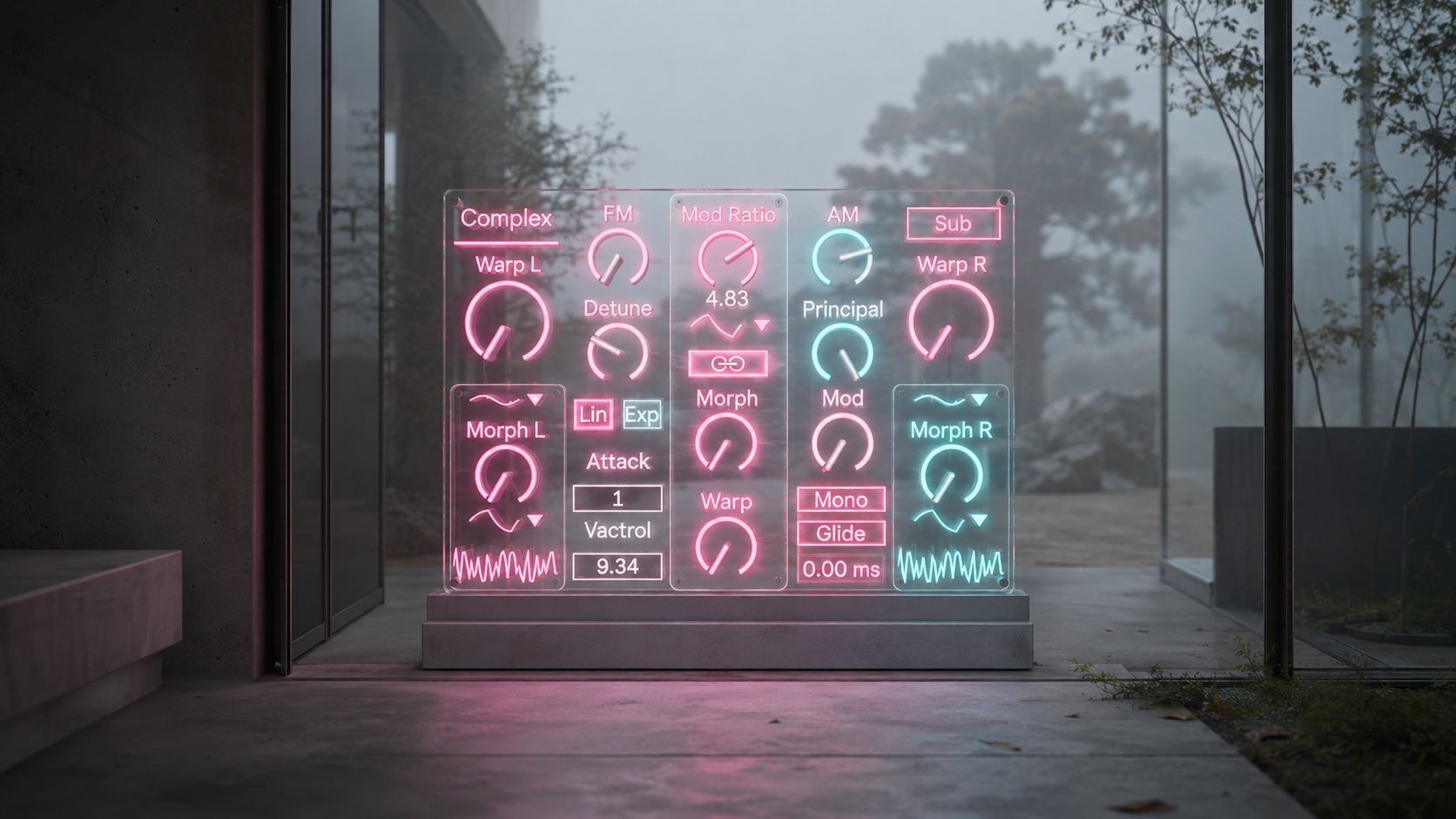
The Music Easel After the Oscillator
After the low pass gate, the Main signal passes through a fixed output stage informed by the perceptual character of sending a Buchla source through the Aux input and Master output of a Music Easel.
This is not a component level circuit replica. It reconstructs the audible behaviour through asymmetric saturation, dynamic headroom, low and mid frequency body, restrained high frequency rounding, and a small interaction between the left and right channels.
Increasing the Principal and audible Modulation levels therefore changes more than volume. It changes density, harmonic balance, and the way the stereo image holds together.
The final stage gives the sound a more coherent centre while preserving most of the independent left and right structure.
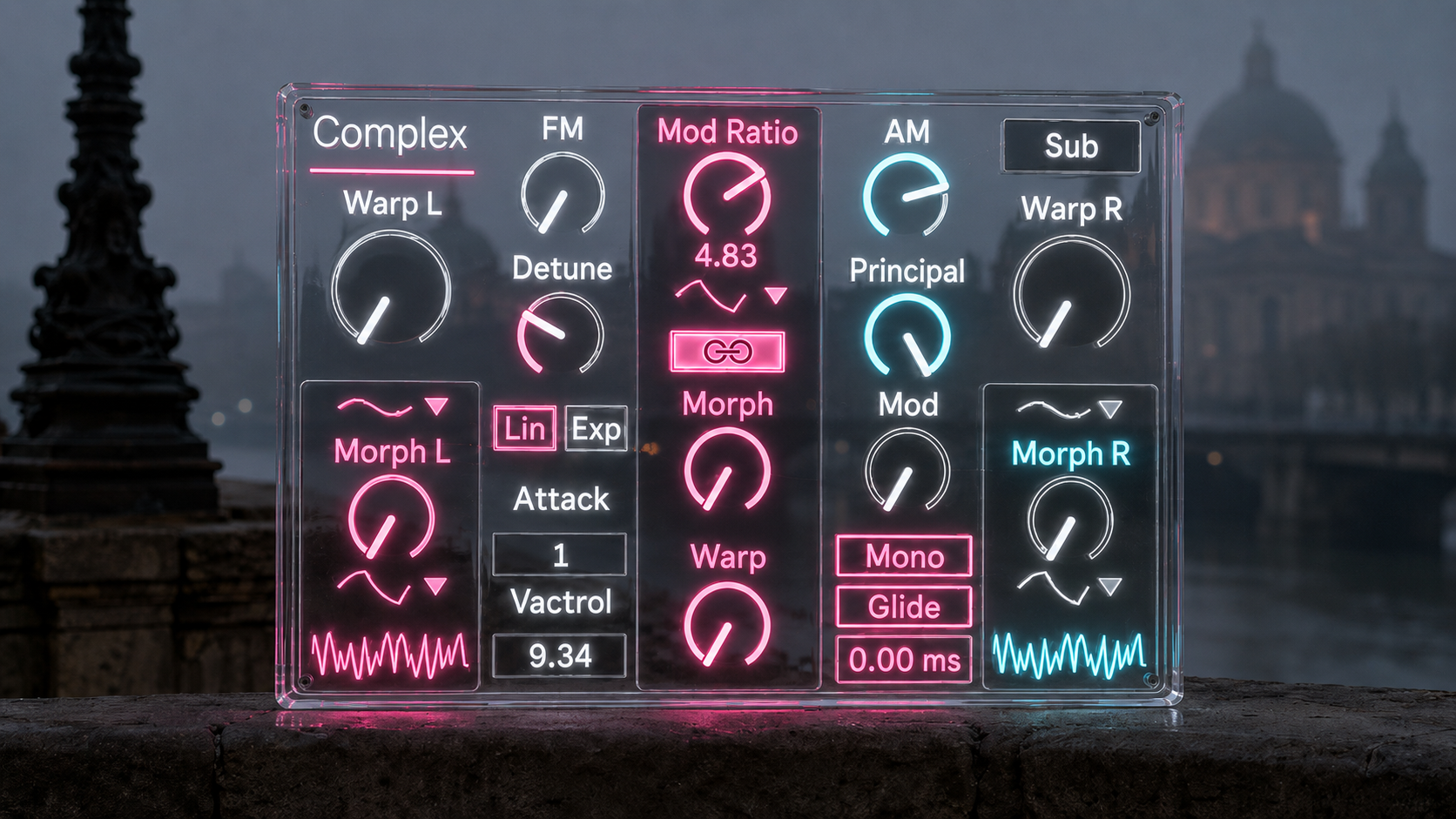
Modular Practice Without Leaving the Arrangement
Complex allows techniques developed through modular synthesis to remain inside the Ableton Live production process.
Frequency ratios can be automated across an arrangement. Slow movement can cross into audio rate modulation over several bars. Left and right waveform relationships can evolve through automation and clip envelopes. A Buchla style percussion sound can be resampled, edited, and placed into a track without recording an external modular system.
This does not replace the physical experience of patching hardware. It translates the method.
The complex oscillator remains a system for discovering sound through interaction. The 259e contributes its digital harmonic identity. The Music Easel contributes its waveforms, low pass gate behaviour, and output character. The stereo architecture extends the idea toward the territory opened by instruments such as the Make Noise XPO.
Complex brings these histories together inside Ableton Live, not as nostalgia, but as a platform for making new sounds.
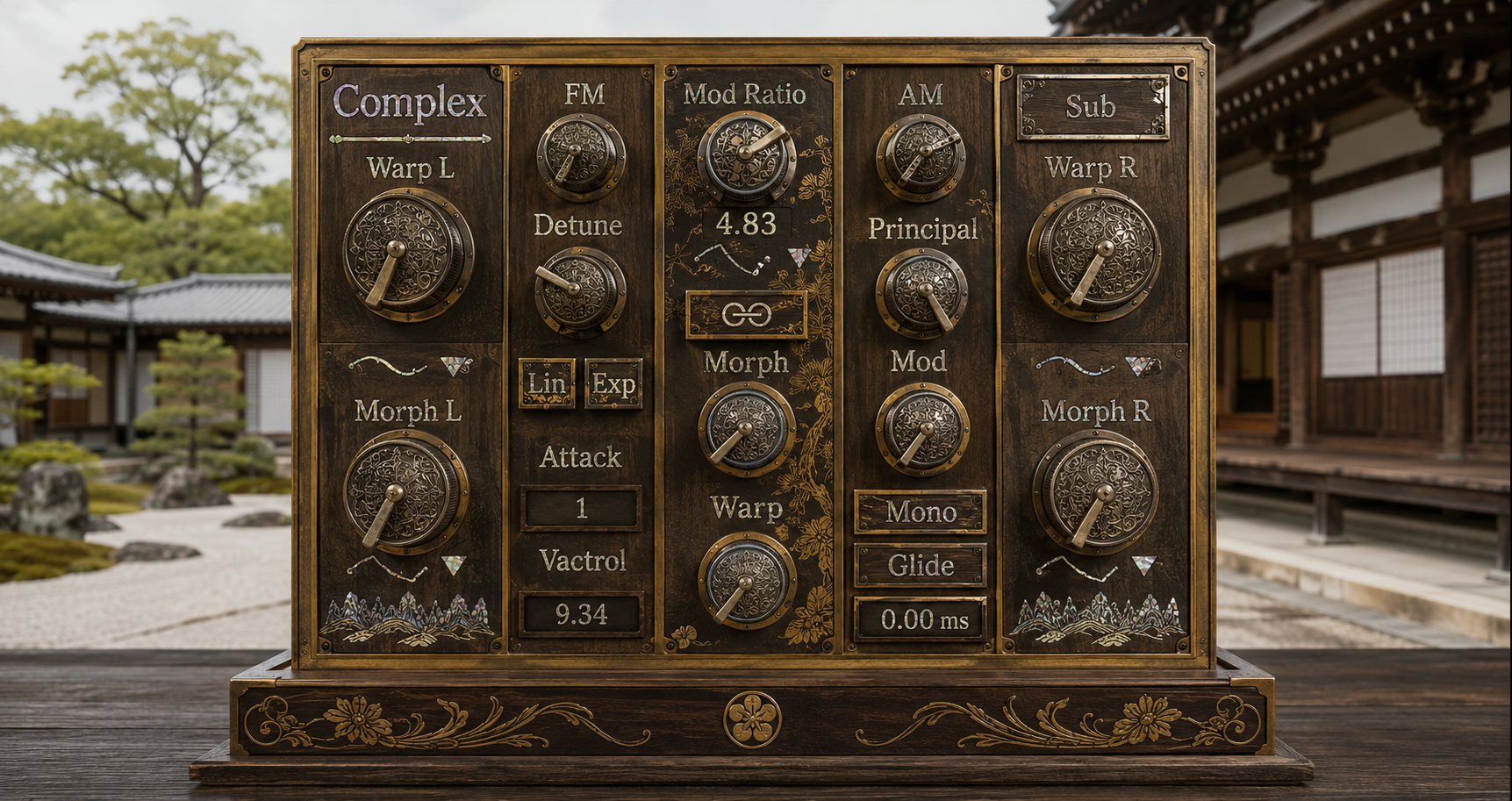
Complex 5.0 is a monophonic Max for Live instrument supplied as an .amxd device. It requires Ableton Live 12 and Max 8.6 or later.
Existing purchasers can log in to Sellfy using the account used for the original purchase. The latest version has already been added to that account at no additional cost. New users can purchase the current version through this product page.
ver.5.0 ... Major Update. Added a new waveform library captured from the Buchla 259e and Buchla Music Easel, with a redesigned Low Pass Gate response. (7/30/2026)
ver.4.0 ... MPE pitch bend supported. (2/28/2025)
ver.3.8 ... Stereo link mode added. (12/10/2024)
ver.1.3 ... octave pitch bug fixed.
ver.1.5 ... midi note on bug fixed, FM range extended.
ver.1.6 ... push3 support.
ver.2.1 ... Linear FM added, Wave 3 updated.
ver.3.0 ... Glide & FM updated. Live 12 supported.
ver.3.5 ... Glitch bug fixed.
ver.3.6 ... 3 more tones added.
Synthesizer
Harmo https://akihikomatsumoto.sellfy.store/p/ableton-harmo/
Reese90 https://akihikomatsumoto.sellfy.store/p/ableton-reese-90/
OP-2 https://akihikomatsumoto.sellfy.store/p/ableton-op2/
Kick Bass https://akihikomatsumoto.sellfy.store/p/ableton-kick-bass/
Complex https://akihikomatsumoto.sellfy.store/p/abletoncomplex/
PCMer https://akihikomatsumoto.sellfy.store/p/ableton-pcmer/
Holy7 https://akihikomatsumoto.sellfy.store/p/ableton-holy7/
Cycle https://akihikomatsumoto.sellfy.store/p/ableton-cycle/
Swarma https://akihikomatsumoto.sellfy.store/p/ableton-swarma/
808 https://akihikomatsumoto.sellfy.store/p/ableton-808/
Trap Snare https://akihikomatsumoto.sellfy.store/p/ableton-trap-snare/
303 https://akihikomatsumoto.sellfy.store/p/ableton-303/
DMGboi https://akihikomatsumoto.sellfy.store/p/ableton-dmgboi/
Akihiko Matsumoto
Study Site https://akihikomatsumoto.com/study/
Ableton M4L, Serum Preset Store https://akihikomatsumoto.com/download/
Sample Pack https://akihikomatsumoto.sellfy.store/sample-pack/
Bandcamp https://akihikomatsumoto.bandcamp.com
Ableton Skin https://akihikomatsumoto.sellfy.store/p/ableton-skin-pack/
Spotify https://open.spotify.com/artist/1tZMmxzZbvNu6klyKXa0L1?si=2JZaFeLbREi-UownD8POSg