
$14.99+
Ableton 808 v.2.5
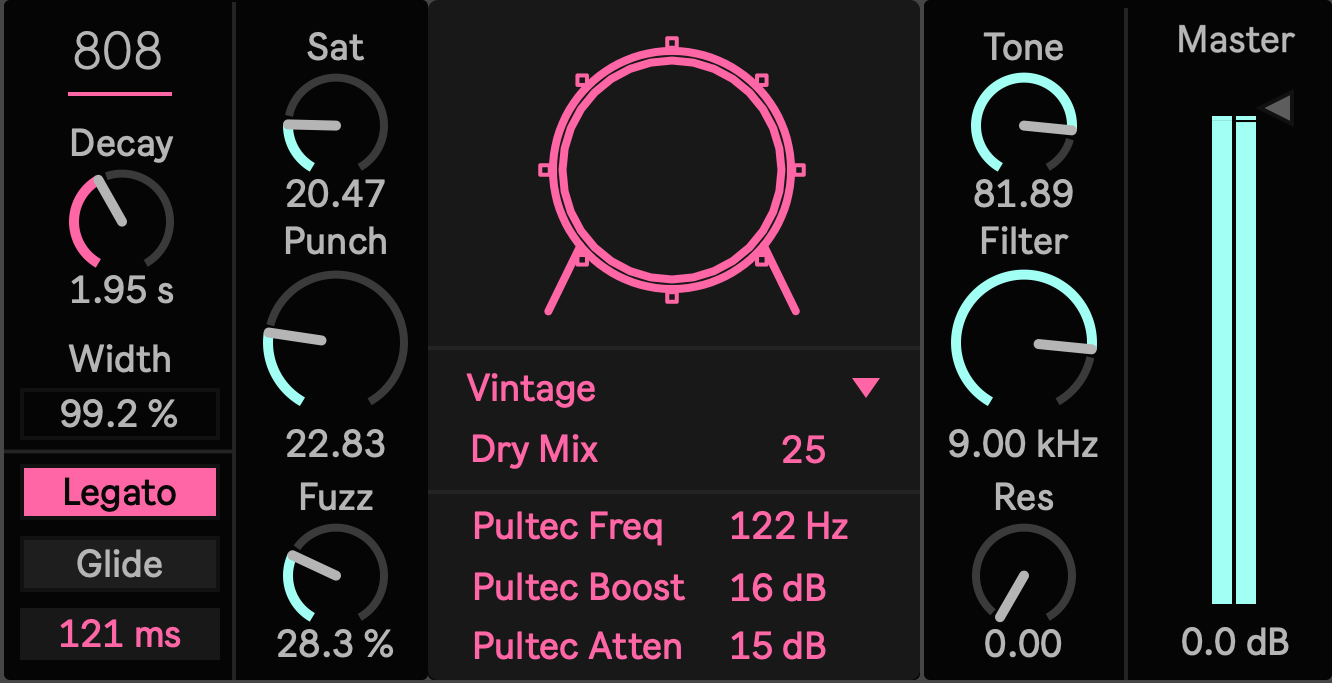
Max for Live Device | Remove the boundary between kick and bass from the beginning
There is a point in working with an 808 kick where asking whether it is still a drum stops being useful.
Keep the decay short and it becomes a focused low frequency impact that defines the beat. Let the same sound ring longer and the resonance begins to occupy the space between events. Extend it further and play different pitches from MIDI, and it starts behaving like a bass line. Add harmonics, filter them, reshape the low end, and introduce spatial detail, and a sound that began as a bass drum can gradually become the low frequency center of an entire track.
808 v.2.5 is a Max for Live MIDI instrument designed around that transition.
It does not load a finished 808 sample and process it afterward. Each MIDI note excites a synthesis core informed by the behavior of the TR 808 bass drum circuit, and the sound is generated in real time from the resulting resonance. Pitch, duration, timing, and the energy that remains before the next trigger are therefore part of the performance from the beginning.
Instead of choosing a kick, you play the system that produces it.
That is the starting point of 808 v.2.5.
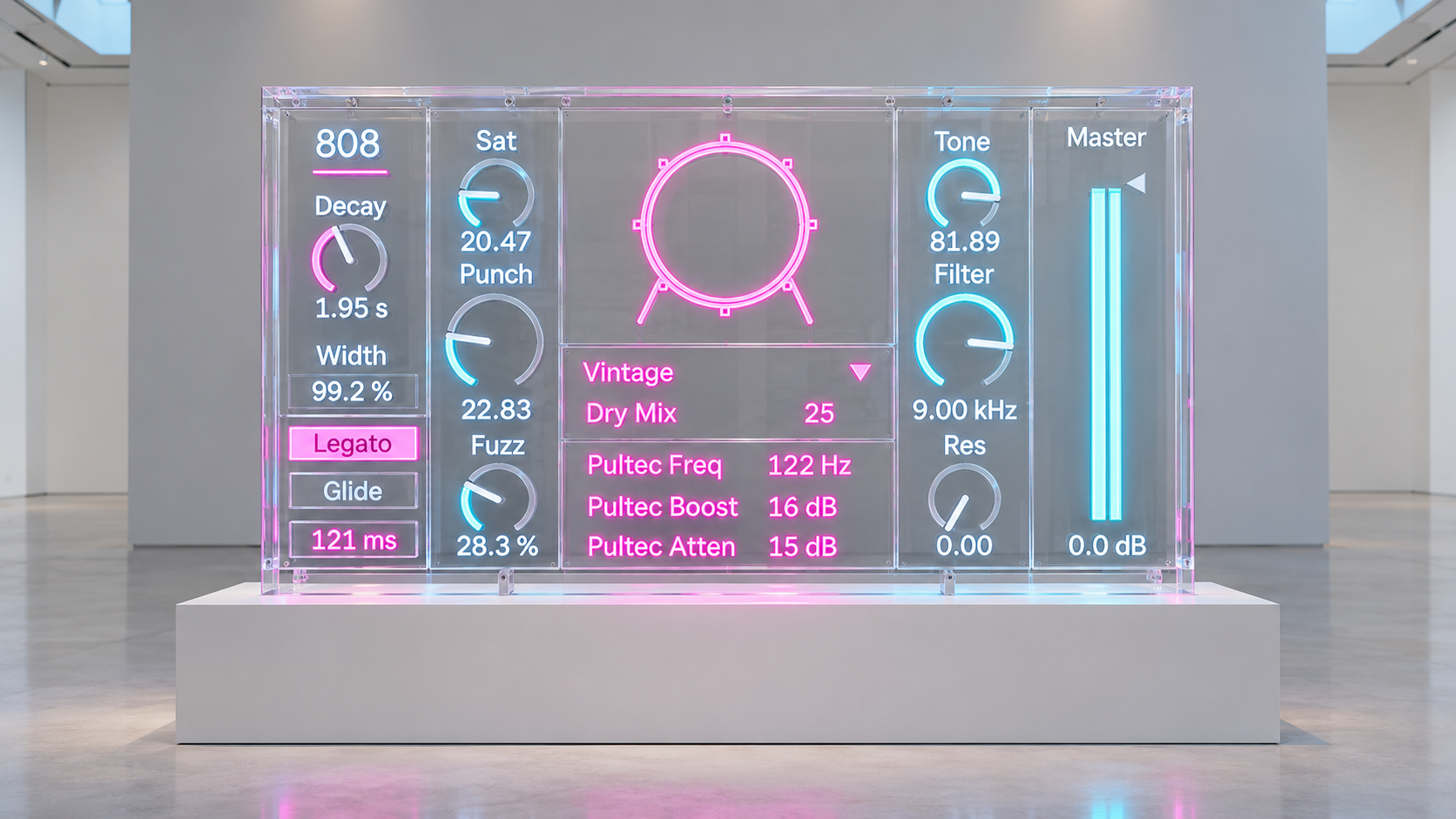
A system that keeps resonating instead of replaying a finished sound
With a sample based kick, each trigger normally starts another playback of an already completed recording. You can transpose it, shorten it, distort it, or process it further, but the source itself has already been decided.
808 v.2.5 works differently.
Its internal synthesis references pulse shaping, a bridged T resonator, feedback behavior, the Tone network, and output coupling associated with the TR 808 bass drum. A trigger is treated as an excitation of a resonating system rather than a command to play a prerecorded sound.
This becomes important when notes arrive close together.
The principal resonator state persists across retriggers, so the next event can interact with energy that is still present inside the synthesis system. A sequence is therefore not simply the same audio file appearing at different points in time. Pitch, timing, and remaining resonance all participate in the behavior of the instrument.
That response can be heard in tightly programmed sixteenth note patterns as well as in isolated kicks with large spaces between them. Even with the same control settings, the internal state of the system can be different when the next note arrives.
The purpose is not simply to reproduce a familiar bass drum tone. It is to make the 808 behave as an instrument that continues responding through time.
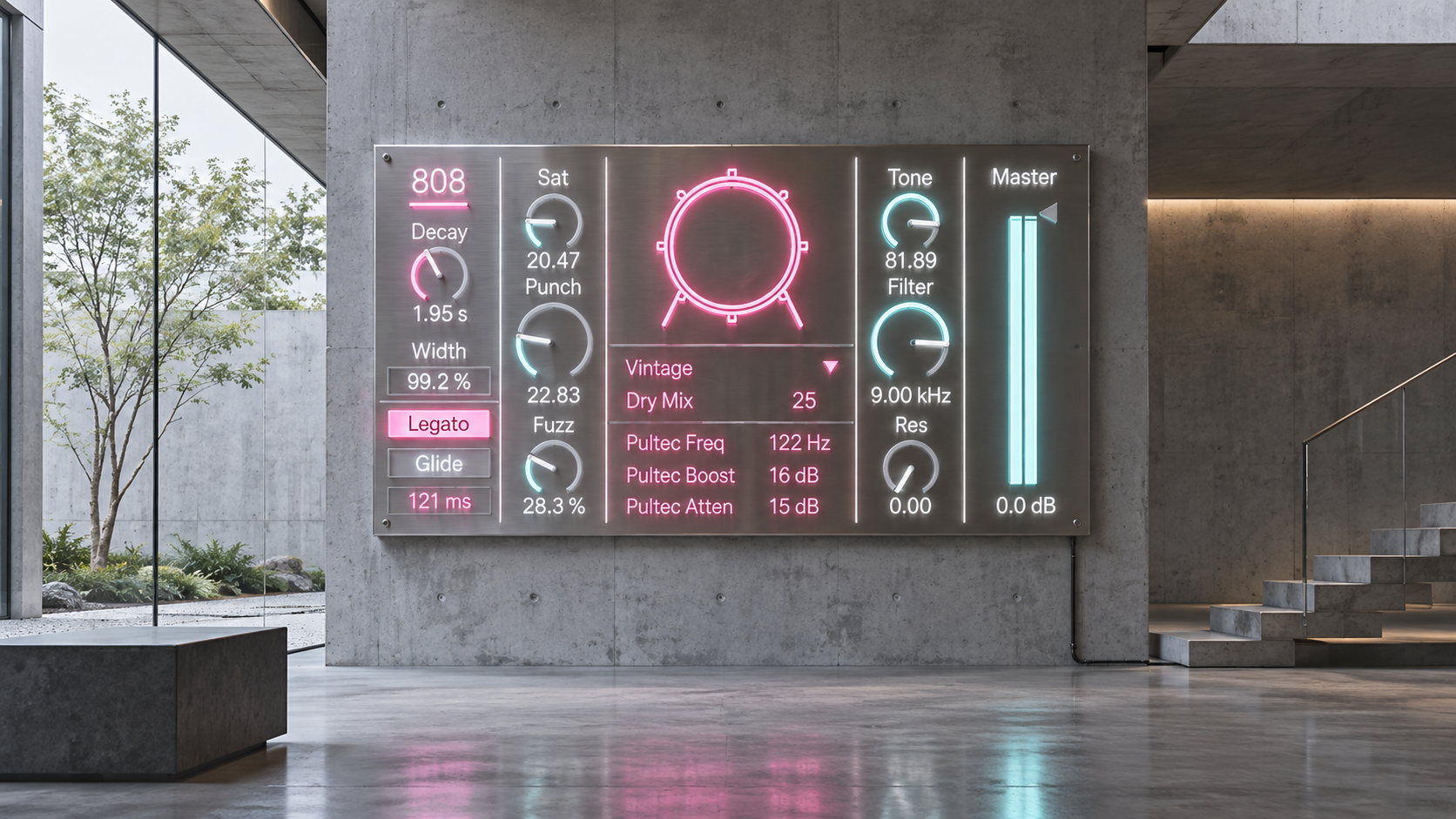
From a 10 millisecond impact to 30 seconds of low frequency resonance
Decay makes this character immediately apparent.
Its range extends from 10 milliseconds to 30 seconds. At the shortest values, the sound can be shaped into compact percussion that leaves room for dense rhythmic programming. Increase the value and the resonance begins to survive beyond a single beat. At extreme settings, the same synthesis system starts to behave less like a conventional kick and more like a sustained low frequency instrument.
When different MIDI notes are introduced, that long resonance becomes pitch material.
A note can continue into the next event, and the distinction between bass drum and bass voice becomes increasingly irrelevant. Instead of layering a separate bass instrument underneath a kick, the same resonating system can occupy both roles.
The 30 second range is not presented as a control found on an original TR 808. 808 v.2.5 begins with a region informed by the circuit inspired behavior and extends it into a larger musical range for contemporary production.
What matters is not the number itself. What matters is that one synthesis model can move continuously from a short impact to a sustained pitched low frequency voice.
The same patch can remain a drum, or become something much larger.
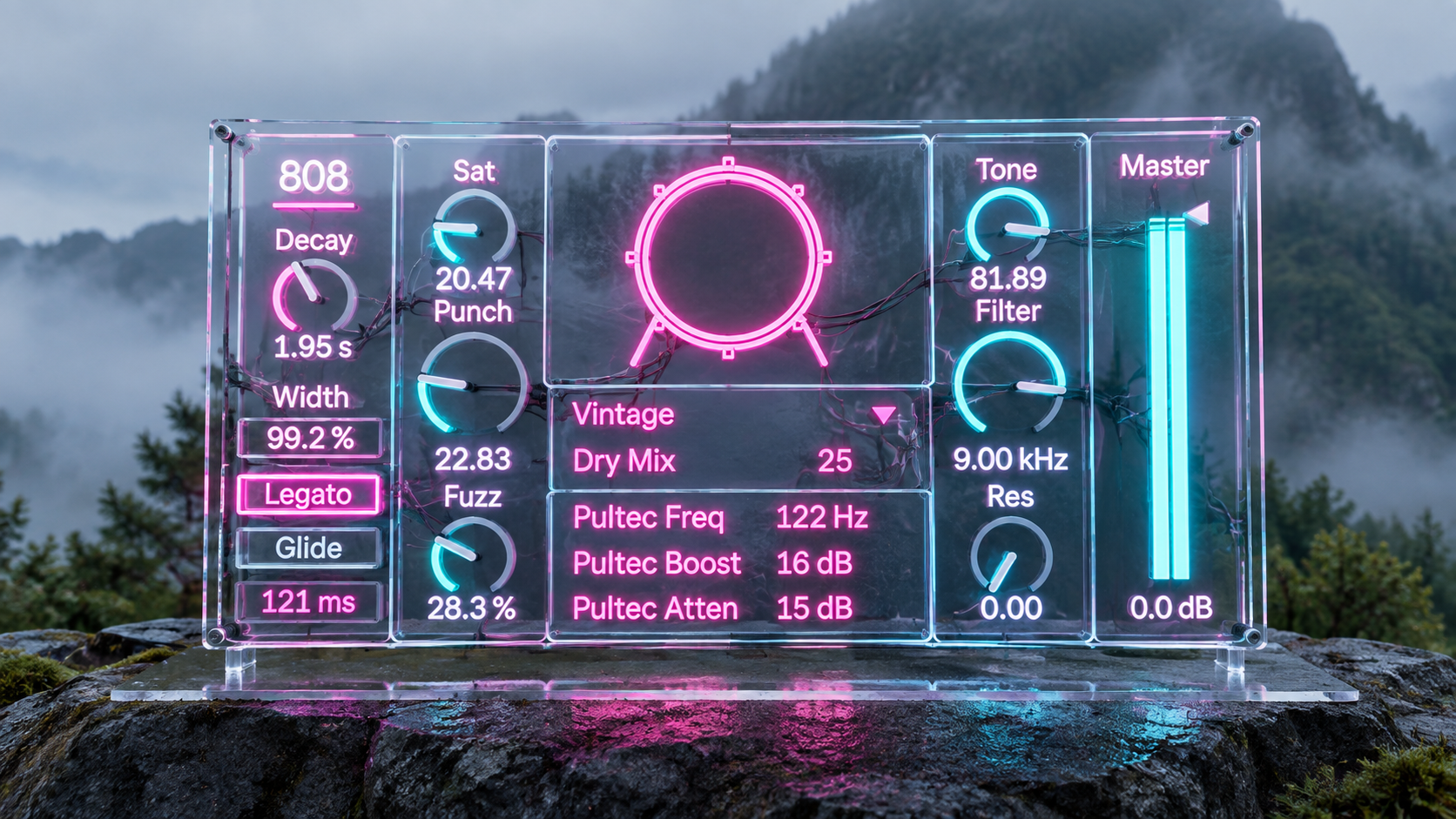
Change the shape of the hit instead of simply making it louder
A powerful low end does not automatically produce a powerful kick.
Sometimes the sub is strong but the beginning of the sound has too little definition. In other cases the attack is clear, yet the area between the initial transient and the resonant tail feels too empty.
Punch is designed to reshape that part of the sound without functioning as a simple final volume boost.
Internally, it introduces an additional voice combining short transient energy, low frequency body, and shell like resonance. With Punch at zero, the approved core path remains unchanged. As the control is increased, more mass can be introduced around the beginning of the hit and the region immediately after it.
This becomes particularly useful before nonlinear processing.
Distorting a resonance with little transient definition produces a different result from shaping that transient first and then driving the signal harder. Because Tone also affects the additional Punch voice, the attack does not have to sound like a separate layer pasted onto the core. It remains connected to the broader voicing of the instrument.
The result is control over where the force of the sound appears in time, rather than a simple increase in level.
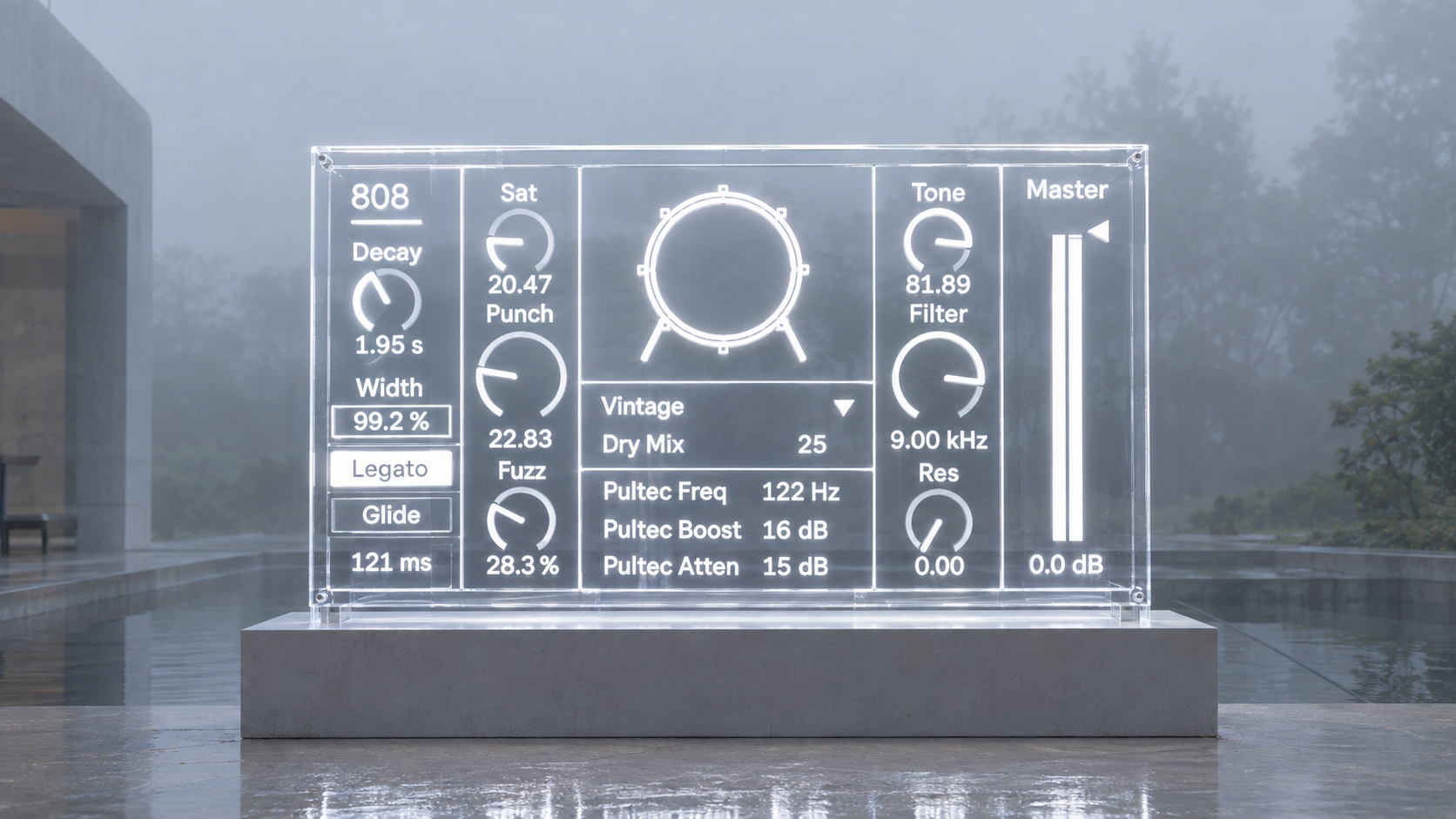
Distortion as a source of new material
808 v.2.5 contains two different nonlinear stages, Drive and Fuzz.
They do not need to be treated as final effects.
Drive increases harmonic density before the later Fuzz and Filter stages. A resonance that initially lives mainly in the low frequency range begins to develop information further up the spectrum. Fuzz can then push that transformation further through two internal voicings called Vintage and Modern, each with different gain, bias, and spectral behavior.
At that point the distorted sound still does not need to be considered finished.
A four state Minimoog style transistor ladder Filter follows the nonlinear stages, allowing the harmonics created by Drive and Fuzz to be shaped afterward. Distortion can therefore act as a generator of new spectral material, while the Filter decides how much of that material becomes part of the final voice.
In one context, a small amount of Drive followed by a slightly closed Filter can increase density without making the kick feel obviously distorted. In another, stronger Fuzz and resonance can move the instrument far beyond a conventional 808 sound and into more synthetic low frequency territory.
The feedforward nonlinear processing in this path uses first order antiderivative antialiasing. During development, offline validation showed reduced high frequency aliasing compared with the corresponding naive nonlinear processing.
This is not a claim that analog is inherently better than digital, or that a particular distortion character is universally preferable. It is an implementation decision intended to make aggressive nonlinear processing more usable while reducing unwanted digital artifacts where the validated processing applies.
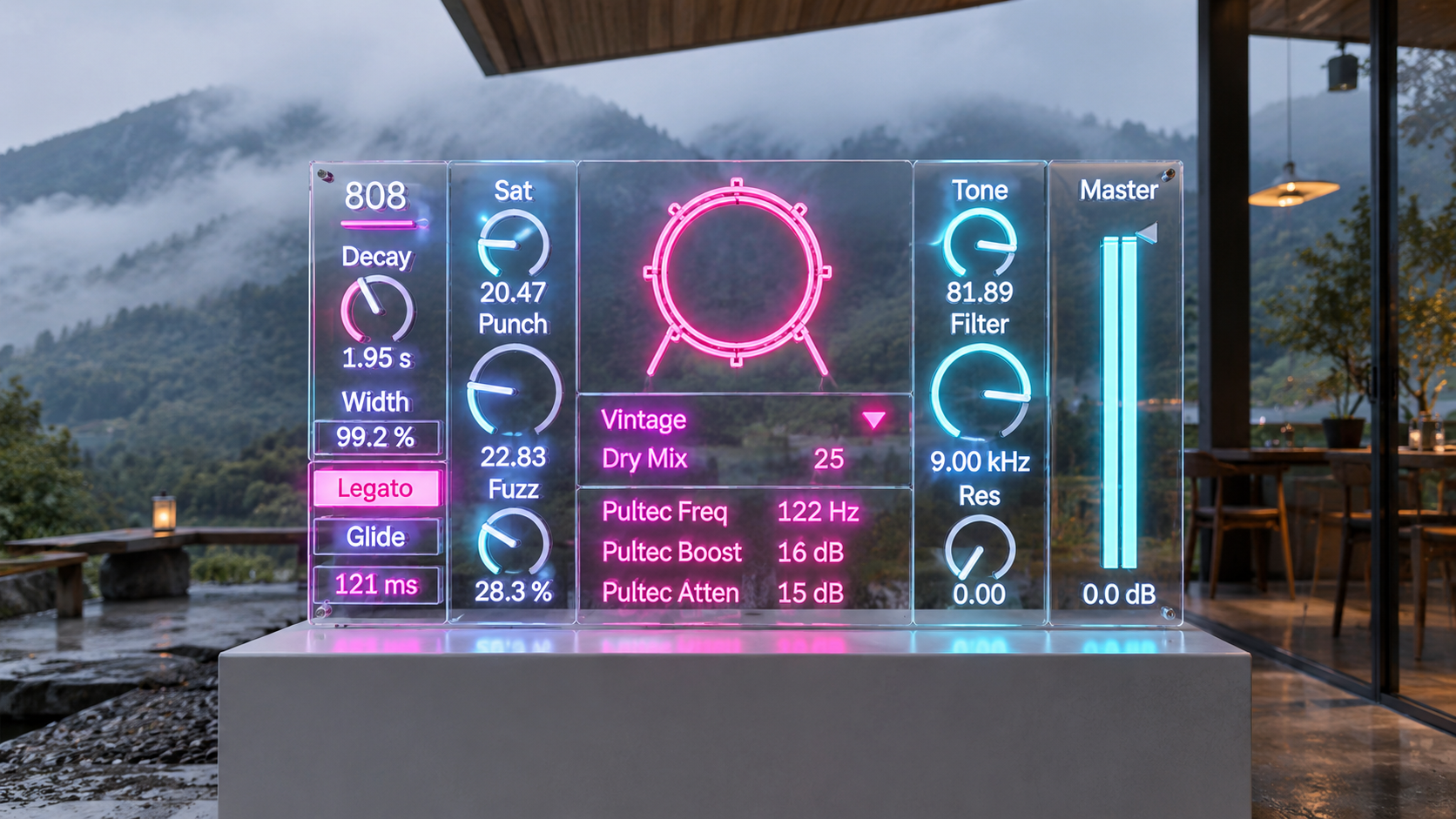
Low frequency shape is not the same thing as decay
When a kick does not sit correctly in the low end, changing Decay is an obvious first reaction.
But duration and spectral shape are not the same problem.
A long tail may have the right length while carrying too much energy in the wrong region. A short kick may already stop exactly where it should, yet still need more apparent weight. For that reason, 808 v.2.5 includes a Pultec style low frequency section constructed from a Wave Digital Filter model.
Freq, Boost, and Atten do not behave simply as three unrelated equalizer controls. They interact to reshape the contour of the low end.
This lets Decay define the behavior in time while the Pultec section handles a different question, namely where the low frequency energy should sit. The two decisions no longer need to be collapsed into a single control.
When Boost and Atten are neutral, the validated implementation returns this section to an exact dry identity.
If the sound already works, the stage does not need to contribute anything. If the low end needs a different contour, it becomes available without requiring the core synthesis to be rebuilt.
That principle runs throughout 808 v.2.5.
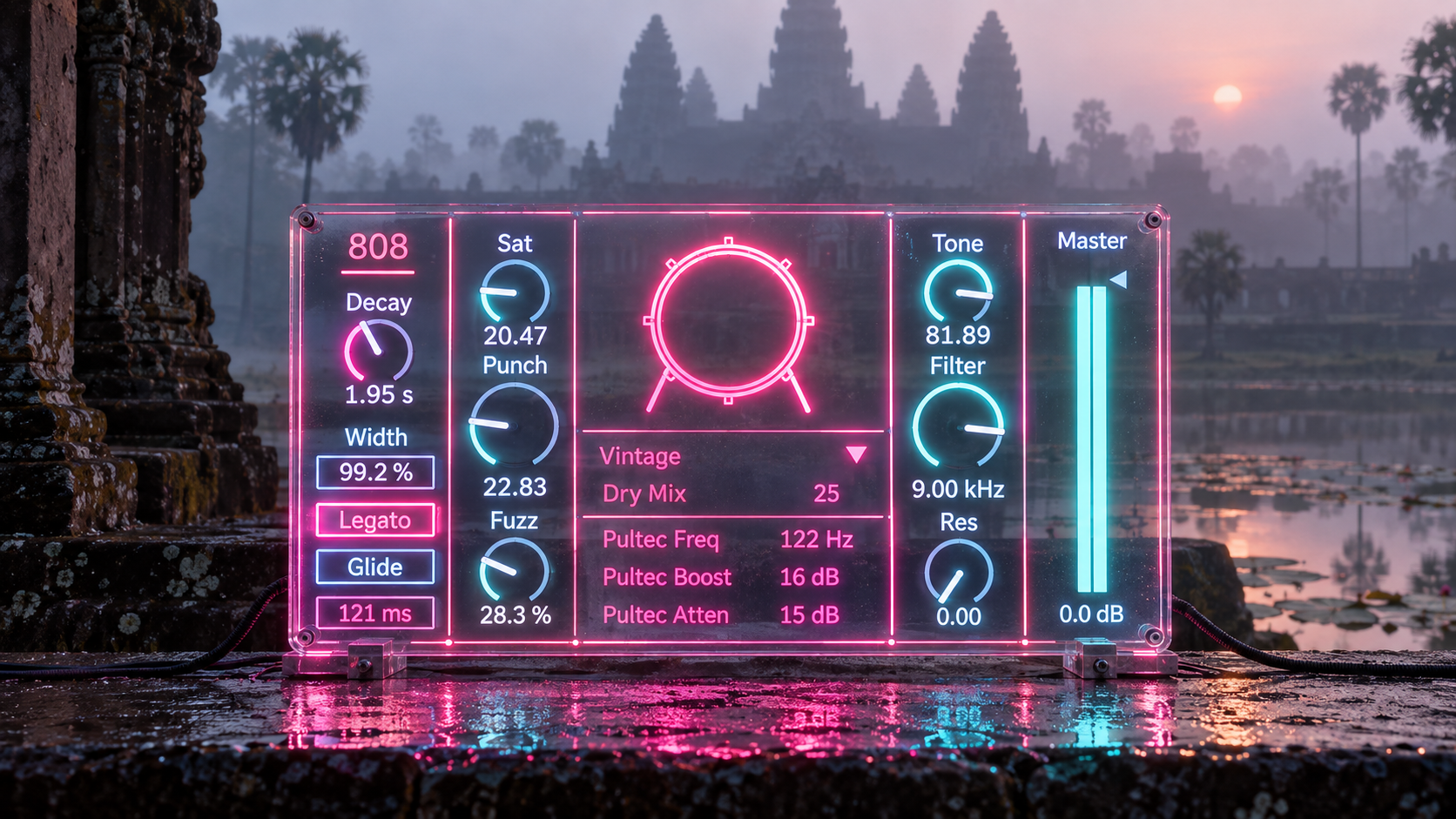
If the sound becomes wider, decide what should become wide
Low frequency stereo processing needs to be handled carefully.
Spreading the fundamental region of a bass drum too aggressively can make the result less predictable in mono playback or large sound systems. At the same time, the upper spectrum created by Drive, Fuzz, and filtering can benefit from some spatial variation.
Width is designed around that distinction.
Rather than turning the entire signal into a large Side component, it derives stereo difference mainly from material above the lowest region of the sound. Differential allpass processing creates Side information while low frequency content is restrained before that Side signal is formed.
Width is therefore not simply a control for making the kick larger from left to right.
It can be used to decide which part of the voice stays strongly centered and which part is allowed to develop spatial character.
This becomes especially useful after nonlinear stages have generated new upper frequency information. Material that barely existed in the original resonator can acquire a subtle stereo presence, while the lowest part of the sound remains more focused.
If the track does not need that behavior, Width can remain at zero, which is an identity endpoint in offline validation.
The point is not to make every kick wide. The point is to have a controlled way of introducing space when the sound actually benefits from it.
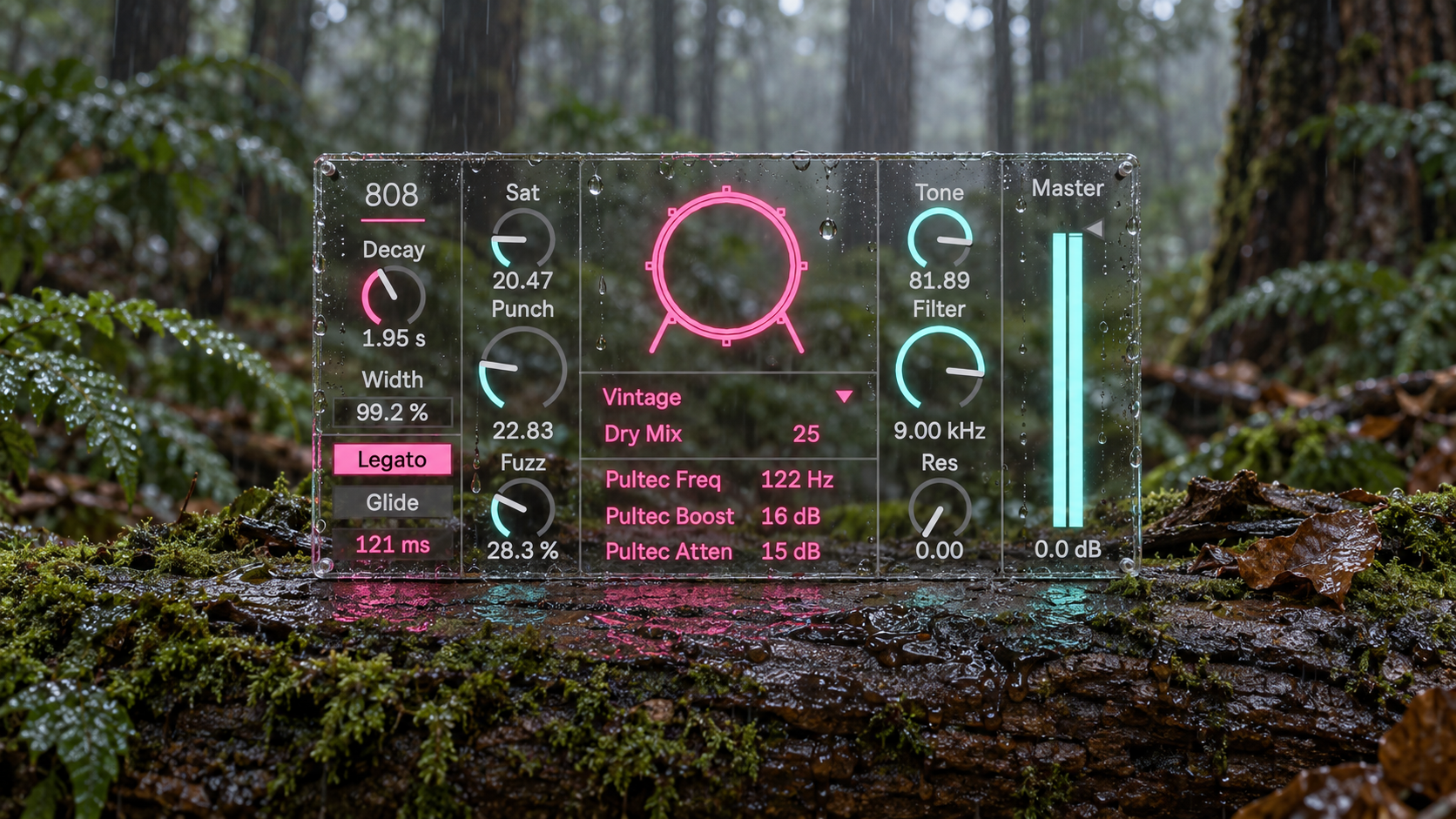
And eventually, play the 808
The reason these processes belong inside one MIDI instrument becomes clearest when pitch enters the performance.
MIDI notes directly control the pitch of the resonating voice. A repeated single note can behave as a conventional kick pattern, while a sequence of pitches can turn the same synthesis system into a bass line.
With a short Decay, pitch differences appear as changes in character from one hit to the next. With a longer Decay, each note remains present for more time and the instrument begins behaving more like a bass synthesizer. Mono and Legato behavior, Glide type, and Glide Time allow pitch transitions to become continuous when the musical part calls for it.
This changes the workflow substantially.
There is no need to render one kick to audio, duplicate it, transpose individual copies, build a separate bass layer, and then reconstruct the relationship between all of those elements every time the harmony changes.
The kick and the bass can remain part of the same instrument.
In techno, electro, experimental club music, and other forms where the relationship between kick and bass defines the structure of the track, that can affect composition as much as sound design. Instead of deciding later how two separate parts should coexist, the relationship can be written directly into the MIDI performance.
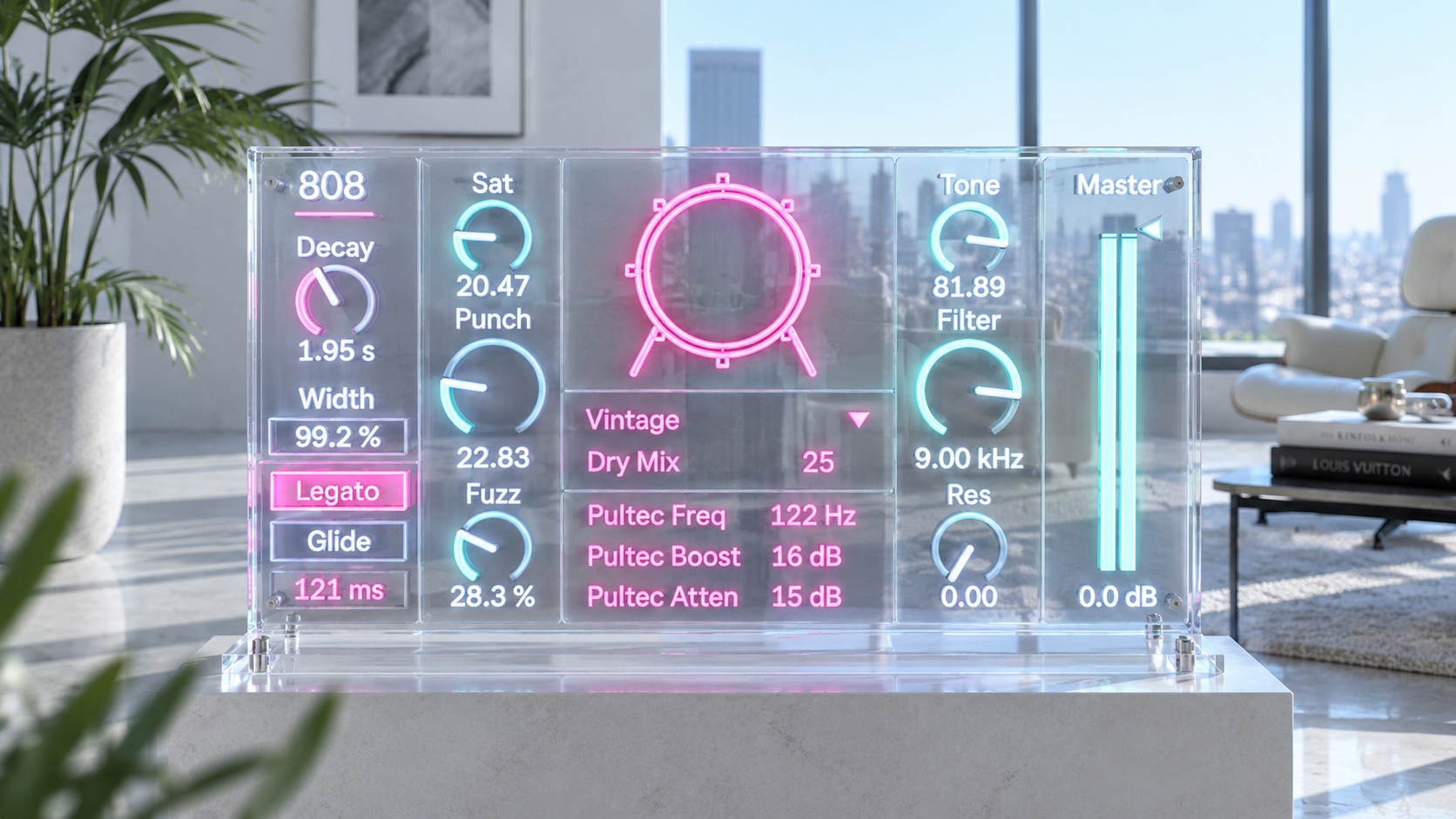
You do not need to use everything
808 v.2.5 contains many processing stages, but it is not designed around the assumption that every stage should always be active.
A more useful starting point is often to listen to the core.
Set Decay according to the tempo and arrangement, then use Tone to place the basic voice where it belongs. Once that sound is heard in the track, the next decision becomes much clearer.
If the beginning of the hit lacks definition, Punch has a reason to exist. If the low end is strong but the sound disappears outside the sub range, Drive can introduce harmonics that make it easier to perceive. If a more extreme character is needed, Fuzz becomes relevant. Once those new harmonics exist, the Filter can determine which parts should remain.
If the duration already feels correct but the low frequency contour does not, changing Decay again may be the wrong move. The Pultec section can reshape the low end without rewriting the timing of the resonance. If nonlinear processing has created enough upper spectrum and a small amount of spatial information would help the sound sit in the track, Width can then become the next useful decision.
Used this way, 808 v.2.5 stops feeling like a device with a large number of features.
It becomes one instrument in which each additional process answers a specific musical problem.
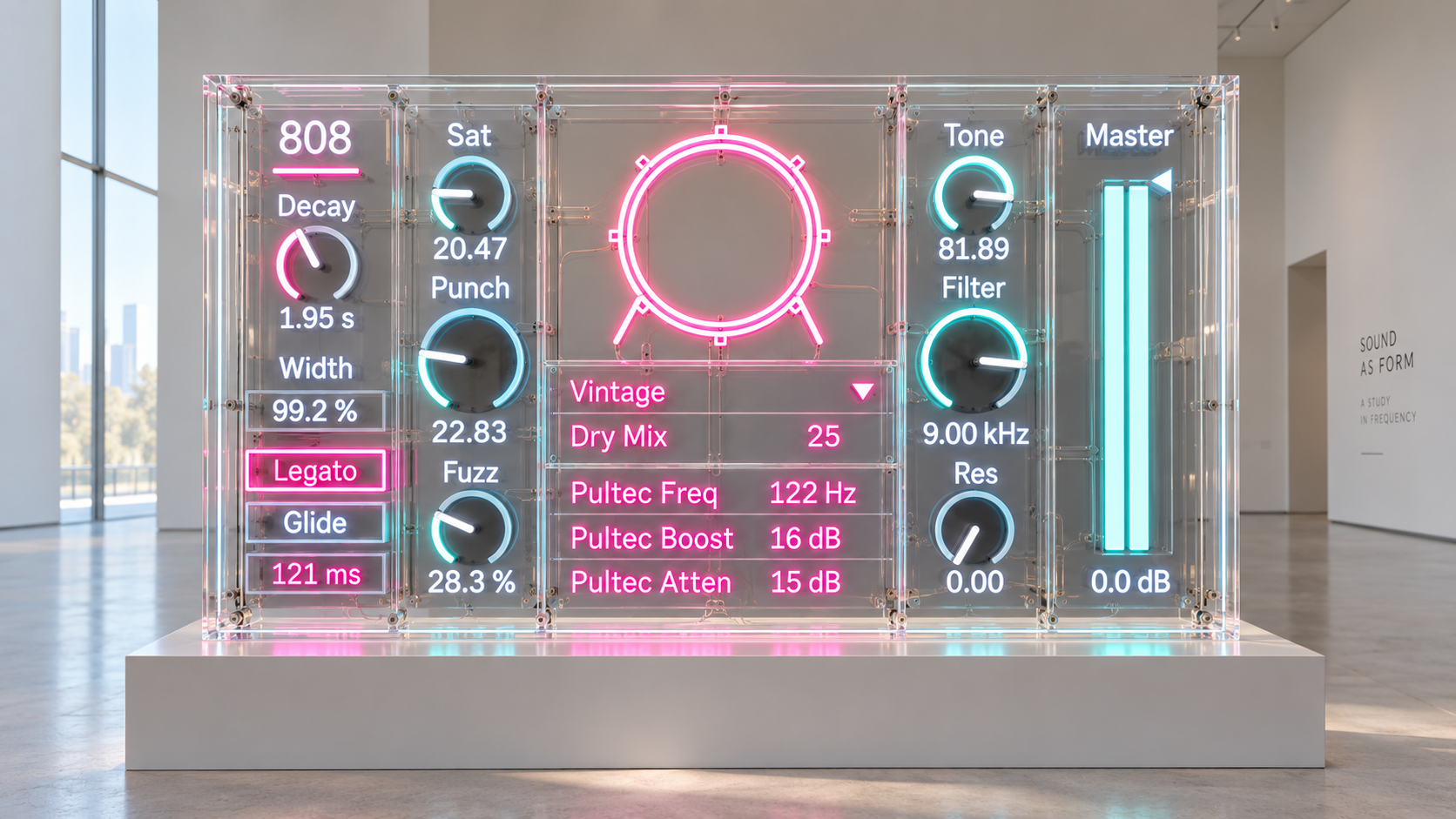
Treat the 808 as an instrument, not as a finished sample
808 v.2.5 is a monophonic Max for Live MIDI instrument for synthesizing pitched bass drum sounds in real time.
It uses a state dependent synthesis core informed by the TR 808 bass drum and integrates Punch, Drive, two Fuzz voicings, a Minimoog style ladder Filter, a Pultec style low frequency section, Width, MIDI pitch control, and Glide into a single voice.
It does not use an embedded kick sample as its sound source.
It is also not presented as a perfect physical reproduction of every TR 808 unit, nor as a complete hardware emulation of a Minimoog or Pultec EQP 1A. Those names describe technical and musical references used inside the instrument, not claims of total hardware identity.
The purpose of 808 v.2.5 is not to preserve one historical machine in a fixed state. It is to extend the underlying idea of the 808 bass drum into an instrument that can be played and transformed inside Ableton Live.
You can create one short kick and stop there.
But the same resonance can be allowed to continue, assigned another pitch from MIDI, shaped into a sustained low frequency voice, enriched with harmonics, filtered, rebalanced, and given only as much spatial detail as the track requires.
What began as a bass drum can gradually become the entire low frequency architecture of the piece.
And that transformation can remain inside one instrument from beginning to end.
That is 808 v.2.5.
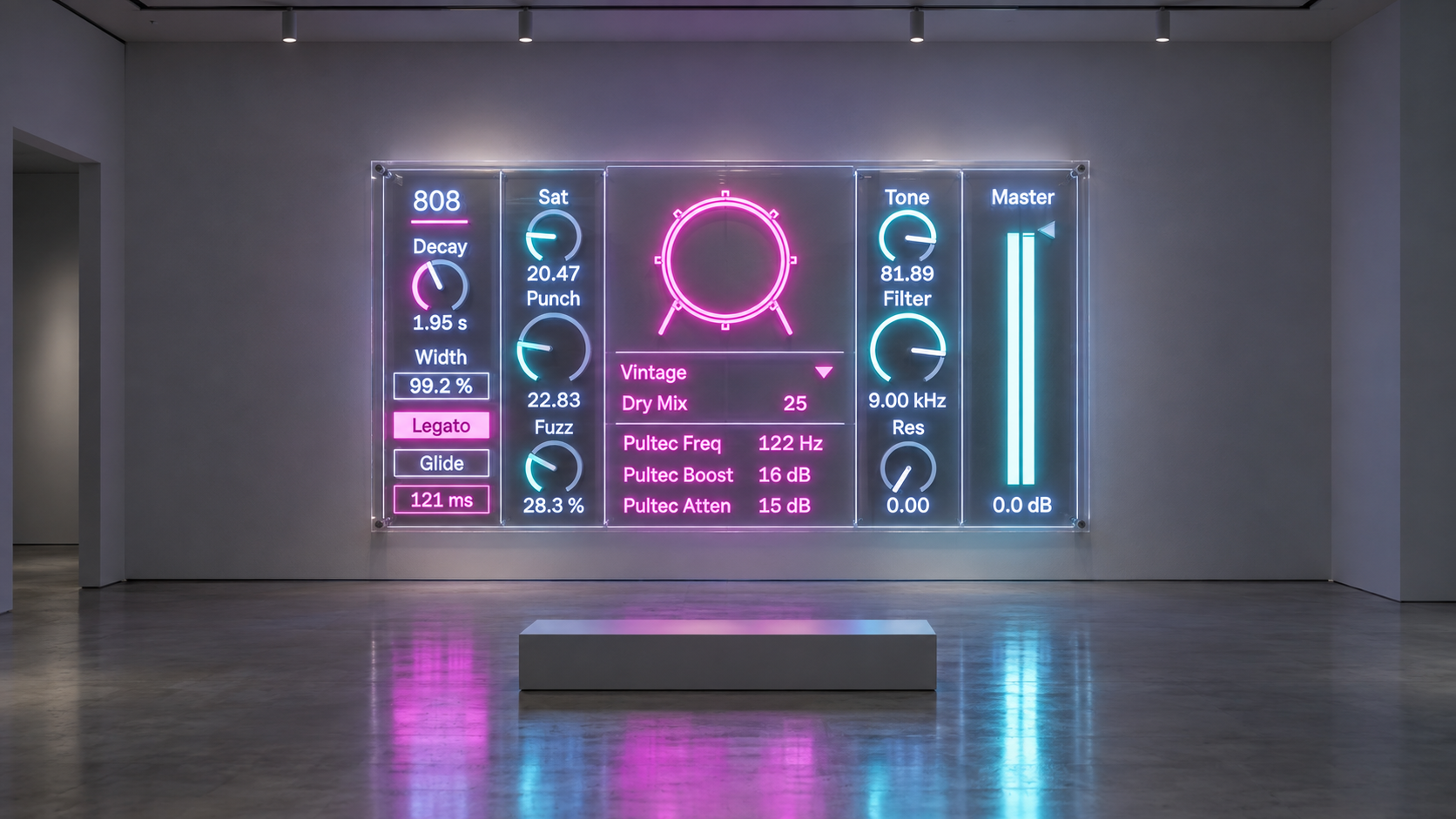
Installation and environment
The product includes 808v.2.5.amxd and the required 808.js companion file. Keep both files in the same location when using the device.
808 v.2.5 is a MIDI instrument designed for Ableton Live with Max for Live.
The current product documentation does not define an exact minimum Ableton Live version, Max version, or operating system version as a verified compatibility claim. Unsupported assumptions about those environments are therefore not presented as product guarantees.
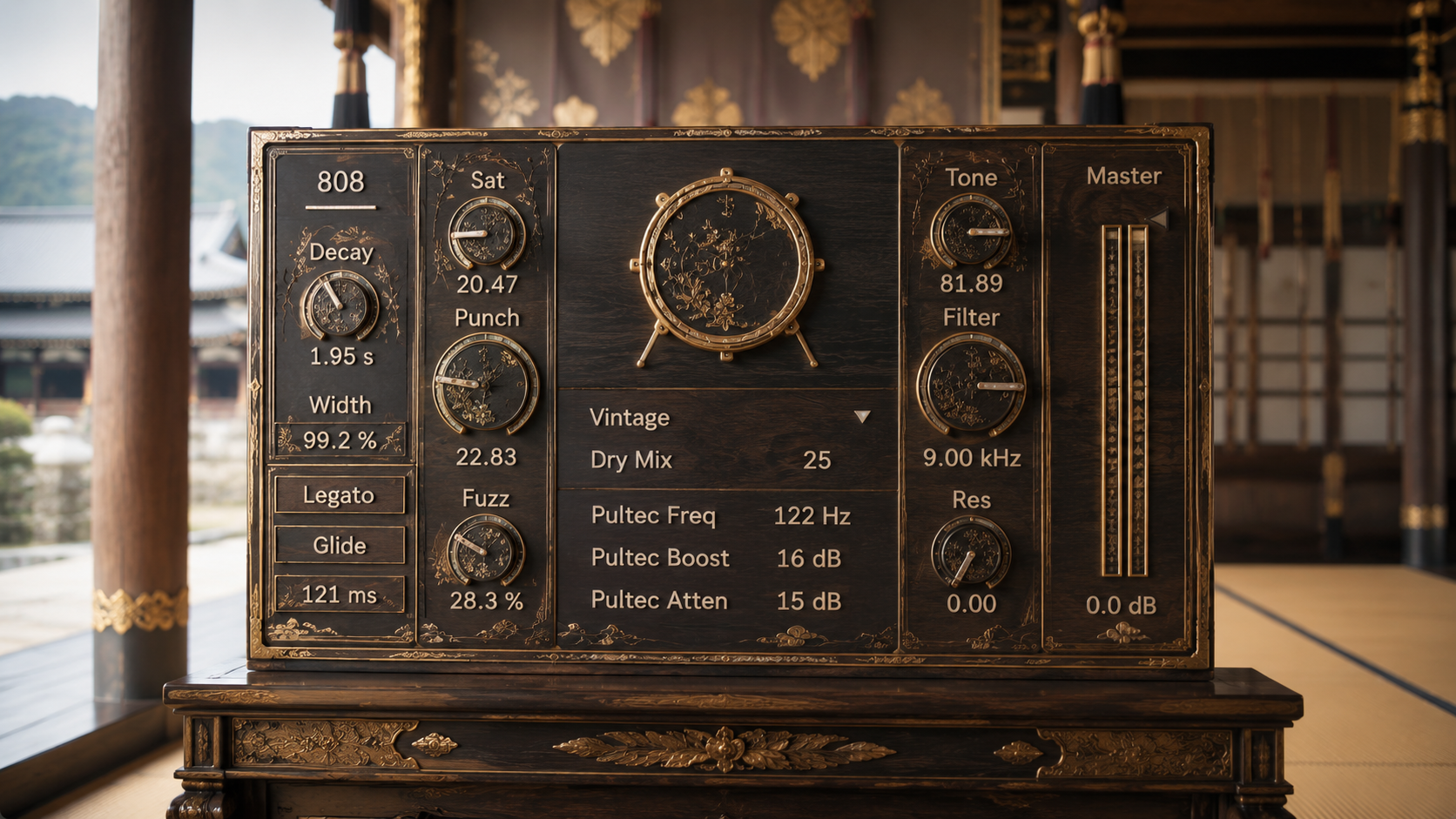
Free lifetime updates
Your purchase of 808 includes free lifetime updates.
If future updates for this product are released, existing customers can access those updates without an additional purchase or additional charge. For Sellfy purchases, the applicable current version can be accessed through the original purchase account.
This describes the update entitlement included with the purchase. It does not guarantee a fixed update schedule or promise any specific future feature.
v.2.6 ... Finalized the physically informed TR 808 bass drum core and its current Punch, Drive, Vintage and Modern Fuzz, nonlinear ladder Filter, Pultec low WDF, Width, Glide and stability architecture. (2026/9/9)
v.2.3 ... Modern bass focused 808 engine with resonant body synthesis, MIDI performance control, Drive, Fuzz, Width, and Pultec inspired low end shaping.(2026/6/20)
v.1.1 ... Updated punch and distortion. (2026/5/28)
v.1.0.4 ... Supported MPE. (2026/5/20)
v.1.0.3 ... Fixed UI bug. (2026/5/3)
Instruments & Drum Synths
Reese90 https://akihikomatsumoto.sellfy.store/p/ableton-reese-90/
A dedicated bass synth for deep, moving Reese tones with weight and stereo width.
OP-2 https://akihikomatsumoto.sellfy.store/p/ableton-op2/
A stereo FM synth with independent left and right structures for metallic modern bass design.
Complex https://akihikomatsumoto.sellfy.store/p/abletoncomplex/
A West Coast inspired synth combining complex oscillator concepts, FM, AM, warp, and LPG behavior.
Harmo https://akihikomatsumoto.sellfy.store/p/ableton-harmo/
A harmonic oscillator synth for building timbre directly from additive overtone components.
Cycle https://akihikomatsumoto.sellfy.store/p/ableton-cycle/
A twelve sine oscillator synth for drones, beating patterns, and non equal tempered harmonic structures.
Holy7 https://akihikomatsumoto.sellfy.store/p/ableton-holy7/
A seven oscillator experimental synth for drones, clusters, and slowly shifting harmonic masses.
Kick Bass https://akihikomatsumoto.sellfy.store/p/ableton-kick-bass/
A low frequency synth that integrates kick pitch drops and sub bass design in one instrument.
808 https://akihikomatsumoto.sellfy.store/p/ableton-808/
A low end synth for shaping modern 808 impact, pitch drop, attack, and sub pressure.
Swarma https://akihikomatsumoto.sellfy.store/p/ableton-swarma/
A swarm synth using dense voices, detuning, and drift to create clouds and evolving drones.
303 https://akihikomatsumoto.sellfy.store/p/ableton-303/
A 303 inspired bass synth for resonant acid tones and fluid pitch movement inside Ableton Live.
PCMer https://akihikomatsumoto.sellfy.store/p/ableton-pcmer/
A PCM synth for quickly switching among classic and modern sampled synthesizer waveforms.
Trap Snare https://akihikomatsumoto.sellfy.store/p/ableton-trap-snare/
A dedicated drum synth for shaping trap and bass music snares from pitch, noise, and attack.
DMGboi https://akihikomatsumoto.sellfy.store/p/ableton-dmgboi/
A chip synth inspired by the Game Boy APU, combining pulse, wavetable, and noise voices.
Akihiko Matsumoto
Study Site https://akihikomatsumoto.com/study/
Ableton M4L, Serum Preset Store https://akihikomatsumoto.com/download/
Sample Pack https://akihikomatsumoto.sellfy.store/sample-pack/
Bandcamp https://akihikomatsumoto.bandcamp.com
Ableton Skin https://akihikomatsumoto.sellfy.store/p/ableton-skin-pack/
Spotify https://open.spotify.com/artist/1tZMmxzZbvNu6klyKXa0L1?si=2JZaFeLbREi-UownD8POSg