
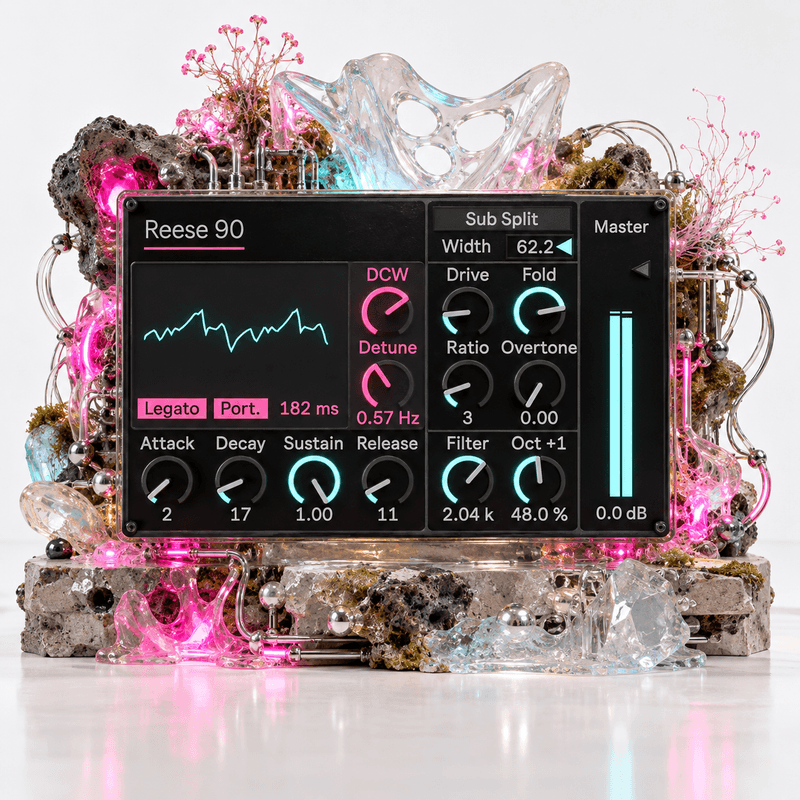
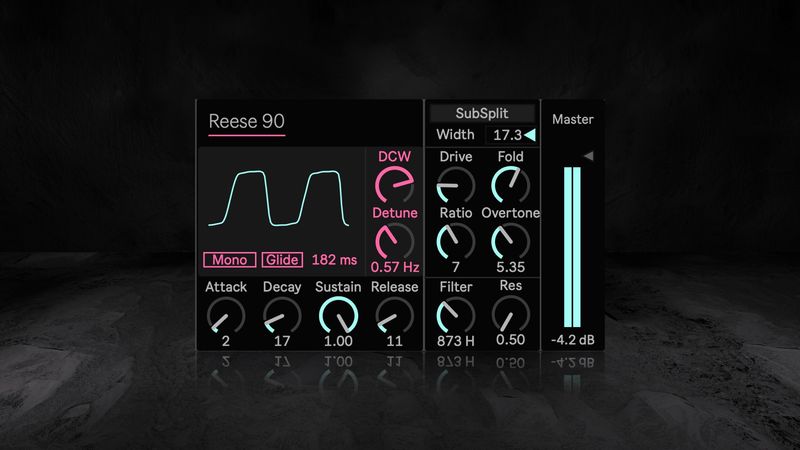
Ableton Reese 90 ver.6.5 | Ultimate Reese Bass Synthesizer
Max for Live Device (.amxd file)
From Detroit to Jungle: The History of the Reese Bass
The Reese Bass was not originally invented for Drum and Bass. Its history begins in Detroit in 1988, when techno pioneer Kevin Saunderson released "Just Want Another Chance" under his Reese alias. The bassline was created using a Casio CZ series synthesizer, whose Phase Distortion Synthesis contributed to the distinctive character of the sound. As slightly detuned oscillators moved in and out of phase, their harmonics continually shifted, creating a dark, unstable bass tone that seemed to evolve within a single sustained note. This sound would eventually become one of the defining elements of British Jungle and Drum and Bass.
Throughout the 1990s, producers transformed these synthesizer tones through sampling, filtering, pitch manipulation, and distortion. The Reese Bass became more than a particular synthesizer patch. It developed into a musical language shaped by the production techniques of different generations. Reese 90 takes this history as its starting point, bringing together the restless movement of classic Reese sounds and the flexibility required for contemporary bass music in a Max for Live synthesizer for Ableton Live.
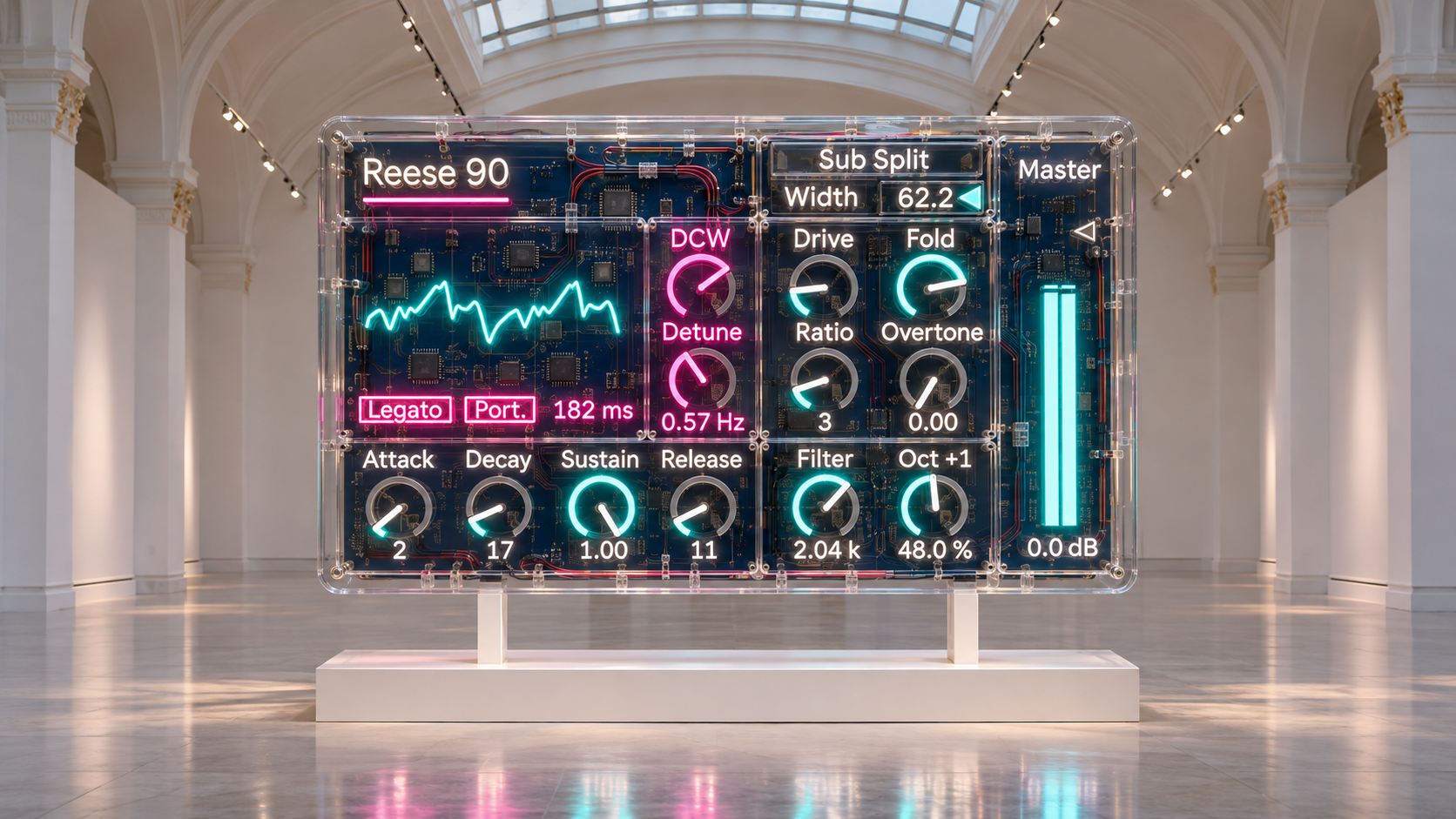
Casio Phase Distortion Meets Modular Synthesis
The appeal of a Reese Bass goes beyond simply detuning oscillators to create a thick sound. Its character emerges from the continuous interaction of frequencies, where changing phase relationships cause harmonics to reinforce and cancel one another. Even a sustained note can develop a complex sense of motion. Inspired by the Phase Distortion Synthesis of the original Casio CZ series, Reese 90 combines waveform shaping with stereo detuning to make this internal movement a central part of its sound design.
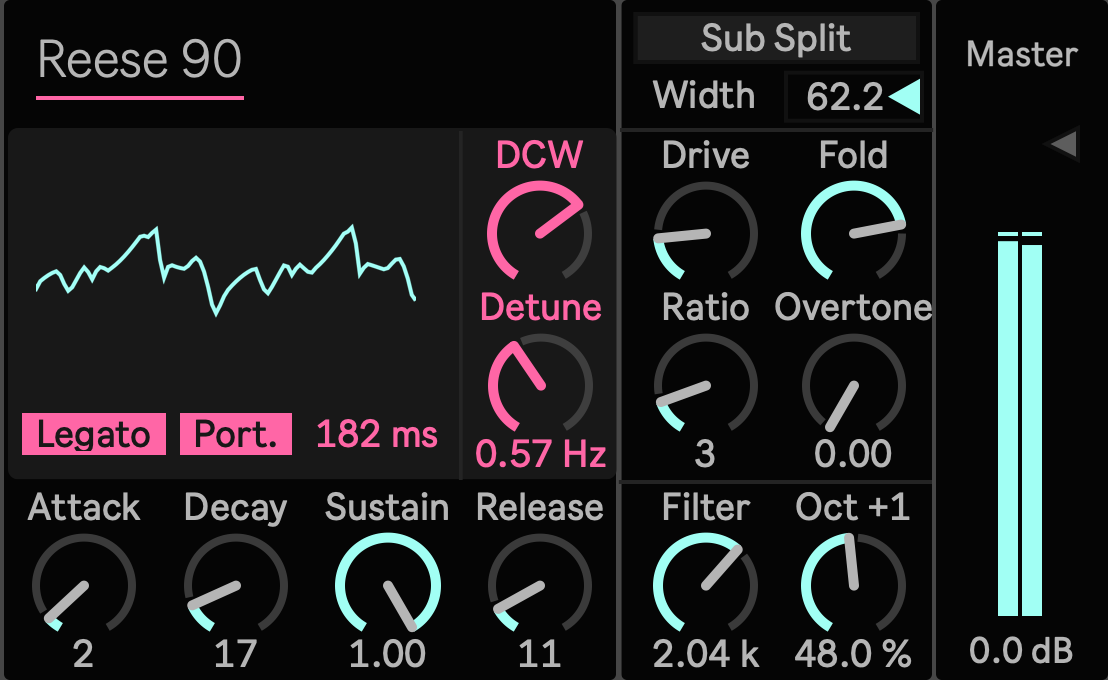
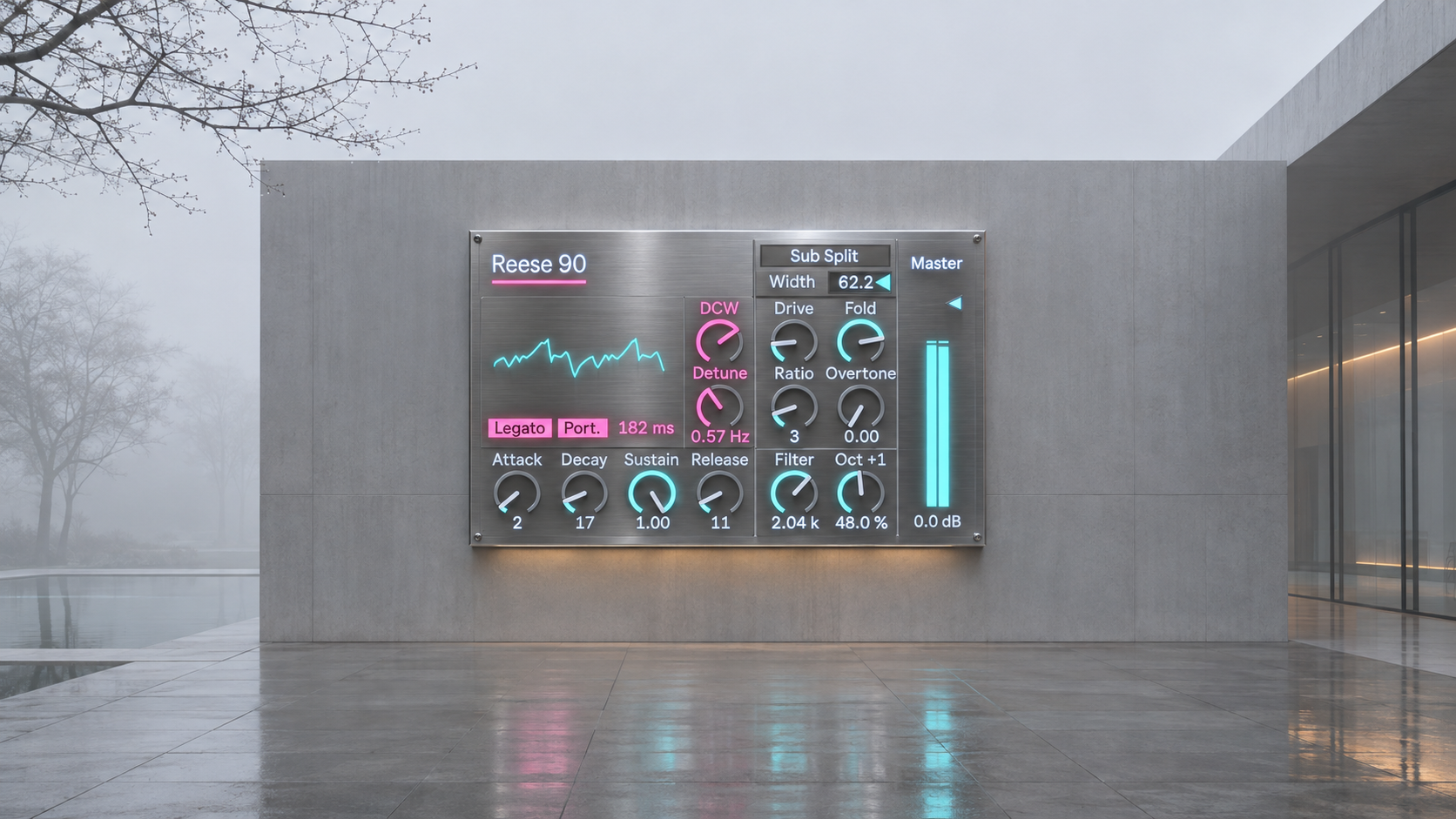
The instrument extends this approach with wavefolding inspired by modular synthesizers. By folding the waveform back upon itself, wavefolding generates additional harmonics, transforming the gradual movement of detuned oscillators into something more complex and aggressive. DCW reshapes the waveform, while Drive and Fold introduce nonlinear distortion. Detune and Width influence the movement and spatial relationship of the oscillators. Rather than functioning as isolated effects, these processes work together to explore different expressions of the instability that has always defined the Reese sound.
The Filtering Aesthetic of the AKAI S950
The history of Jungle and Drum and Bass cannot be separated from the samplers that helped shape their sound. During the 1990s, a synthesizer note could become something entirely different once it was sampled, transposed, filtered, and distorted. Pitching a sample across the keyboard changed not only its musical register but also its spectral character. Filtering then provided a way to reduce bright harmonics and transform animated synthesizer tones into darker, heavier bass sounds.
Reese 90 incorporates low pass filtering inspired by the AKAI S950, bringing this approach to tonal shaping into its synthesis architecture. Closing the filter changes the balance of the complex harmonics generated by detuning and wavefolding, allowing an aggressive texture to move toward the darker character associated with classic Jungle. Opening it reveals more of the harmonic movement, making the same underlying sound suitable for contemporary bass production. The intention is not to claim a complete hardware recreation of the S950, but to bring an important part of its musical aesthetic into a flexible synthesis environment.
Classic Reese Movement, Modern Sub Bass Control
The phase interference that gives classic Reese Bass its distinctive motion can also introduce instability in the lowest frequencies. As oscillators drift against one another, the fundamental and upper harmonics may change in intensity. This unpredictable movement is part of the beauty of the original sound, but contemporary bass music often requires a different relationship between the moving texture and the weight of the sub bass.
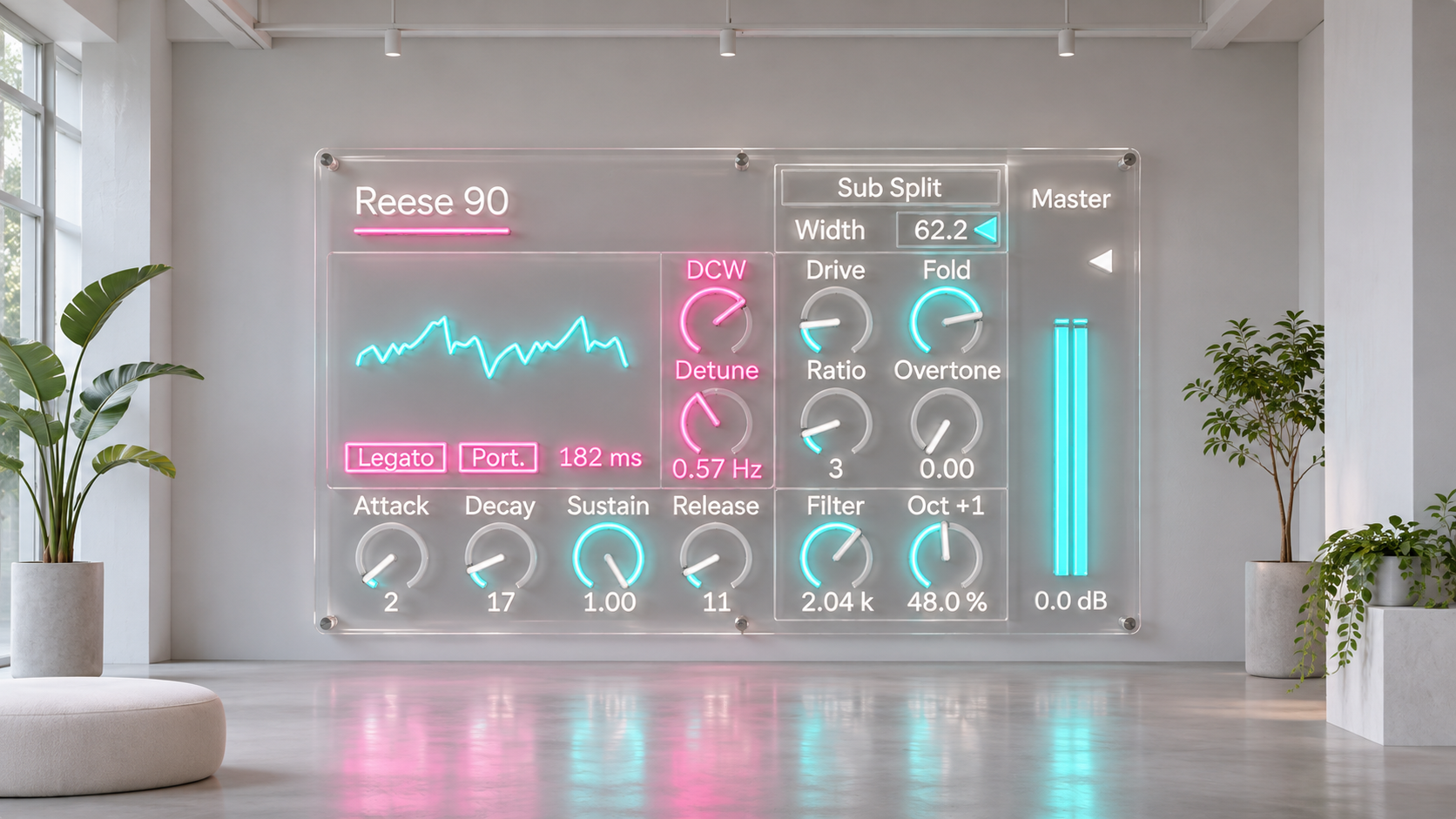
Reese 90 addresses this through a dedicated sub oscillator and Sub Split functionality, allowing the main stereo sound and the sub component to be approached as separate elements. The main sound can retain aggressive detuning, wavefolding, and complex harmonic movement, while the dedicated sub signal can be routed independently in supported Ableton Live configurations. This makes it possible to shape the animated upper texture and the low frequency foundation according to different mixing priorities, without removing the character that makes the Reese Bass compelling.
Additional harmonic control expands these possibilities. The Oct +1 layer introduces an octave above the fundamental, while Ratio and Overtone allow further exploration of harmonic relationships. These elements can add presence, density, and contrasting registers to the original sound. From the dark, shifting basslines of classic Jungle to the intricate harmonic movement of contemporary Neurofunk, Drum and Bass, Dubstep, and UK Bass, Reese 90 provides a way to explore different generations of bass synthesis through a shared musical foundation.
Playing the Reese Bass as a Synthesizer Again
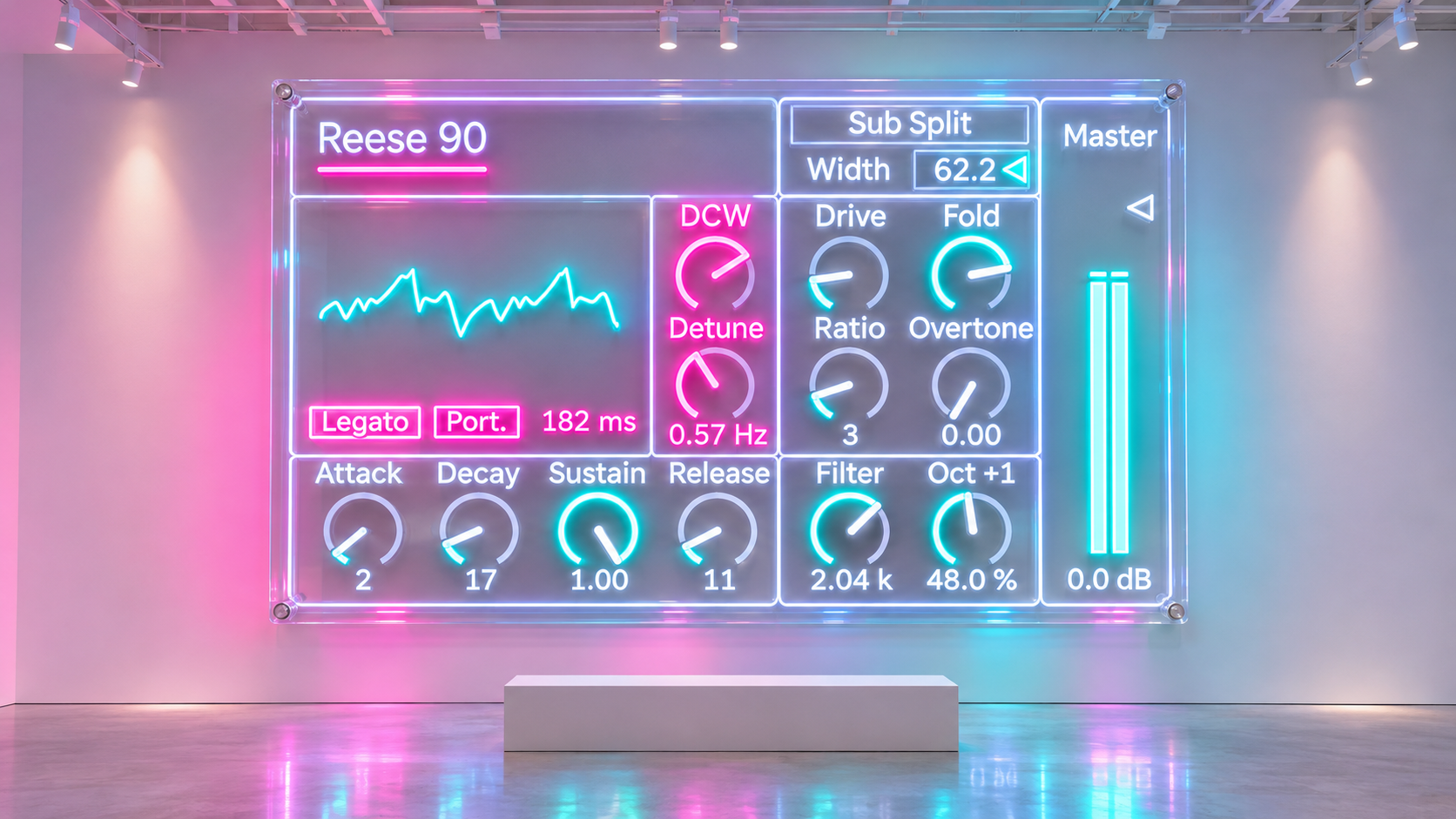
Although Reese sounds are often sampled and rearranged as audio, their original appeal also comes from the experience of playing a synthesizer while its tone continually changes. Reese 90 brings that process directly into Ableton Live. Hold a single note and listen to its internal movement, reshape its harmonics with the filter, or use Glide and Legato to connect one pitch to the next. Even a simple two note riff can develop a sense of expression through changes in timbre rather than additional melodic complexity.
Working with the instrument inside Ableton Live also makes these decisions part of the arrangement itself. A sustained note can carry a transition through gradual spectral changes, while shorter articulations can turn the same sound into a rhythmic gesture. The moving stereo texture can occupy one role in the composition, with the separately routed sub component providing another. Sound design and musical performance become parts of the same process.
Reese 90 is not simply an attempt to reproduce a nostalgic bass sound from the 1990s. It brings together the legacy of Casio Phase Distortion Synthesis, the harmonic possibilities of modular inspired wavefolding, filtering informed by the AKAI S950, and the independent sub bass control associated with modern production techniques. The result is a synthesizer that connects the history of the Reese Bass to new approaches in electronic music, preserving the unstable movement of the original while opening it to further transformation.
License & Free Lifetime Updates
Your purchase grants you a license to use the software, not ownership of its program code. Unauthorized copying, sharing, resale, sublicensing, or redistribution of the device, its source code, or bundled software assets is prohibited, except where permitted by applicable law or required for authorized installation and backup.
The software, including its source code, algorithms, and bundled software assets, may not be used to create machine learning datasets or to train, fine tune, or develop AI and machine learning models without prior written permission. These restrictions do not prohibit the creation or commercial use of original music produced with the device.
Your purchase includes free lifetime updates. Future published updates to this product are available at no additional cost. Existing customers can access the latest available files through the Sellfy account used for their original purchase without purchasing the product again.
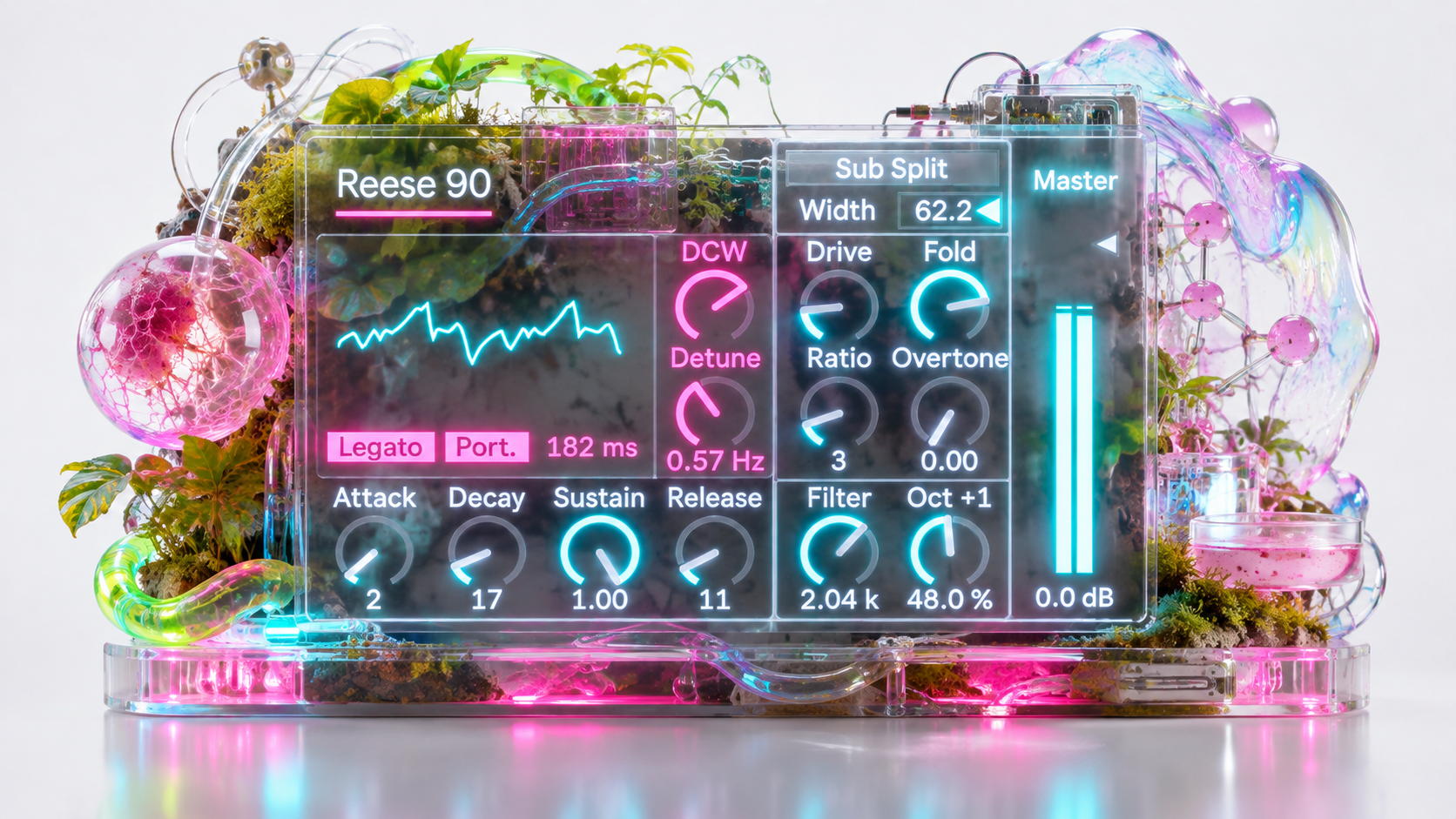
v.6.5 ... Replaced legacy filter with S950 style six pole low pass, removed Res, and added continuous Oct +1 dial.
v.6.1 ... Corrected ADSR envelope processing. (2026/7/19)
v.6.0 ... Added octave unison mode. (2026/6/25)
v.5.0 ... Added sub 3-4 ch out. (2026/5/26)
v.4.0.3 ... Fixed envelope bug & MPE bug. (2026/5/18)
v.4.0.2 ... Replaced minimoog-style VCA with an Akai-style VCA. (2026/5/11)
v.4.0 ... Added sub split mode & minimoog style VCA. (2026/5/10)
v.3.0 ... Added AKAI S950 Style Filter & Legato Mode. (2026/5/4)
v.2.5 ... Expanded ADSR Length. (6/26/2025)
v.2.3 ... Fixed missing sound bug. (4/4/2025)
v.2.1 ... Fixed note off bug, added fine tune. (1/27/2025)
v.2.0 ... Added overtone for wobble reese bass & stereo width. (1/14/2025)
v.1.5 ... mono / stereo click noise fixed, level bug fixed, detune algorithm updated. (12/31/2024)
v.1.2 ... Two additional oscillators in stereo mode.(12/25/2024)
v.1.1 ... Adjusted the mono level. (12/17/2024)
v.1.0 ... Launch. (12/16/2024)
Synthesizer
Reese90 https://akihikomatsumoto.sellfy.store/p/ableton-reese-90/
Dedicated bass synth for deep, moving Reese tones with weight and stereo width.
OP-2 https://akihikomatsumoto.sellfy.store/p/ableton-op2/
Stereo FM synth with independent left and right structures for metallic modern bass design.
Complex https://akihikomatsumoto.sellfy.store/p/abletoncomplex/
West Coast inspired synth combining complex oscillator concepts, FM, AM, warp, and LPG behavior.
Harmo https://akihikomatsumoto.sellfy.store/p/ableton-harmo/
Harmonic oscillator synth for building timbre directly from additive overtone components.
Cycle https://akihikomatsumoto.sellfy.store/p/ableton-cycle/
Twelve sine oscillator synth for drones, beating patterns, and non equal tempered harmonic structures.
Holy7 https://akihikomatsumoto.sellfy.store/p/ableton-holy7/
Seven oscillator experimental synth for drones, clusters, and slowly shifting harmonic masses.
Kick Bass https://akihikomatsumoto.sellfy.store/p/ableton-kick-bass/
Low frequency synth that integrates kick pitch drops and sub bass design in one instrument.
808 https://akihikomatsumoto.sellfy.store/p/ableton-808/
Low end synth for shaping modern 808 impact, pitch drop, attack, and sub pressure.
Swarma https://akihikomatsumoto.sellfy.store/p/ableton-swarma/
Swarm synth using dense voices, detuning, and drift to create clouds and evolving drones.
303 https://akihikomatsumoto.sellfy.store/p/ableton-303/
303 inspired bass synth for resonant acid tones and fluid pitch movement inside Ableton Live.
PCMer https://akihikomatsumoto.sellfy.store/p/ableton-pcmer/
PCM synth for quickly switching among classic and modern sampled synthesizer waveforms.
Trap Snare https://akihikomatsumoto.sellfy.store/p/ableton-trap-snare/
Dedicated drum synth for shaping trap and bass music snares from pitch, noise, and attack.
DMGboi https://akihikomatsumoto.sellfy.store/p/ableton-dmgboi/
Chip synth inspired by the Game Boy APU, combining pulse, wavetable, and noise voices.
Akihiko Matsumoto
Study Site https://akihikomatsumoto.com/study/
Ableton M4L, Serum Preset Store https://akihikomatsumoto.com/download/
Sample Pack https://akihikomatsumoto.sellfy.store/sample-pack/
Bandcamp https://akihikomatsumoto.bandcamp.com
Ableton Skin https://akihikomatsumoto.sellfy.store/p/ableton-skin-pack/
Spotify https://open.spotify.com/artist/1tZMmxzZbvNu6klyKXa0L1?si=2JZaFeLbREi-UownD8POSg