
$24.99+
Ableton Vinyloid v.2.0 | Physical Modeling Vinyl Record Simulator
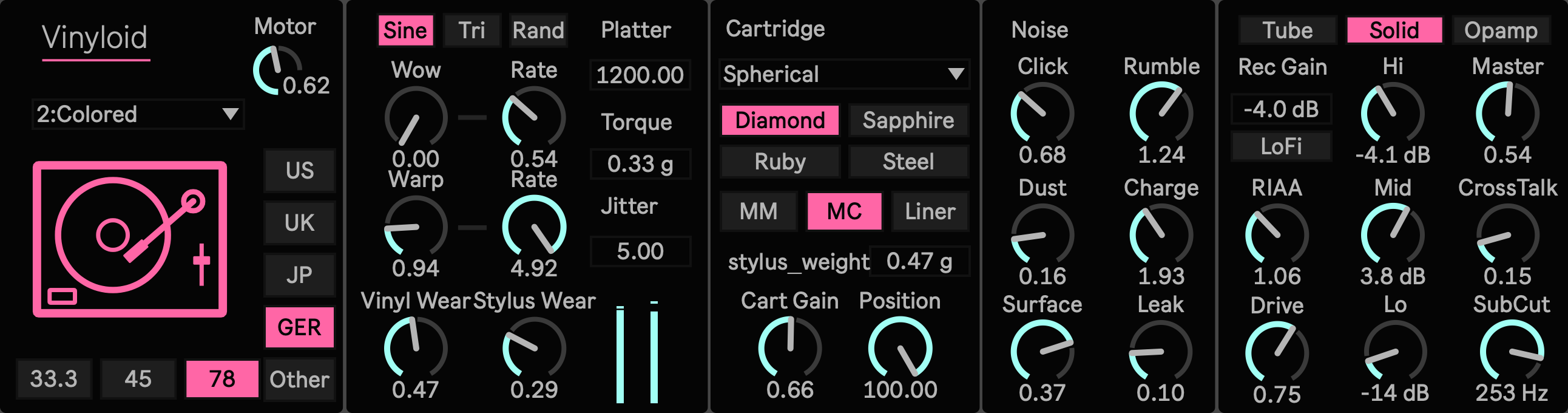
Max for Live Device (.amxd file)
Vinyloid is a Max for Live device built for producers who treat texture as composition. It does not simply add vinyl flavor. It reconstructs the behavior of a record path as a controllable sonic system, where pitch instability, groove wear, surface noise, stylus behavior, cartridge response, and playback coloration become design material.
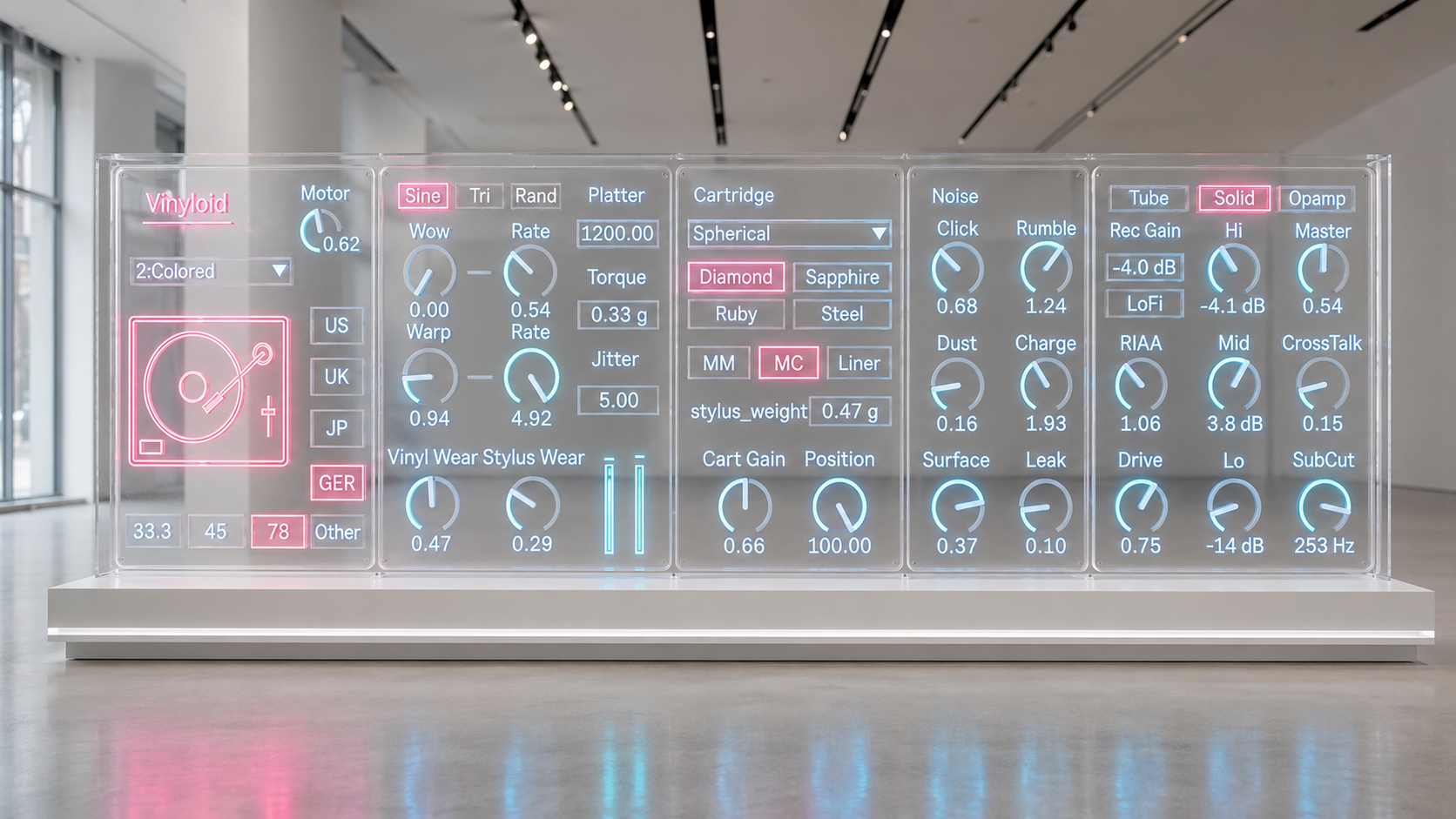
For sound designers who listen at the microscopic level
The appeal of vinyl in sample culture has never been nostalgia alone. It is the way a physical medium imposes structure on sound. A record is never neutral. It compresses, softens, drifts, distorts, and breathes in ways that digital sources do not. Vinyloid turns that logic into an instrument. You can move from barely perceptible coloration to extreme degradation, from a clean listening chain to a damaged, unstable playback scenario, all within a single device.
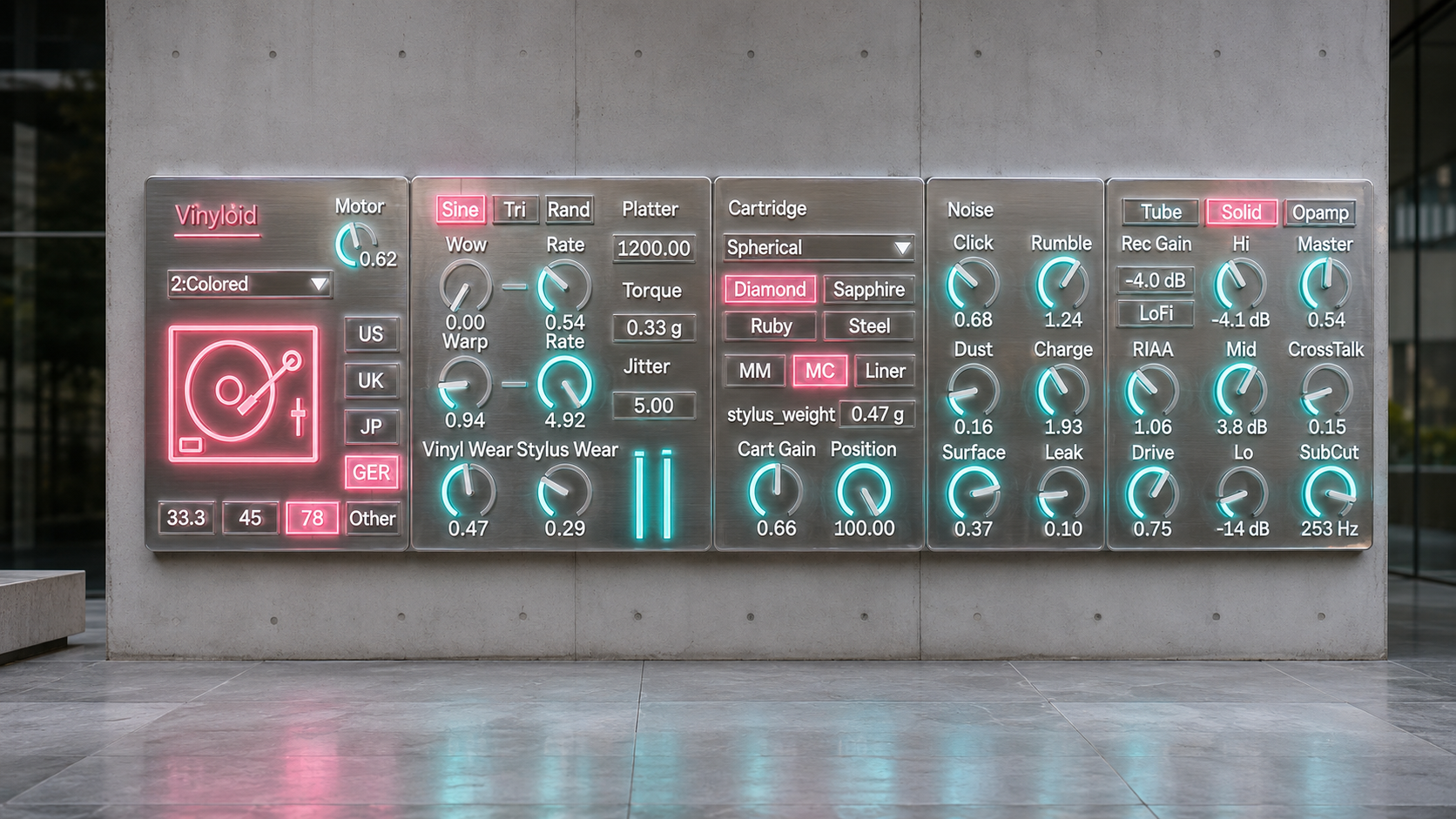
A physical model, not a cosmetic effect
Vinyloid was designed for detailed control rather than superficial patina. It lets you shape the motion of the platter, the behavior of the stylus, the condition of the record surface, the character of the preamp stage, and the logic of the noise floor as a connected system. That means the result is not a generic lo fi coating. It is a coherent playback environment with a believable internal physics.

Useful for more than imitation
For sample based music, beat making, ambient work, and experimental sound design, this matters. A small amount of instability can make a loop feel handled, aged, or discovered. A stronger setting can push it into fractured, surreal, or damaged territory. Vinyloid is equally at home on drums, chords, field recordings, synth loops, and full mixes. It can suggest a crate dug sample, a worn private press, a badly aligned cartridge, a drifting belt drive, or a system pushed beyond specification.

Designed for practical creative control
The device gives you enough range to move from subtle realism to overt degradation without losing control of the source material. That makes it useful both as a finishing layer and as a generative texture source. In one setting, it behaves like an elegant playback chain. In another, it becomes a machine for unstable memory, mechanical residue, and analog tension.
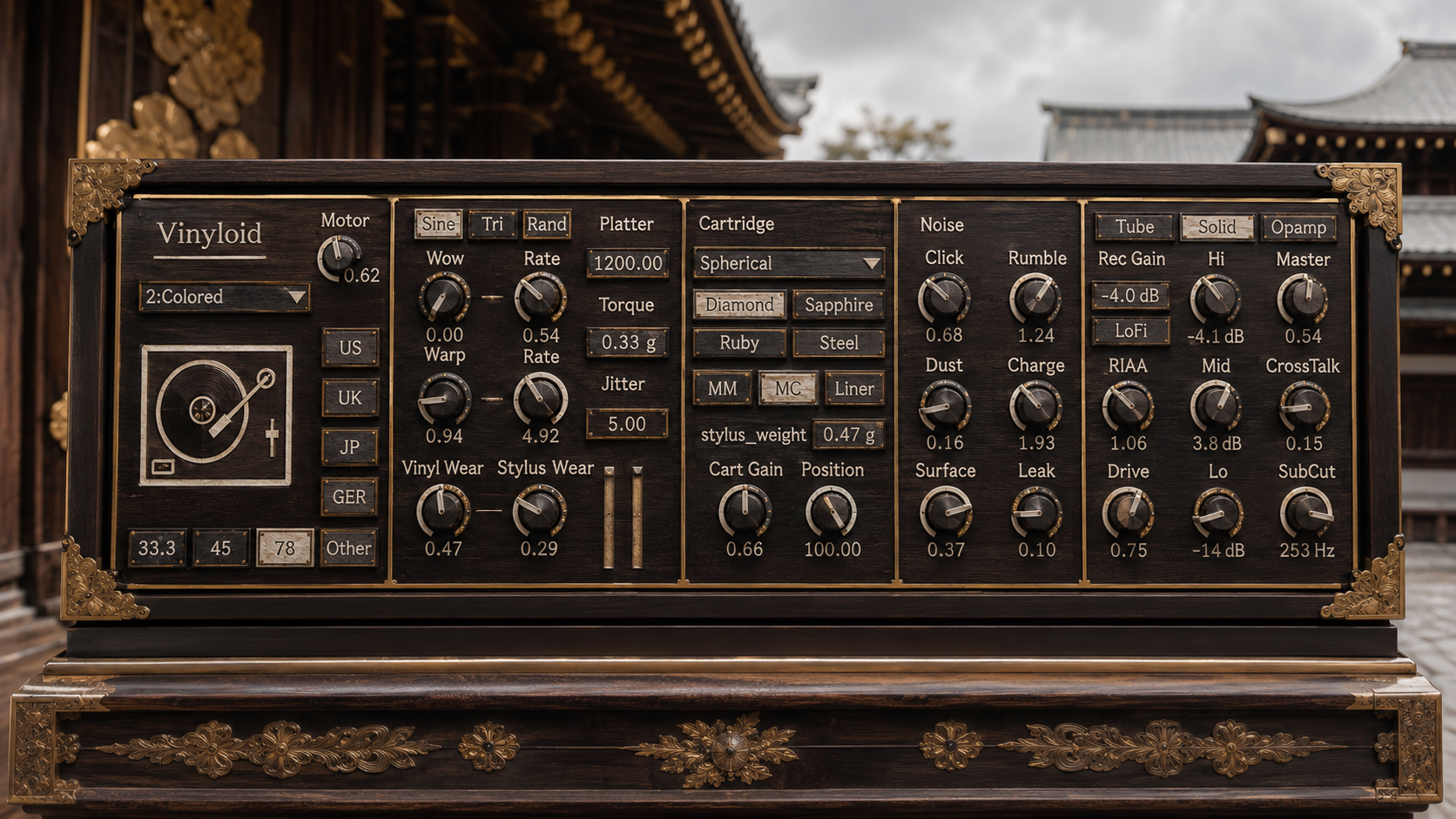
Built for long term use
Buyers who purchase Vinyloid can log in to Sellfy with the same account and receive future versions at no additional cost. The device is meant to keep evolving, while preserving a workflow you can return to with confidence.
For creators who want the record to feel alive
Vinyloid is for producers who do not just want vinyl character. It is for those who want the logic of vinyl to become part of the sound itself.
v.2.0 ... Improved overall physics modeling fidelity. (2026/7/4)
v.1.7 ... Improved overall physics modeling fidelity. (2026/5/26)
v.1.5 ... Improved realism and overall fidelity for a more polished experience. (2026/5/15)
v.1.0.9 ... Fixed latency bug. (2026/5/9)
v.1.0.8 ... Fixed latency information bug. (2026/5/8)
Filter
VHSoid https://akihikomatsumoto.sellfy.store/p/ableton-vhsoid/
Vinyloid https://akihikomatsumoto.sellfy.store/p/ableton-vinyloid/
Growl Filter https://akihikomatsumoto.sellfy.store/p/ableton-growl-filter/
XY-Plane Filter https://akihikomatsumoto.sellfy.store/p/abletonxyplanefilter/
FFT Filter https://akihikomatsumoto.sellfy.store/p/abletonfftfilter/
Octa Comb https://akihikomatsumoto.sellfy.store/p/ableton-octa-comb/
Feedback EQ https://akihikomatsumoto.sellfy.store/p/ableton-feedback-eq/
Massive Filter https://akihikomatsumoto.sellfy.store/p/ableton-massive-filter/
AKAIst https://akihikomatsumoto.sellfy.store/p/ableton-akaist/
Tetra Comb https://akihikomatsumoto.sellfy.store/p/abletontetracomb/
Akihiko Matsumoto
Study Site https://akihikomatsumoto.com/study/
Ableton M4L, Serum Preset Store https://akihikomatsumoto.com/download/
Sample Pack https://akihikomatsumoto.sellfy.store/sample-pack/
Bandcamp https://akihikomatsumoto.bandcamp.com
Ableton Skin https://akihikomatsumoto.sellfy.store/p/ableton-skin-pack/
Spotify https://open.spotify.com/artist/1tZMmxzZbvNu6klyKXa0L1?si=2JZaFeLbREi-UownD8POSg
Doc
■ Overview
Vinyloid v1.07 is a highly simulates the physical phenomena of vinyl record playback.
This manual provides explanations for parameters adapted to the UI names, as well as detailed one-by-one descriptions of the "Hidden Parameters" accessible via automation.
1. Main Media & Material Settings (Left UI)
--------------------------------------------------
- RPM Selector (33.3 / 45 / 78 / Other)
[Internal: rpm] Sets the rotation speed. Acts as the reference for wow/flutter, noise intervals, and tracing distortion.
- Pressing Origin (US / UK / JP / GER)
[Internal: press_origin] Presets for country-specific pressing quality. JP is low noise, US is high noise.
- Material Dropdown (Vinyl / Colored / Shellac / Picture)
[Internal: vinyl_material] Defines internal damping coefficients. Affects resonance sharpness and high-freq attenuation.
2. Motor & Drive System (Middle-Left Block)
--------------------------------------------------
- Motor
[Internal: motor_cogging] Torque variation from motor pole "cogging." Higher values increase micro-instability in rotation.
- Wow
[Internal: wow_amt] Depth of pitch fluctuation. Simulates belt stretch or motor irregularities.
- Rate (Below Wow)
[Internal: flutter_freq] Speed of the wow and flutter (LFO frequency).
- Warp
[Internal: warp_amt] Intensity of volume and pitch modulation caused by the physical warping of the record.
- Rate (Below Warp)
[Internal: warp_rate] Frequency of the warp modulation. Also excites the tone arm resonance system.
- LFO Shape (Sine / Tri / Rand)
[Internal: wow_shape] Modulation waveform. Sine is smooth; Rand provides irregular speed changes.
- Platter
[Internal: platter_mass] Inertial mass of the platter. Higher values stabilize rotation and suppress wow.
- Torque
[Internal: torque_const] Motor torque constant. Determines the force maintaining constant rotation speed.
- Jitter
[Internal: dd_jitter_amt] PLL jitter residuals. Adds fine, high-frequency pitch instability.
- Vinyl Wear
[Internal: vinyl_wear] Amount of record wear. Increases surface graininess and noise.
- Stylus Wear
[Internal: stylus_wear] Needle wear. Reduces high-frequency resolution and increases non-linear tracing distortion.
3. Cartridge & Tone Arm (Cartridge Block)
--------------------------------------------------
- Stylus Shape (Spherical / Elliptical / Fine / Line)
[Internal: stylus_shape] Physical geometry of the needle. Affects contact area and high-frequency resolution.
- Tip Material (Diamond / Sapphire / Ruby / Steel)
[Internal: tip_material] Friction coefficients. "Ruby" is simulated as synthetic diamond properties.
- Cartridge Type (MM / MC / Liner)
[Internal: cart_type] Circuit design. "Liner" operates as MI type internally. MM enables specific high-freq compensation.
- stylus_weight
[Internal: stylus_weight] Tracking force in grams. Distortion increases if outside the optimal range.
- Cart Gain
[Internal: cart_output_mv] Cartridge output voltage. Determines the input gain into the electrical simulation.
- Position
[Internal: inner_groove_pos] Playback position (0-100%). Distortion worsens towards the inner groove (100).
4. Noise System (Noise Block)
--------------------------------------------------
- Click
[Internal: click_gain] Volume of transient click noise from scratches or dust.
- Dust
[Internal: dust_density] Frequency or density of click noise occurrences.
- Rumble
[Internal: rumble_amt] Level of low-frequency rumble transmitted from the motor or bearings.
- Charge
[Internal: static_charge] Probability of spike noise generated by static electricity.
- Surface
[Internal: surface_noise_lvl] Steady surface noise level from needle/groove friction.
- Leak
[Internal: hum_leak_lvl] Level of power supply hum (50/60Hz).
5. Amp, EQ & Output (Right UI Block)
--------------------------------------------------
- Preamp Type (Tube / Solid / Opamp)
[Internal: preamp_type] Preamp distortion characteristics. Tube provides warmth, Solid provides harder clipping.
- Rec Gain
Input stage attenuator at the very start of the device. Adjust this to control the saturation level in the Drive stage.
- LoFi
[Internal: lofi_tone] When ON, drastically cuts high frequencies for a vintage sampler-like texture.
- RIAA
[Internal: riaa_correction] Amount of RIAA equalization. 100% is normal; 0% results in a thin, treble-heavy sound.
- Drive
[Internal: preamp_drive] Input saturation amount. Increases analog-style saturation.
- Hi / Mid / Lo
[Internal: eq_treble_db, eq_mid_db, eq_bass_db] 3-band output EQ (±20dB).
- Master
[Internal: out_gain] Final output level.
- CrossTalk
[Internal: crosstalk_lvl] Signal leakage between L/R channels. Higher values narrow the stereo image.
- SubCut
[Internal: subsonic_cutoff] Subsonic cut. Suppresses unwanted woofer wobble caused by record warping.
6. Hidden Parameters (Automation Only)
--------------------------------------------------
These parameters are not on the GUI but can be controlled individually via automation.
- motor_poles
Number of motor poles. Changing this alters the cogging noise period, changing the "grain" of rotation.
- startup_transient
Needle stability at start. Higher values make rotation more unstable immediately after playback starts.
- warp_resonance
The strength of how much record warping shakes the tone arm. Higher values cause more intense modulation.
- arm_eff_mass
Effective mass of the tone arm. Together with stylus compliance, it determines the system's resonant frequency.
- stylus_compliance
Flexibility of the needle tip. Balance with arm mass affects tracking and specific low-freq emphasis.
- arm_damping
Damping of the tone arm resonance. Lower values let the resonance ring out longer.
- arm_resonance_boost
Artificially boosts arm resonance to simulate old or degraded equipment.
- anti_skating
Compensation for inward force. Affects L/R volume balance and asymmetry in distortion.
- vta_angle
Vertical Tracking Angle. Reproduces distortion caused by mismatch with the original cutting angle.
- azimuth_deg
Needle tilt (azimuth). Causes phase shifts and signal leakage between channels.
- cart_inductance_mh
Cartridge inductance. Forms the basis for electrical high-frequency roll-off.
- load_capacitance_pf
Load capacitance (including cable). Creates a specific resonance peak in the high frequencies.
- load_resistance_ohm
Load resistance. Determines electrical damping (Q) and the sharpness of the high-freq peak.
- mm_resonance_freq
Electrical resonance frequency specific to Moving Magnet types.
- mm_resonance_q
Sharpness (Q) of the MM electrical resonance. High values significantly boost specific high frequencies.
- vinyl_temp_c
Record temperature. Changes material hardness, subtly affecting damping and noise texture.
- press_era
Pressing era. Scales differences in record thickness and material compounds.
- click_decay_ms
Decay of click noise. Shorter for sharp "ticks," longer for softer "thumps."
- click_stereo
Stereo width of click noise. 1.0 means clicks are fully scattered across L/R.
- hum_freq_sel
Base hum frequency. Choose between 50Hz (East JP/EU) or 60Hz (West JP/US).
- hum_harmonic3
Mix ratio of the 3rd harmonic (150Hz/180Hz). Higher values make the hum sound brighter.
- grounding_quality
Quality of the ground connection. Lower values result in significantly louder hum.
- signal_noise_amt
Friction noise that occurs in proportion to the signal amplitude.
- azimuth_xtalk
Frequency-dependent crosstalk caused by azimuth misalignment.
- input_sat
Direct saturation applied to the input signal, separate from the Preamp Drive.
- master_wet
Mix ratio between the processed (wet) signal and original (dry) signal.
- channel_balance
Final output balance between Left and Right channels.