
$14.99+
Ableton Feedback EQ v.4.0 | Ten Bands Network Resonator
Max for Live Device (.amxd file)
Building Resonance Instead of Correcting It
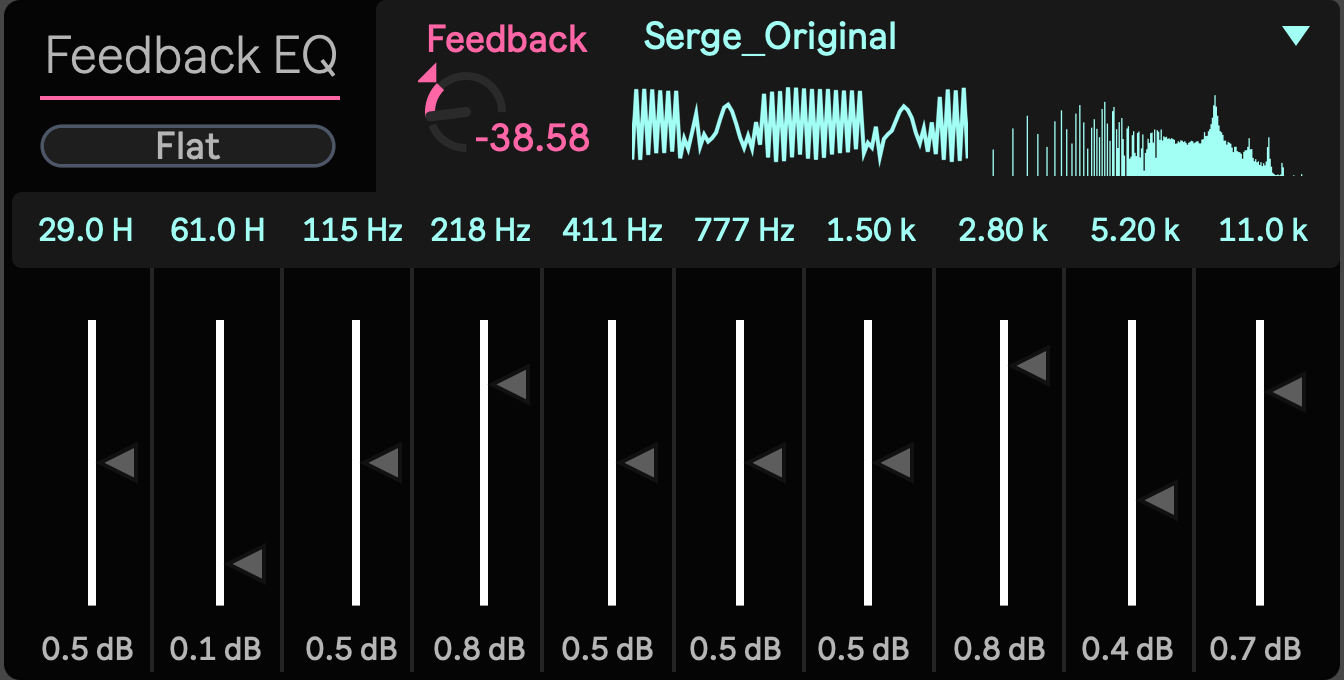
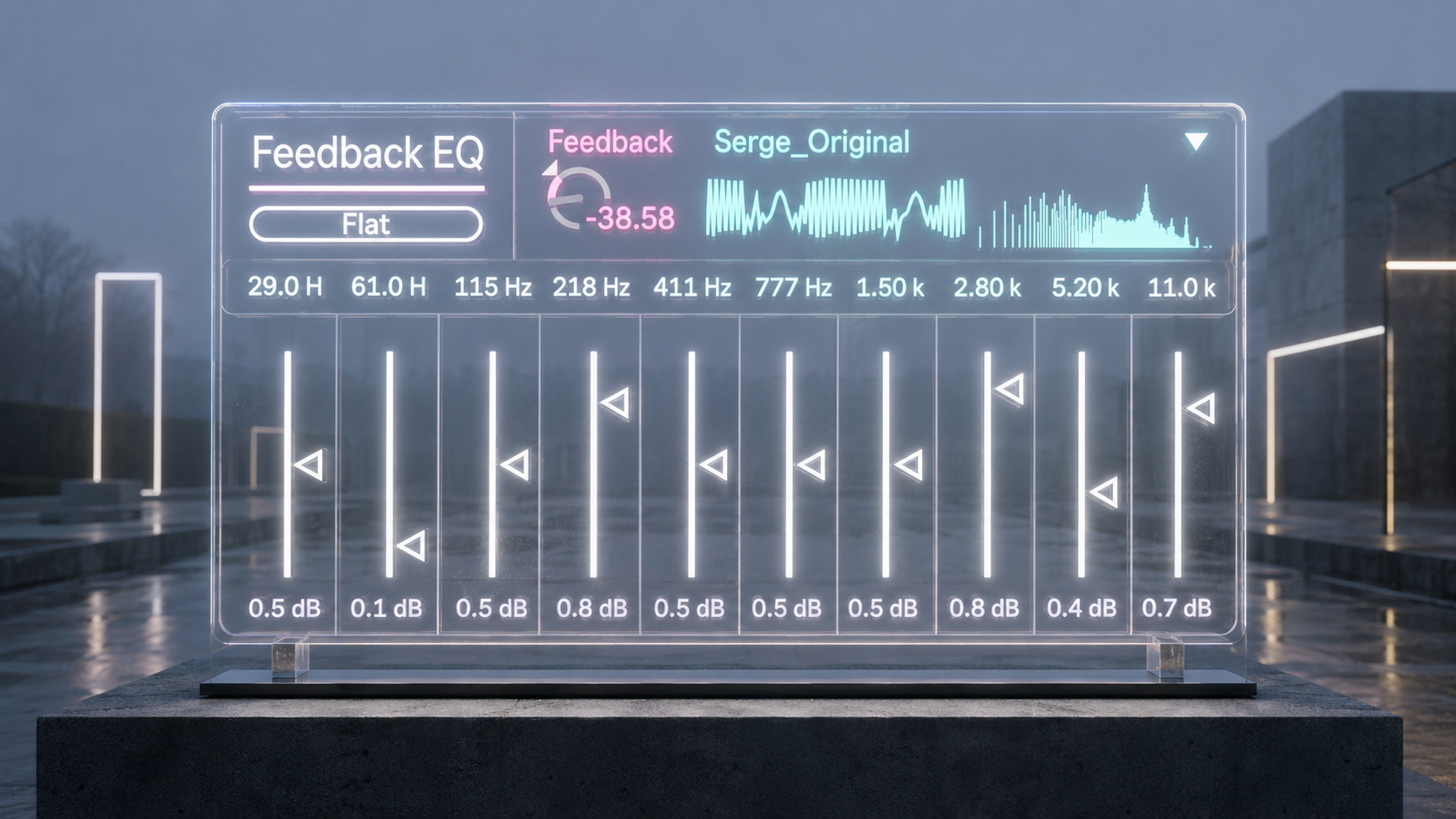
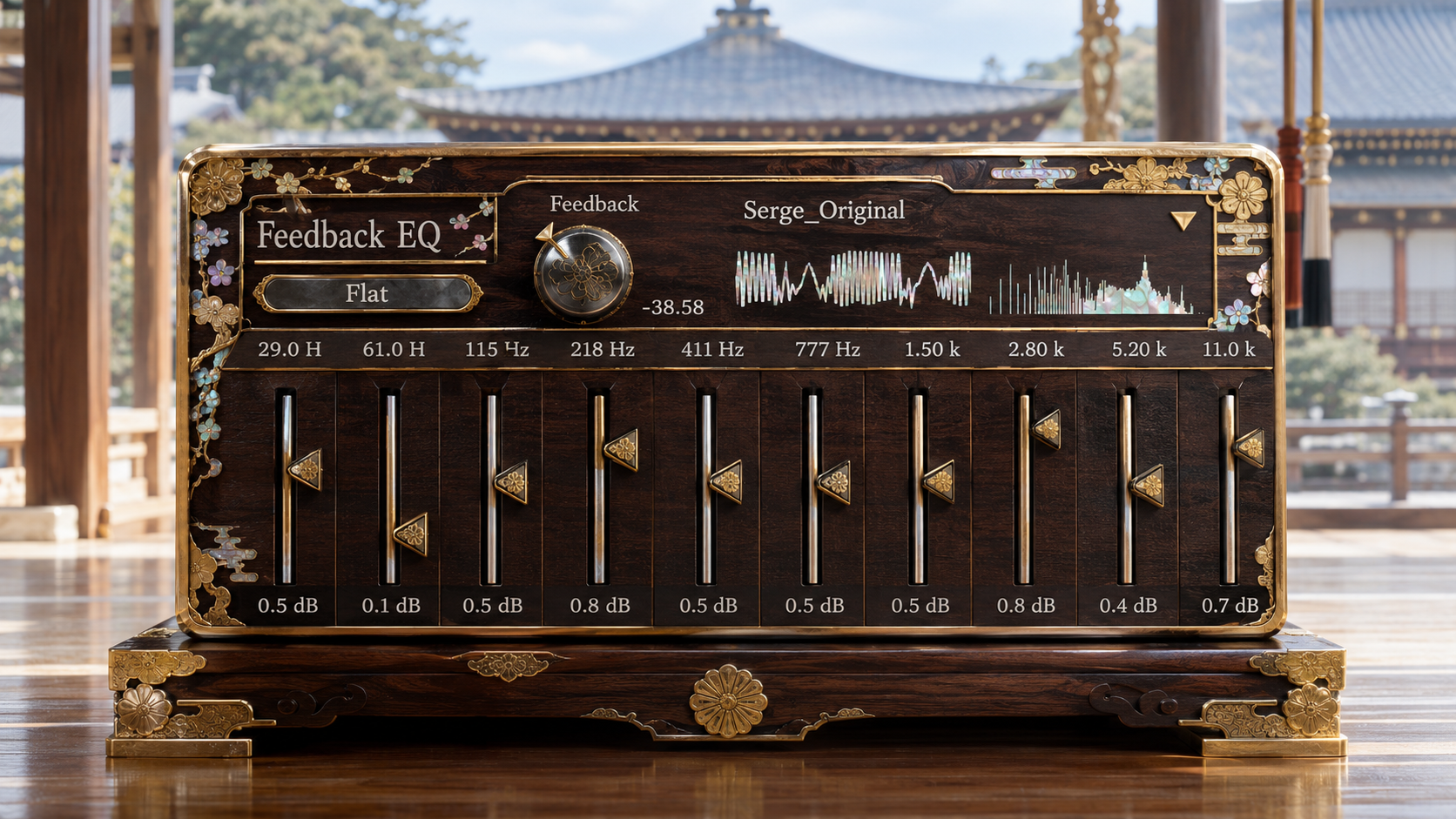
There are moments when shaping a sound with EQ makes you want to push one particular region much further, until an operation that began as correction starts becoming part of the timbre itself. Feedback EQ begins at that point. It is a ten band resonant spectral processor in which each center frequency can be moved independently, while every band can travel from attenuation through boost and into stronger resonance. Rather than drawing a fixed EQ curve, you can use it to construct a new resonant structure inside the input signal.
I own and use a Serge system in my own music production. What continues to interest me about Serge is not only the sound of a particular circuit, but the way a seemingly simple function can take on a different role according to signal level, feedback, resonance, and its relationship with the surrounding system. Feedback EQ belongs to my continuing series of Serge inspired devices and grows from that experience. It is not intended as a literal copy of a particular Serge circuit. Instead, it takes ideas I have encountered through working with the instrument and reinterprets them as spectral processing inside Ableton Live.
Treat Ten Bands as One Network
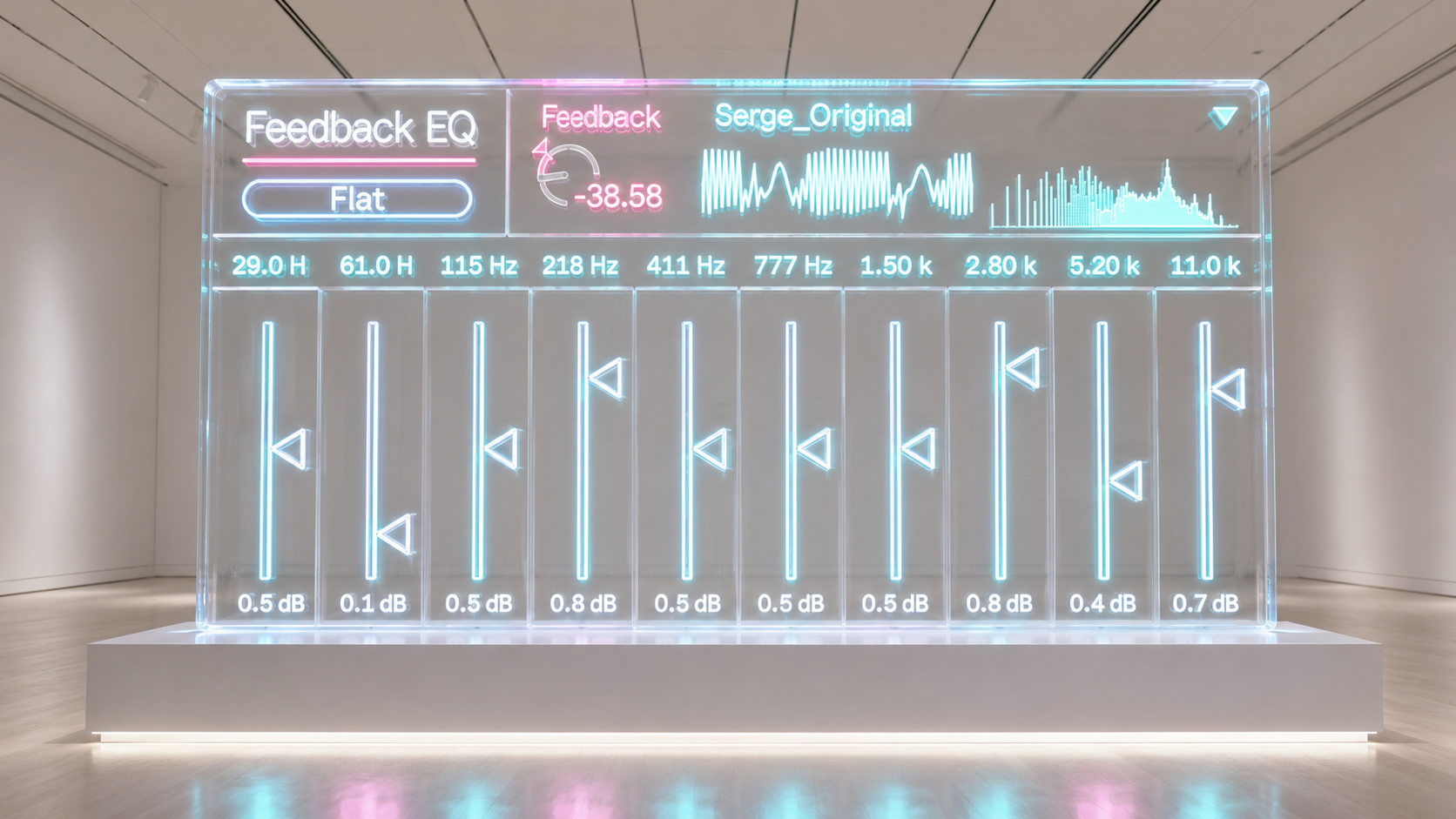
Feedback EQ makes more sense when its ten bands are treated as interacting resonant points rather than as ten independent graphic EQ faders. Raising several neighboring bands can create a broad resonant body, while pushing a single band harder can establish one frequency as an anchor for the entire sound. In the lower range this can reshape the body of a kick or tom. Uneven relationships in the middle range can create hollow or formant like structures, while separated upper resonances can move a sound toward harder metallic or glass like textures. Because each center frequency can be moved, the resulting structure does not have to remain a fixed EQ shape. The resonant relationships themselves can be automated and changed over time.
Each Band control has a neutral midpoint. Moving below it reduces that region, while moving above it enters boost and then stronger resonance. Flat returns all ten Band controls to their neutral position while leaving the frequency layout and Feedback state intact. This makes it possible to preserve the larger structure of the device while rebuilding only the distribution of resonance, allowing different spectral shapes to be compared without resetting the entire sound.
Positive and Negative Feedback Lead in Different Directions
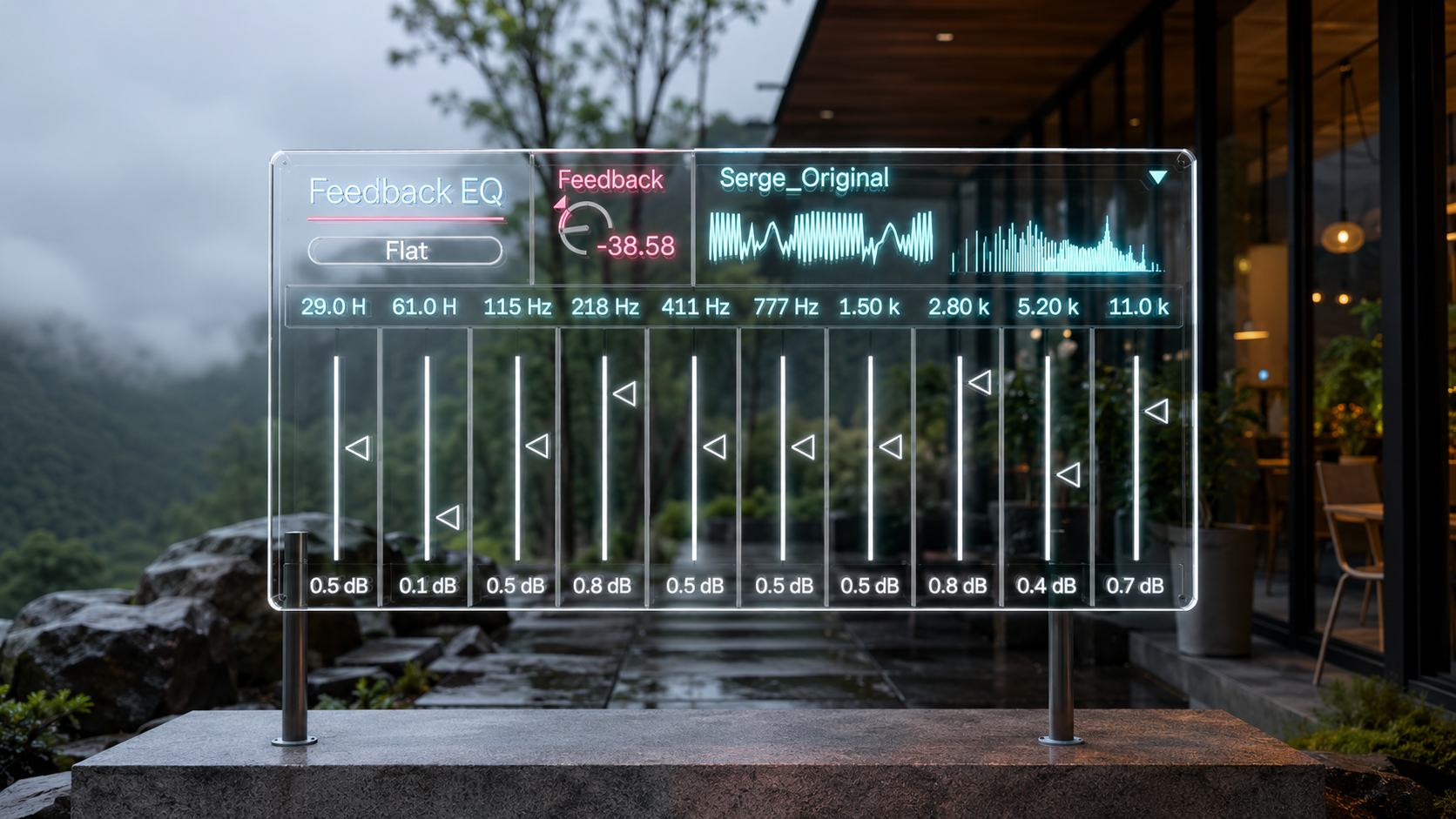
Feedback is the control that changes the identity of the device most dramatically. Positive and negative values are not opposite versions of one algorithm. They are implemented as separate processing paths with different sonic purposes.
Positive Feedback regenerates the resonant structure you have already created through a comparatively clean return path. At lower settings it can add persistence and bloom to the existing resonances. As the amount increases, those resonances become increasingly prominent. On drums, this can extend the body created by selected bands. On synthesizers, it can make particular parts of the spectrum remain present for longer without immediately changing the basic harmonic identity of the return.
Negative Feedback approaches the problem differently. The returning signal enters a folded process based around an odd harmonic trajectory, so increasing the amount does more than reinforce the same resonance. The harmonic structure of the returning signal itself begins to change. Applied to a synthesizer or noise source with an uneven upper spectral shape, this can move the sound away from simple emphasis and toward a denser, harder transformation built from the resonant network itself.
Positive Feedback can therefore be understood as developing the resonance that already exists, while negative Feedback increasingly transforms the material being returned to the network. Crossing zero is not simply reversing the strength of one effect. It means moving between two different forms of regeneration.
Sixteen Modes as Frequency Structures
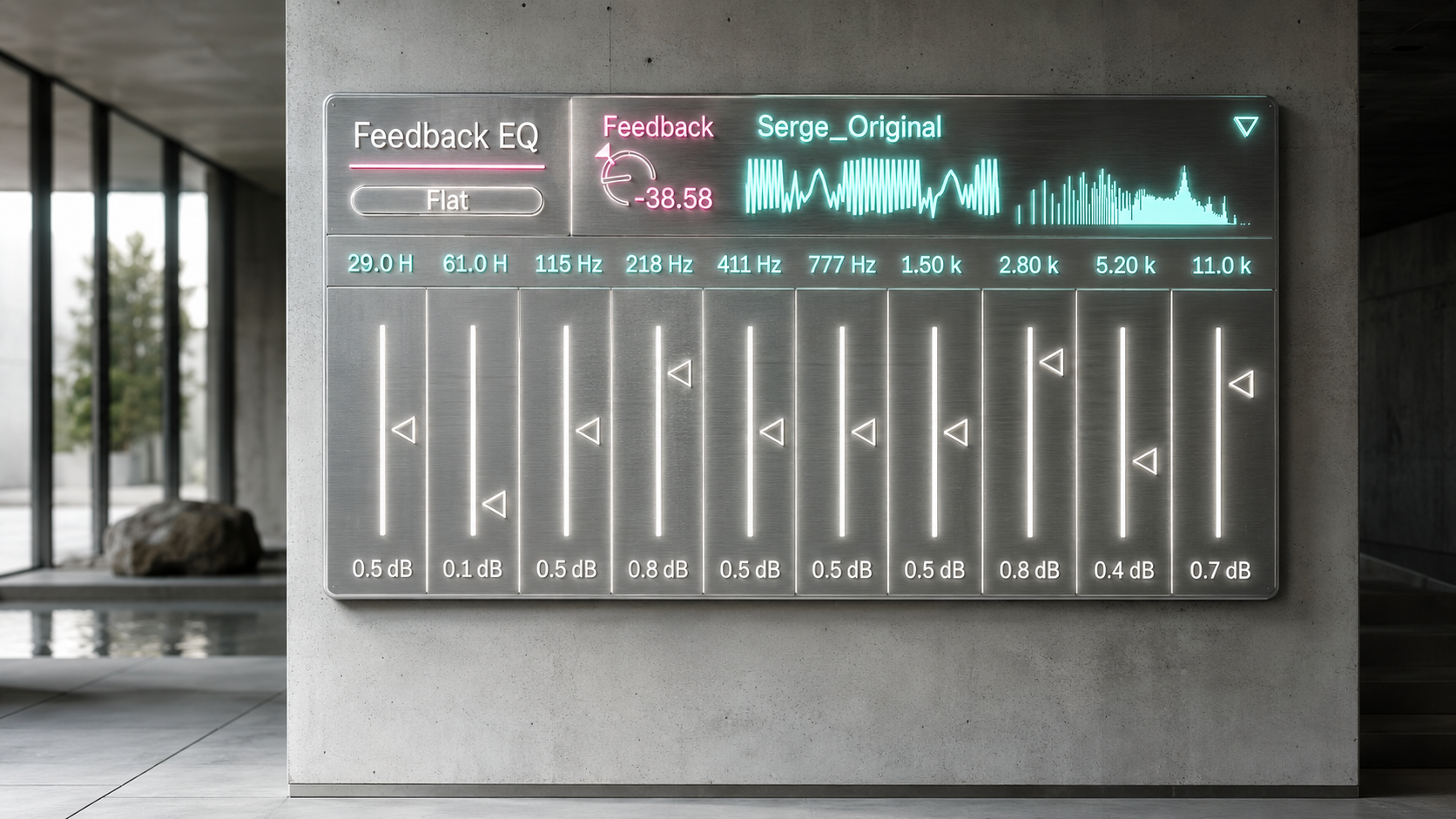
Feedback EQ includes sixteen Factory Modes, but they are not conventional finished sound presets. A Mode recalls only the ten center frequencies. Your current Band positions and Feedback value remain unchanged, which means an existing resonant shape can be placed into a completely different frequency structure without losing the sound design decisions already made.
Some Modes concentrate the network toward lower frequency weight and resonant drum body. Others create denser middle frequency relationships, wider spacing, formant oriented structures, or deliberately irregular arrangements. Certain Modes also avoid a simple ascending frequency order. These become particularly useful with negative Feedback, where the relationships created by alternating parts of the network contribute to the character of the folded return.
The purpose of Mode is therefore not to provide a finished sound. It allows the same Band configuration and Feedback state to be heard through a different arrangement of resonant frequencies. You can preserve the structure and change its geometry, or keep the geometry and rebuild the resonant contour from Flat. This separation makes it easier to explore frequency relationships without constantly reconstructing the entire device state.
From Subtle Spectral Shaping to Active Transformation
Feedback EQ can move continuously from restrained spectral shaping into much more active sound transformation without changing devices. With drums, only a few resonant bands may be enough to redefine the body of a kick, tom, snare, or percussion sound. Positive Feedback can extend those resonances while preserving a cleaner regenerative identity, while negative Feedback can push the same structure toward a more complex and harmonically altered response.
Sustained synthesizers and drones reveal another side of the network. Automating several center frequencies allows groups of resonances to move through the spectrum instead of behaving like a fixed filter curve. Irregular upper band settings combined with negative Feedback can create dense harmonic textures that move well beyond the original source. Noise and long samples provide continuous energy to the network, making the interaction between Band settings, frequency geometry, and Feedback especially easy to hear.
The nonlinear DSP core runs inside an eight times oversampled processing stage and includes behaviour such as amplitude dependent resonator damping and stateful overload processing. This does not mean that Feedback EQ reproduces the measured behaviour of a specific Serge circuit. It means that the device is designed as more than a static EQ transfer curve. Input level and recent signal state can influence how the nonlinear network responds, so the same parameter configuration can behave differently according to what is being fed into it.
The integrated spectrum display is intended for visual orientation while shaping the network. It allows broad spectral changes to be followed while several resonances are moving at once, but it is not presented as a calibrated measurement instrument. For precise analysis, a dedicated spectrum analyzer should still be used.
For me, Feedback EQ is not about transferring the appearance or circuit diagram of Serge into software. It is about reconsidering something I repeatedly encounter when using a Serge system: a processor does not have to remain limited to its nominal function. Its role can change according to feedback, input level, resonance, and interaction with the rest of the system.
Feedback EQ begins with the familiar structure of an equalizer, but it does not have to remain one. As resonance is increased, frequency geometry is changed, and Feedback is returned through the network, spectral correction can gradually become sound generation and transformation.
Format and Updates
Feedback EQ is supplied as a Max for Live audio effect.
Your purchase includes free lifetime updates. Future published updates for Feedback EQ are available at no additional cost. This does not guarantee that updates will be released forever or at any fixed frequency. It means that when future updates are published, existing customers are not charged again for them.
Existing customers can access the latest published files by signing in to the Sellfy account used for the original purchase.
v.4.0 ... Expanded FeedbackEQ into a ten band Serge inspired resonant filterbank with movable frequency centers, distinct positive and negative feedback characters, sixteen frequency set Modes, 8 times oversampling, alternating COMB outputs, and integrated spectrum visualization. (2026/8/30)
v.2.0 ... Updated UI & internal serge 1973 filter. (2026/5/3)
v.1.9 ... Added 4x oversampling. (2026/4/21)
Distortion
Drivecore https://akihikomatsumoto.sellfy.store/p/ableton-drivecore/
NOTT https://akihikomatsumoto.sellfy.store/p/ableton-nott/
Japanoise https://akihikomatsumoto.sellfy.store/p/ableton-japanoise/
EXTortion https://akihikomatsumoto.sellfy.store/p/abletonextortion/
Feedbacker https://akihikomatsumoto.sellfy.store/p/abletonfeedbacker/
Lotka–Volterra https://akihikomatsumoto.sellfy.store/p/ableton-lotka-volterra/
Bit Mangler https://akihikomatsumoto.sellfy.store/p/abletonbitmangler/
Wave Folder https://akihikomatsumoto.sellfy.store/p/abletonwavefolder/
Sine Shaper https://akihikomatsumoto.sellfy.store/p/ableton-sine-shaper/
Freq Modulator https://akihikomatsumoto.sellfy.store/p/abletonfreqmodulator/
Feedback EQ https://akihikomatsumoto.sellfy.store/p/ableton-feedback-eq/
AKAIst https://akihikomatsumoto.sellfy.store/p/ableton-akaist/
Akihiko Matsumoto
Study Site https://akihikomatsumoto.com/study/
Ableton M4L, Serum Preset Store https://akihikomatsumoto.com/download/
Sample Pack https://akihikomatsumoto.sellfy.store/sample-pack/
Bandcamp https://akihikomatsumoto.bandcamp.com
Ableton Skin https://akihikomatsumoto.sellfy.store/p/ableton-skin-pack/
Spotify https://open.spotify.com/artist/1tZMmxzZbvNu6klyKXa0L1?si=2JZaFeLbREi-UownD8POSg