
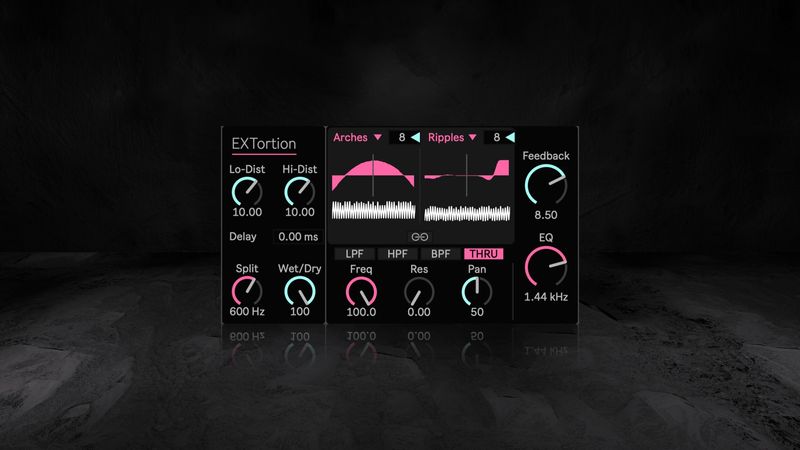
Ableton EXTortion ver.4.0
Max for Live Device (.amxd file)
Distortion Is a Question of Shape
A drum hit can be loud without feeling sharp. A bass sound can carry plenty of weight but still disappear behind a dense arrangement. Sometimes the answer is not another layer or more level. It is changing how the sound responds to its own movement, from the quieter parts of the waveform to the peaks that give it an edge.
EXTortion 4.0 brings that kind of sound design into Ableton Live. This Max for Live stereo distortion effect lets you explore different amplitude shaping curves rather than treating distortion as a single fixed character. The result depends on the sound you feed into it and how far you drive it. A small adjustment can be enough to change the definition of a drum transient, while a more assertive setting can turn an ordinary sound into raw material for a new texture.
One Signal, Two Different Reactions
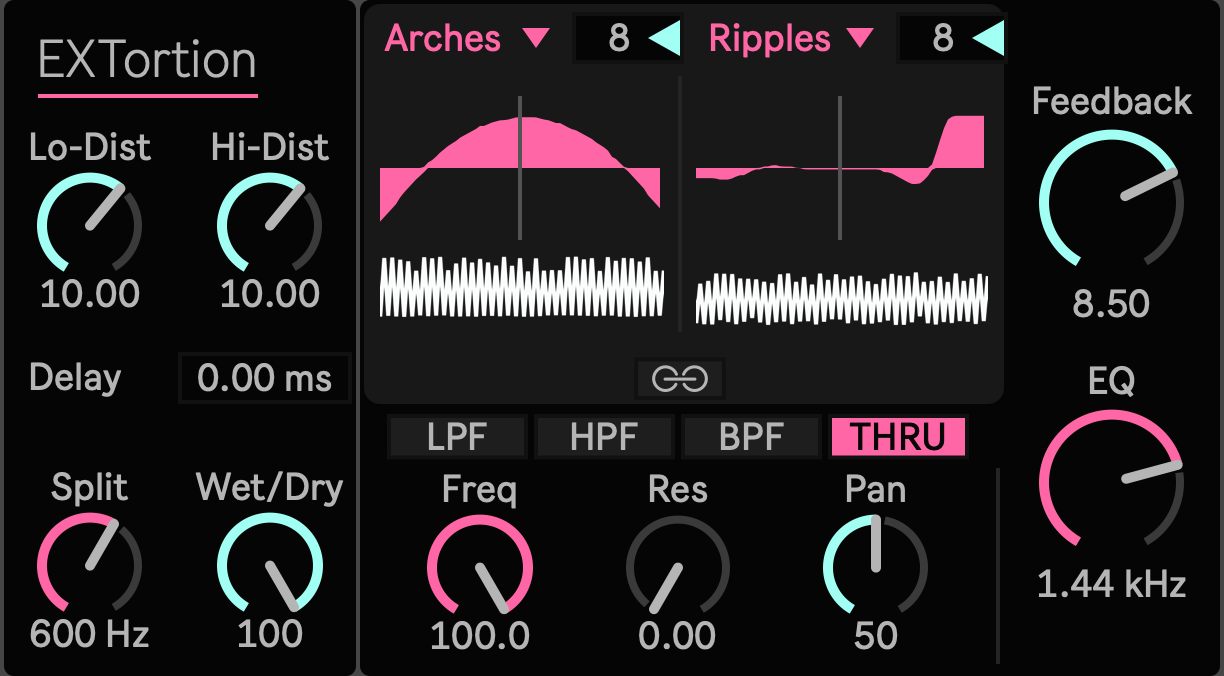
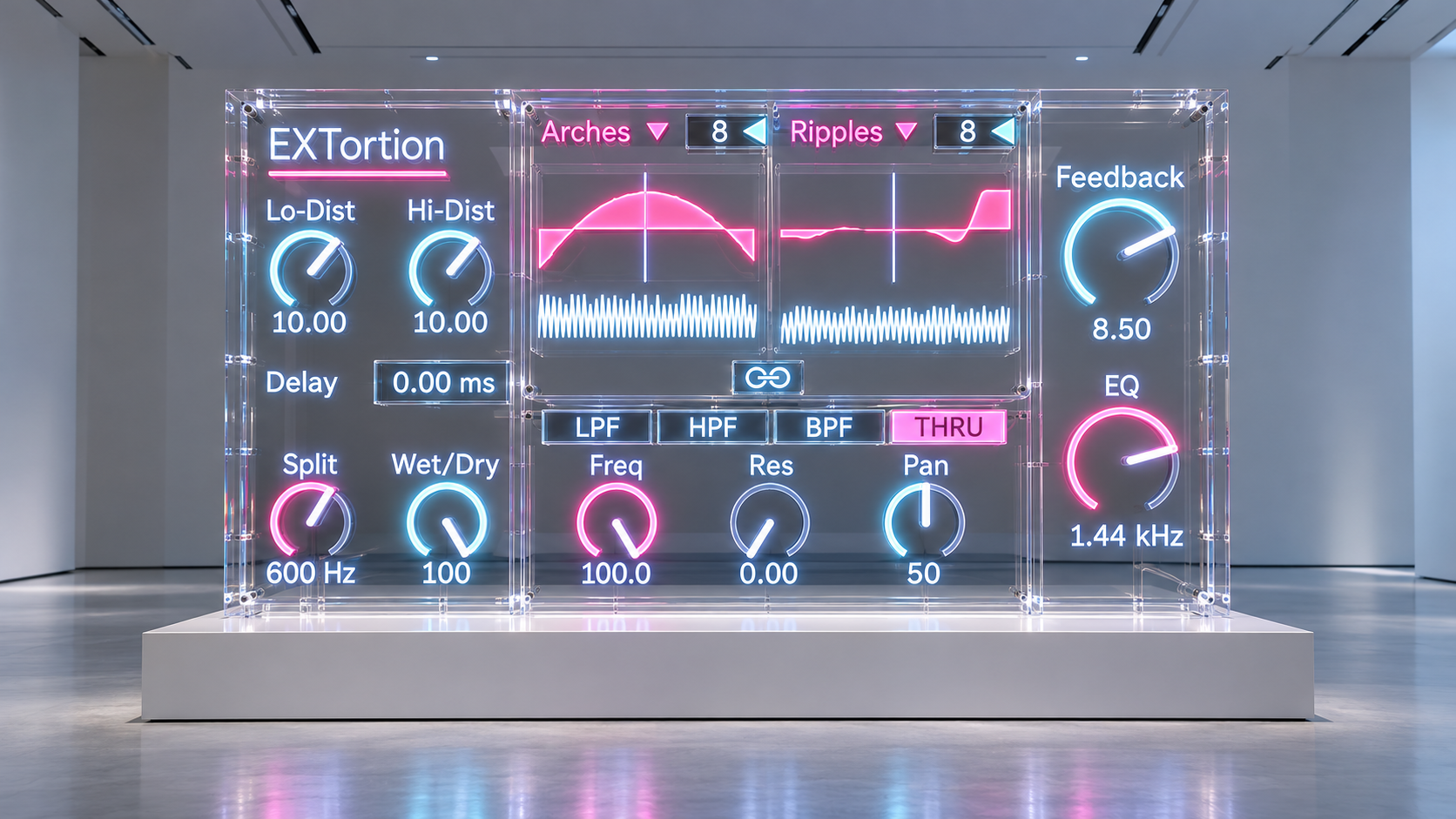
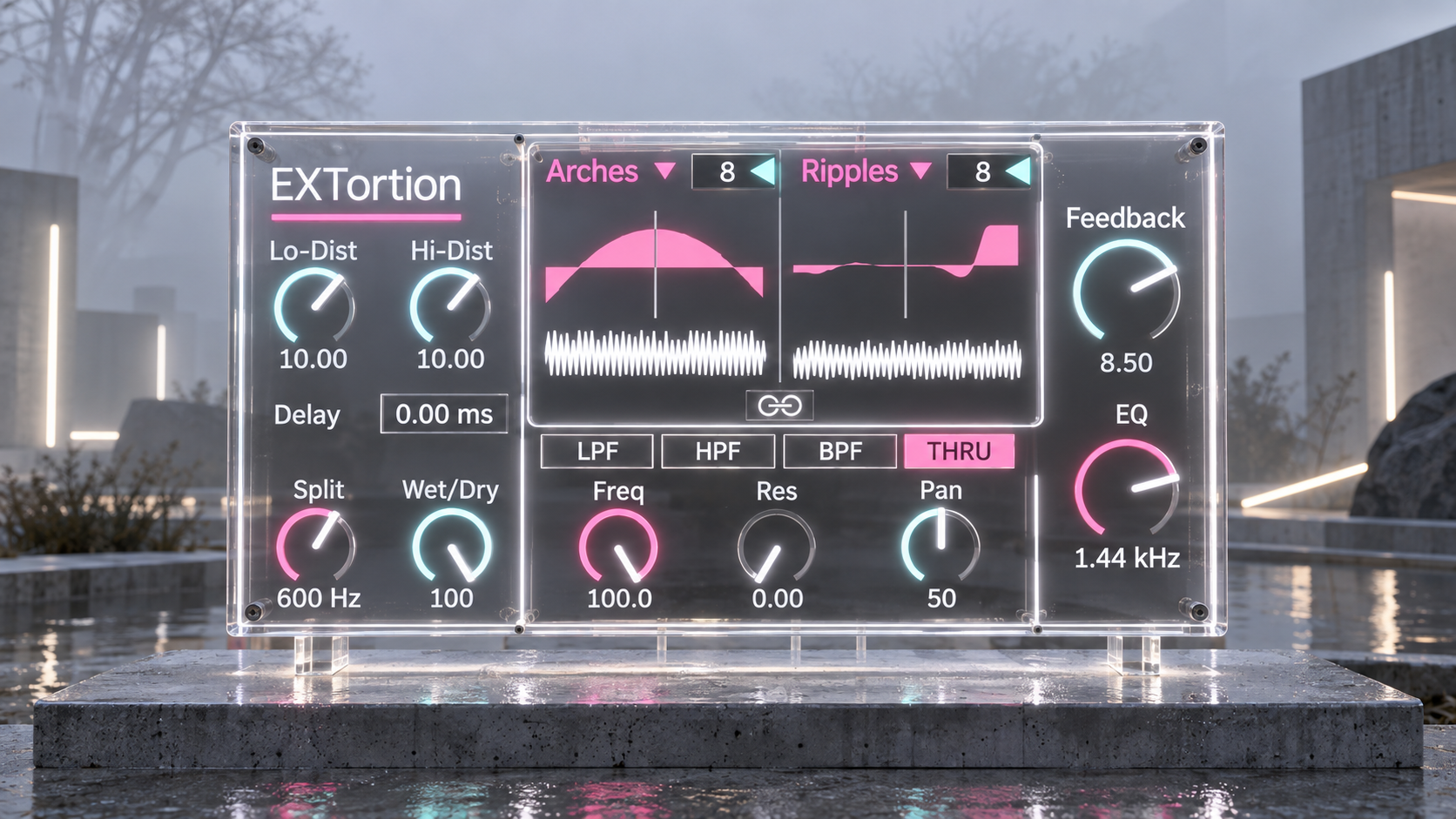
A stereo recording does not need identical treatment on both sides. Sometimes the center should remain familiar while the detail at the edges takes on another character. EXTortion gives the left and right channels independent waveform selections, so the two sides can respond differently to the same musical moment. Each channel can select from 512 transfer curves, organized into 32 banks with 16 slots each. Those choices are not 512 promises of equally dramatic sounds. They are different starting points for deciding how input amplitude becomes output character.
The LR Link control keeps the waveform selections together when a shared response suits the track. Turn it off and you can compare different shapes on either side. Try this on a stereo percussion recording or a moving noise texture: one side might emphasize a clipped, abrupt gesture while the other retains a different contour. What matters is not the number of curves in isolation, but the ability to place tonal contrast inside an existing performance without rebuilding the arrangement.
Keep the Weight, Change the Edge
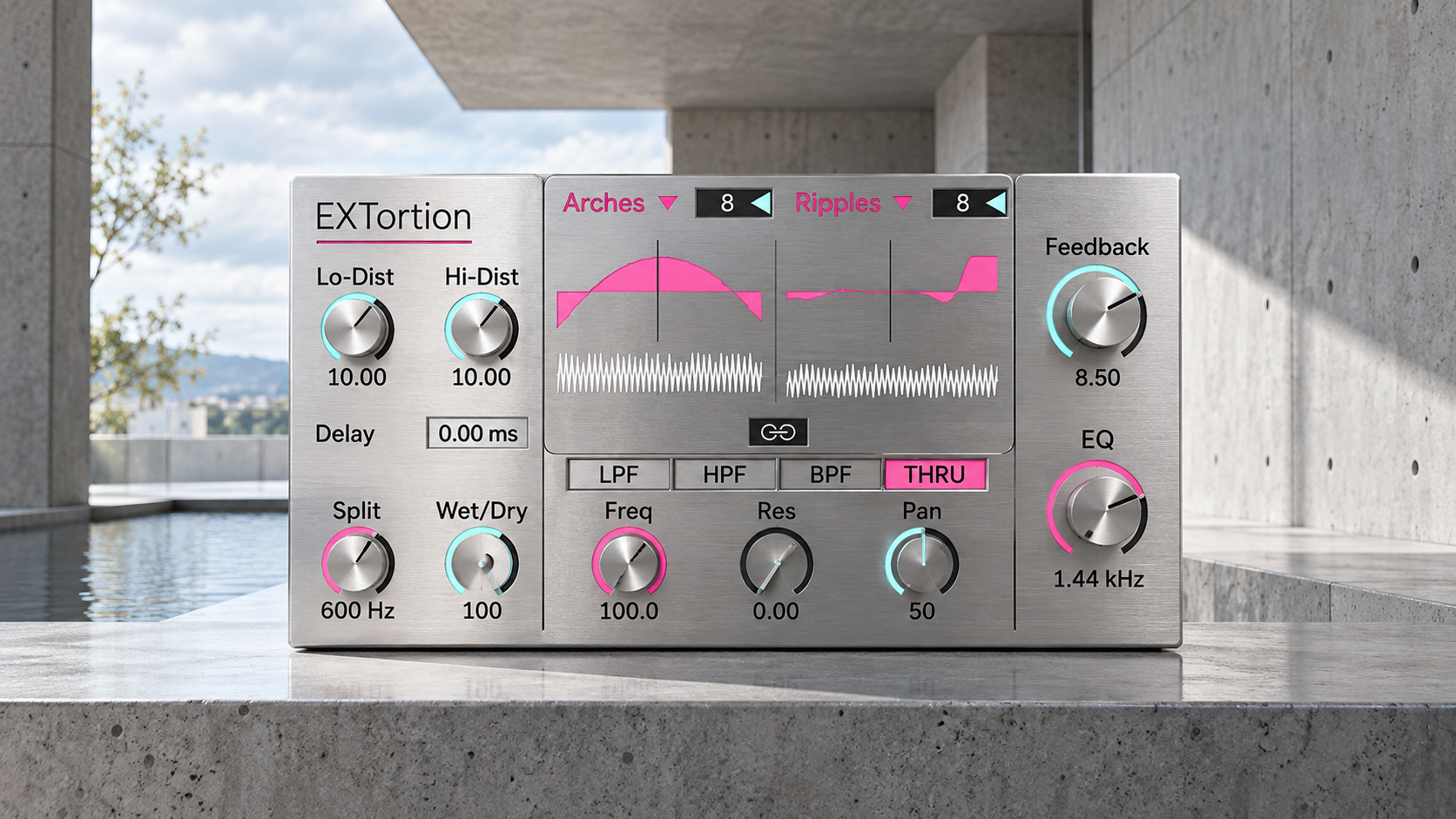
Driving an entire sound harder often changes the part you wanted to preserve. A bass may gain presence in the upper harmonics while its low end becomes less useful. A drum loop may acquire exciting grit but lose the relationship between its kick and its smaller details. EXTortion lets you choose a frequency split and adjust the distortion drive for the lower and upper regions separately. Instead of committing the whole signal to the same degree of transformation, you can listen for where the extra density helps and where it begins to obscure the rhythm.
Start with a familiar loop and keep the lower range relatively restrained. Then increase the upper drive until the hats, rims or the noisy tail of the snare begin to change their relationship to the kick. You can also explore the available low pass, high pass and band pass filtering to focus the texture further, or pass around the filter stage without bypassing the distortion itself. The purpose is not to force every source toward the same aggressive sound. It is to decide which part of the source should become less predictable.
A Sound That Does Not End at the Transient
Distortion is often heard as an instant change: the signal enters, its shape changes, and the event ends. EXTortion also provides feedback and delay controls, opening up another kind of relationship between the initial hit and what follows it. With restrained settings, they offer a way to explore resonance and a lingering response. Pushed further, the result may become much less stable, especially when the incoming sound already contains strong peaks. The effect is intended for exploration, so begin with low feedback and a conservative Wet/Dry balance, then listen before increasing intensity.
That approach can be more interesting than simply making a drum bus louder. A sparse sequence gives each processed impact room to leave a trace. A sustained pad or a noisy field gives the shaping curves more continuous material to work with. Wet/Dry lets the original sound remain part of the decision, while Pan places the processed contribution across the stereo image. In each case, the aim is to discover a rhythmic or textural function for distortion, not to cover the source with an effect for its own sake.
Made for the Session
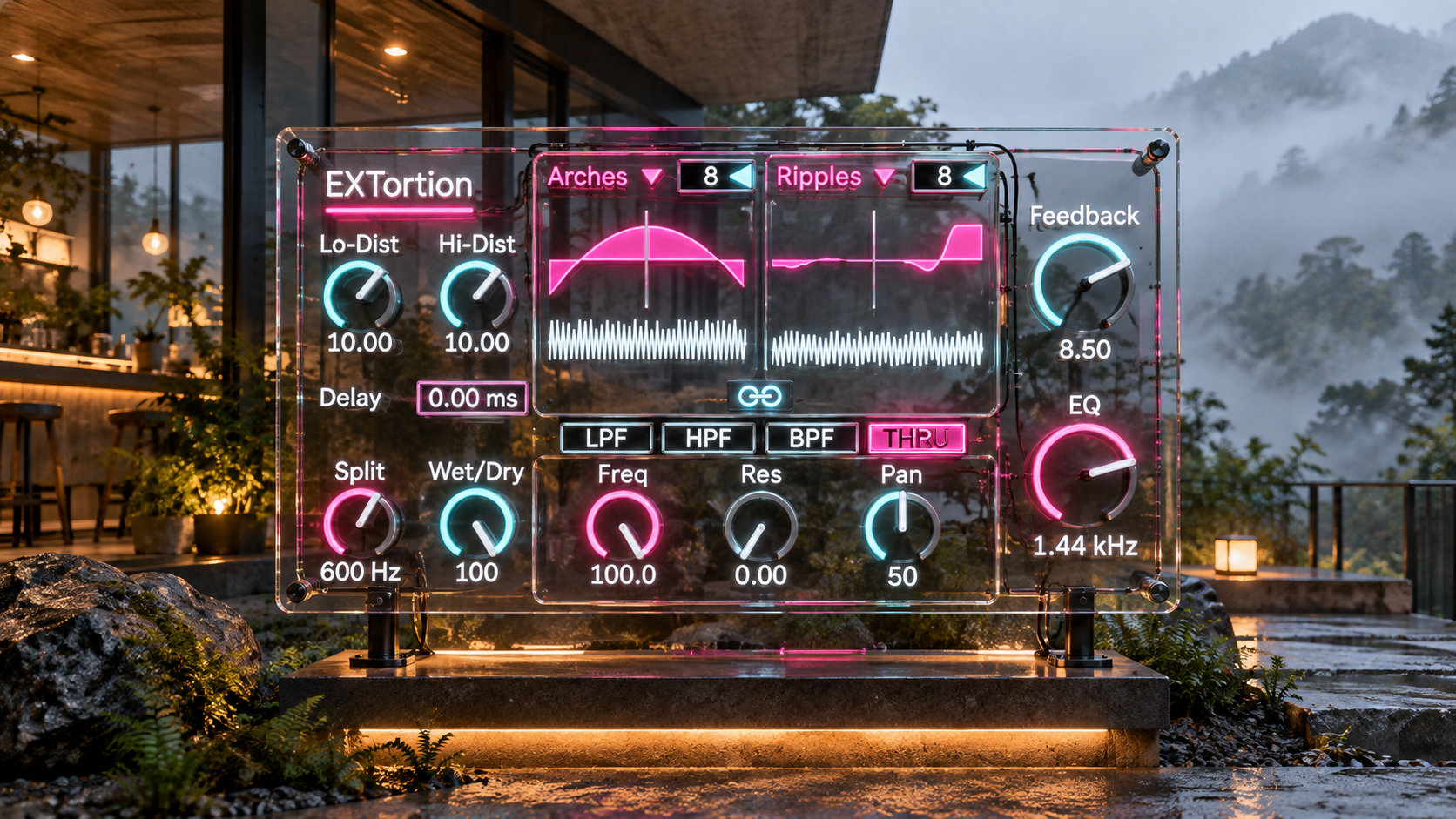
EXTortion 4.0 is a Max for Live audio effect intended for use with Ableton Live and Max 9. The device uses an .amxdfile together with companion JavaScript and SVG files, which must remain in the same folder for the required resources to load. It is a sound shaping instrument for producers who want to make deliberate decisions about impact, spectral weight and stereo contrast, whether working on percussion, bass or more abstract electronic material.
Its central idea is simple: the same note or drum hit can occupy a different place in a track when its shape changes. Instead of reaching automatically for another sound, try hearing the one you already have in a different way.
Free Lifetime Updates
Your purchase includes free lifetime updates. Any future published updates for EXTortion are included at no additional cost. Existing customers can access the latest available files through the Sellfy account used for the original purchase. No additional purchase is required.
v4.0 Stereo waveshaping device updated with 512 selectable transfer curves. (2026/10/10)
ver.3.0 ... Added Feedback System. (2025/10/27)
ver.1.01... Wet gain reduced to 1/3.
ver.1.5... Filter mode added, Delay added.
ver.2.1 ... Stereo independent support, total renewal.
ver.2.5 ... 8 simple distortion tones added.
Ableton Distortion
Feedbacker https://akihikomatsumoto.sellfy.store/p/abletonfeedbacker/
A feedback processor that turns short delay loops into resonance, self oscillation, and noise.
Japanoise https://akihikomatsumoto.sellfy.store/p/ableton-japanoise/
A destructive processor combining wave folding, distortion, shaping, bit crushing, and filtering.
Wave Folder https://akihikomatsumoto.sellfy.store/p/abletonwavefolder/
A stereo wave folder that adds complex harmonics by folding simple waveforms back onto themselves.
Lotka Volterra https://akihikomatsumoto.sellfy.store/p/ableton-lotka-volterra/
A nonlinear audio processor that applies predator prey dynamics to evolving modulation and feedback.
EXTortion https://akihikomatsumoto.sellfy.store/p/abletonextortion/
A stereo distortion that processes the left and right channels as independent nonlinear systems.
Sine Shaper https://akihikomatsumoto.sellfy.store/p/ableton-sine-shaper/
A sine function waveshaper that transforms smooth signals into increasingly complex harmonic spectra.
AKAIst https://akihikomatsumoto.sellfy.store/p/ableton-akaist/
A lo fi processor inspired by vintage AKAI conversion and low bit sampling characteristics.
VHSoid https://akihikomatsumoto.sellfy.store/p/ableton-vhsoid/
A physical modeling effect for VHS style bandwidth loss, wow, flutter, hiss, and transport instability.
Drivecore https://akihikomatsumoto.sellfy.store/p/ableton-drivecore/
A distortion processor that switches among multiple circuit inspired nonlinear clipping behaviors.
Bit Mangler https://akihikomatsumoto.sellfy.store/p/abletonbitmangler/
A digital degradation effect that turns bit depth and numerical failure into unstable distortion.
Vinyloid https://akihikomatsumoto.sellfy.store/p/ableton-vinyloid/
A physical modeling vinyl simulator covering groove, stylus, cartridge, rotation error, and surface noise.
Akihiko Matsumoto
Study Site https://akihikomatsumoto.com/study/
Ableton M4L, Serum Preset Store https://akihikomatsumoto.com/download/
Sample Pack https://akihikomatsumoto.sellfy.store/sample-pack/
Bandcamp https://akihikomatsumoto.bandcamp.com
Ableton Skin https://akihikomatsumoto.sellfy.store/p/ableton-skin-pack/
Spotify https://open.spotify.com/artist/1tZMmxzZbvNu6klyKXa0L1?si=2JZaFeLbREi-UownD8POSg