
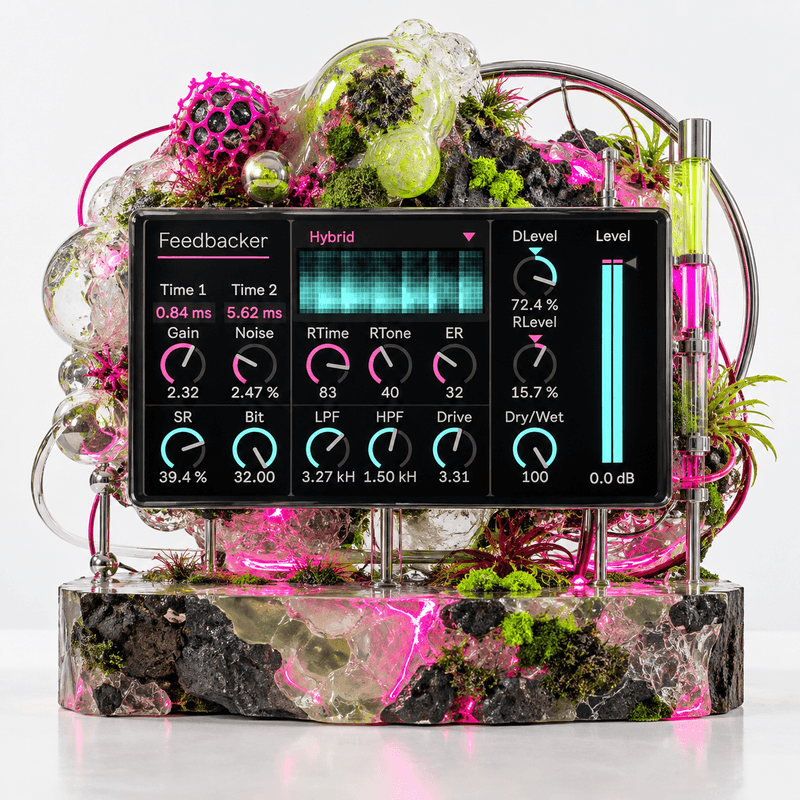
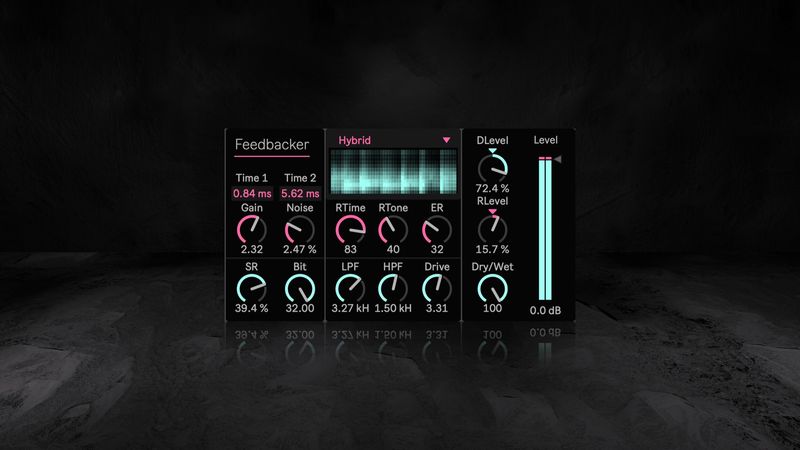
Ableton Feedbacker ver.2.0 | Expanding the No-Input Mixer Concept
Max for Live Device (.amxd file)
Bring No Input Feedback Performance into Ableton Live
Connect a mixer's output back to one of its inputs, and a device intended to transmit sound can begin to produce its own. In no input mixing, tiny disturbances grow into whistles, pulses and noise as the performer changes the circuit that keeps them alive. The appeal is not simply that sound appears without an instrument. The feedback path becomes the instrument, and listening to what it does is part of playing it.
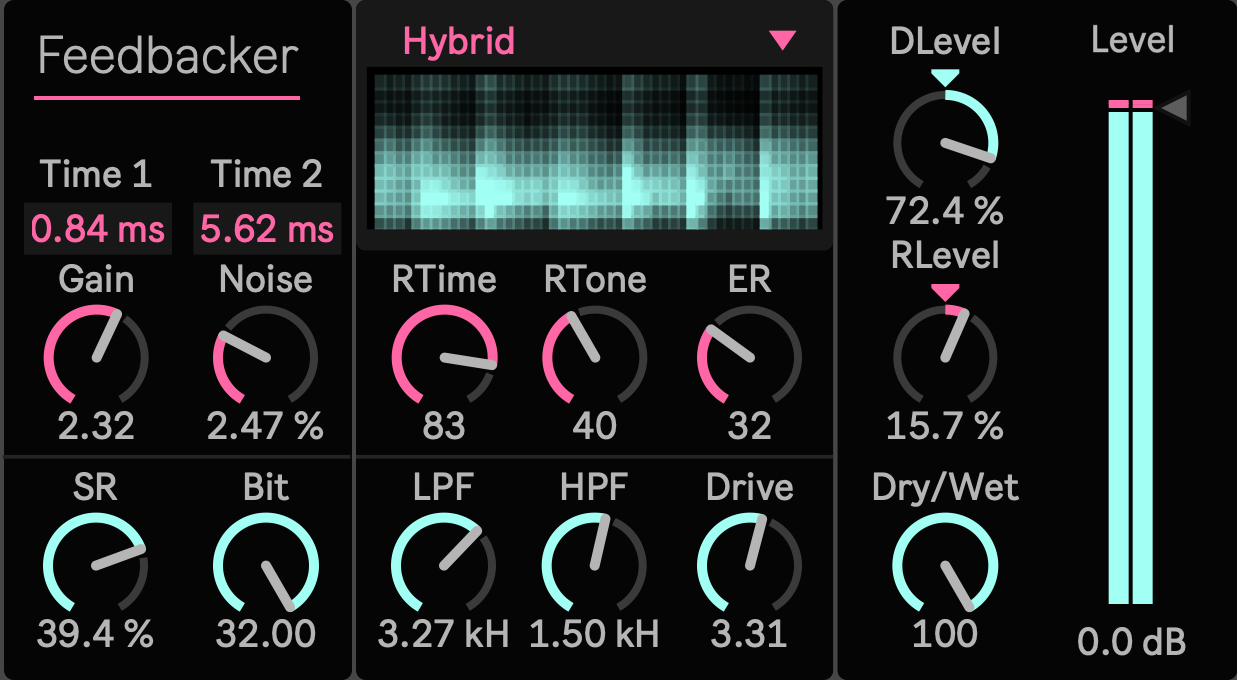
Feedbacker 2.0 brings that approach to Ableton Live as a stereo Max for Live audio effect. It does not imitate a particular analog mixer. Instead, it makes a digital feedback circuit available for performance: you can introduce a sound, excite the system with internal noise, or work with the changing relationship between returning signals. The aim is to shape a process, rather than select a finished texture from a preset.
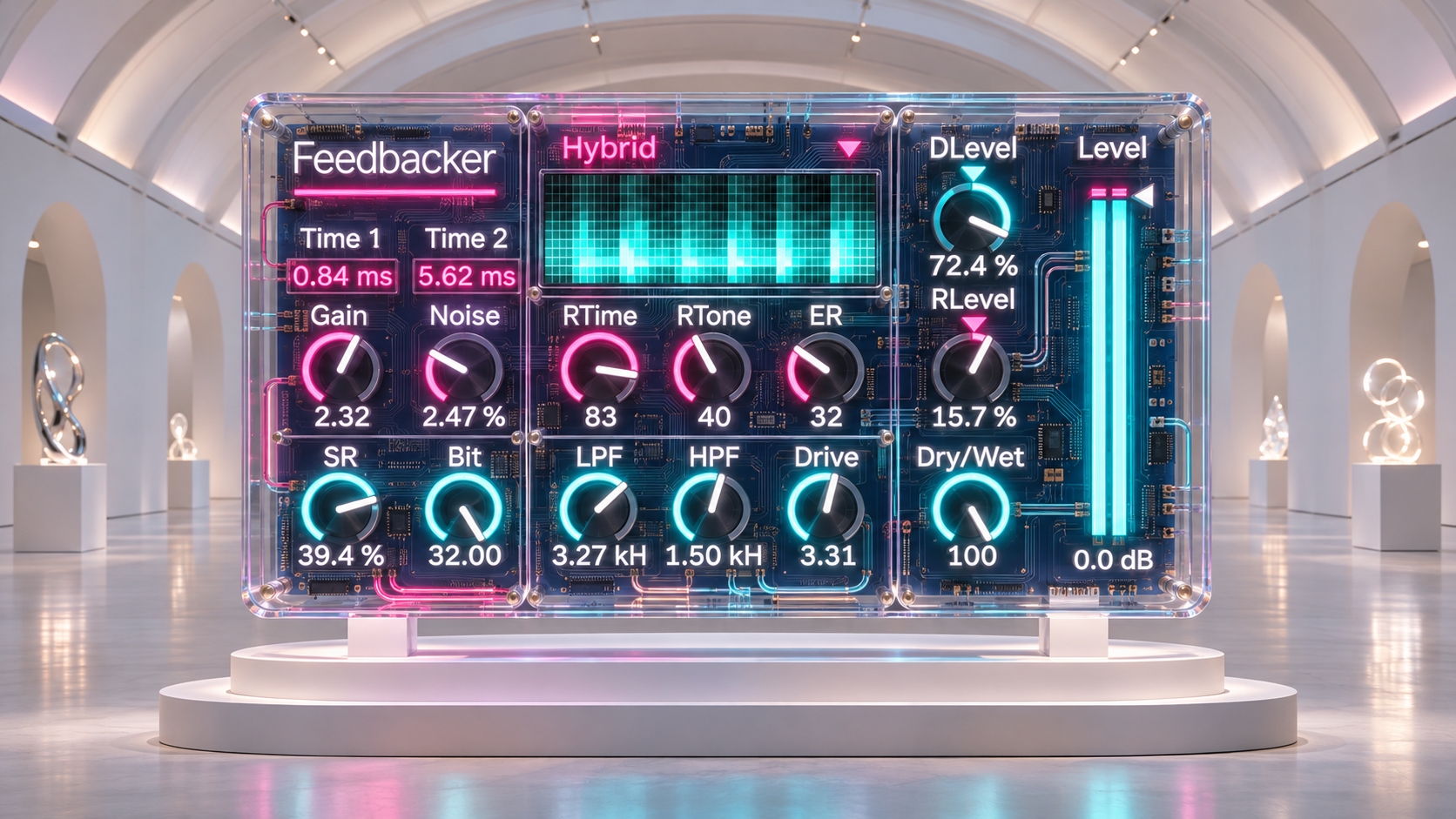
A Sound That Changes Because It Returns
Start with a single dry percussion hit. Its first return may be recognizable as an echo, but subsequent returns need not preserve its rhythm or color. Set slightly different delay times on the left and right, and the two cycles begin to move against each other. As the sound continues to circulate, what was one attack can become an uneven mechanical pulse. The original sample is still the starting point, but it no longer decides everything that follows.
This is where feedback becomes a performance decision. Changing the amount of processed delay sent back into the circuit changes not only the sound you hear now, but also the material that will arrive in the next cycle. A small reduction can let a pattern fall away; increasing the return can bring a resonance forward. The return levels can also reverse polarity, altering the way cycles reinforce or cancel one another. You listen, intervene, and hear the consequences of that intervention come back to you.
The circuit can begin without a percussion hit at all. Feedbacker's internal Noise provides a small excitation that may develop into sustained tones or unstable movement. You are not obliged to supply a melody or a continuous audio stream. Sometimes the most interesting performance begins with making a path for sound to emerge, then resisting the urge to control every moment of it.
Playing Between Resonance and Collapse
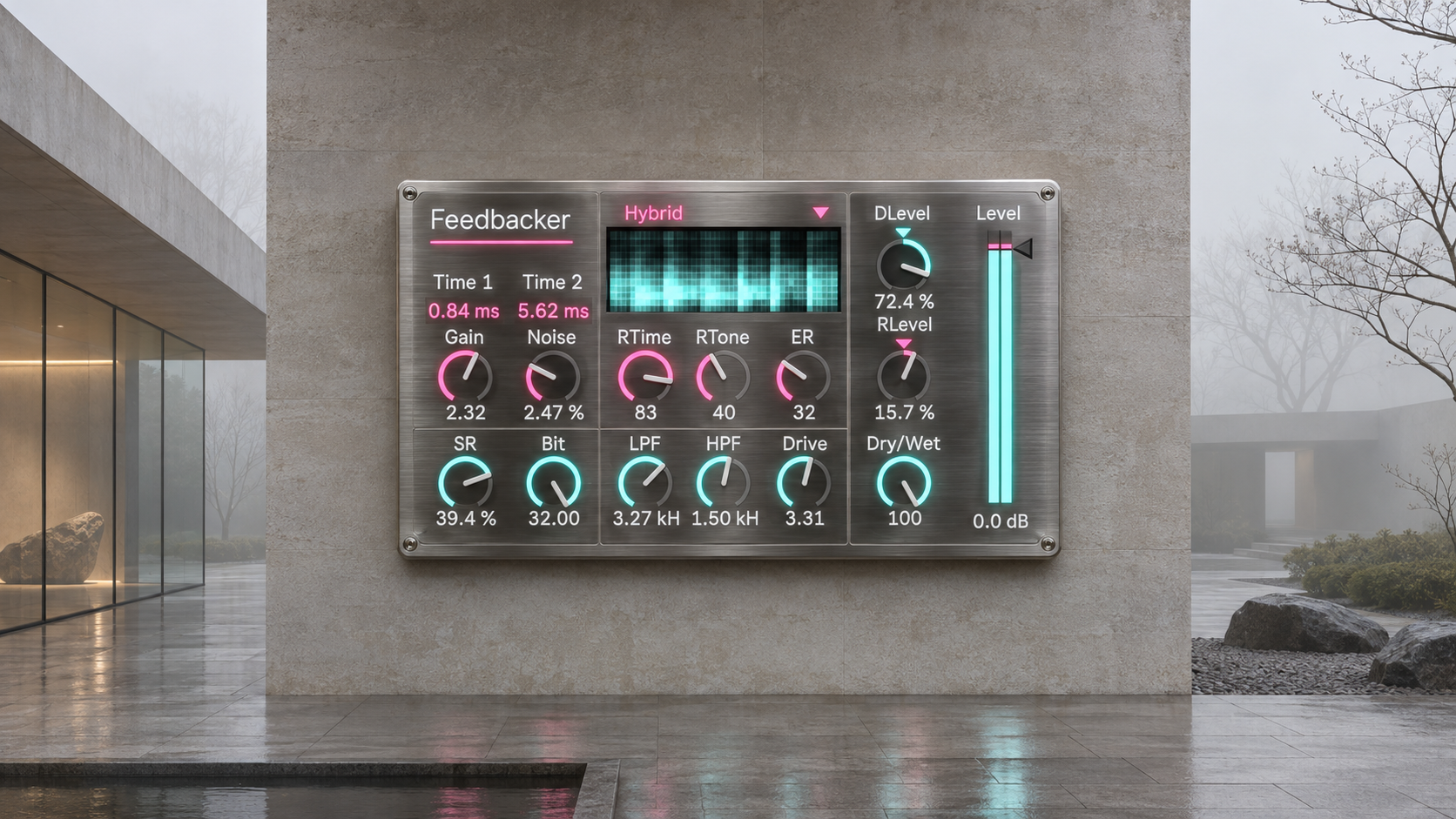
Once a pulse has taken hold, the next question is what the circuit is allowed to keep. Filtering the returning delay can gradually darken a bright sound or expose a narrow ringing band. Lowering SR or Bit makes the processed return less faithful, so its imperfections take part in the following cycles instead of sitting like an effect on top of a finished recording. A gesture that began as a drum sound can move toward something that no drum machine could simply repeat.
Space also enters this exchange rather than appearing only at the end. Feedbacker's reverb can return into the same recursive path, letting its reflections influence what comes next. A hard, metallic response may gather into a ringing texture; a more diffused response can make the individual attacks disappear into a sustained field. The change is useful because it asks you to hear the space as another contributor to the sound, not merely as the room around it.
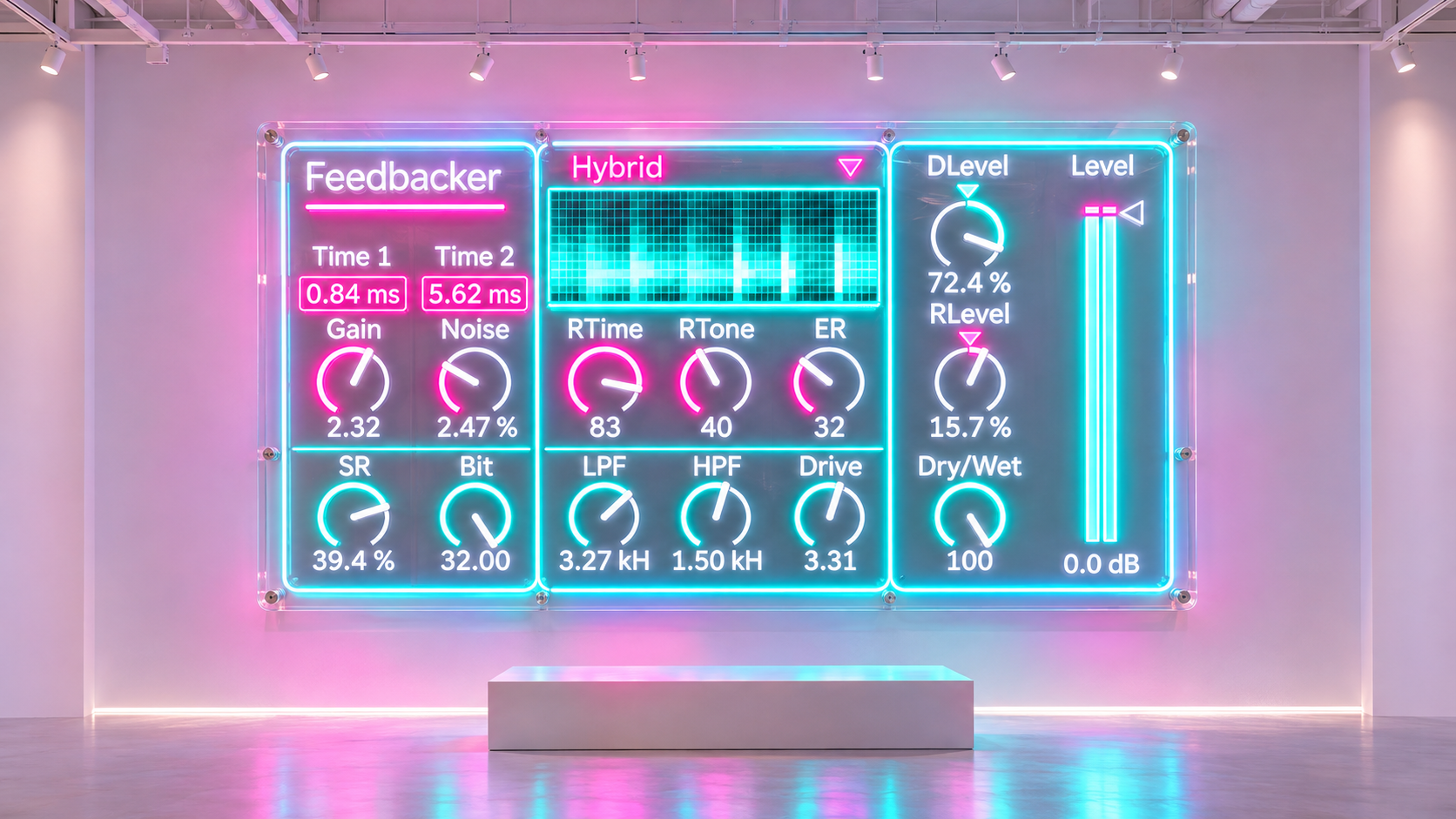
The most interesting moment may lie just before one frequency takes over. The internal spectrogram looks at the signal being written back into the feedback delays, offering a view of which regions are gathering energy. It cannot tell you what is musically right. It can, however, help you decide whether to interrupt a growing resonance, let it settle, or record it before it changes. Because feedback can rise sharply, begin with the output Level low and use a downstream limiter when exploring strong self oscillation; internal saturation is not a final output limiter.
Capture the Performance, Not Just the Effect
Working inside Ableton Live makes the unpredictable part of the process useful after the improvisation ends. Record a take in which a short strike becomes a pulse, begins to ring, and finally dissolves into noise. You might use its opening seconds as a rhythm, keep a brief unstable tone as a transition, or stretch the lingering passage into a layer beneath another track. These are not separate sounds you had to design in advance. They are moments discovered in the same evolving performance.
That is the proposition behind Feedbacker: treat feedback as something to play and record, not as a technical problem to suppress or an echo to set and forget. You can leave room for the circuit to surprise you, then use the precision of a DAW to choose what belongs in the composition. The experiment and the finished track no longer have to be separate activities.
Free Lifetime Updates
Feedbacker 2.0 is supplied as a Max for Live .amxd audio effect for Ableton Live. Your purchase includes free lifetime updates to future published versions of the purchased product, at no additional cost. Existing customers can access the latest available files through the Sellfy account used for their original purchase, without buying the product again.
ver.2.0 ... Rebuilt the feedback engine with stereo delay, Metal, Hybrid, and Cloud reverb modes, signed feedback, SR and Bit degradation, noise excitation, Drive, and a feedback spectrogram. (8/4/2026)
ver.1.1 ... Push3 support. (4/30/2024)
Distortion
Feedbacker https://akihikomatsumoto.sellfy.store/p/abletonfeedbacker/
Feedback processor that turns short delay loops into resonance, self oscillation, and noise.
Japanoise https://akihikomatsumoto.sellfy.store/p/ableton-japanoise/
Destructive processor combining wave folding, distortion, shaping, bit crushing, and filtering.
Wave Folder https://akihikomatsumoto.sellfy.store/p/abletonwavefolder/
Stereo wave folder that adds complex harmonics by folding simple waveforms back onto themselves.
Lotka Volterra https://akihikomatsumoto.sellfy.store/p/ableton-lotka-volterra/
Nonlinear audio processor that applies predator prey dynamics to evolving modulation and feedback.
EXTortion https://akihikomatsumoto.sellfy.store/p/abletonextortion/
Stereo distortion that processes the left and right channels as independent nonlinear systems.
Sine Shaper https://akihikomatsumoto.sellfy.store/p/ableton-sine-shaper/
Sine function waveshaper that transforms smooth signals into increasingly complex harmonic spectra.
AKAIst https://akihikomatsumoto.sellfy.store/p/ableton-akaist/
Lo fi processor inspired by vintage AKAI conversion and low bit sampling characteristics.
VHSoid https://akihikomatsumoto.sellfy.store/p/ableton-vhsoid/
Physical modeling effect for VHS style bandwidth loss, wow, flutter, hiss, and transport instability.
Drivecore https://akihikomatsumoto.sellfy.store/p/ableton-drivecore/
Distortion processor that switches among multiple circuit inspired nonlinear clipping behaviors.
Bit Mangler https://akihikomatsumoto.sellfy.store/p/abletonbitmangler/
Digital degradation effect that turns bit depth and numerical failure into unstable distortion.
Vinyloid https://akihikomatsumoto.sellfy.store/p/ableton-vinyloid/
Physical modeling vinyl simulator covering groove, stylus, cartridge, rotation error, and surface noise.
Akihiko Matsumoto
Study Site https://akihikomatsumoto.com/study/
Ableton M4L, Serum Preset Store https://akihikomatsumoto.com/download/
Sample Pack https://akihikomatsumoto.sellfy.store/sample-pack/
Bandcamp https://akihikomatsumoto.bandcamp.com
Ableton Skin https://akihikomatsumoto.sellfy.store/p/ableton-skin-pack/
Spotify https://open.spotify.com/artist/1tZMmxzZbvNu6klyKXa0L1?si=2JZaFeLbREi-UownD8POSg