
$24.99+
Ableton Air v.6.0
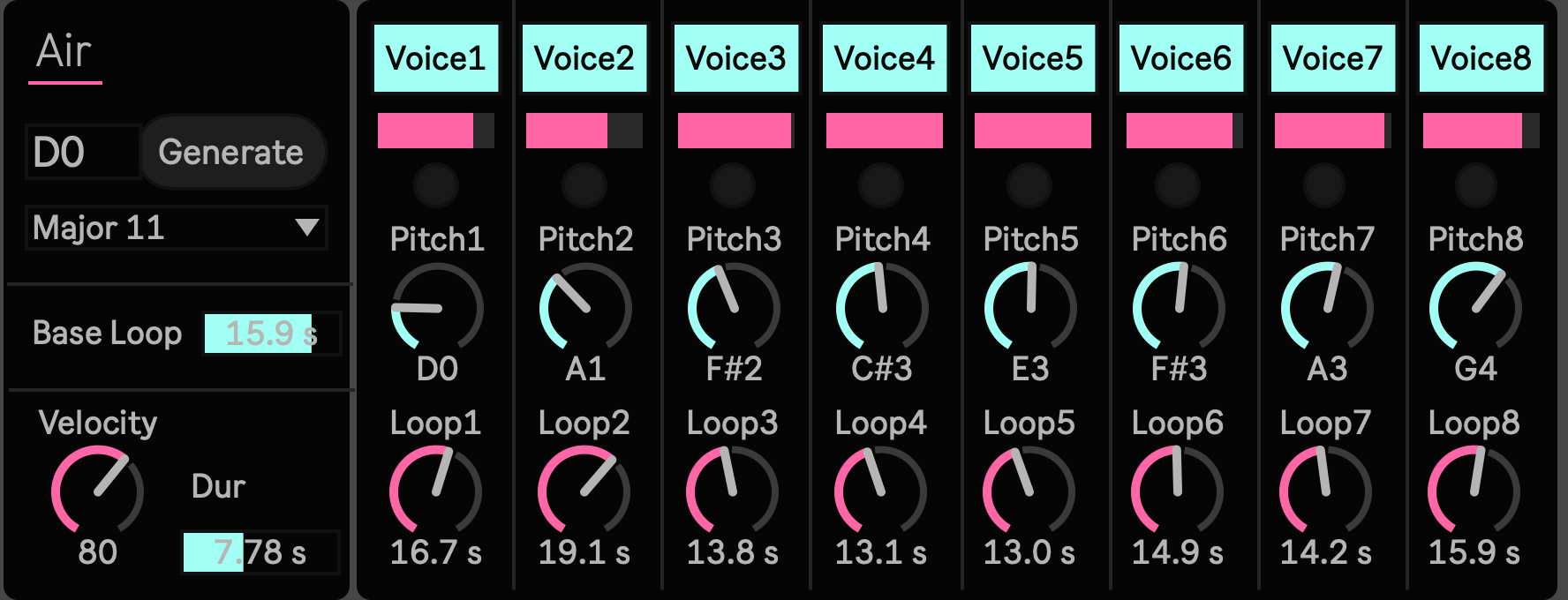
Max for Live (.amxd file) | Ambient Generative Sequencer: Inspired by Timeless Techniques
Air draws inspiration from Brian Eno's Music for Airports and the idea of overlapping tape loops moving at different lengths.
When several loops repeat independently, their relationship never stays completely fixed. Familiar notes meet in new combinations, drift apart, and return from different positions in time. A small amount of musical material can continue changing without requiring a long sequence to be programmed in advance.
Air translates this idea into a Max for Live MIDI Effect.
Eight MIDI voices run on their own Loop Times, each carrying its own Pitch. Instead of forcing every note onto the same rhythmic grid, Air allows independent cycles to overlap and continually reshape their relationship.
The result is a generative structure that can keep evolving from a surprisingly small amount of material.
Let Repetition Stop Sharing the Same Clock
A repeated phrase can be perfectly synchronized and still feel static. The more every note agrees on the same grid, the easier it is for repetition to become predictable.
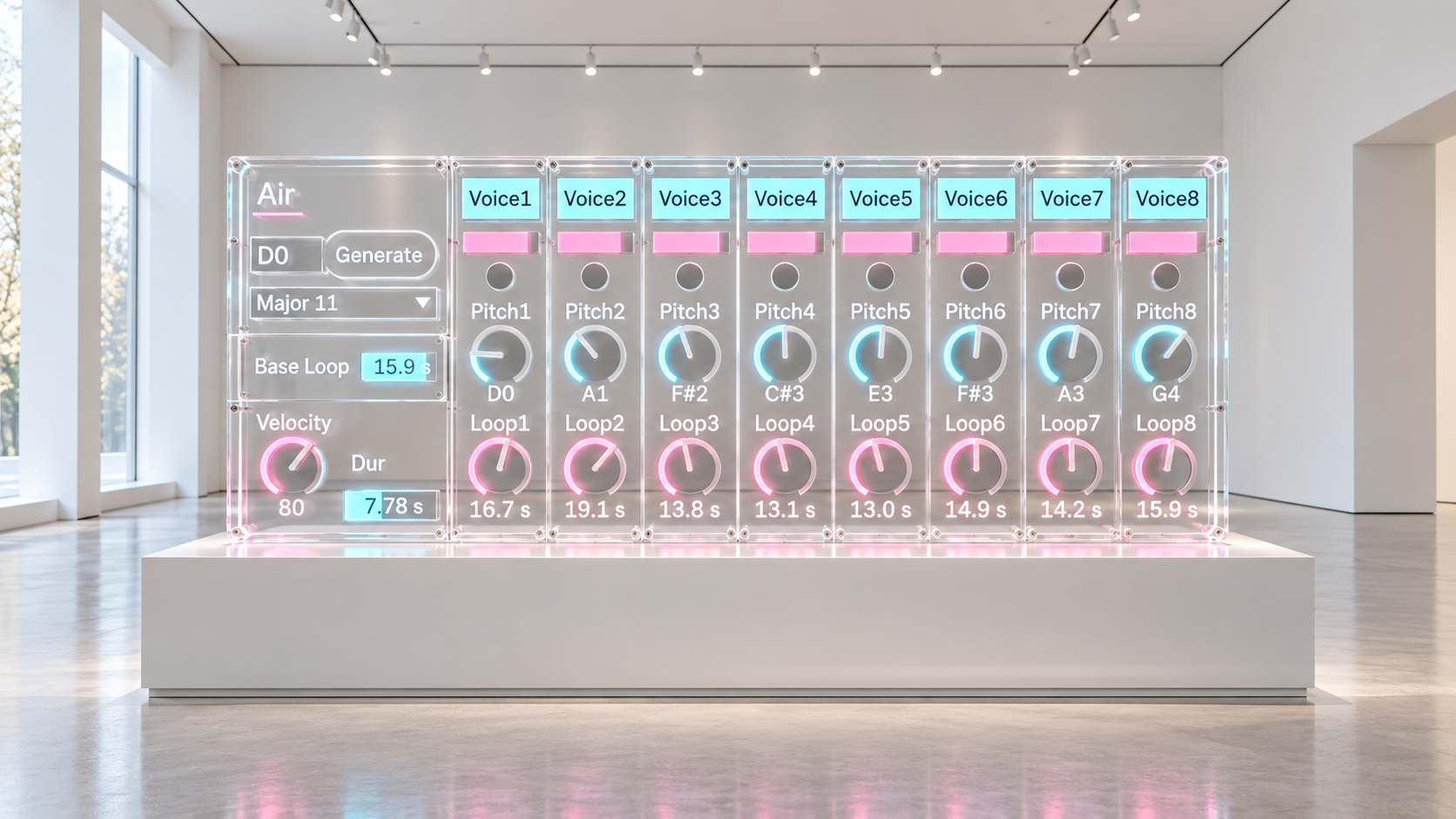
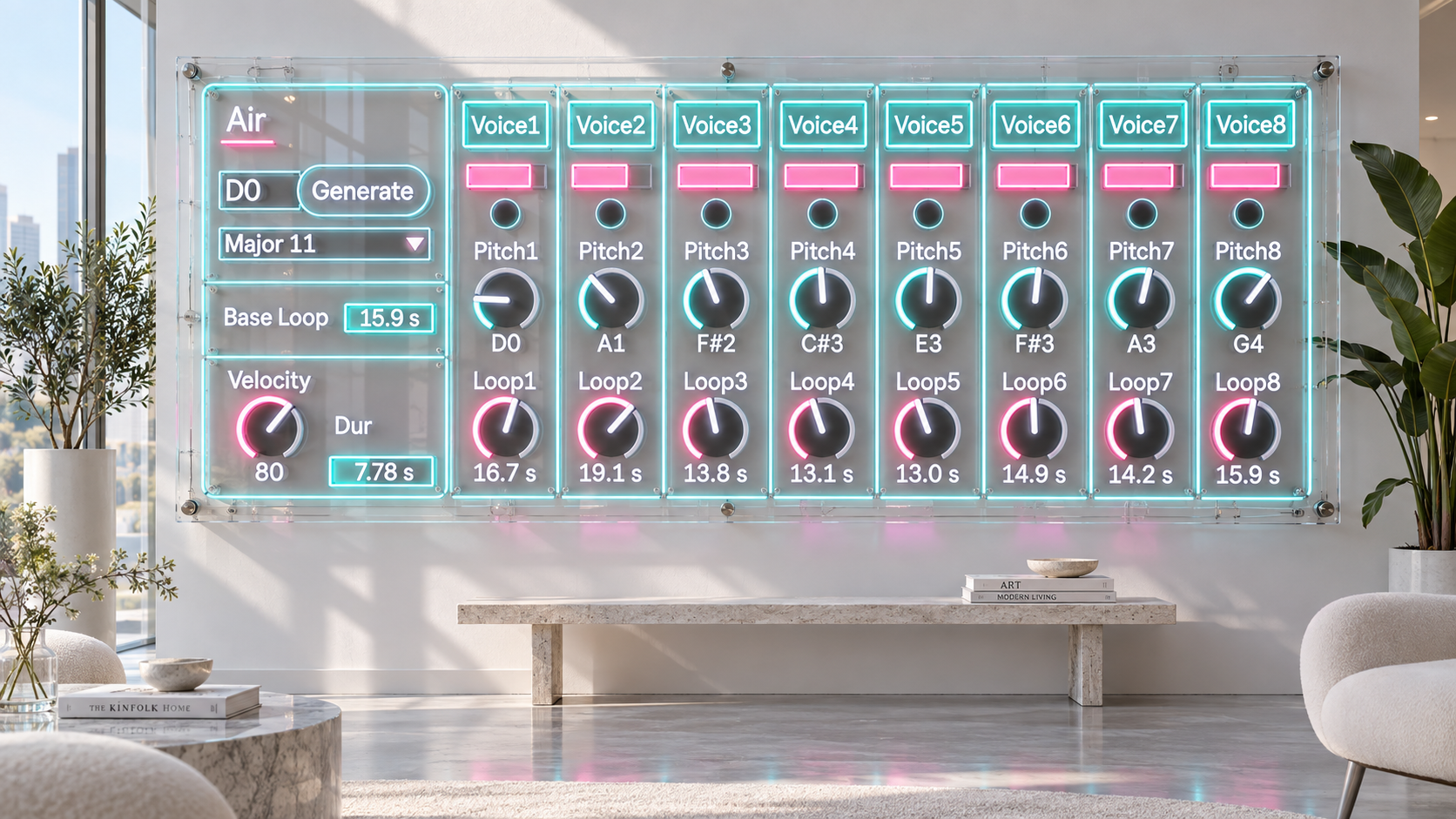
Air takes a different approach. It creates eight MIDI voices, each with its own Pitch and its own Loop Time. Instead of forcing all eight voices onto one shared rhythmic subdivision, the cycles repeat independently in milliseconds. They can remain related to one another without returning at exactly the same moment.
A small group of notes can slowly reorganize itself through timing alone. A simple chord can become an evolving field. A restricted collection of pitches can produce patterns whose internal relationships continue changing long after the first Generate.
Air does not generate audio itself. Place an instrument after it in Ableton Live and the eight MIDI voices become the material that drives the sound.
Generate a Structure, Then Keep What Works
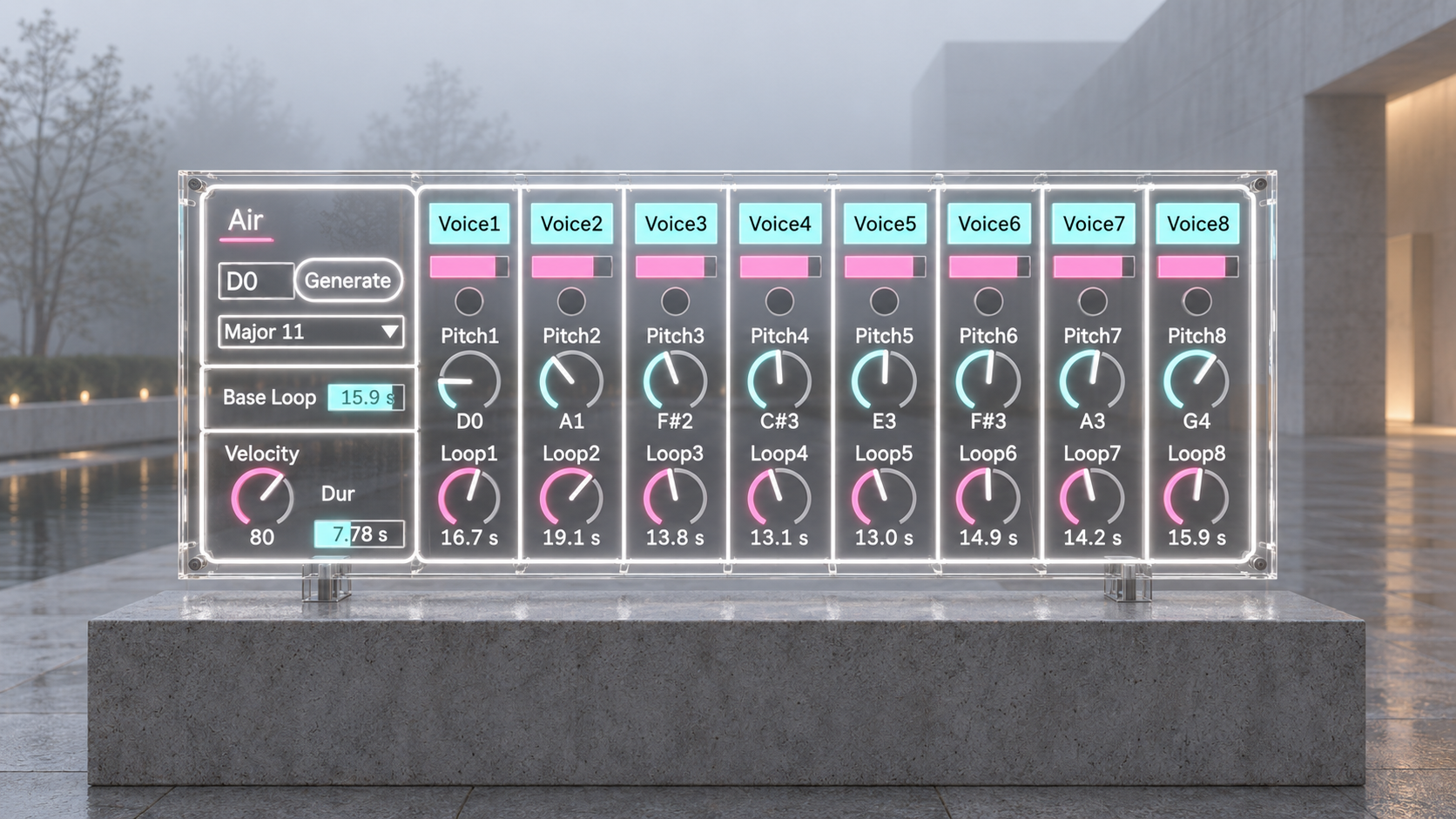
The central workflow is intentionally simple. Choose a Base Note, select a Scale, set the Base Loop, then press Generate.
Air creates eight Pitch values and eight Loop Times at once. The Pitch values are constrained by the selected collection and distributed across different registers. The Loop Times are generated around one common timing center rather than being copied from a single interval.
What matters is what happens next.
The generated result remains editable. If seven voices feel right and one does not, change that Pitch. If the harmony works but one cycle repeats too quickly, adjust that Loop. If the pattern becomes too dense, turn individual Voices off without destroying their stored Pitch and Loop values.
Generate is not a button that asks you to surrender the composition to randomness. It creates an editable starting point, then leaves the musical decisions with you.
One Base Loop, Eight Related Timelines
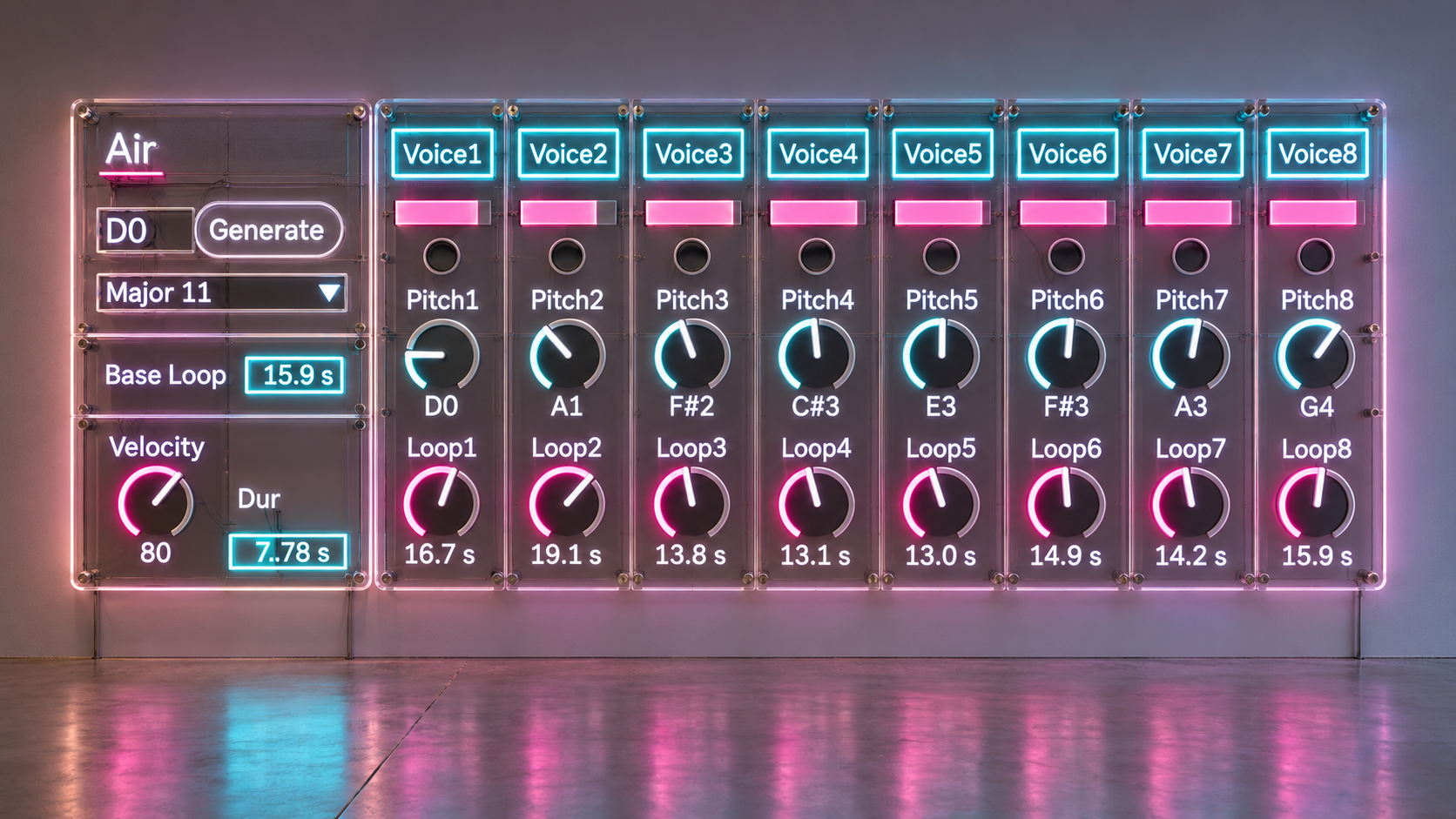
Air 6.0 keeps every newly generated Loop Time between 80 percent and 120 percent of the current Base Loop, with a 100 ms minimum at the shortest settings.
This keeps the eight cycles connected to the same general time scale while preventing them from becoming identical.
Set a longer Base Loop and the voices can unfold slowly across sustained sounds. Shorten it and the relationships become more active and rhythmically immediate.
Because every resulting Loop remains directly accessible, the generated timing can become only the beginning. Keep the overall cluster intact and move one voice farther away. Shorten one cycle until it starts acting like a pulse against slower voices. Remove voices until only the relationships that matter remain.
The interesting part is not randomness by itself. It is the ability to move between controlled generation and deliberate editing without rebuilding the structure from the beginning.
Forty Ways to Define the Pitch Material
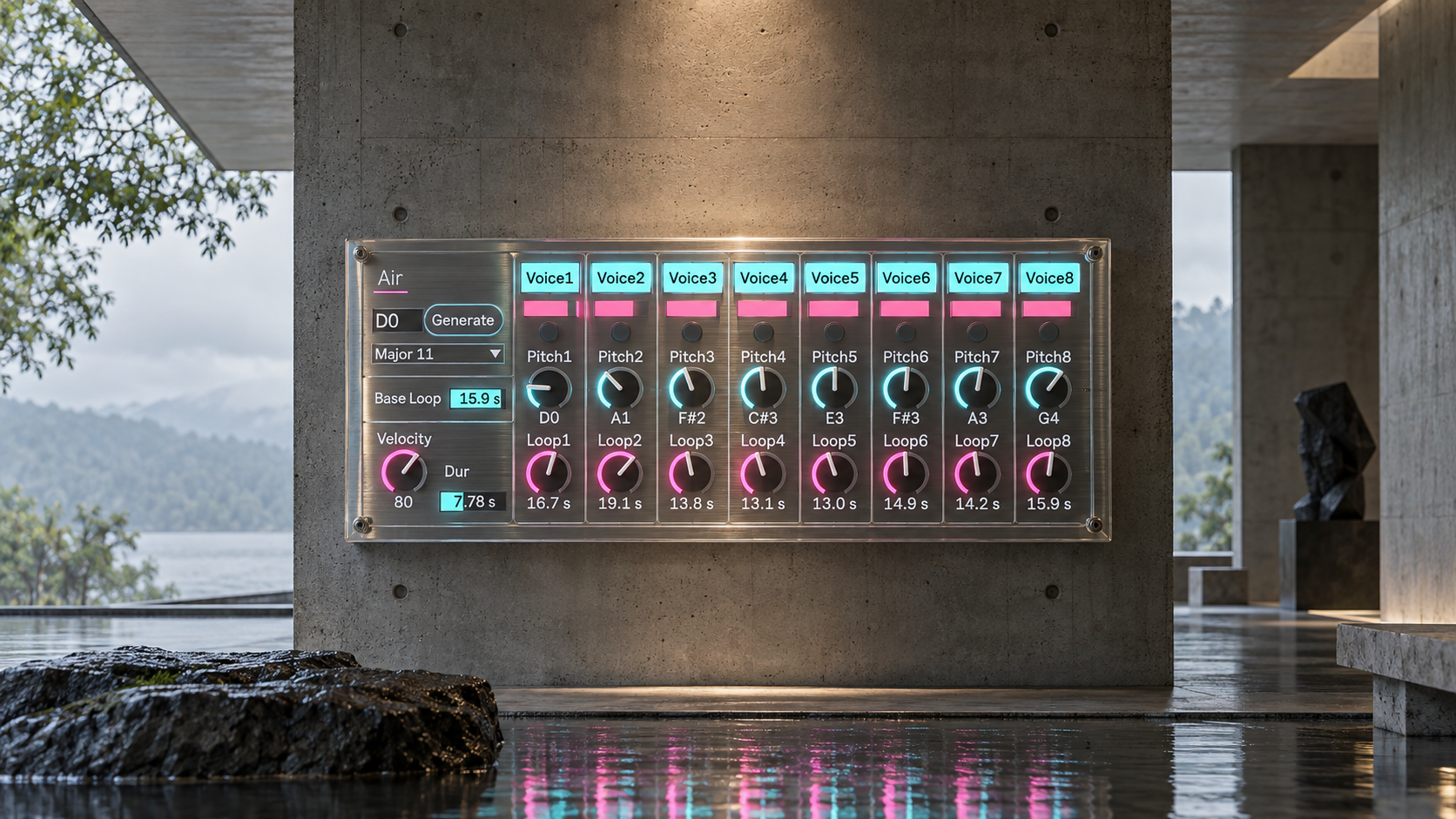
Air 6.0 expands the Scale selection to 40 collections.
Major, Minor and familiar modes sit alongside Triads, 7th, 9th, 11th and 13th chord collections. Hirajoshi, In Sen, Iwato, Yo, Ryukyu and Kumoi provide more restricted pitch vocabularies, while Hijaz, Hijaz Kar, Nahawand, Persian and other collections open different harmonic directions.
The Scale does not write a fixed melody. It defines the pitch material from which the eight voice state is generated.
That distinction makes Air useful when you want harmonic consistency without repeating a predetermined phrase. A Major Triad can become a slowly shifting chordal pulse. Hirajoshi can reduce the pitch vocabulary while the independent Loops create movement around it. Chromatic can leave the generator much more open while the register structure still distributes the eight voices across a broader range.
Change the Scale and Base Note, press Generate again, and the same timing concept can lead somewhere completely different.
Music That Changes Through Combination
The underlying idea is simple: variation does not always require more notes.
When several independent cycles share the same musical space, new relationships can emerge simply because they meet at different times.
This is where Air connects most directly to the thinking behind overlapping tape loop music. Instead of continually writing new events, you establish a small system and allow its internal timing relationships to produce change.
Air gives you control over that system. The generated state can remain sparse or become dense. Voices can disappear and return. Individual pitches can be corrected. Individual Loop Times can be pushed away from the original cluster.
The process can begin generatively without becoming hands off.
Use Air as Part of the Arrangement
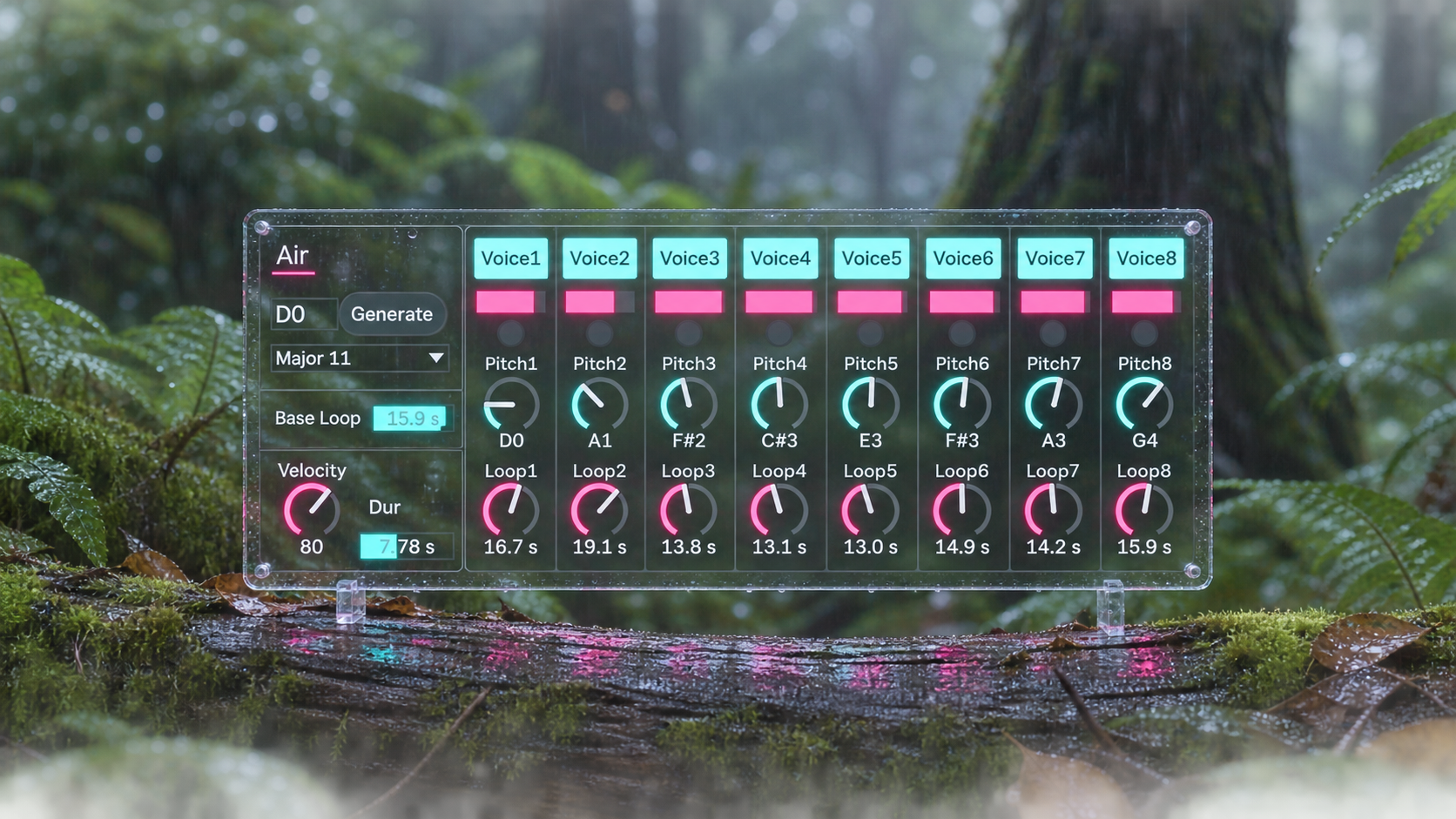
Place Air before a polyphonic instrument and let longer Loop Times create a changing harmonic layer behind the main sequence. Use shorter Duration settings with tighter Loops to turn the same system into separated pulses and generative arpeggio material.
On sustained synths and pads, the independent cycles can create long form movement without drawing a long MIDI clip. On shorter sounds, the timing relationships become easier to hear as rhythm.
With only a few Voices active, the device can stay sparse. Bring more Voices in and the same generated state becomes denser without changing its underlying material.
Air also passes incoming MIDI through the device, so its generated notes can coexist with MIDI already travelling through the track. You can play into the same instrument, run another sequence before Air, or treat the generated voices as an additional layer rather than an isolated system.
Velocity and Duration provide another level of control over the generated notes. Short notes expose the individual cycles clearly. Longer notes allow the voices to overlap into a more continuous harmonic texture.
From Generation to Performance
One of the most useful ways to work with Air is to stop pressing Generate once something interesting appears.
Treat the first generation as material.
Remove a few Voices. Correct one Pitch. Change two Loops. Let the remaining relationships run.
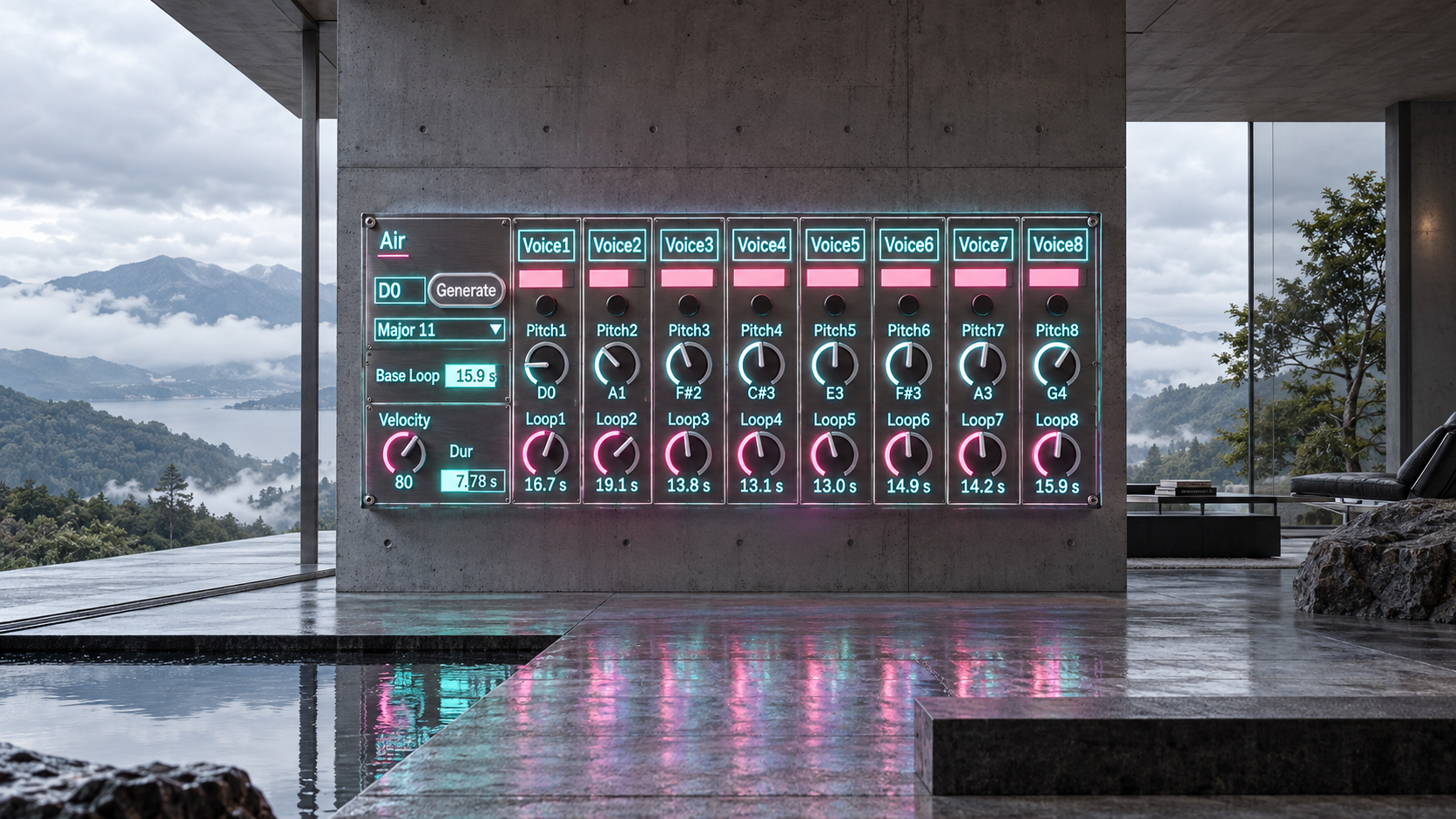
The Voice controls then become performance controls. An existing cycle can disappear and return without losing its Pitch or timing value. A dense eight voice field can be reduced to a few repeating points and gradually rebuilt.
The same state can move through different levels of density without requiring another generation.
This makes Air useful not only for discovering patterns, but for performing their structure.
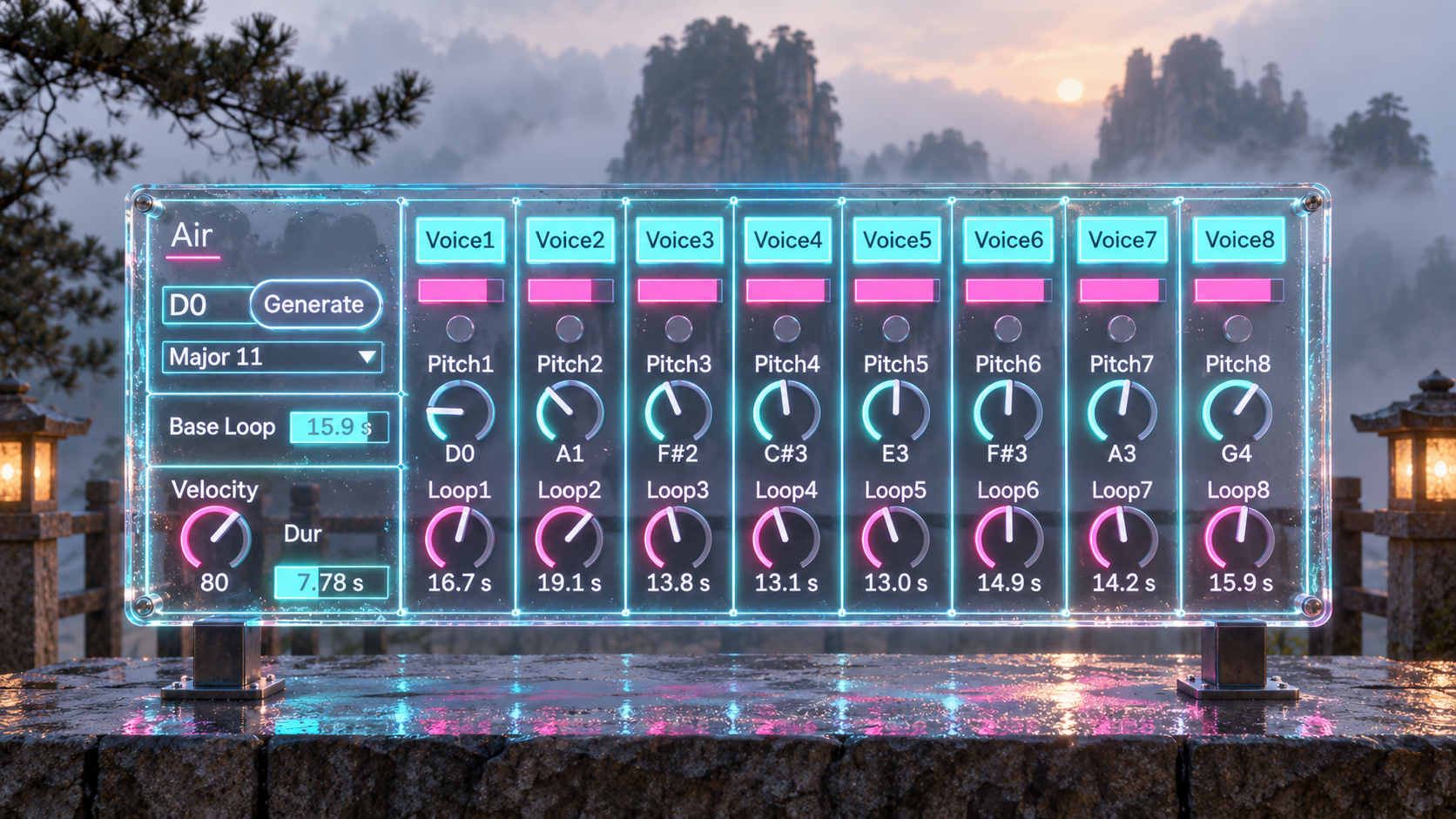
Air 6.0
Version 6.0 expands the Scale selection from 28 to 40 collections and changes the generated timing so that all eight Loop Times remain closely related to the Base Loop.
The established Air interface remains unchanged.
The original idea stays intact: eight independently repeating MIDI voices that can be generated quickly, allowed to interact over time, then edited one by one.
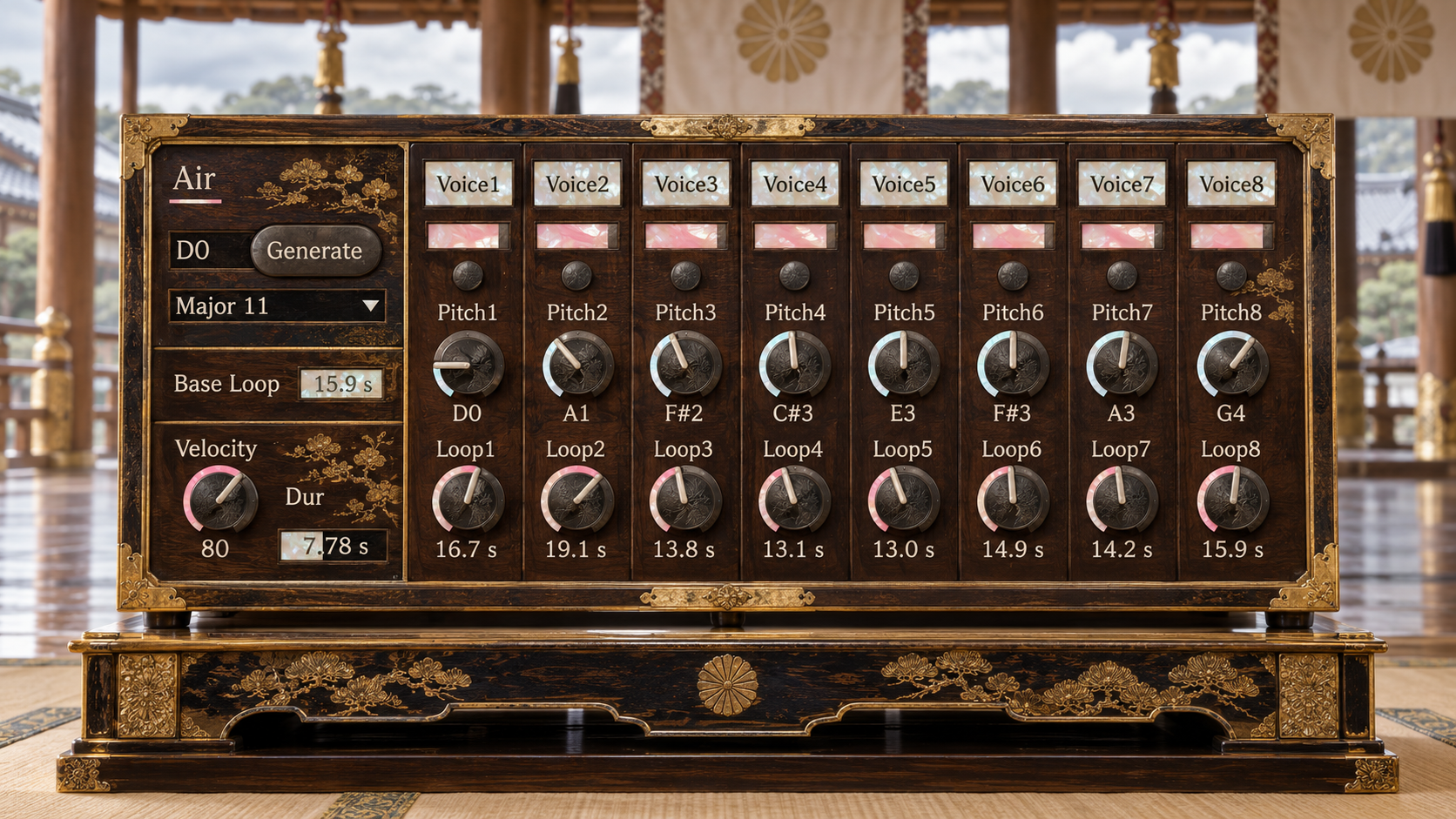
Availability and Free Lifetime Updates
Air is available as a Max for Live MIDI Effect through Sellfy.
https://akihikomatsumoto.sellfy.store/p/abletonair/
Your purchase includes free lifetime updates. Future published updates for Air are included at no additional cost. Existing customers can access the latest available files through the Sellfy account used for the original purchase. No additional purchase is required.
v.6.0 Expanded the scale selection to 40 options. All eight generated Loop Times now stay within 20% above or below the Base Loop for more cohesive timing variation, while the existing UI remains unchanged. (2026/9/5)
ver.5.2 ... Updated UI. (2026/4/29)
ver.5.1 ... Fixed UI bug. (2026/4/10)
ver.5.0 ... Added preset generator. (2026/4/4)
ver.4.3 ... Added randomize function. (5/26/2025)
ver.3.0 ... Transport bug fixed.
ver.3.1 ... UI Updated.
ver.4.0 ... Meter UI added.
ver.4.1 ... Push3 standalone support.
Sequencers & MIDI Generation
Air https://akihikomatsumoto.sellfy.store/p/abletonair/
A generative MIDI sequencer for continuously evolving ambient patterns built from overlapping repetition.
MODE https://akihikomatsumoto.sellfy.store/p/abletonmode/
A modal generative sequencer that creates pitches and patterns from scale based musical logic.
Telequencer https://akihikomatsumoto.sellfy.store/p/abletontelequencer/
A generative sequencer that reshapes repetition through snake routing, duration control, and shuffle.
Trance Arpeggiator https://akihikomatsumoto.sellfy.store/p/ableton-trance-arpeggiator/
A MIDI generator that turns chords into repeating 1990s inspired trance arpeggios.
Solfa https://akihikomatsumoto.sellfy.store/p/abletonsolfa/
A MIDI sequencer that creates minimalist isorhythms from independent pitch and rhythm cycles.
Trance Shifter https://akihikomatsumoto.sellfy.store/p/abletontranceshifter/
A MIDI effect that transforms simple notes into fast ornamental phrases for trance and hardwave.
Div Beat https://akihikomatsumoto.sellfy.store/p/ableton-div-beat/
A probability based MIDI sequencer that divides a bar into flexible rhythmic trigger positions.
Hardwave Arpeggiator https://akihikomatsumoto.sellfy.store/p/hardwavearpeggiator/
A MIDI sequencer for sharp, driving arpeggio patterns in hardwave and bass music.
MIDI Gate Slicer https://akihikomatsumoto.sellfy.store/p/ableton-midi-gate-slicer/
A MIDI slicer that chops note gates into tight rhythmic repetitions and trigger patterns.
GENE https://akihikomatsumoto.sellfy.store/p/abletongene/
A random MIDI sequencer that generates unpredictable phrases within scale, range, and timing constraints.
303quencer https://akihikomatsumoto.sellfy.store/p/ableton-303quencer/
A generative MIDI sequencer for repeating and evolving 303 style bassline patterns.
MIDI Burst https://akihikomatsumoto.sellfy.store/p/ableton-midi-burst/
A MIDI generator that turns a single note into rapid bursts of repeated note events.
Ratchet Gate https://akihikomatsumoto.sellfy.store/p/ableton-ratchet-gate/
A rhythmic MIDI effect that divides notes into fast ratcheting gate repetitions.
ISO https://akihikomatsumoto.sellfy.store/p/abletoniso/
An isorhythmic MIDI sequencer that cycles pitch and rhythm sequences at independent lengths.
Euclidean SEQ https://akihikomatsumoto.sellfy.store/p/ableton-euclidean-seq/
A Euclidean MIDI sequencer that distributes hits evenly while controlling pitch and velocity.
Akihiko Matsumoto
Study Site https://akihikomatsumoto.com/study/
Ableton M4L, Serum Preset Store https://akihikomatsumoto.com/download/
Sample Pack https://akihikomatsumoto.sellfy.store/sample-pack/
Bandcamp https://akihikomatsumoto.bandcamp.com
Ableton Skin https://akihikomatsumoto.sellfy.store/p/ableton-skin-pack/
Spotify https://open.spotify.com/artist/1tZMmxzZbvNu6klyKXa0L1?si=2JZaFeLbREi-UownD8POSg