
Ableton MODE 7.2 | Modal Generative Sequencer
Max for Live Device (.amxd file)
Discover the Sacred Sounds of the Past: A Generative Sequencer Inspired by Medieval Chant
The melodies preserved in medieval chant manuscripts offer a different way to think about how a line of music can find its direction. Their modal organization is not simply a set of major or minor chords waiting to be played. The identity of a mode is carried through the movement of pitches, the places where a melody comes to rest, and the way one note gives meaning to the next. Working with that material asks for attention to melodic relationship rather than harmonic progression alone.
I spent more than a year studying medieval chant manuscripts and neume notation by hand. That research is the human starting point behind MODE. Neumes, however, are not interchangeable with modern MIDI notes: early notation could indicate melodic movement without fixing every pitch in the way later staff notation did, and the theory of the modes changed across periods. I wanted to bring the questions raised by that material into a contemporary composition environment, not claim that a MIDI sequencer can reproduce a manuscript or reconstruct a medieval performance.
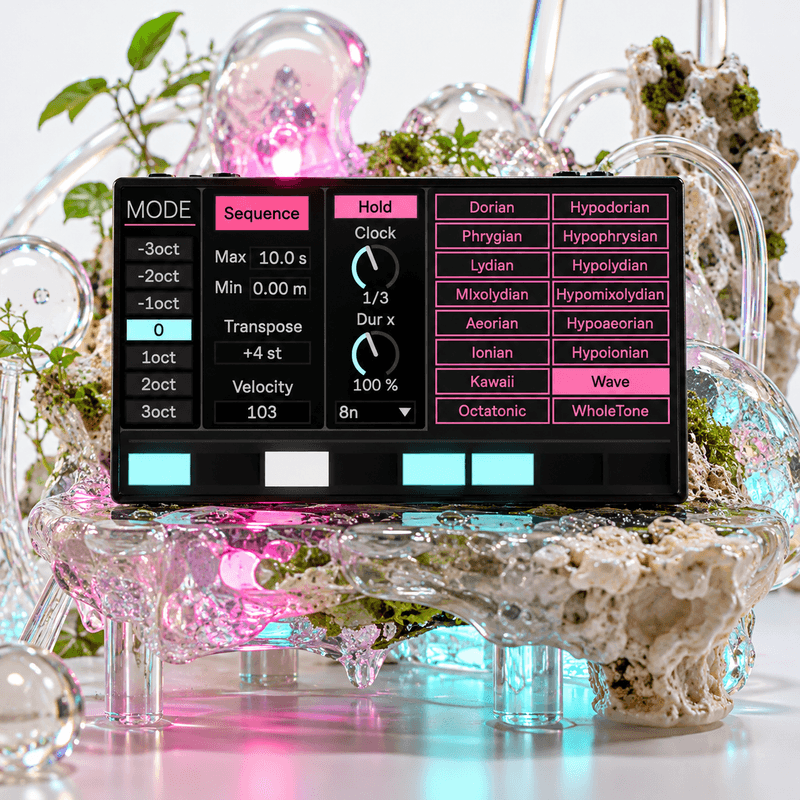
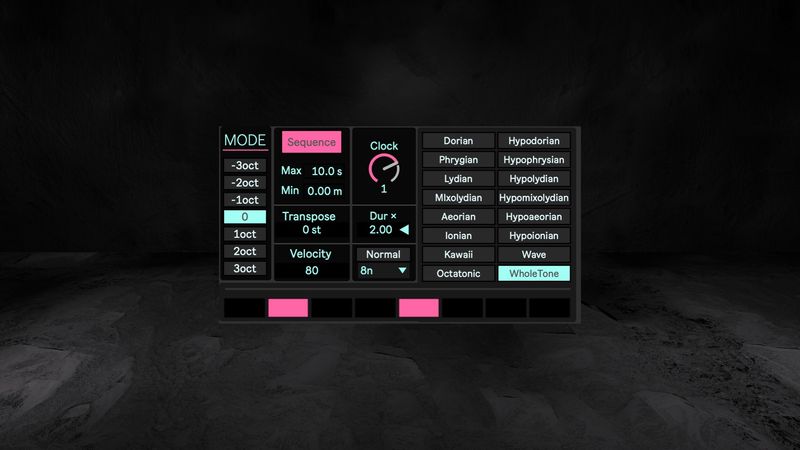
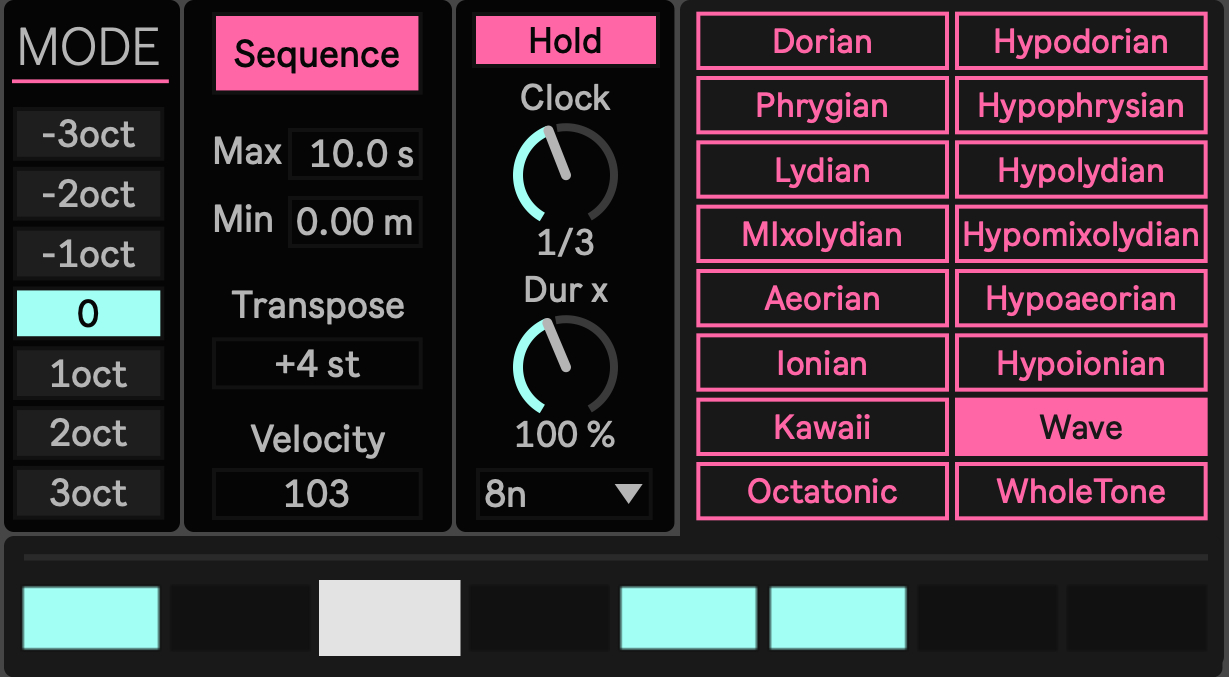
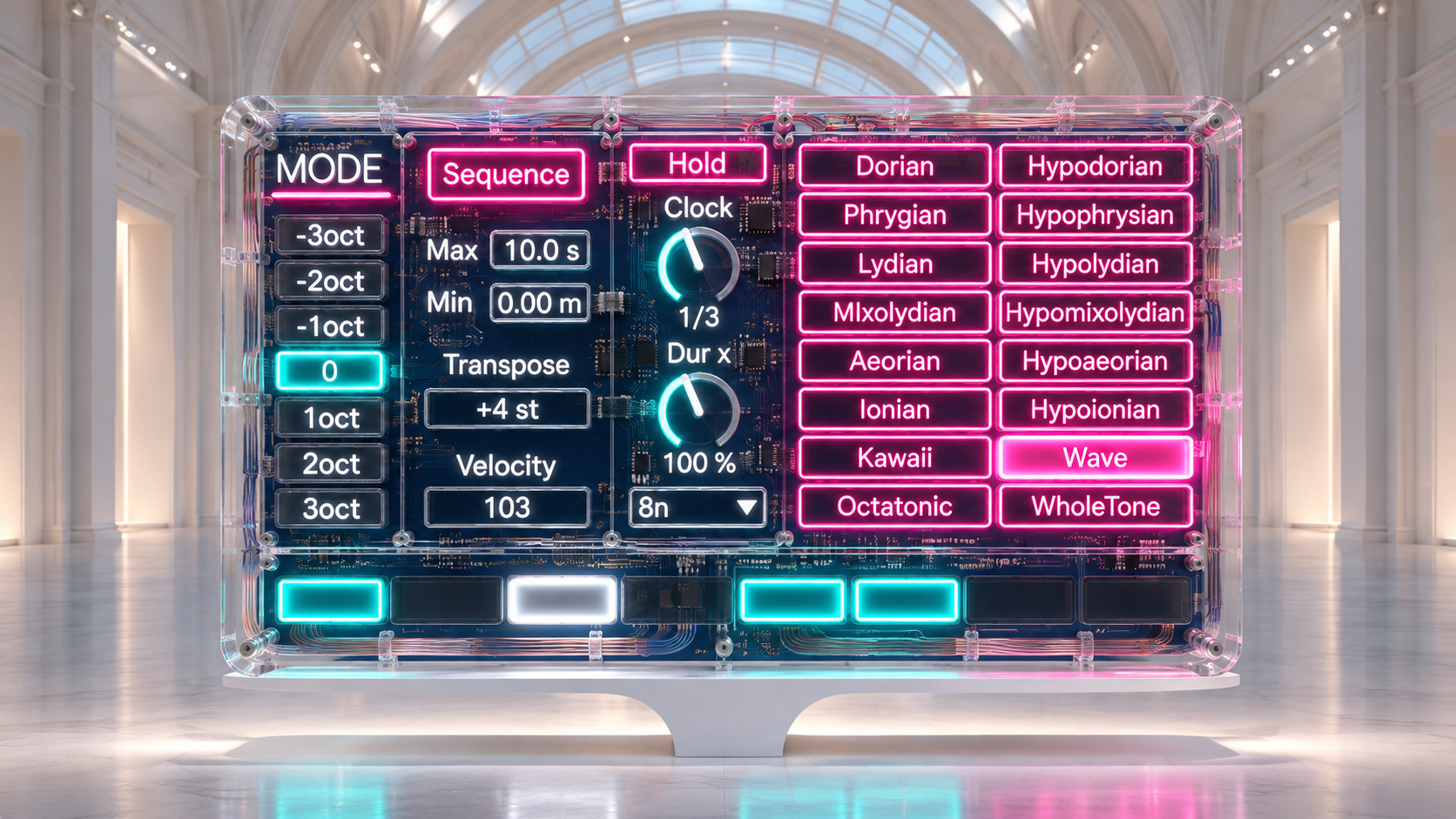
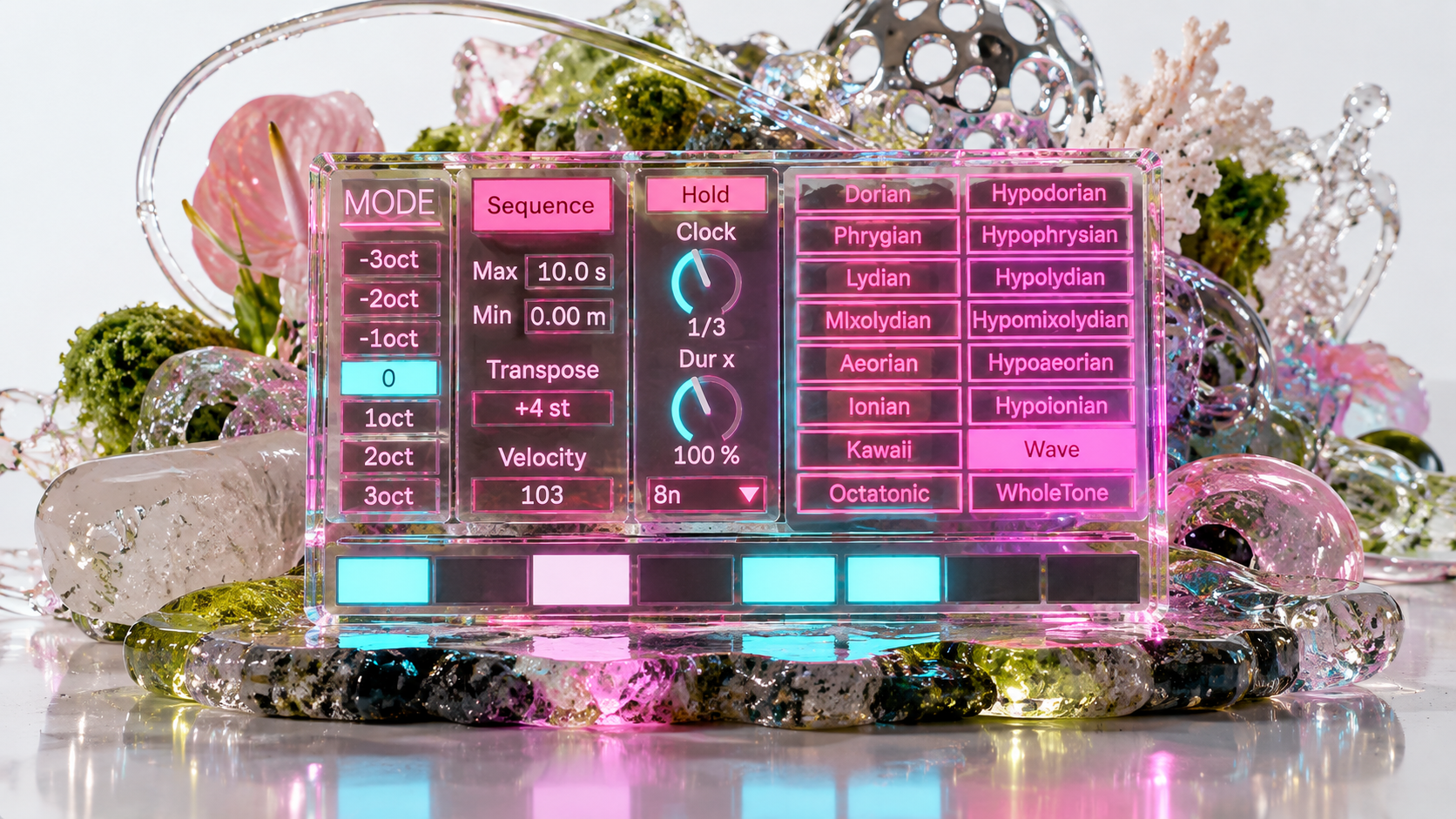
MODE v7.2 turns that interest into a generative MIDI instrument for Ableton Live. Its sixteen selectable profiles include twelve historically named modal profiles alongside Kawaii, Wave, Octatonic and WholeTone. They offer different pitch environments from which to begin composing, allowing the modal idea to move into ambient soundscapes, modern classical writing, cinematic passages and experimental electronic music. The historical research gives the instrument its point of departure; the music you make with it belongs to the present.
The root is based on Heinrich Glarean's 12 church modes and cannot be freely moved like in jazz.
However, you can achieve the same effect by transposing the MIDI after generating the melody.
F - Lydian
C - Ionian
G - Mixolydian
D - Dorian
A - Aeolian
E - Phrygian
Dodecachordon (Glareanus, Henricus)
First Publication 1547
https://imslp.org/wiki/Dodecachordon_(Glareanus%2C_Henricus)
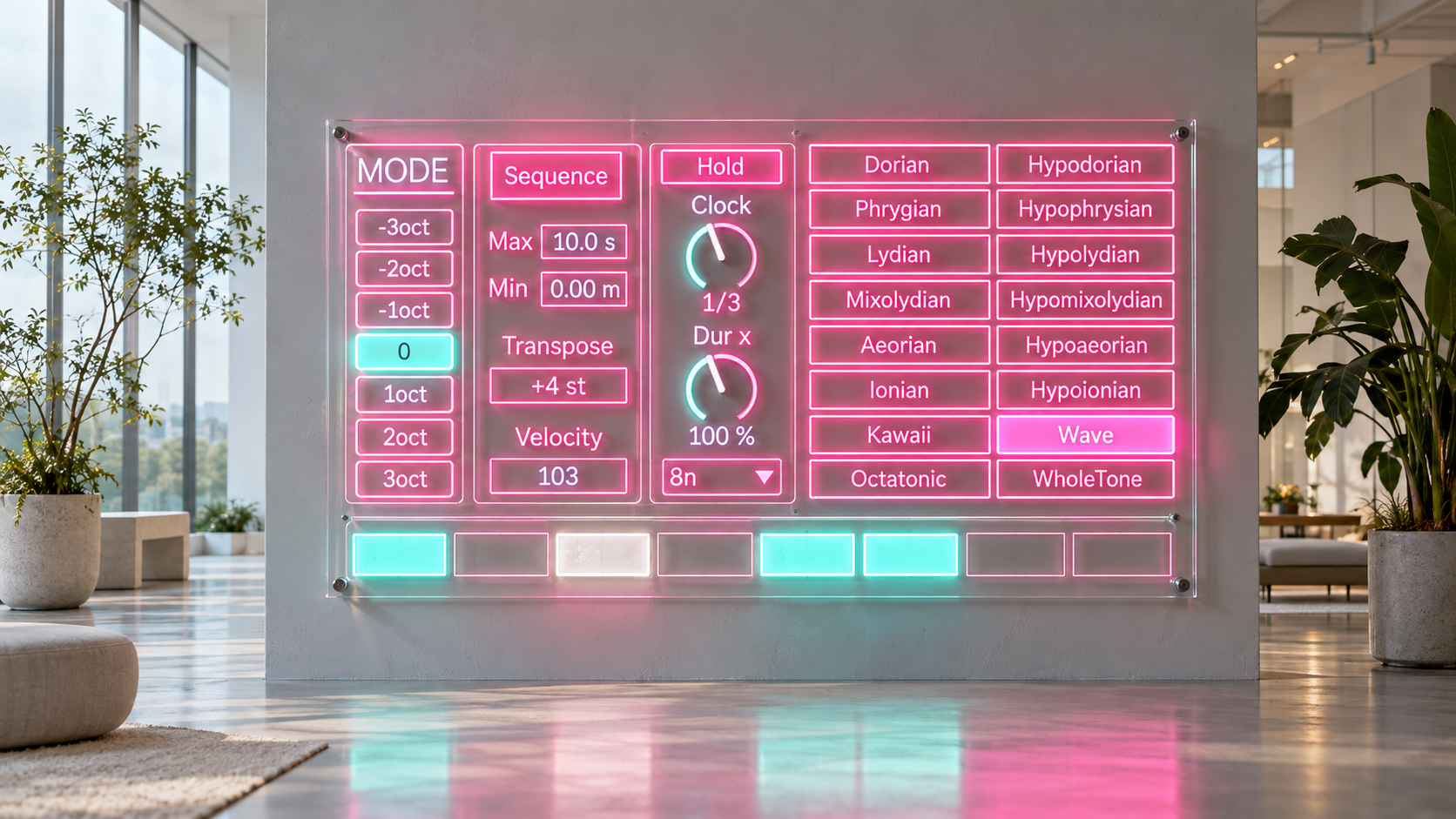
Infinite Melodic Possibilities
A mode gives a melody a pitch vocabulary, but it does not decide how the next note should follow the previous one. That is where MODE's generative approach becomes useful. Its weighted second order Markov process considers the previous two pitches as a changing context, then selects a next pitch from the weighted continuations available for that pair. As the new note enters, the context changes too. The line develops through successive relationships, rather than drawing an unrelated note from a scale at every step.
This is a different starting point from programming a complete melody before hearing it. You can let MODE continue producing material while listening for a turn of phrase that has a character of its own. The result may be a small melodic cell, a longer contour or an unexpected intervallic direction. The sequence is not intended to make compositional decisions on your behalf. It gives you material to recognize, select and shape, while the profile and the recent notes keep the generation connected to a modal environment.
The same phrase can feel very different when its timing changes. Sequence follows the editable step grid, while Random uses a separate timing path shaped by Max and Min. Clock changes the timing ratio, Division changes the rhythmic grid, and Dur x adjusts how long each generated note remains active. These decisions matter because a line that sounds measured at one pace may become more fragmented or more sustained at another. The pitch material can continue to develop while its temporal character changes around it.
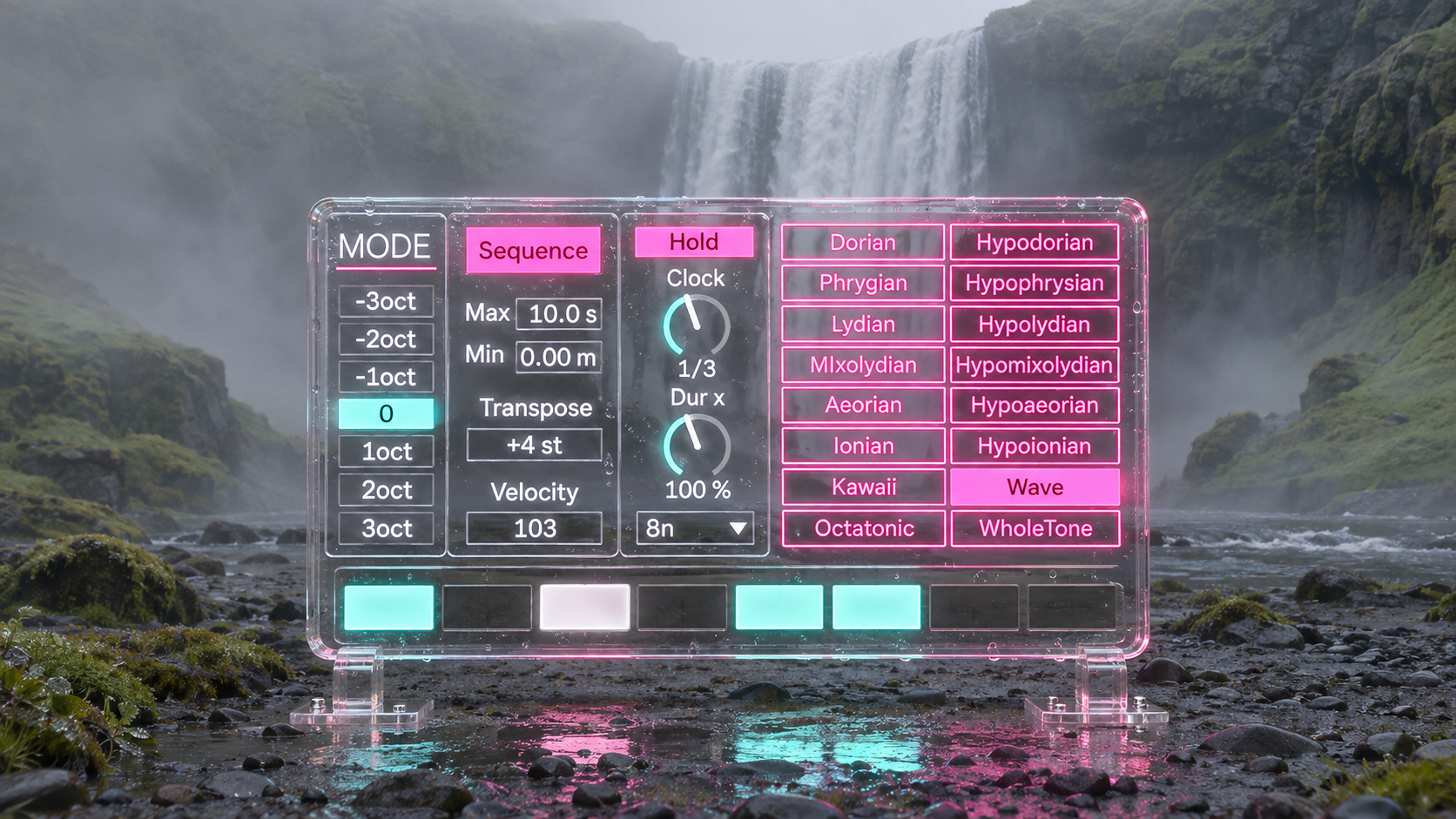
Keep a Motif While the Melody Continues to Develop
Generative composition often reaches a moment when the most valuable thing is not another variation, but the chance to stay with a phrase that has just appeared. You may want to hear it against another sound, build a counterline, or decide whether its rhythm belongs in the arrangement. If the generator keeps replacing the phrase, that moment can pass before you have had time to work with it.
MODE's grid aware Phrase Hold makes the active step pattern part of that decision. The number of enabled cells in the SEQ grid determines the length of the recent generated phrase to be held. Once enough notes have been generated, Hold repeats that phrase instead of replacing it with new Markov choices. You can give a newly discovered motif room to become recognizable, record it into a Live clip, and work on the rest of the arrangement without losing the line that caught your attention.
When Hold is released, generation resumes from the notes that were actually played, so the held phrase becomes a temporary point of focus within a continuing process. If there is not yet enough note history to fill the requested phrase, generation continues until the material is available. An empty grid does not define a phrase to repeat. This makes the grid more than a visual timing aid: it helps connect the open ended search for material with the composer's decision to keep something.
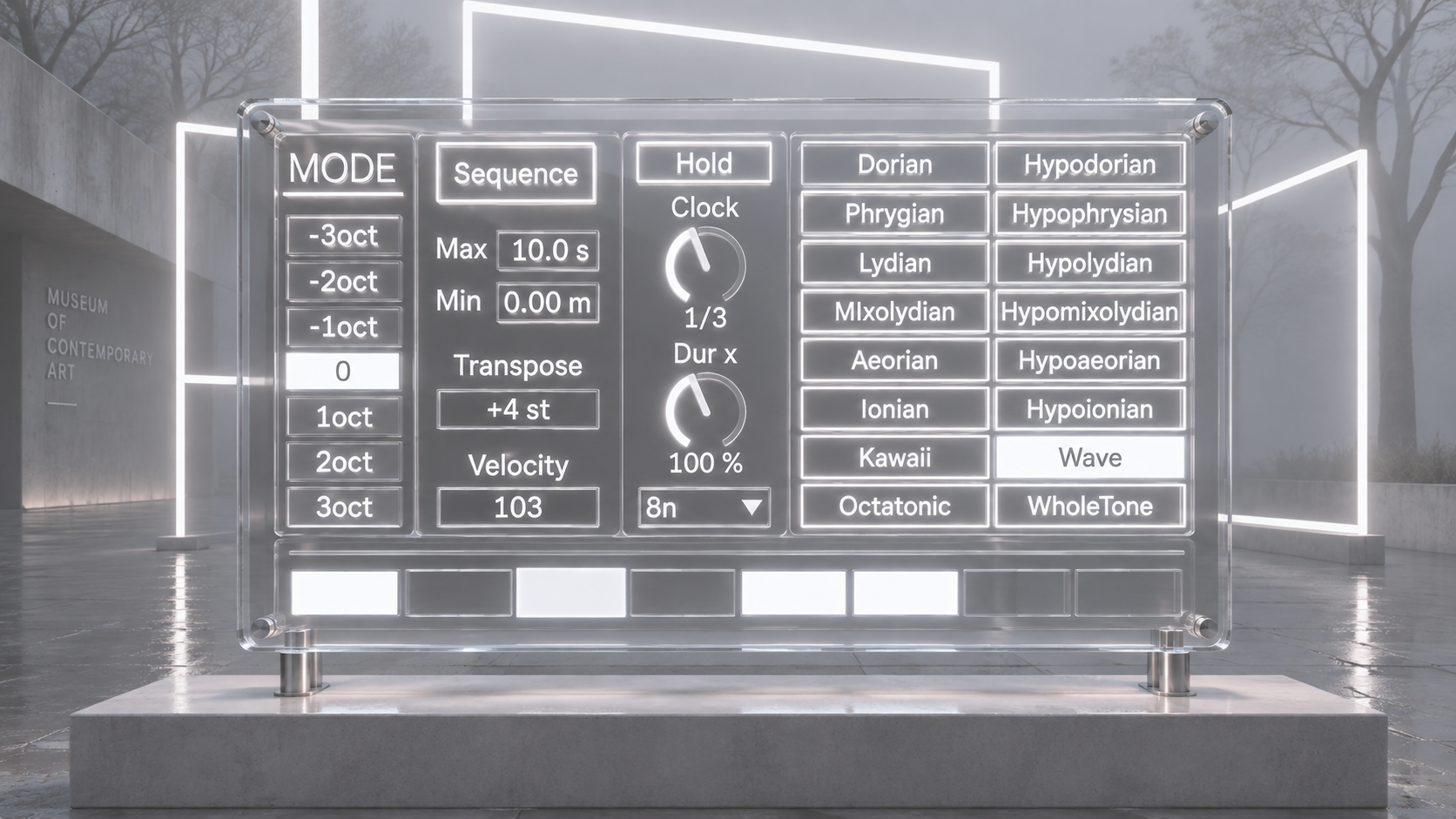
Bring the Generated Line into Your Own Instrument Arrangement
MODE sends MIDI, not audio. Place it before an instrument on an Ableton Live MIDI track and the same generated line can be heard through a piano, synthesizer, sampler or another MIDI receiving instrument. Range moves the output by octaves, Transpose shifts it by semitones, and Velocity sets the MIDI note velocity. Together with note duration, these controls let you hear the same modal idea in another register or with a different articulation, without having to regenerate the phrase from the beginning.
Once a passage feels promising, record its MIDI output into a clip. From there, edit individual notes, change the sound, layer another instrument or keep the phrase as a recurring element while the surrounding music changes. MODE is not an automatic finished song generator, and the character of the result depends on the instrument and the arrangement you build around it. Its role is to make a different kind of melodic starting point available, then let you decide which discoveries deserve to become part of the composition.
From manually researched chant manuscripts to a melody that can keep unfolding inside Ableton Live, MODE connects historical modal curiosity with contemporary generative composition. The aim is not to imitate the past. It is to bring a different melodic perspective into the studio and give it room to become your own music.
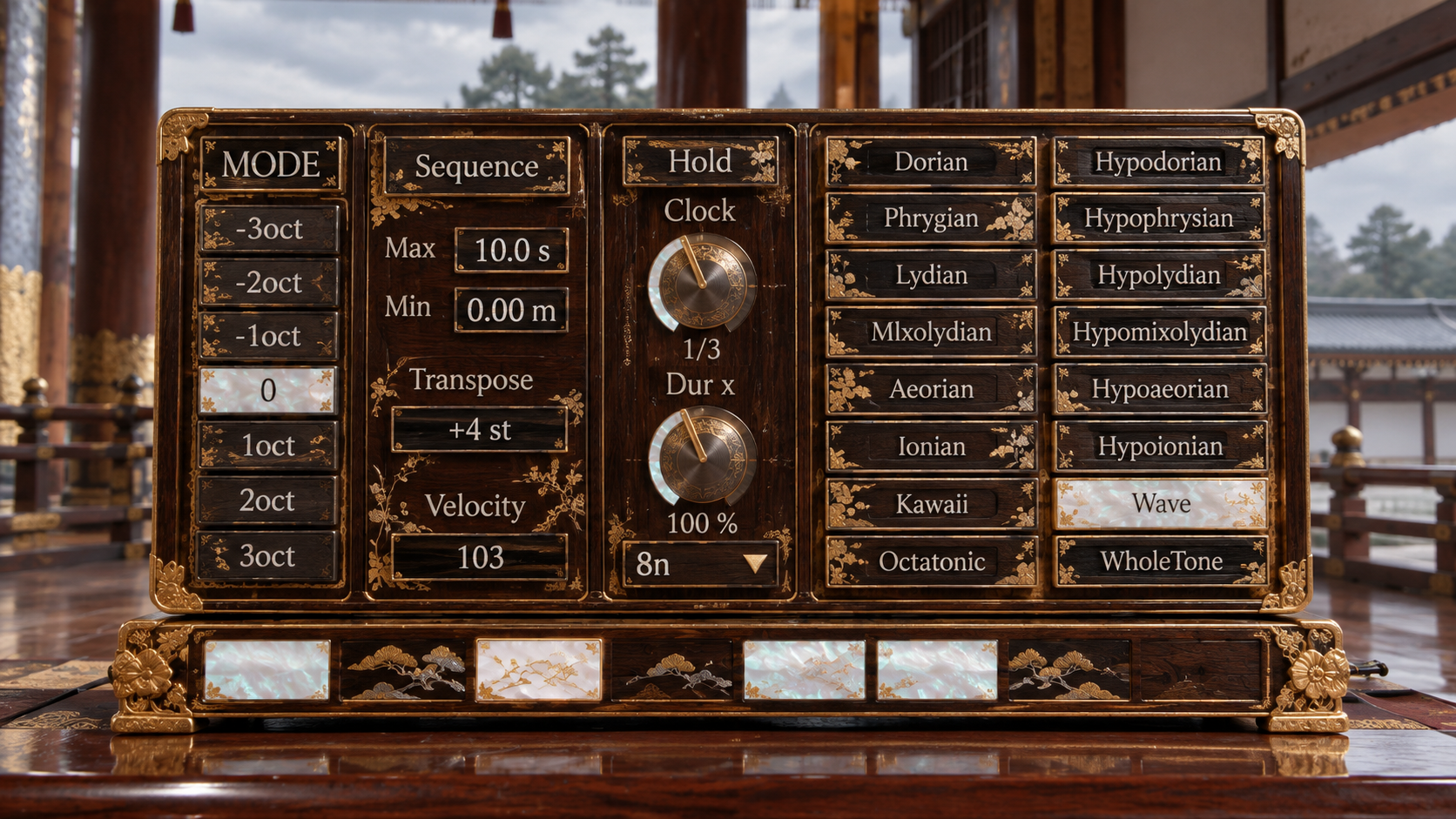
License & Free Lifetime Updates
Your purchase grants a license to use the software, not ownership of its program code. Unauthorized copying, sharing, resale, sublicensing, or redistribution of the device, its source code, or bundled software assets is prohibited, except where permitted by applicable law or for authorized installation and backup.
The software, including its source code, algorithms, and bundled software assets, may not be used to create training datasets or to train or fine tune machine learning or AI models without prior written permission. These restrictions do not prohibit the creation or commercial use of original music made with the device.
Your purchase includes free lifetime updates. Future published updates to this product are available at no additional cost. Existing customers can access the latest available files through the Sellfy account used for their original purchase. No additional purchase is required.
v.7.2 ... Added grid-aware Phrase Hold and MIDI pitch-range correction. (2026/10/26)
v.7.1 ... Fixed note off bug. (2026/5/9)
ver.7.0 ... Added 2 synthetic scale / octatonic & wholetone. (2025/11/15)
ver.6.3 ... Fixed transposition bug & Improve melodic algorithm. (2025/9/2)
ver.6.1 ... Fixed file missing bug. (7/6/2025)
ver.6.0 ... Update to a more melodic algorithm. (7/6/2025)
ver.5.0 ... Added random sequence mode. (1/26/2025)
Ver.1.5 ... Tie added, Kawaii mode added. Multiplier bug fixed.
Ver.2.0 ... Plagal mode added, UI updated.
Ver.3.0 ... Duration bug fixed, UI updated.
ver.4.0 ... Wave (Bass Music) mode added.
ver.4.1 ... melodic algorithm updated.
Generative Sequencer
Air https://akihikomatsumoto.sellfy.store/p/abletonair/
Generative MIDI sequencer for continuously evolving ambient patterns built from overlapping repetition.
MODE https://akihikomatsumoto.sellfy.store/p/abletonmode/
Modal generative sequencer that creates pitches and patterns from scale based musical logic.
Telequencer https://akihikomatsumoto.sellfy.store/p/abletontelequencer/
Generative sequencer that reshapes repetition through snake routing, duration control, and shuffle.
Trance Arpeggiator https://akihikomatsumoto.sellfy.store/p/ableton-trance-arpeggiator/
MIDI generator that turns chords into repeating 1990s inspired trance arpeggios.
Solfa https://akihikomatsumoto.sellfy.store/p/abletonsolfa/
MIDI sequencer that creates minimalist isorhythms from independent pitch and rhythm cycles.
Trance Shifter https://akihikomatsumoto.sellfy.store/p/abletontranceshifter/
MIDI effect that transforms simple notes into fast ornamental phrases for trance and hardwave.
Div Beat https://akihikomatsumoto.sellfy.store/p/ableton-div-beat/
Probability based MIDI sequencer that divides a bar into flexible rhythmic trigger positions.
Hardwave Arpeggiator https://akihikomatsumoto.sellfy.store/p/hardwavearpeggiator/
MIDI sequencer for sharp, driving arpeggio patterns in hardwave and bass music.
MIDI Gate Slicer https://akihikomatsumoto.sellfy.store/p/ableton-midi-gate-slicer/
MIDI slicer that chops note gates into tight rhythmic repetitions and trigger patterns.
GENE https://akihikomatsumoto.sellfy.store/p/abletongene/
Random MIDI sequencer that generates unpredictable phrases within scale, range, and timing constraints.
303quencer https://akihikomatsumoto.sellfy.store/p/ableton-303quencer/
Generative MIDI sequencer for repeating and evolving 303 style bassline patterns.
MIDI Burst https://akihikomatsumoto.sellfy.store/p/ableton-midi-burst/
MIDI generator that turns a single note into rapid bursts of repeated note events.
Ratchet Gate https://akihikomatsumoto.sellfy.store/p/ableton-ratchet-gate/
Rhythmic MIDI effect that divides notes into fast ratcheting gate repetitions.
ISO https://akihikomatsumoto.sellfy.store/p/abletoniso/
Isorhythmic MIDI sequencer that cycles pitch and rhythm sequences at independent lengths.
Euclidean SEQ https://akihikomatsumoto.sellfy.store/p/ableton-euclidean-seq/
Euclidean MIDI sequencer that distributes hits evenly while controlling pitch and velocity.
Gene Tracker https://akihikomatsumoto.sellfy.store/p/ableton-gene-tracker/
Generative MIDI tracker that evolves patterns through mutation, memory, and editable sequencing.
Akihiko Matsumoto
Study Site https://akihikomatsumoto.com/study/
Ableton M4L, Serum Preset Store https://akihikomatsumoto.com/download/
Sample Pack https://akihikomatsumoto.sellfy.store/sample-pack/
Bandcamp https://akihikomatsumoto.bandcamp.com
Ableton Skin https://akihikomatsumoto.sellfy.store/p/ableton-skin-pack/
Spotify https://open.spotify.com/artist/1tZMmxzZbvNu6klyKXa0L1?si=2JZaFeLbREi-UownD8POSg